Page 260 of 320

/!\ WARNINGWhen replacing full size tires, never mixradial, bias-belted, or bias-type tires. Use onlythe tire sizes that are listed on the tirepressure decal. Make sure that all tires arethe same size, speed rating, and load-carryingcapacity. Use only the tire combinationsrecommended on the decal. If you do notfollow these precautions, your vehicle may notdrive properly and safely.Tires that are larger or smaller than your vehicle's
original tires may also affect the accuracy of your
speedometer.
258Information About Tire Quality Grades
New vehicles are fitted with tires that have their Tire
Quality Grade (described below) molded into the
tire's sidewall. These Tire Quality Grades are
determined by standards that the United States
Department of Transportation has set.
Tire Quality Grades apply to new pneumatic tires for
use on passenger cars. They do not apply to deep
tread, winter-type snow tires, space-saver or
temporary use spare tires, tires with nominal rim
diameters of 10 to 12 inches or limited production
tires as defined in Title 49 Code of Federal
Regulations Part 575.104(c)(2).
U.S. Department of Transportation - Tire quality
grades: The U.S. Department of Transportation
requires Ford to give you the following information
about tire grades exactly as the government has
written it.
Page 261 of 320

Treadwear
The treadwear grade is a comparative rating based
on the wear rate of the tire when tested under
controlled conditions on a specified government test
course. For example, a tire graded 150 would wear
one and one-half (1 1/2) times as well on the
government course as a tire graded 100. The
relative performance of tires depends upon the
actual conditions of their use, however, and may
depart significantly from the norm due to variations
in driving habits, service practices and differences in
road characteristics and climate.
Traction A B C
The traction grades, from highest to lowest, are A, B,
and C, and they represent the tire's ability to stop on
wet pavement as measured under controlled
conditions on specified government test surfaces of
asphalt and concrete. A tire marked C may have
poor traction performance. Warning: The traction
grade assigned to this tire is based on braking(straightahead) traction tests and does not include
cornering (turning) traction.
Temperature A B C
The temperature grades are A (the highest), B, and
C, representing the tire's resistance to the generation
of heat and its ability to dissipate heat when tested
under controlled conditions on a specified indoor
laboratory test wheel. Sustained high temperature
can cause the material of the tire to degenerate and
reduce tire life, and excessive temperature can lead
to sudden tire failure. The grade C corresponds to a
level of performance which all passenger car tires
must meet under the Federal Motor Vehicle Safety
Standard No. 109. Grades B and A represent higher
levels of performance on the laboratory test wheel
than the minimum required by law. Warning: The
temperature grade for this tire is established for a tire
that is properly inflated and not overloaded.
Excessive speed, underinflation, or excessive
259
Page 262 of 320

loading, either separately or in combination, can
cause heat buildup and possible tire failure.
Snow tires
The tires on your vehicle have all-weather treads
that provide traction in rain or snow. However,
during the winter months in some climates, you may
need to use snow tires.
Use of tire chains is not recommended. The use of
tire chains could result in damage to your vehicle./!\ WARNINGSnow tires must be the same size and gradeas the tires you Currently have on yourvehicle.Cleaning the Wheels
Wash the wheels with the same detergent you use
to wash your vehicle's body. Do not use acid-based
wheel cleaners, steel wool, abrasives, fuel, or strong
260detergents. These substances will damage protective
coatings. Use tar and road oil remover to remove
grease and tar.
NOTE: Before going to a car wash, find out if the
brushes are abrasive.
If you have whitewall tires that are difficult to clean
with regular detergent, use whitewall tire cleaner.
Follow the directions on the container and rinse the
tires with plenty of clean water.
Securitires (If equipped)
Securitires are designed to allow you to continue
driving your Continental a limited number of miles
when one of your vehicle's tires is at low or even
zero air pressure./!\ WARNINGDo not use aerosol tire inflator/sealer withSecuritires. Doing so may damage the tire'spressure sensor.
Page 265 of 320

Brake Fluid
Under normal circumstances, your vehicle should
not use up brake fluid rapidly. However, expect the
level of the brake fluid to slowly fall as you put
more mileage on your vehicle and the brake lining
wears.
You should check the brake fluid at every scheduled
engine oil change, but be sure to check it at least
once a year. You can do this by looking at the fluid
level in the plastic reservoir on the master cylinder.
(See The Engine Type in this chapter to locate the
master cylinder.) The fluid level should be at or near
the MAX mark./!\ WARNINGBrake fluid is toxic.If brake fluid contacts eyes, flush eyes with running
water for 15 minutes. Get medical attention ifirritation persists. If taken internally, drink water and
induce vomiting. Get medical attention immediately.
If the fluid is low, carefully clean and remove the cap
from the reservoir. Fill the reservoir to the MAX
line with Ford High Performance DOT 3 Brake Fluid
C6AZ-19542-AA, C6AZ-19542-BA, or equivalent
DOT 3 fluid meeting Ford specification ESA-
M6C25-A./!\ WARNINGIf you use a brake fluid that is not DOT 3, youwill cause permanent damage to your brakes.Do not fill the reservoir above the MAX line.
If you find that the fluid level is excessively low
below the seam or ridge on the outside of the plastic
reservoir - have the brake system inspected.
263
Page 266 of 320
/!\ WARNINGDo not let the reservoir for the mastercylinder run dry. This may cause the brakesto fail.The brake fluid reservoir
264Power Steering Fluid
Check the level of the power steering fluid at least
twice a year (i.e., every Spring and Fall).
Checking and Adding Power Steering
Fluid
1. Start the engine and let it run until the power
steering fluid reaches normal operating
temperature. The power steering fluid will be at
the right temperature when the engine coolant
temperature gauge in the instrument cluster is
near the center of the NORMAL operating
temperature range.
2. While the engine idles, turn the steering wheel
back and forth several times. Make sure that the
cap assembly is installed at this time.
Page 274 of 320
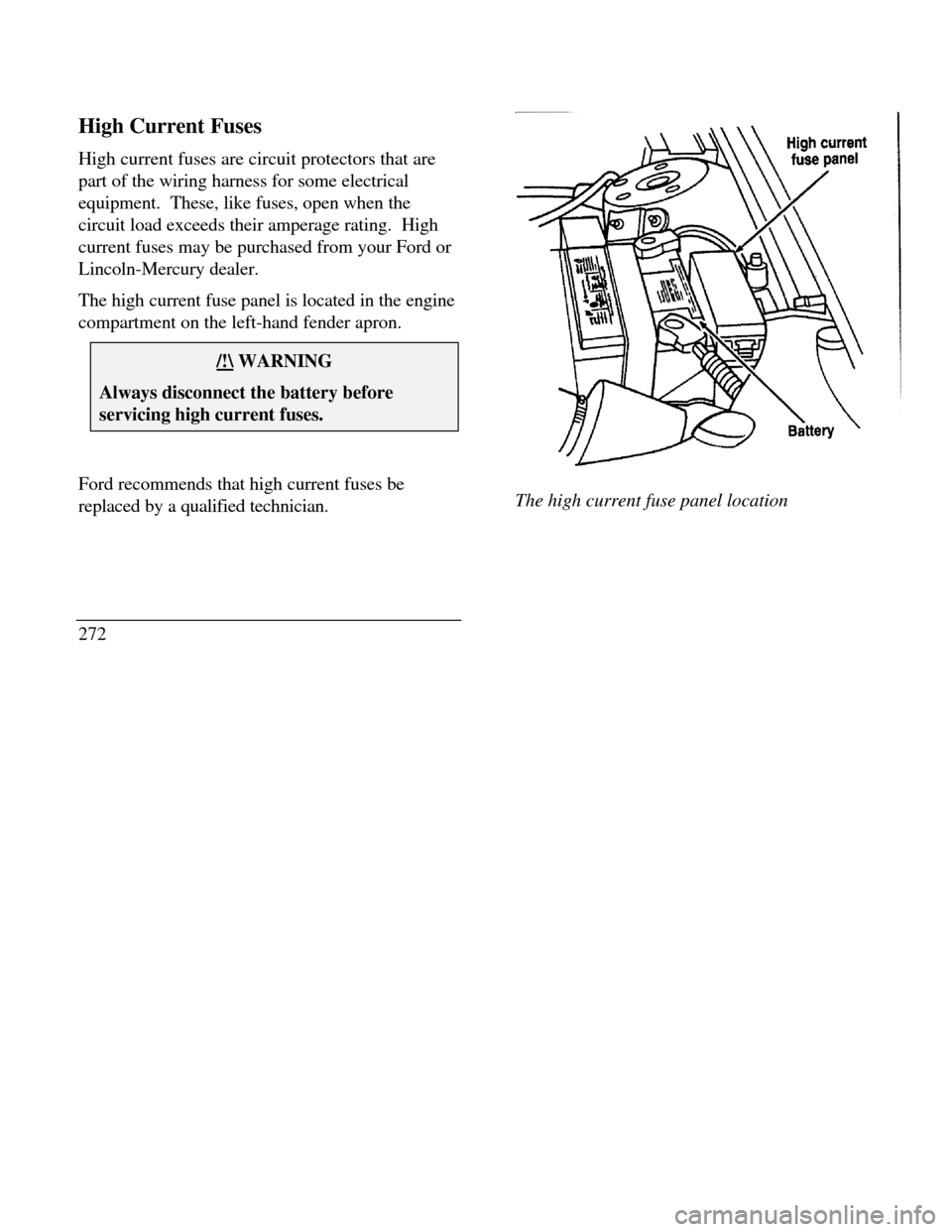
High Current Fuses
High current fuses are circuit protectors that are
part of the wiring harness for some electrical
equipment. These, like fuses, open when the
circuit load exceeds their amperage rating. High
current fuses may be purchased from your Ford or
Lincoln-Mercury dealer.
The high current fuse panel is located in the engine
compartment on the left-hand fender apron./!\ WARNINGAlways disconnect the battery beforeservicing high current fuses.Ford recommends that high current fuses be
replaced by a qualified technician.
272The high current fuse panel location
Page 279 of 320
/! WARNINGAlways replace a fuse with one that has thespecified amperage rating. Using a fuse witha higher amperage rating can cause severewire damage and could start a fire.5.Align the edge of the cover with the edge of
the fuse panel and push the cover up until it
latches.
Even after you replace a fuse, it will continue to
blow if you do not find what caused the overload.
If the fuse continues to blow, have your electrical
system checked.
Lights and Bulb Replacement
It is a good idea to check the operation of the
following lights ftequently: headlamps high-mount brakelamp tail lamps brakelamps hazard flasher turn signals side markers license plate lamp
The alignment of your headlamps should be
checked if: oncoming motorists frequently signal you to
turn off your vehicle's high beams when you do
not have the high beams on the headlamps do not seem to give you enough
light to see clearly at night
277
Page 280 of 320
the headlamp beams are pointed substantially
away from a position slightly down and to the
right
Headlamp Bulb
The headlamps on your vehicle use replaceable
bulbs. When the lamp bums out, simply replace
the bulb, rather than the whole lamp./!\ WARNINGHandle a halogen headlamp bulb carefullyand keep out of children's reach. Grasp thebulb only by its plastic base and do nottouch the glass. The oil from your handcould cause the bulb to break the next timethe headlamps are operated.278Removing the headlamp bulb
Do not remove the burned-out bulb unless you can
immediately replace it with a new one. If a bulb is
removed for an extended period of time,
contaminants may enter the headlamp housing and
affect its performance.
Rear face of bulb socket Reflector Flat side of plastic base bulb retaining ringParts of a headlamp
Electrical connector Lock Unlock