Page 204 of 320
5.Turn on the heater fan in both vehicles. Press the
DEFROST button. Turn off all other switches
and gauges.
Connecting the jumper cables
1. Connect one end of the first jumper cable to the
positive (+) terminal of the discharged battery.
(You can connect either jumper cable to the
positive (+) terminal, as long as you use the
same cable for both positive terminals.) Most
jumper cables have a red cable and a black cable.
The red cable is generally used for the positive
terminals and the black for the negative ones.
2. Connect the other end of the first cable to the
positive (+) terminal of the booster battery.3. Connect one end of the second cable to the
negative (-) terminal of the booster battery NOT
to the discharged battery.
4. Connect the other end of the second cable to a
good metallic surface on the engine or frame of
the disabled vehicle./! WARNINGDo not connect the end of the second cable tothe negative (-) terminal of the battery to bejumped. A spark may cause an explosion ofthe gases that surround the battery.201
Page 207 of 320
Changing a Tire
if you get a flat tire while you are driving, do not
apply the brake heavily. Instead, gradually decrease
the speed. Hold the steering wheel firmly and
slowly move to a safe place on the side of the road.
Park on a level spot, turn off the ignition, set the
parking brake, and turn on the hazard flashers.
The Temporary Spare Tire
You may have a high pressure temporary spare tire.
This spare tire is smaller than a regular tire and is
designed for emergency use only. Use it only when
you get a flat tire and replace it as soon as you can.
This spare tire is marked with the words
"TEMPORARY USE ONLY" so that you can easily
identify it.
204/! WARNINGIf you use the temporary spare tirecontinuously or do not follow theseprecautions, the tire could fail, causing you tolose control of the vehicle, possibly injuringyourself or others.When you drive with the temporary spare tire,
DO NOT: exceed 50 mph (80 km/h) under any
circumstances. load your vehicle so that it is heavier than the
maximum vehicle load rating listed on the tire
decal. tow a trailer. try to repair the temporary spare tire or remove it
from its wheel. use the wheel for any other type of vehicle.
Page 208 of 320
drive through an automatic car wash with this
tire. Because the temporary spare tire is smaller
than a conventional tire, it reduces the ground
clearance. Your vehicle may get caught in the rails
and it could be damaged.
Spare Tire Location
The spare tire is stored under the carpet on the floor
of the trunk.
You will find additional instructions for the spare
tire on the warning label located on the wheel and
the jacking instructions located on the spare tire
cover.Washer Spare tire Wing nut Spring Jack bolt hook Cover Wheel nut wrenchThe spare tire location
205
Page 209 of 320
To remove the spare tire:
1.Remove the spare tire cover.
2.Unscrew the wing-nut holding down the spare
tire.
3. Lift out the spare tire and jack kit.
Preparing to Change the Tire
1.Make sure that your vehicle will not move or
roll. Put the gearshift in P (Park). Set the
parking brake and block the wheel that is
diagonally opposite the tire that you are
changing./! WARNINGIf the vehicle slips off the jack, you orsomeone else could be seriously injured.Turn off the air suspension switch prior to jacking.
206/! WARNINGOn vehicles equipped with Air Suspension,turn OFF the Air Suspension switch prior tojacking, hoisting or towing your vehicle.Air suspension switchThe air suspension switch - located in the trunk
Page 210 of 320
2. Get out the spare tire and jack./! WARNINGTo avoid injury, never run the engine withone wheel off the ground, such as whenchanging a tire.3. Remove the center ornament from the aluminum
wheel with the tapered end of the wheel nut
wrench which came with your vehicle. Insert
and twist the handle, then pry against the wheel.
4. Loosen each wheel lug nut one-half turn
counterclockwise, but do not remove them until
the tire is raised off the ground. You should pull
up on the handle rather than push to develop
maximum force to loosen wheel lug nuts. See
Anti-Theft Wheel Lug Nuts later in this chapter
for information on removing anti-theft lug nuts.Removing and Replacing the Tire
I -Place the scissors-type jack under the side of the
vehicle and adjust the jack height with the jack
handle. The jack should fit in the notch in the
vertical rocker panel flange which is nearest to
the wheel to be changed./! WARNINGTo lessen the risk of personal injury, do notput any part of your body under the vehiclewhile changing a tire. Do not start the enginewhen your vehicle is on the jack. The jack isonly meant for changing the tire.207
Page 235 of 320
Precautions When Servicing Your
Vehicle
Be especially careful when inspecting or servicing
your vehicle. Here are some general precautions
for your safety: Do not work on a hot engine. The engine
cooling fan may come on unexpectedly. Always
turn the engine off and let it cool./!\ WARNINGThe cooling fan is automatic and may comeon at any time. Always disconnect thenegative terminal of the battery beforeworking near the fan. If you must work with the engine running,
avoid wearing loose clothing or jewelry that
could get caught in moving parts. Take
appropriate precautions with long hair. Do not work on a vehicle in an enclosed space
with the engine running, unless you are sure you
have enough ventilation. Never get under a vehicle while it is supported by a
jack only. If you must work under a vehicle, use
safety stands. Keep all lit cigarettes and other smoking materials
away from the battery and all fuel-related parts.
If you disconnect the battery, the engine must
“relearn" its idle conditions before your vehicle will
drive properly. To find out how the engine does this,
see Battery in this chapter.
Working with the engine off.
1. Set the parking brake fully and make sure that the
gearshift is securely latched in P (Park).
2.Remove the key from the ignition after you turn
the engine off.
233
Page 236 of 320
3.Block the wheels. This will prevent your
vehicle from moving unexpectedly.
Working with the engine on:
1. Set the parking brake fully and make sure that
the gearshift is securely latched in P (Park).
2.Block the wheels. This will prevent your
vehicle from moving unexpectedly./! WARNINGDo not start your engine with the aircleaner removed and do not remove it whilethe engine is running./! WARNINGThe cooling fan is automatic and may comeon at any time. Always disconnect thenegative terminal of the battery beforeworking near the fan.234If the battery is disconnected' the computer must
releam its idle control. See Battery in the Index.
NOTE: The engine compartment light may be
switched on or off at the light assembly. The light
assembly is located on the hood on the driver's side.
To turn the light on, pull the switch toward you; to
turn it off, push it away from you. The switch may
remain in the on position at all times, as the light will
turn off when the hood is closed.
Opening the Hood
1. Inside the vehicle, pull the hood release handle
located under the bottom left comer of the
instrument panel.
Page 241 of 320
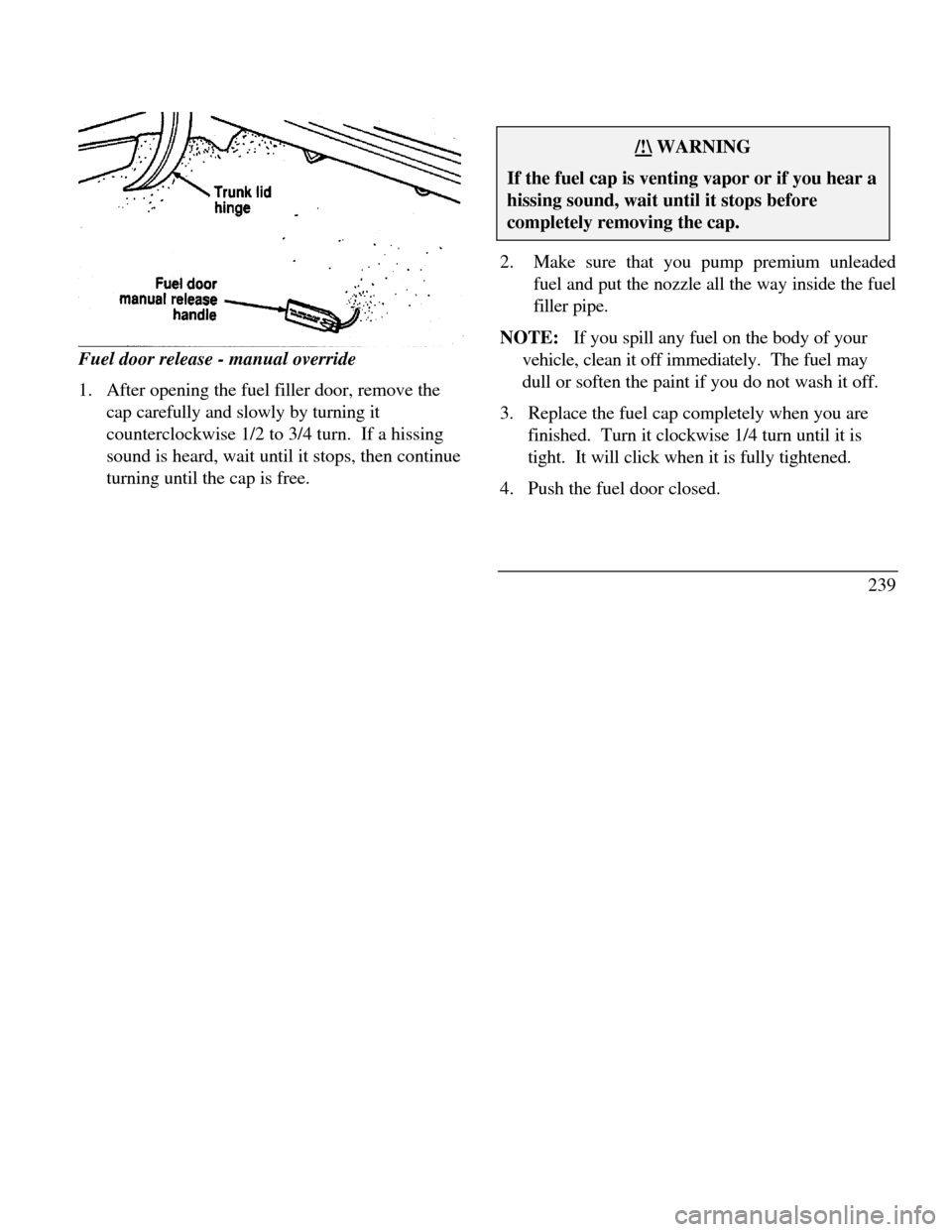
Fuel door release - manual override
1. After opening the fuel filler door, remove the
cap carefully and slowly by turning it
counterclockwise 1/2 to 3/4 turn. If a hissing
sound is heard, wait until it stops, then continue
turning until the cap is free./!\ WARNINGIf the fuel cap is venting vapor or if you hear ahissing sound, wait until it stops beforecompletely removing the cap.2.Make sure that you pump premium unleaded
fuel and put the nozzle all the way inside the fuel
filler pipe.
NOTE: If you spill any fuel on the body of your
vehicle, clean it off immediately. The fuel may
dull or soften the paint if you do not wash it off.
3. Replace the fuel cap completely when you are
finished. Turn it clockwise 1/4 turn until it is
tight. It will click when it is fully tightened.
4. Push the fuel door closed.
239