Page 134 of 320
Programming the Universal Transmitter
NOTE: It is recommended that your hand-held
transmitter contain fresh batteries prior to
programming./!\ WARNINGMake sure that people or objects are clearof the garage door, gate, etc. while you areprogramming the system.To program the Universal Transmitter:
I.Make sure your vehicle's engine is off.
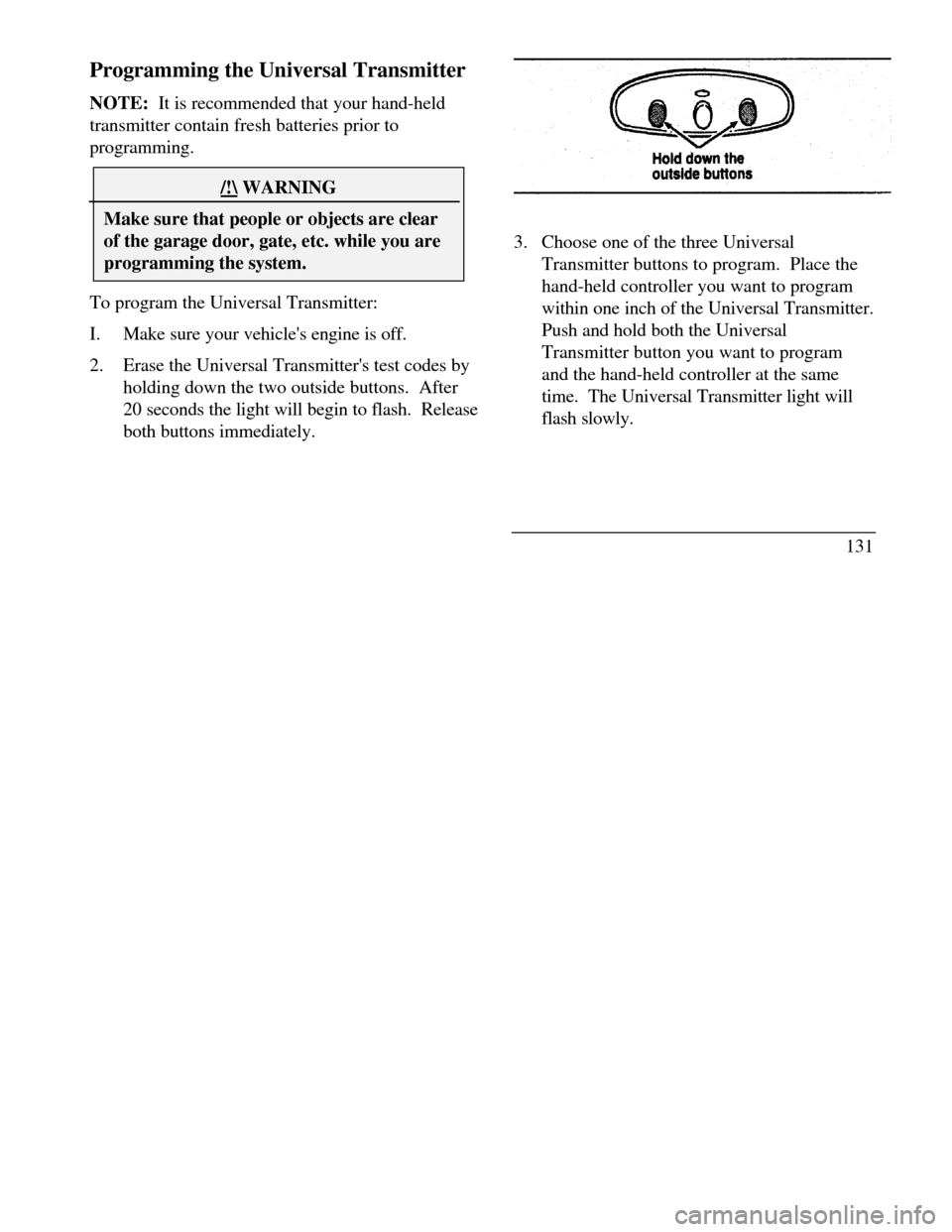
2.Erase the Universal Transmitter's test codes by
holding down the two outside buttons. After
20 seconds the light will begin to flash. Release
both buttons immediately.3. Choose one of the three Universal
Transmitter buttons to program. Place the
hand-held controller you want to program
within one inch of the Universal Transmitter.
Push and hold both the Universal
Transmitter button you want to program
and the hand-held controller at the same
time. The Universal Transmitter light will
flash slowly.
131
Page 136 of 320
Operating the Universal Transmitter/!\ WARNINGDo not use the Universal Transmitter with anygarage door opener that lacks safety "stop"and "reverse" features as required by federalstandards.To operate, press the appropriate button on the
Universal Transmitter. The light will illuminate
while the signal is being transmitted.
NOTE:The effective transmission range of
the Universal Transmitter may differ from your
hand-held transmitter.Erasing the Universal Transmitter
Channels
To clear the Universal Transmitter of all three
previously stored frequencies, follow Step 2 of
the Programming the Universal Transmitter
section.
Console
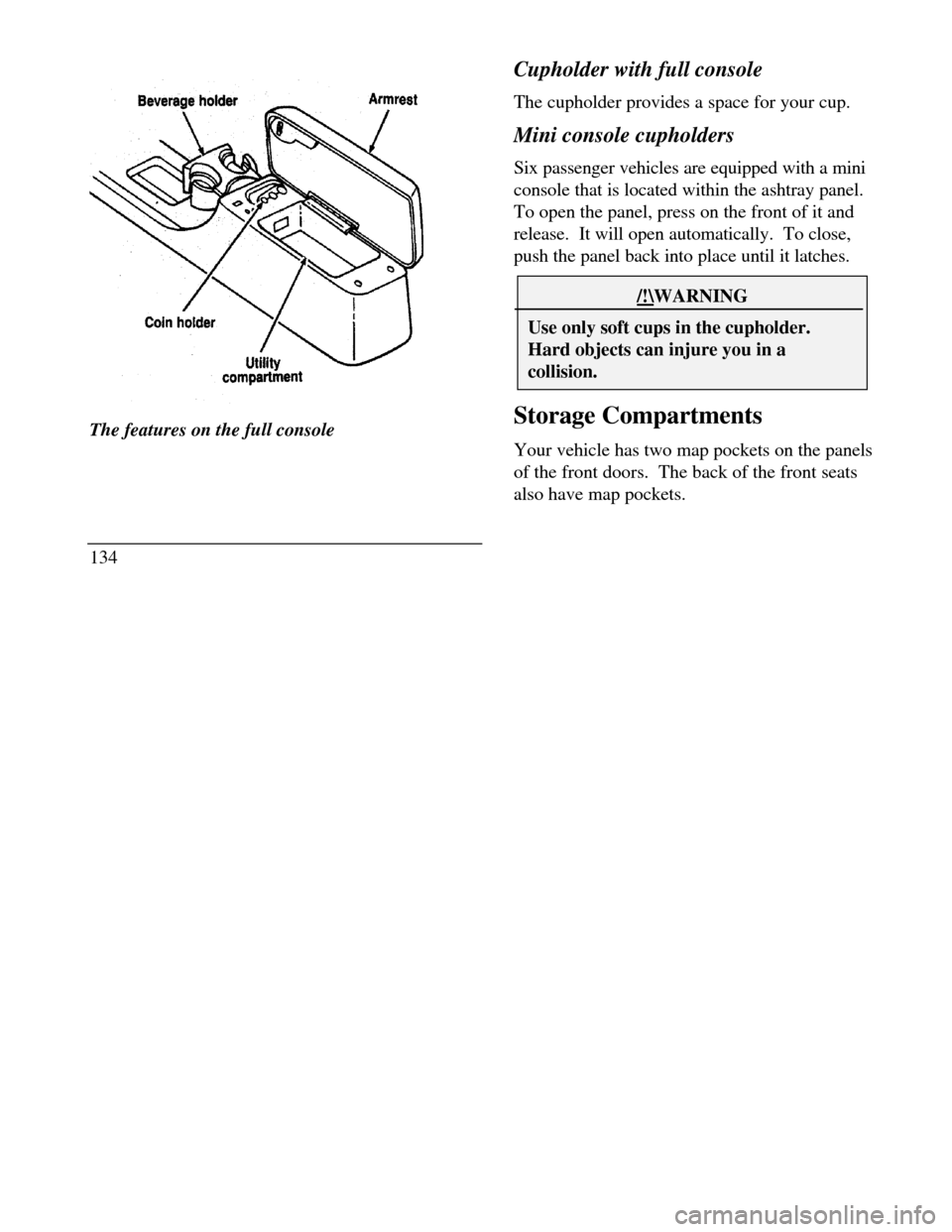
Your vehicle may have a full console. The full
console has the following features:
133
Page 137 of 320
Utility compartment armrest utility compartment beverage holderThe features on the full console
134Cupholder with full console
The cupholder provides a space for your cup.
Mini console cupholders
Six passenger vehicles are equipped with a mini
console that is located within the ashtray panel.
To open the panel, press on the front of it and
release. It will open automatically. To close,
push the panel back into place until it latches./!\WARNINGUse only soft cups in the cupholder.Hard objects can injure you in acollision.Storage Compartments
Your vehicle has two map pockets on the panels
of the front doors. The back of the front seats
also have map pockets.
Page 145 of 320

At zero pressure, the Securitires will provide you
with a minimum driving capability of approximately
20 miles (30 kms). How you drive and the actual
amount of air pressure left in your tires will
determine exactly how many miles can be driven.
To extend the mileage and help prevent damage to
low or deflated tires, you should: not exceed 55 mph (90 km/h) and drive at a
reduced rate of speed, if possible avoid excessive hard steering and braking
maneuvers, if possible stop periodically to allow the tires to cool down/! WARNINGIf your vehicle is driven with a low tire, thetire itself may become very hot. Allow thetire and wheel to cool before attempting tochange it.142Pressure Alert System
Each of your Securitires is monitored by a low
tire pressure sensor. A warning will appear in
the overhead console when the pressure in one
of your tires drops below acceptable levels or if
the system has malfunctioned.
Low Tire Pressure Warning Light Overhead
consoleLow Tire Pressure Warning in the overhead
console
Page 146 of 320

THIS DEVICE COMPLIES WITH FCC RULES,
PART 15. OPERATION IS SUBJECT TO THE
FOLLOWING TWO CONDITIONS: (1) THIS
DEVICE MAY NOT CAUSE HARMFUL
INTEREFERENCE AND (2) THIS DEVICE
MUST ACCEPT ANY INTEREFERENCE THAT
MAY BE RECEIVED, INCLUDING
INTEREFERENCE THAT MAY CAUSE
UNDESIRABLE OPERATION.
Maintenance Warning
The "Low Tire Pressure" warning will illuminate
and stay on when one of your vehicle's tires drops
below 18 psi (124 kps). The warning light will also
come on and stay lit if the Pressure Alert System has
malfunctioned.
If this warning appears, check the pressure in your
tires at the earliest possible convenience and adjust
any tire that is low to the recommended air pressure
level. This information can be found on the Service
Station Information page at the back of this manual
or on the driver's door placard.If the warning remains on after you have
adjusted the tires to recommended air pressure
levels, take your vehicle to an authorized
Lincoln/Mercury dealer for service.
Flat Tire Warning
If the sensors detect a tire pressure lower than I
0 psi (68 kps), the "Low Tire Pressure" warning
will flash repeatedly in the overhead console and
the message "Warning Low Tire Pressure" will
be displayed in the Message Center, indicating
an impending flat tire. If this condition occurs,
your Securitire requires service as soon as
possible. Refer to Servicing Your Secutitires.
NOTE: The Pressure Alert System will
activate only when the vehicle is moving faster
than 10 mph (15 km/h).
143
Page 147 of 320

Servicing Your Securitires/!\ WARNINGDo not use aerosol tire inflator/sealer withSecuritires. Doing so may damage the tire'spressure sensor.If you cannot service your Securitire immediately,
replace it with your mini-spare as soon as it is safe
to do so.
Your mini-spare tire can be used until your
Securitire has been repaired. See Tires in the
Servicing chapter of this guide for more information
on using the spare.
It is recommended that you always have your
Securitires serviced by an authorized Michelin tire
dealer. Each Securitire is equipped with a
pressure sensor around the wheel rim. This
sensor could be damaged when removing and
installing the tire. Servicing a Securitire at
144locations other than your Michelin tire dealer
lmay adversely affect your warranty.
If you have questions concerning your
Securitires or servicing, please call the Michelin
Tire Information Line at 1-800-847-3435 or
contact your local Michelin tire dealer.
Lincoln RESCU System
(If equipped) /!\ WARNINGIt is important that you understand thelimitations of your Lincoln RESCUSystem prior to initiating an activation.See Lincoln RESCU System Limitationslater in this chapter for details.
Page 148 of 320

Quick Summary To utilize your vehicle's assistance request
feature, YOUR CELLULAR PHONE MUST BE
ACTIVATED. Roadside or emergency assistance can be
requested whenever your key is in the
RUN/START position and for two minutes after
the vehicle is turned off. An assistance request is initiated by pressing
either the tow truck or ambulance button located
in the overhead console. When a button is pressed, a warning lamp located
in the overhead console begins to flash and status
messages are displayed on the vehicle's message
center. (Messages are only displayed when your
key is in the RUN/START position.) The vehicle's cellular phone automatically
places a call to a 24 hour emergency
response center. When contact is made, the vehicle sends an
electronic data message to the response center's
computer. This data message includes latitude
and longitude coordinates obtained from the
vehicle's positioning system. Once the data transmission is complete, the
call is forwarded to a response center
operator who confirms your location using a
computerized map. The vehicle's cellular handset is locked-out,
the phone is automatically placed in "hands
free" mode and voice communication is
established with the operator through the
"hands free" microphone. Typically, voice communication with an
operator is established within one minute
after an assistance button is pressed.
145
Page 149 of 320
The operator verbally obtains details of Your
situation and, if necessary, ties your vehicle into a
three-way phone call with the United States Auto
Club or local 911 or other emergency services to
dispatch the appropriate assistance to your
location. Once the situation has been appropriately
handled, the operator will terminate the call, the
system warning light will stop flashing and the
system will be reset. In most situations, ONLY
the response center can terminate an assistance
request.
General Description
Lincoln's Remote Emergency Satellite Cellular
Unit (RESCU) is designed to expedite roadside or
emergency assistance to distressed motorists who
are uncertain of their location and/or are uncertain
of who to contact for assistance.
The Lincoln RESCU System utilizes Global
Positioning System (GPS) technology and the
146nation's cellular phone network to track vehicle
location and, at the touch of a button, put you in
voice contact with the Lincoln Security
Response Center.
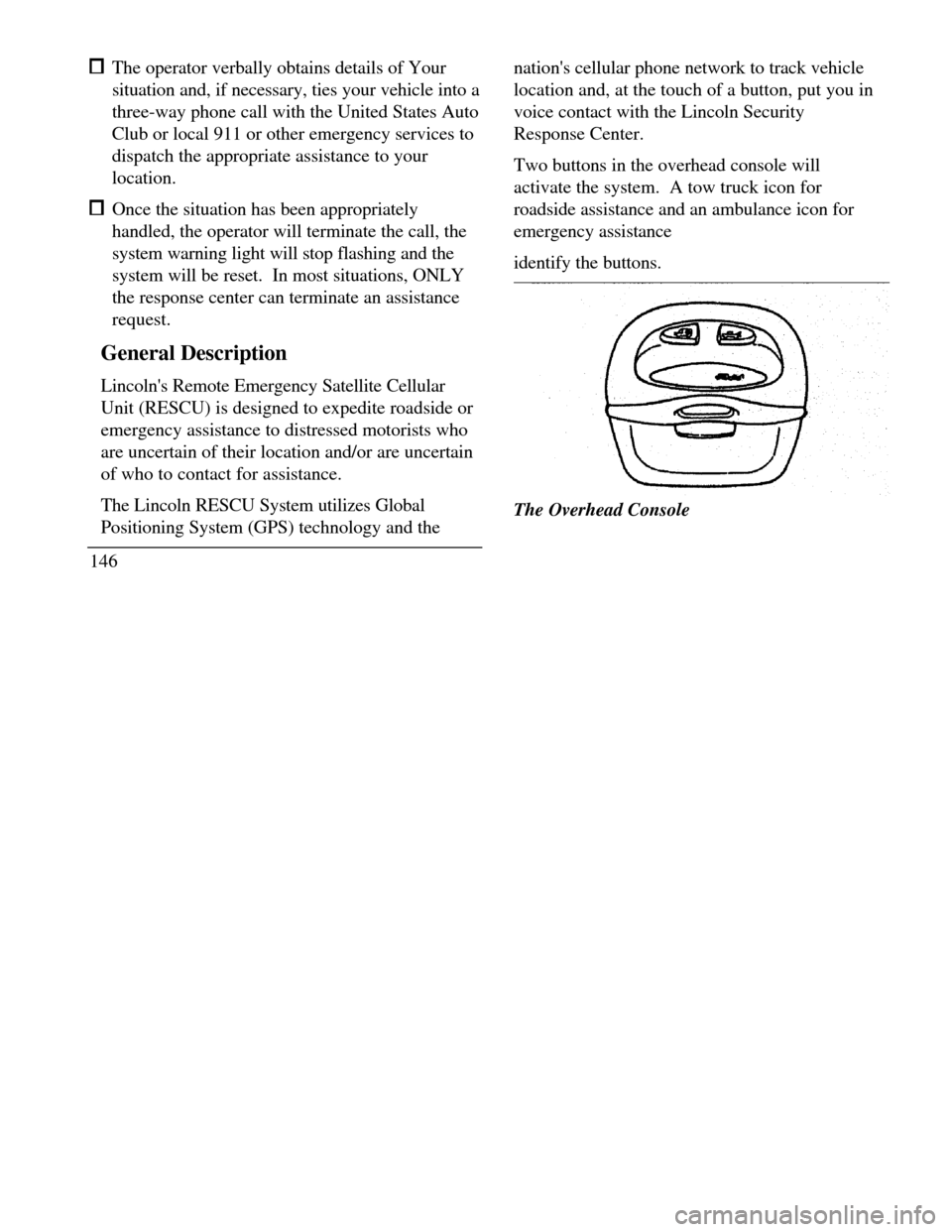
Two buttons in the overhead console will
activate the system. A tow truck icon for
roadside assistance and an ambulance icon for
emergency assistance
identify the buttons.The Overhead Console