Page 164 of 240
Windshield Wipers
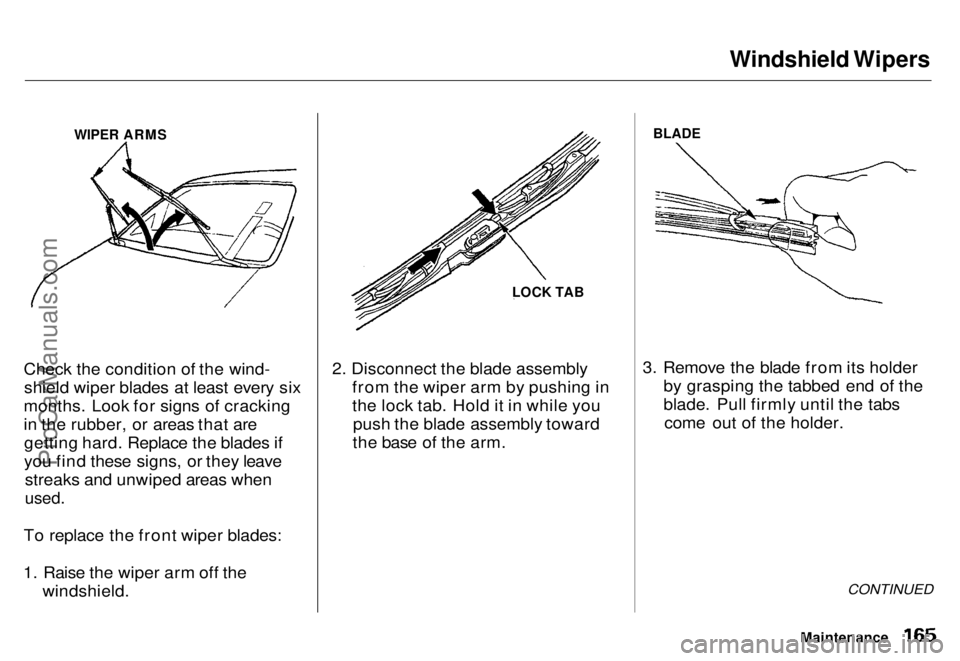
WIPER ARMS
Check the condition of the wind- shield wiper blades at least every six
months. Look for signs of cracking
in the rubber, or areas that are getting hard. Replace the blades if
you find these signs, or they leave streaks and unwiped areas when
used.
To replace the front wiper blades:
1. Raise the wiper arm off the windshield. 2. Disconnect the blade assembly
from the wiper arm by pushing in
the lock tab. Hold it in while youpush the blade assembly toward
the base of the arm.
BLADE
3. Remove the blade from its holder by grasping the tabbed end of the
blade. Pull firmly until the tabscome out of the holder.
CONTINUED
Maintenance
LOCK TABProCarManuals.comMain Menu s t Table of Contents
Page 165 of 240
Windshield Wipers
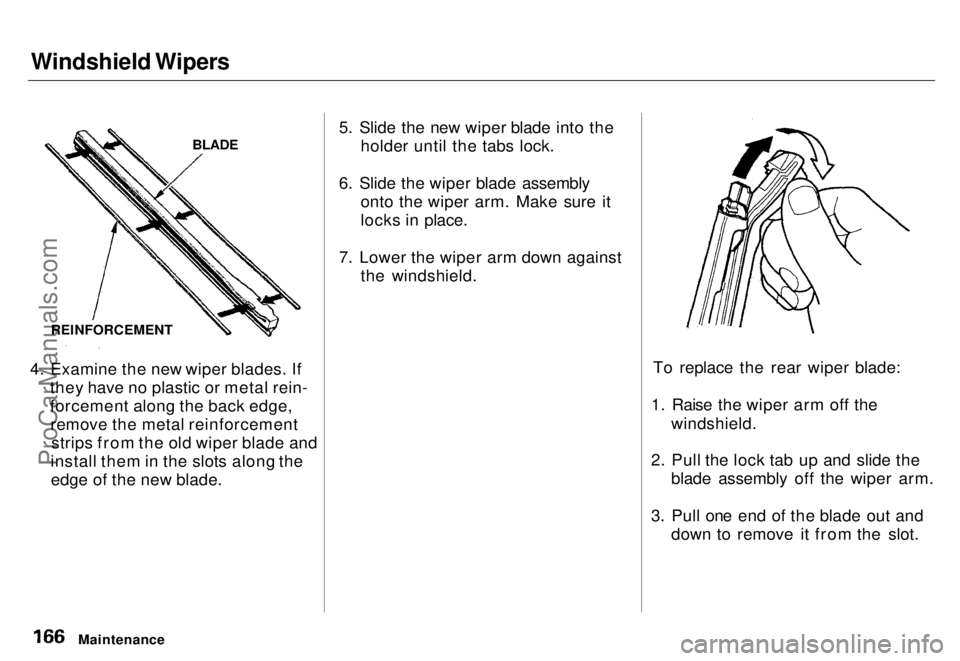
4. Examine the new wiper blades. If they have no plastic or metal rein-
forcement along the back edge,remove the metal reinforcement strips from the old wiper blade and
install them in the slots along the edge of the new blade. 5. Slide the new wiper blade into the
holder until the tabs lock.
6. Slide the wiper blade assembly onto the wiper arm. Make sure it
locks in place.
7. Lower the wiper arm down against the windshield.
To replace the rear wiper blade:
1. Raise the wiper arm off the windshield.
2. Pull the lock tab up and slide the blade assembly off the wiper arm.
3. Pull one end of the blade out and down to remove it from the slot.
Maintenance
BLADE
REINFORCEMENTProCarManuals.comMain Menu s t Table of Contents
Page 172 of 240
Tires
It is best to replace all four tires at
the same time. If that is not possible or necessary, then replace the two
front tires or the two rear tires as a pair. Replacing just one tire can
seriously affect your car's handling.
The ABS works by comparing the speed of the wheels. When replacing
tires, use the same size originallysupplied with the car. Tire size and
construction can affect wheel speed
and may cause the system to work in-
consistently. If you ever need to replace a wheel,
make sure the wheel's specificationsmatch those of the original wheel
that came on your car. Replacement
wheels are available at your Honda
dealer.
Wheels and Tires
Wheel:
15x6JJ
Tire:
P205/65R15 92S
See Tire Information on page 221 for
additional information about tire and
wheel size designations. See page 222 for information about DOT Tire
Quality Grading.
Winter Driving
Tires that are marked "M + S" or
"All Season" on the sidewall have an
all-weather tread design. They
should be suitable for most winter
driving conditions. Tires without
these markings are designed for
optimum traction in dry conditions.
They may not provide adequate
performance in winter driving.
For the best performance in snowy
or icy conditions, you should install
snow tires or tire chains. They may
be required by local laws under
certain conditions.
CONTINUED
Maintenance
Installing improper tires on your
car can affect handling and
stability. This can cause a crash in which you can be seriously
hurt or killed.
Always use the size and type of
tires recommended in thisowner's manual.
ProCarManuals.comMain Menu s t Table of Contents
Page 176 of 240
Lights
Replacing a Headlight Bulb
Your car has halogen headlight bulbs, one on each side. When
replacing a bulb, handle it by its steel
base and protect the glass fromcontact with your skin or hard
objects. If you touch the glass, clean
it with denatured alcohol and a clean
cloth.
Halogen headlight bulbs get very hot when lit. Oil, perspiration, or a scratchon the glass can cause the bulb to
overheat and shatter.
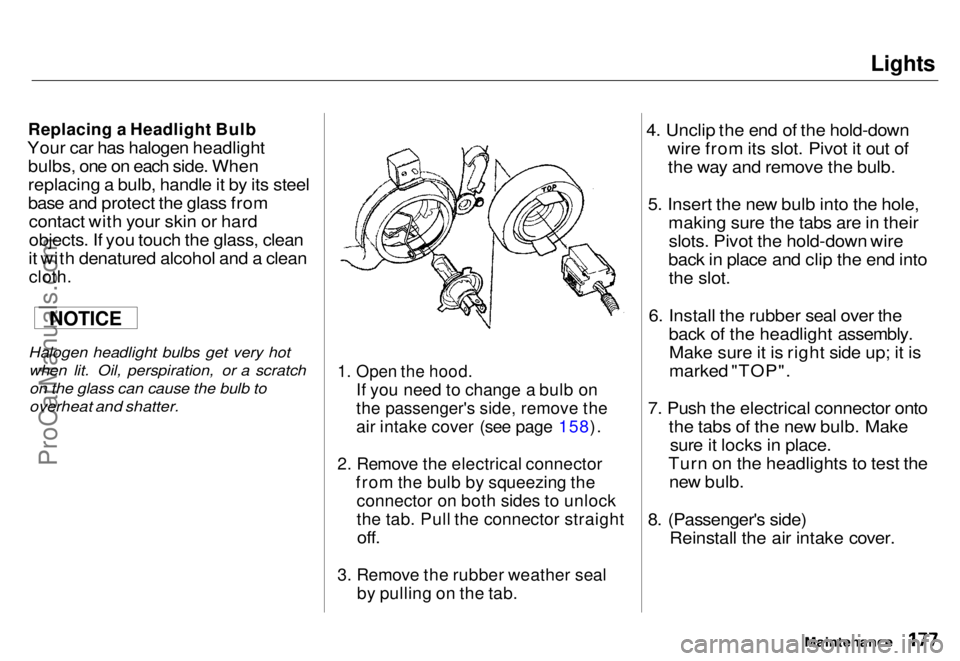
1. Open the hood.
If you need to change a bulb on
the passenger's side, remove the
air intake cover (see page 158).
2. Remove the electrical connector
from the bulb by squeezing the
connector on both sides to unlock
the tab. Pull the connector straight
off.
3. Remove the rubber weather seal
by pulling on the tab.
4. Unclip the end of the hold-down
wire from its slot. Pivot it out ofthe way and remove the bulb.
5. Insert the new bulb into the hole, making sure the tabs are in theirslots. Pivot the hold-down wire
back in place and clip the end into the slot.
6. Install the rubber seal over the back of the headlight assembly.Make sure it is right side up; it is
marked "TOP".
7. Push the electrical connector onto the tabs of the new bulb. Makesure it locks in place.
Turn on the headlights to test the new bulb.
8. (Passenger's side) Reinstall the air intake cover.
Maintenance
NOTICEProCarManuals.comMain Menu s t Table of Contents
Page 177 of 240
Lights
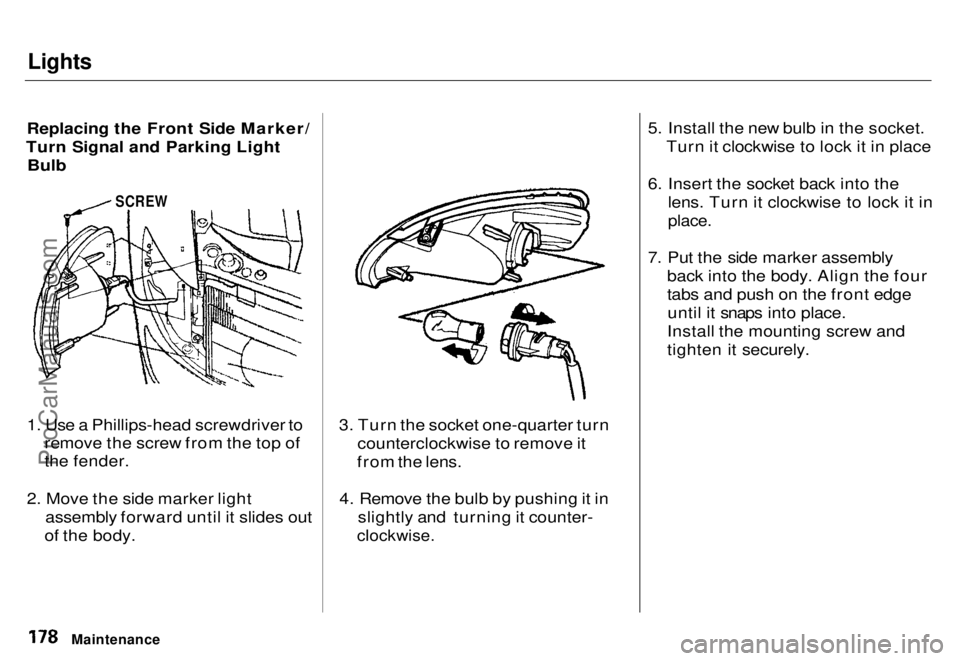
Replacing the Front Side Marker/
Turn Signal and Parking Light
Bulb
SCREW
1. Use a Phillips-head screwdriver to remove the screw from the top of
the fender.
2. Move the side marker light assembly forward until it slides out
of the body. 3. Turn the socket one-quarter turn
counterclockwise to remove it
from the lens.
4. Remove the bulb by pushing it in slightly and turning it counter-
clockwise.
5. Install the new bulb in the socket.
Turn it clockwise to lock it in place
6. Insert the socket back into the lens. Turn it clockwise to lock it in
place.
7. Put the side marker assembly back into the body. Align the four
tabs and push on the front edgeuntil it snaps into place.
Install the mounting screw and
tighten it securely.
MaintenanceProCarManuals.comMain Menu s t Table of Contents
Page 180 of 240
Lights
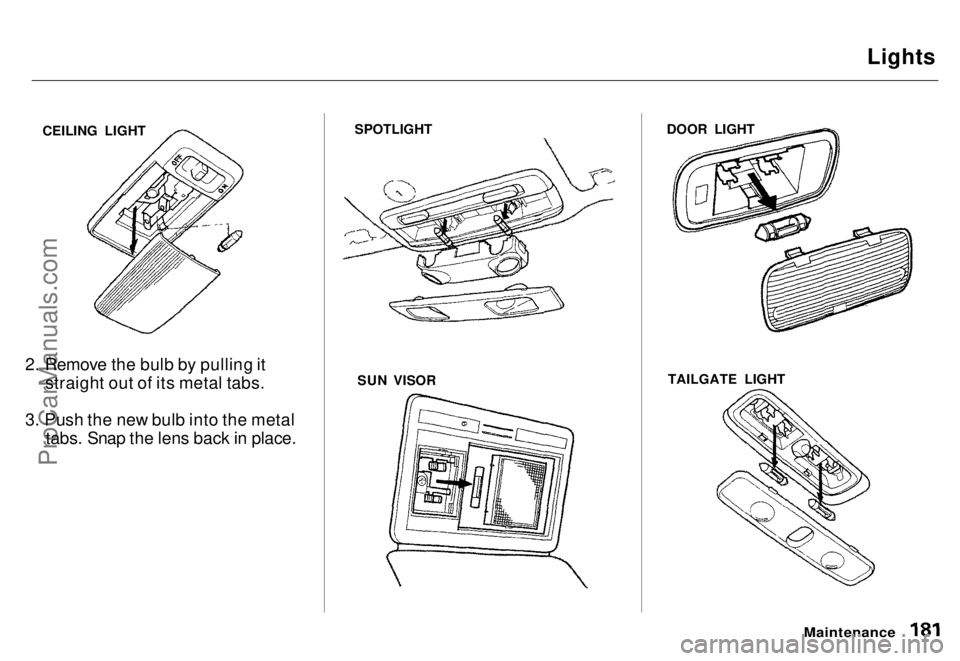
CEILING LIGHT
2. Remove the bulb by pulling it straight out of its metal tabs.
3. Push the new bulb into the metal tabs. Snap the lens back in place. SPOTLIGHT
SUN VISOR DOOR LIGHT
TAILGATE LIGHT
MaintenanceProCarManuals.comMain Menu s t Table of Contents
Page 187 of 240

Corrosion Protection
Two factors normally contribute to causing corrosion in your car:
1. Moisture trapped in body cavities. Dirt and road salt that collects in
hollows on the underside of the car stays damp, promoting
corrosion in that area.
2. Removal of paint and protective coatings from the exterior and
underside of the car. Many corrosion-preventive measures
are built into your Honda. You can
help keep your car from corroding
by performing some simple periodic
maintenance:
Repair chips and scratches in the
paint as soon as you discover them.
Inspect and clean out the drain
holes in the bottom of the doors and body. Check the floor coverings for
dampness. Carpeting and floor
mats may remain damp for a long
time, especially in winter. This dampness can eventually cause
the floor panels to corrode. Use a high-pressure spray to clean
the underside of your car. This is especially important in areas that
use road salt in winter. It is also a
good idea in humid climates and areas subject to salt air. Carsequipped with ABS have a sensor
and wiring at each wheel. Be
careful not to damage them. Have the corrosion-preventive
coatings on the underside of your
car inspected and repaired periodically.
Appearance CareProCarManuals.comMain Menu s t Table of Contents
Page 207 of 240
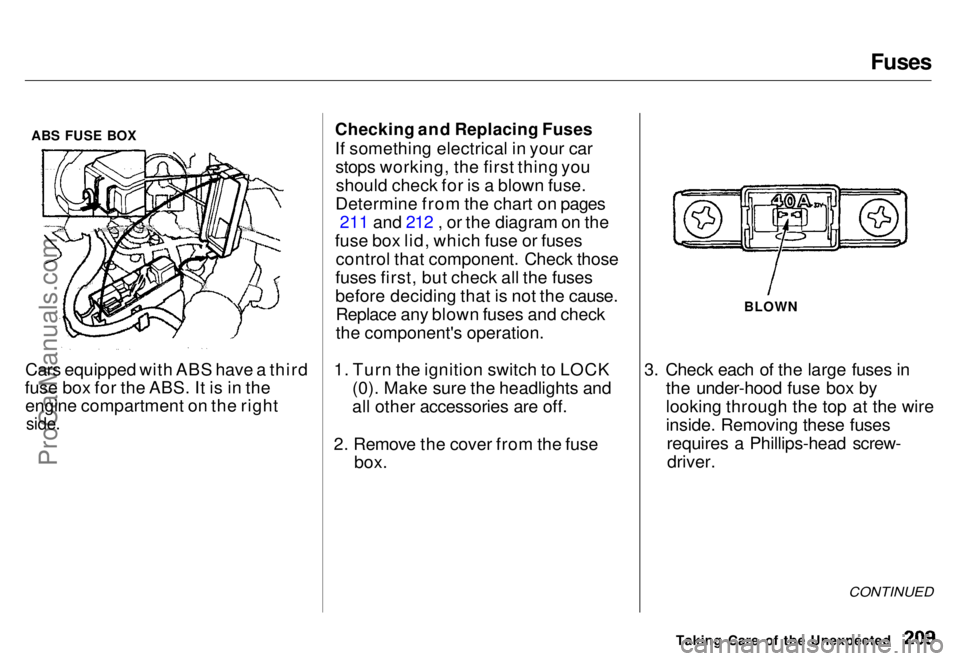
Fuses
ABS FUSE BOX
Cars equipped with ABS have a third
fuse box for the ABS. It is in the engine compartment on the right
side.
Checking and Replacing Fuses
If something electrical in your car
stops working, the first thing youshould check for is a blown fuse.
Determine from the chart on pages 211 and 212 , or the diagram on the
fuse box lid, which fuse or fuses control that component. Check those
fuses first, but check all the fuses
before deciding that is not the cause. Replace any blown fuses and check
the component's operation.
1. Turn the ignition switch to LOCK (0). Make sure the headlights and
all other accessories are off.
2. Remove the cover from the fuse box. 3. Check each of the large fuses in
the under-hood fuse box by
looking through the top at the wire
inside. Removing these fusesrequires a Phillips-head screw-driver.
CONTINUED
Taking Care of the Unexpected BLOWNProCarManuals.comMain Menu s t Table of Contents