Page 173 of 372
0 Tie a red cloth to your vehicle to alert police that
you’ve been stopped by the snow.
0 Put on extra clothing or wrap a blanket around you.
If you have no blankets or extra clothing, make body
insulators from newspapers, burlap bags, rags, floor
mats
-- anything you can wrap around yourself or
tuck under your clothing
to keep warm.
You can run the engine to keep warm, but be careful.
L
Snow can trap exhaust gases under your vehicle.
This can cause deadly
CO (carbon monoxide) gas
$0 get inside. CO could overcome you and kill
you. You can’t see it or smell it, so you might not
know it
is in your vehicle. Clear away snow from
around the base of your vehicle, especially any
that is blocking your exhaust pipe. And check
around again from time to time to be sure snow
doesn’t collect there.
Open
a window just a little on the side of the
vehicle that’s away from the wind. This will help
keep
CO out.
4-25
ProCarManuals.com
Page 193 of 372
7. Don’t let the other end
touch metal. Connect
it
to the positive (+)
terminal of the good
battery. Use
a remote
positive
(+) terminal if
the vehicle has one. Now
connect the black
negative
(-) cable to
the good battery‘s negative
(-) terminal.
Don’t let the other end touch anything
until the
next step.
9. Make your last connection away from the battery,
to the engine block, frame or other metal parts of
your vehicle.
10. Now start the vehicle with the good battery and run
the engine for
a while.
1 I. Try to start the vehicle with the dead battery.
If it won’t start after a few tries, it probably
needs service.
5-5
ProCarManuals.com
Page 194 of 372
12. Remove the cables in reverse order to prevent
electrical shorting. Take care
that they don’t touch
each other or any other metal.
A
A. Engine Block, Frame, Heavy Metal Engine Part
B. Good Battery
C. Dead Battery
Towing Your Vehicle
Try to have your GM dealer or a professional towing
service tow your vehicle. They
can provide the right
equipment and know how to tow it without damage. See
“Roadside Assistance” in your Index.
If your vehicle has been changed since it was
factory-new, by adding things like fog lamps, aero
skirting, or special tires and wheels, these things could
be damaged during towing.
Before
you do anything, turn on the hazard
warning flashers.
When you call, tell the towing service:
0
0
0
0
That your vehicle has rear wheel drive.
The make, model and year of your vehicle.
Whether you can move the shift lever for
the transmission.
If there was an accident, what was damaged.
5-6
ProCarManuals.com
Page 195 of 372
A CAUTION: A CAUTION:
To help avoid injury to you or others:
0
0
0
0
0
Never let passengers ride in a vehicle that is
being towed.
Never tow faster than safe or posted speeds.
Never tow with damaged parts not
fully secured.
Never get under your vehicle after it has
been lifted by the tow truck.
Always use separate safety chains on each
side when towing
a vehicle.
When your vehicle is being towed, have the ignition
key’off. The steering wheel should be clamped in a
straight-ahead position, with a clamping device
designed
for towing service. Do not use the vehicle’s
steering column lock for this. The transmission should
be in
NEUTRAL (N) and the parking brake should
be released.
A vehicle can fall from a car carrier if it isn’t
adequately secured. This can cause
a collision,
serious personal injury and vehicle damage. The
vehicle should be tightly secured with chains or
steel cables before it is transported.
Don’t use substitutes (ropes, leather straps,
canvas webbing, etc.) that can be cut by sharp
edges underneath the towed vehicle.
5-7
ProCarManuals.com
Page 204 of 372
How to Add Coolant to the Radiator
I
1.
I
2. Then keep turning the pressure cap, but now push
down
as you turn it. Remove the pressure cap.
You can remove the radiator pressure cap when the
cooling system, including the radiator pressure cap
and upper radiator hose,
is no longer hot. Turn the
pressure
cap slowly counterclockwise until it first
stops. (Don’t press down while turning the
pressure cap.)
If you hear a hiss, wait for that to stop. A hiss means
there is still some pressure left.
5-16
ProCarManuals.com
Page 208 of 372
If a Tire Goes Flat
It’s unusual for a tire to “blow out” while you’re driving,
especially
if you maintain your tires properly. If air goes
out of a tire, it’s much more likely
to leak out slowly.
But
if you should ever have a “blowout,” here are a few
tips about what to expect and what to do:
If a front tire fails, the flat tire will create a drag that
pulls the vehicle toward that side. Take
your foot off the
accelerator pedal and grip the st.eering wheel firmly.
Steer to maintain lane position, and then gently brake to
a stop well out of the traffic lane.
A rear blowout, particularly on a curve, acts much like a
skid and may require the same correction you’d use in a
skid.
In any rear blowout, remove your foot from the
accelerator pedal. Get the vehicle under control
by
steering the way you want the vehicle to go. It may be
very bumpy and noisy, but you can still steer. Gently
brake to
a stop -- well off the road if possible.
If a tire goes flat, the next part shows how to use your
jacking equipment to change a
flat tire safely.
Changing a Flat Tire
If a tire goes flat, avoid further tire and wheel damage
by driving slowly to
a level place. Turn on your hazard
warning flashers.
Changing a tire can cause an injury. The vehicle
can slip off the jack and roll over you or other
people. You and they could be badly injured.
Find a level place
to change your tire. To help
prevent the vehicle from moving:
1. Set the parking brake firmly.
2. Put the shift lever in PARK (P).
3. Turn off the engine.
To be even more certain the vehicle won’t move,
you can put blocks at the front and rear of the
tire farthest away from the one being changed.
That would be the tire on the other side of the
vehicle, at the opposite end.
5-20
ProCarManuals.com
Page 212 of 372
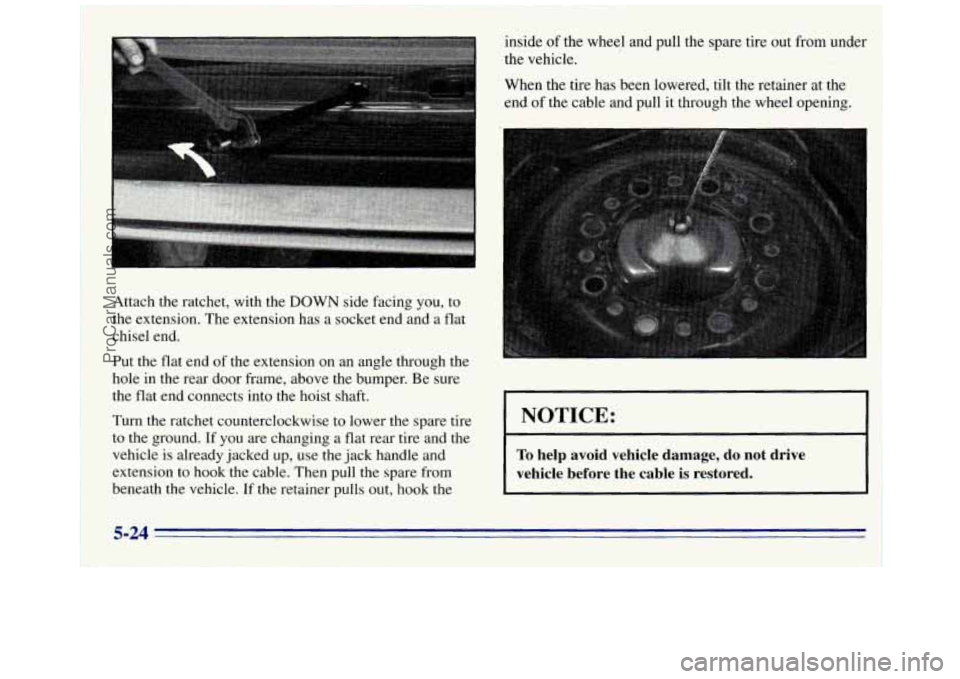
Attach the ratchet, with the DOWN side facing you, to
the extension. The extension has a socket end and a flat
chisel end.
Put the flat end of the extension on an angle through the
hole in the rear door frame, above the bumper. Be sure
the flat end connects into the hoist shaft.
Turn the ratchet counterclockwise to lower the spare tire
to the ground.
If you are changing a flat rear tire and the
vehicle is already jacked up, use the jack handle and
extension to hook the cable. Then pull the spare from
beneath the vehicle.
If the retainer pulls out, hook the inside
of the wheel and pull the
spare tire out from under
the vehicle.
When the tire has been lowered, tilt the retainer at the end
of the cable and pull it through the wheel opening.
NOTICE:
To help avoid vehicle damage, do not drive
vehicle before the cable is restored.
5-24 i
t
ProCarManuals.com
Page 214 of 372
Removing the Wheel Covers and Locking
Wheel
P
I. You will need to take oft' the wheel nut caps to reach
your wheel nuts.
2. Loosen the plastic nut caps with the ratchet and
socket and remove them. Make sure the DOWN
side faces you.
5-26
ProCarManuals.com