Page 216 of 372
2. The jack has a bolt on the end. Attach the socket end
of the extension to the jack bolt.
Attach the ratchet to the extension
with the UP side
facing
you.
3. Rotate the ratchet clockwise. That will raise the jack
lift head a little,
Front Position
5-28
ProCarManuals.com
Page 217 of 372
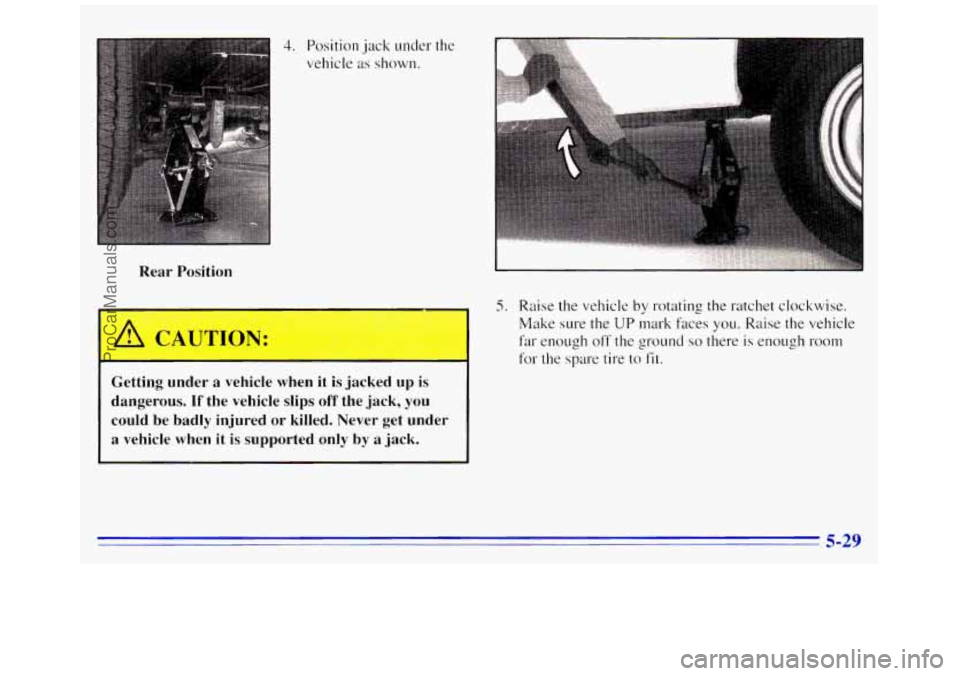
4. Position jack under the
vehicle
as shown.
Rear Positio~
Getting under a vehicle when it is jacked
up is
dangerous.
If the vehicle slips off the jack, you
could be badly injured or killed. Never get under
a vehicle when it is supported only by a jack.
5. Raise the vehicle by rotating the ratchet clockwise.
Make sure the
UP mark faces you. Raise the vehicle
far enough
off the ground so there is enough room
for the spare tire to
fit.
5-29
ProCarManuals.com
Page 219 of 372
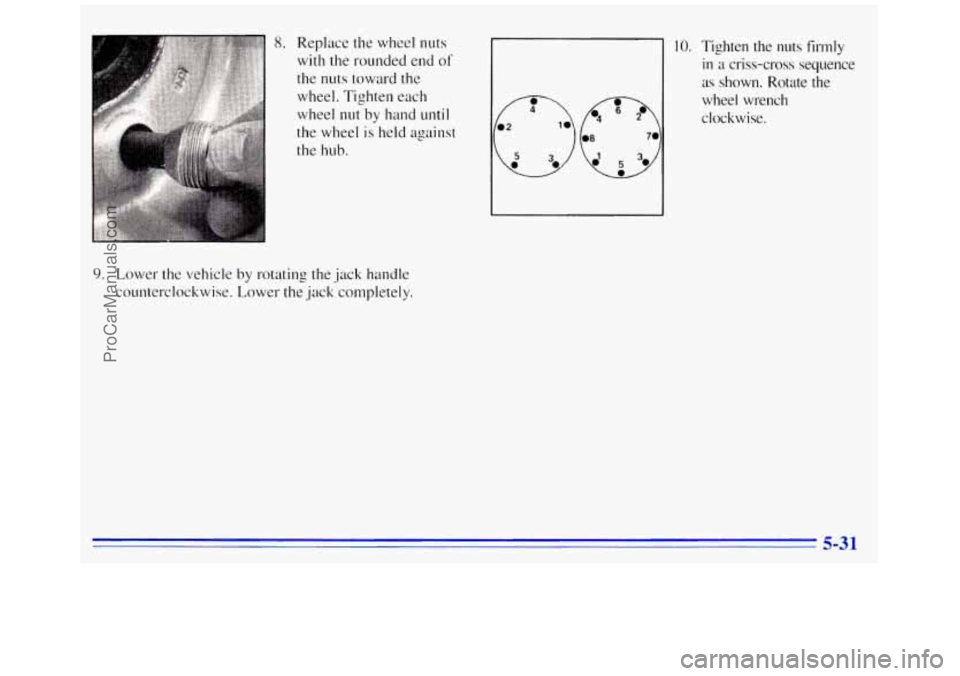
8. Replace the wheel nuts
with the rounded end of
the nuts toward the
wheel. Tighten each
wheel nut
by hand until
the wheel is held against
the hub.
9. Lower the vehicle by rotating thejack handle
counterclockwise. Lower the
jack completely.
10. Tighten the nuts firmly
in a criss-cross sequence
as shown. Rotate the
wheel wrench
clockwise.
5-31
ProCarManuals.com
Page 220 of 372
A CAUTION:
Incorrect wheel nuts or improperly tightenea
wheel nuts can cause the wheel to become loose
and even come off. This could lead to an accident.
Be sure to use the correct wheel nuts.
If you have
to replace them, be sure to get new
GM original
equipment wheel nuts.
Stop, somewhere
as soon as you can and have
the nuts tightened with a torque wrench to
122 lb-ft (165 N-m).
NOTICE:
Improperly tightened wheel nuts can lead to
brake pulsation and rotor damage.
To avoid
expensive brake repairs, evenly tighten the wheel
nuts in the proper sequence and to the proper'
torque specification.
11. Put the wheel cover back on, if you have one.
Remove any wheel blocks.'
Remember that the jack, jacking equipment and tire
must
be properly stored in their original storage
position before you begin driving again. The next
part will show you how.
5-32
ProCarManuals.com
Page 223 of 372

5. Put the flat end of the extension on an angle through
the hole in the rear door frame, above the bumper.
Turn the ratchet clockwise until the tire is against the
underside
of the vehicle.
You will hear two “clicks” when the tire is up all the
way. Try
to move the tire with your hands to make
sure it is securely in place.
Return the jacking equipment to the proper location.
Secure the items and replace the jack cover.
If You’re Stuck: In Sand, Mud,
Ice or Snow
What you don’t want to do when your vehicle is stuck is
to spin your wheels too fast. The method known as
”rocking” can help you get out when you’re stuck, but
you must use caution.
If you let your tires spin at high speed, they can
explode, and you or others could be injured.
And, the transmission or other parts
of the
vehicle can overheat. That
could cause an engine
compartment fire or other damage. When you’re
stuck, spin the wheels as little
as possible. Don’t
spin the wheels above
35 mph (55 kmh) as shown
on the speedometer.
5-35
ProCarManuals.com
Page 229 of 372
L
If you get gasoline on yourself and then
something ignites it, you could be badly burned.
Gasoline can spray out
on you if you open the
fuel filler cap too quickly.
This spray can happen
if your tank
is nearly full, and is more likely in
hot weather. Open the fuel filler cap slowly and
wait for any “hiss” noise to stop. Then unscrew
the cap all the way.
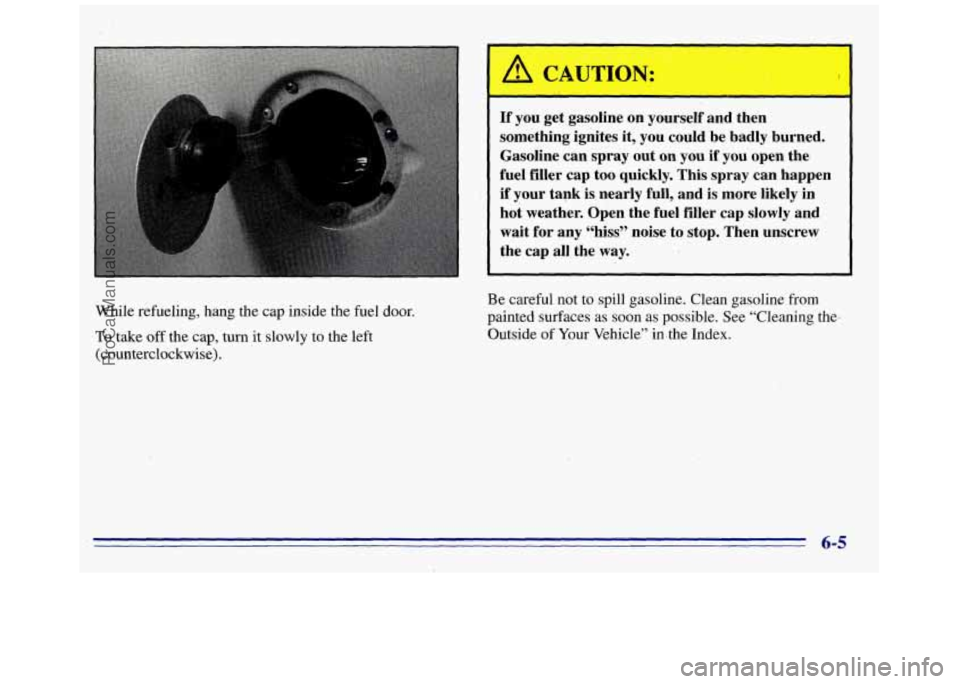
While refueling, hang the cap inside the fuel door.
To take off the cap, turn it slowly to the left
(counterclockwise). Be
careful not
to spill gasoline. Clean gasoline from
painted surfaces
as soon as possible. See “Cleaning the-
Outside of Your Vehicle” in.the Index.
6-5
f
ProCarManuals.com
Page 242 of 372
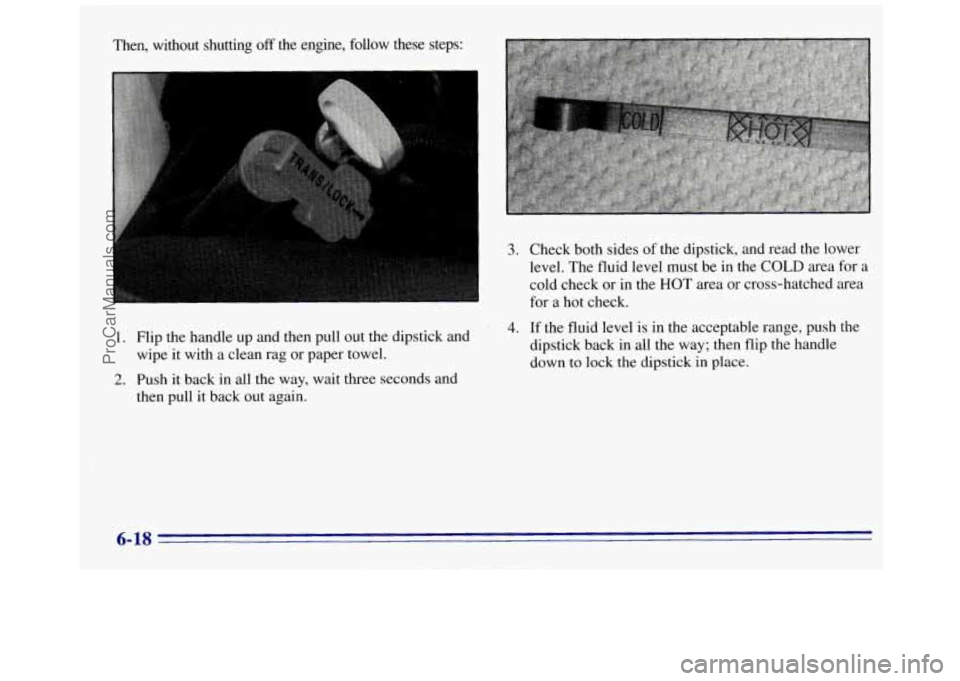
Then, without shutting off the engine, follow these steps:
1.
2.
3. Check both sides of the dipstick, and read the lower
level. The fluid level must be in the
COLD area for a
cold check
or in the HOT area or cross-hatched area
for a hot check.
Flip the handle
up and then pull out the dipstick and 4. If the fluid level is in the acceptable range, push the
wipe
it with a clean rag or paper towel. dipstick back
in all the way; then flip the handle
down to lock the dipstick in place.
Push it back
in all the way, wait three seconds and
then pull
it back out again.
6-18
ProCarManuals.com
Page 243 of 372

How to Add Fluid Rear Axle
Refer to the Maintenance Schedule to determine what
kind of transmission fluid to use. See “Recommended
Fluids and Lubricants”
in the Index.
Add
tluid only after checking the transmission fluid
HOT. (A COLD check is used only as a reference.) If
the fluid level is low, add only enough of the proper
fluid to bring
the level up to the HOT area for a hot
check.
It doesn’t take much fluid, generally less than a
pint (0.5 L). DOLJ ’t overfill. We recommend you use only
fluid labeled DEXRON@-111, because fluid with that
label is made especially for your automatic transmission.
Damage caused by
fluid other than DEXRON-111 is not
covered by your new vehicle warranty.
After adding fluid, recheck the fluid level as
described under ”How to Check.”
When the correct fluid level is obtained, push the
dipstick back
in all the way; then flip the handle
down to lock
the dipstick in place.
When to Check and Change Lubricant
Refer to the Maintenance Schedule to determine how
often to check the lubricant and when to change
it. See
“Scheduled Maintenance Services” in the Index.
How to Check Lubricant
If the level is below the
bottom of the filler plug
hole,
you’ll need to add
some lubricant. Add
enough lubricant to raise
the level
to the bottom of
the filler plug hole.
What to Use
Refer to the Maintenance Schedule to determine what
kind
of lubricant to use. See “Recommended Fluids and
Lubricants”
in the Index.
6-19
ProCarManuals.com