1996 CHRYSLER VOYAGER windshield wipers
[x] Cancel search: windshield wipersPage 446 of 1938

WINDSHIELD WIPER BLADE ELEMENT
REMOVAL
(1) Disengage the release tab holding the wiper
blade to the wiper arm and remove the wiper blade
from the wiper arm (Fig. 6).
(2) Disengage clip holding the wiper element to
wiper blade (Fig. 7).
(3) Pull the element from the claws on the wiper
blade.
INSTALLATION
(1) Insert the element vertebra (Fig. 8) into claw
at the open end of the wiper blade and through each
claw location along the blade.
(2) Engage clip to hold wiper element to wiper
blade.
(3) Test wiper effectiveness using washer mode
and align if necessary.
WINDSHIELD WIPER MOTOR
REMOVAL
(1) Remove wiper unit from vehicle.
(2) Remove wiper linkage and motor mount plate
from wiper unit.
(3) Disconnect wire connectors from back of wiper
motor (Fig. 16).
(4) Remove wiper linkage from motor crank. Do
NOT remove crank from motor.(5) Remove bolts holding wiper motor to mount
plate and remove motor (Fig. 9) and (Fig. 10).
INSTALLATION
(1) Place wiper unit on a suitable work surface.
(2) Place wiper motor in position on mount plate.
(3) Install bolts to hold wiper motor to mount
plate.
(4) Install wiper linkage and motor mount plate
into wiper unit.
(5) Connect wire connectors to wiper motor (Fig.
16).
(6) Place the wiper unit into engine compartment
and connect wiper unit wire connector to engine wire
harness (Fig. 13).
(7) Operate wiper motor and verify that the wiper
motor parks when wiper switch is turned OFF.
Fig. 7 Windshield Wiper Blade Element
Fig. 8 Wiper Blade and Element
Fig. 9 Wiper Motor Crank
Fig. 10 Wiper Motor
8K - 6 WINDSHIELD WIPERS AND WASHERSNS
REMOVAL AND INSTALLATION (Continued)
Page 447 of 1938

WIPER ARM
CAUTION: The Driver side wiper arm must be parked
above the passenger side. Failure to do so will result
in damage to the arms, blades, or system.
REMOVAL
(1) Disengage the clip holding outside end of the
wiper arm pivot cover to the wiper arm.
(2) Lift the arm cap upward.
(3) Remove the nut holding wiper arm to the wiper
pivot.
(4) Using a suitable two jaw puller, separate the
wiper arm from the wiper pivot (Fig. 11).
INSTALLATION
(1) Verify that the wiper motor and linkage are in
the park position.
(2) Place the wiper arm in position over the wiper
pivot (Fig. 12). Refer to Alignment.
(3) Install the nut to hold the wiper arm to the
wiper pivot. Tighten nut to 35 N´m (26 ft. lbs.).
(4) Push the arm cap cover down.
(5) Engage clip to the hold outside end of wiper
arm pivot cover to the wiper arm.
WIPER UNIT
REMOVAL
(1) Remove the wiper arms.
(2) Remove the cowl cover. Refer to Group 23 Body
for proper procedure.
(3) Release the hood latch and open hood.
(4) Disconnect the positive lock on the wiper unit
wire connector (Fig. 13).
(5) Disconnect the wiper unit wire connector from
the engine compartment wire harness.
(6) Disconnect the windshield washer hose from
coupling inside unit.(7) Disconnect the drain tubes from nipples on bot-
tom of the wiper unit.
(8) Remove nuts holding wiper unit to lower wind-
shield fence.
(9) Remove bolts holding the wiper unit to the
dash panel (Fig. 14).
(10) Lift wiper unit from weld-studs on lower
windshield fence.
CAUTION: Do not allow wiper unit to rest on brake
master cylinder reservoir, damage to brake system
can result.
(11) Remove wiper unit.
INSTALLATION
For installation, reverse the above procedure.
WIPER LINKAGE
REMOVAL
(1) Remove the windshield wiper unit from vehicle.
Fig. 11 Wiper Arm Removal
Fig. 12 Wiper Arm Adjustment
Fig. 13 Wiper Unit Wire Connector
NSWINDSHIELD WIPERS AND WASHERS 8K - 7
REMOVAL AND INSTALLATION (Continued)
Page 448 of 1938

(2) Place the wiper unit on a suitable work sur-
face.
(3) Remove nuts holding the cowl cover brackets to
the wiper unit.
(4) Remove cowl cover brackets from the wiper
unit.
(5) Remove nuts holding linkage and motor mount
plate to the wiper unit (Fig. 15).
(6) Remove the wiper linkage from the wiper unit.
(7) Disconnect the wire connectors from back of
the wiper motor (Fig. 16).
INSTALLATION
For installation, reverse the above procedure.
CLEANING AND INSPECTION
WIPER BLADES
Wiper blades exposed to the weather for a long
period of time tend to lose their wiping effectiveness.Periodic cleaning of the wiper blade is recommended
to remove the accumulation of salt and road grime.
The wiper blades, arms and windshield should be
cleaned with a sponge or cloth and a mild detergent
or nonabrasive cleaner. If the wiper blades continue
to streak or smear, they should be replaced. The
wiper blade should run smoothly across the wind-
shield in both directions. The wiper blade should
slightly roll over center when the blade reverses
direction. A wiper blade insert that has lost flexibility
or a wiper arm that has lost spring tension, will
cause the blade to skip or chatter across the wind-
shield. If the wiper blades are new and the wiper
arm spring tension is OK and a chattering sound is
emitted from the wiper(s), the wiper blade is not roll-
ing over center. If this condition exists, refer to the
Wiper Arm Alignment paragraph of this group.
ADJUSTMENTS
WIPER ARM ALIGNMENT
(1)Verify wiper blade element condition and wiper
arm spring tension. Run wipers in low speed mode
while applying water to the windshield. Observe the
wiper blade that is chattering or skipping across the
windshield. If the wiper element is not rolling over
when the wiper direction reverses, align the wiper arm.
The extension bar portion of the wiper arm must be
twisted in the proper direction to allow the wiper ele-
ment to roll over when the direction reverses.
(2) Place two small adjustable wrenches placed 50
mm (2 in.) apart on the wiper arm extension rod.
(3) Twist the extension rod slightly in the opposite
direction that the element is laying on the wind-
shield while holding the wrench closest to the pivot
stationary.
(4) Repeat step Step 1, and align as necessary
until wiper stops chattering and wipes the wind-
shield clear.
Fig. 14 Wiper Unit
Fig. 15 Wiper Linkage
Fig. 16 Wiper Motor Connector
8K - 8 WINDSHIELD WIPERS AND WASHERSNS
REMOVAL AND INSTALLATION (Continued)
Page 449 of 1938

REAR WIPER AND WASHER
INDEX
page page
DESCRIPTION AND OPERATION
INTRODUCTION......................... 9
REAR WINDOW WIPER/WASHER SWITCHES . . . 9
DIAGNOSIS AND TESTING
DIAGNOSTIC PROCEDURES................ 9
REMOVAL AND INSTALLATION
REAR GLASS RUBBER GROMMET........... 9REAR WINDOW WIPER MOTOR............ 10
REAR WIPER ARM...................... 10
REAR WIPER BLADE ELEMENT............ 10
REAR WIPER BLADE..................... 10
DESCRIPTION AND OPERATION
INTRODUCTION
When continuous rear wiper operation is required,
the Body Control Module (BCM) will provide ignition
ON voltage to the rear wiper motor. When the wiper
switch is turned OFF, the BCM provides circuit
ground to operate the motor until the wipe cycle is
complete and the wiper arm returns to the base of
the rear window.
When intermittent rear wiper mode is selected, the
wiper motor will cycle every 7 seconds. The intermit-
tent delay time is also adjusted based upon vehicle
speed. With the vehicle traveling greater at 50 mph,
the cycle changes to every 5 seconds.
REAR WINDOW WIPER/WASHER SWITCHES
The rear window wiper/washer switches are incor-
porated into the HVAC switch panel. Refer to Group
8E, Instrument Panel for proper service procedures.
DIAGNOSIS AND TESTING
DIAGNOSTIC PROCEDURES
The rear window wiper system operates in several
modes:
²Continuous wipe
²Intermittent wipe
²Wash
²Wipe after wash
The windshield wiper circuits are continuously
monitored and controlled by the Body Control Mod-
ule (BCM). If a problem occurs in the electronic com-
ponents, wiring, switch (except integral motor park
switch) and wiper motor a Diagnostic Trouble Code
(DTC) will be stored in the BCM memory. The
DTC(s) can be retrieved using a scan tool (DRB).
Refer to proper Body Diagnostic Procedures manual
for DTC descriptions and retrieval information.
REMOVAL AND INSTALLATION
REAR GLASS RUBBER GROMMET
REMOVAL
(1) Remove rear window wiper motor.
(2) Peel wiper pivot seal grommet from rear glass.
(3) Remove grommets from vehicle (Fig. 1).
INSTALLATION
For installation, reverse the above procedure.
Fig. 1 Rear Glass Rubber Grommet
Fig. 2 Rear Glass Rubber Grommets
NSWINDSHIELD WIPERS AND WASHERS 8K - 9
Page 450 of 1938

REAR WINDOW WIPER MOTOR
REMOVAL
(1) Remove rear wiper arm.
(2) Open liftgate.
(3) Remove liftgate trim panel.
(4) Disconnect wire connector from rear wiper
motor.
(5) Remove screws holding rear wiper motor to lift-
gate (Fig. 3).
(6) Remove wiper motor from liftgate.
INSTALLATION
For installation, reverse the above procedure.
REAR WIPER ARM
REMOVAL
(1) Lift and hold wiper blade away from rear win-
dow.
(2) Lift lock holding wiper arm to wiper pivot
upward.
(3) Allow wiper arm to rest against lock.
(4) Pull wiper from pivot (Fig. 4).
INSTALLATION
For installation, reverse the above procedure.
REAR WIPER BLADE
REMOVAL
(1) Lift wiper blade away from rear window.
(2) Release latch holding blade to wiper arm (Fig.
5).
(3) Remove blade from wiper arm.
INSTALLATION
For installation, reverse the above procedure.
REAR WIPER BLADE ELEMENT
Refer to Windshield Wiper Blade Element in this
section.
Fig. 3 Rear Window Wiper Motor
Fig. 4 Rear Wiper Arm
Fig. 5 Rear Wiper Arm
8K - 10 WINDSHIELD WIPERS AND WASHERSNS
REMOVAL AND INSTALLATION (Continued)
Page 1152 of 1938
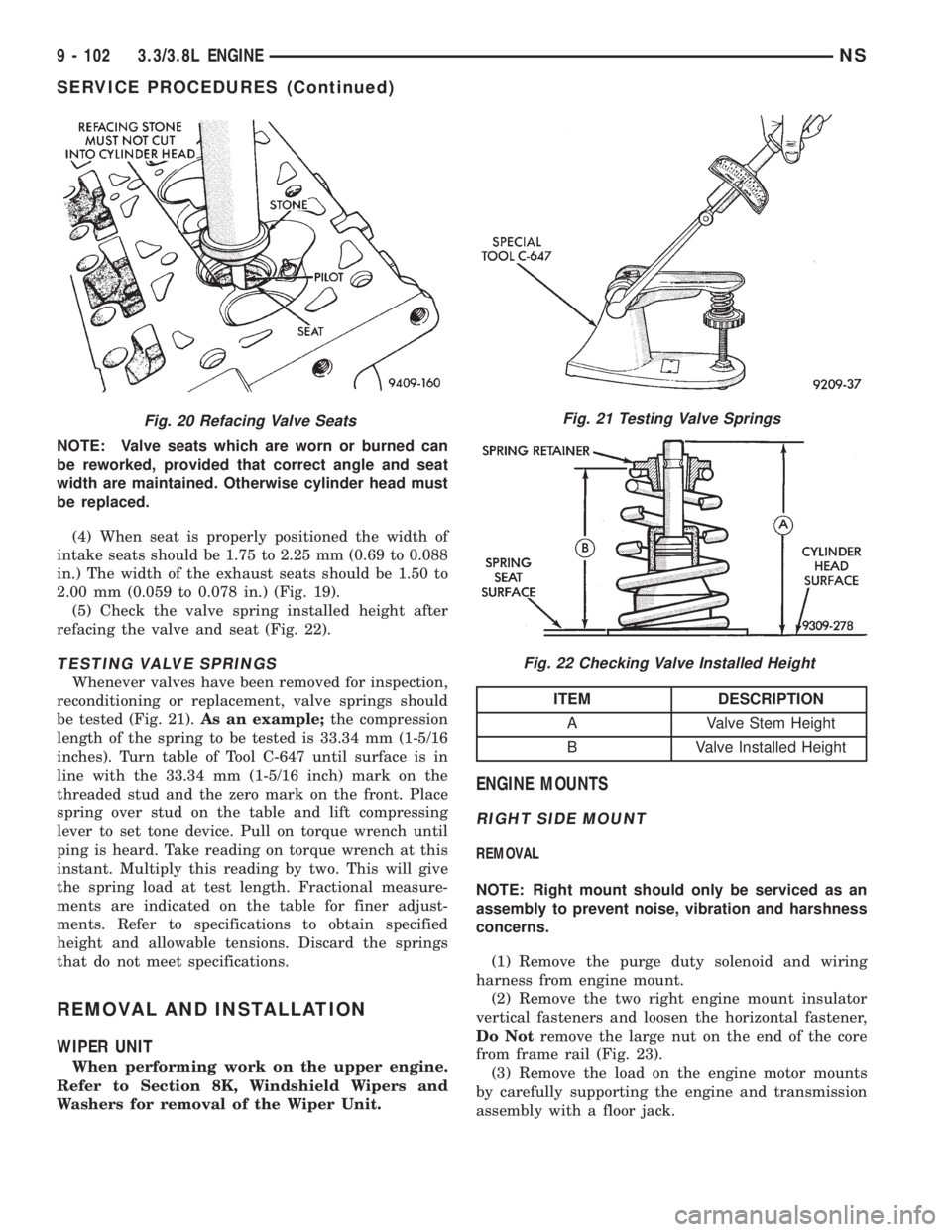
NOTE: Valve seats which are worn or burned can
be reworked, provided that correct angle and seat
width are maintained. Otherwise cylinder head must
be replaced.
(4) When seat is properly positioned the width of
intake seats should be 1.75 to 2.25 mm (0.69 to 0.088
in.) The width of the exhaust seats should be 1.50 to
2.00 mm (0.059 to 0.078 in.) (Fig. 19).
(5) Check the valve spring installed height after
refacing the valve and seat (Fig. 22).
TESTING VALVE SPRINGS
Whenever valves have been removed for inspection,
reconditioning or replacement, valve springs should
be tested (Fig. 21).As an example;the compression
length of the spring to be tested is 33.34 mm (1-5/16
inches). Turn table of Tool C-647 until surface is in
line with the 33.34 mm (1-5/16 inch) mark on the
threaded stud and the zero mark on the front. Place
spring over stud on the table and lift compressing
lever to set tone device. Pull on torque wrench until
ping is heard. Take reading on torque wrench at this
instant. Multiply this reading by two. This will give
the spring load at test length. Fractional measure-
ments are indicated on the table for finer adjust-
ments. Refer to specifications to obtain specified
height and allowable tensions. Discard the springs
that do not meet specifications.
REMOVAL AND INSTALLATION
WIPER UNIT
When performing work on the upper engine.
Refer to Section 8K, Windshield Wipers and
Washers for removal of the Wiper Unit.
ENGINE MOUNTS
RIGHT SIDE MOUNT
REMOVAL
NOTE: Right mount should only be serviced as an
assembly to prevent noise, vibration and harshness
concerns.
(1) Remove the purge duty solenoid and wiring
harness from engine mount.
(2) Remove the two right engine mount insulator
vertical fasteners and loosen the horizontal fastener,
Do Notremove the large nut on the end of the core
from frame rail (Fig. 23).
(3) Remove the load on the engine motor mounts
by carefully supporting the engine and transmission
assembly with a floor jack.
Fig. 20 Refacing Valve SeatsFig. 21 Testing Valve Springs
Fig. 22 Checking Valve Installed Height
ITEM DESCRIPTION
A Valve Stem Height
B Valve Installed Height
9 - 102 3.3/3.8L ENGINENS
SERVICE PROCEDURES (Continued)
Page 1736 of 1938
(16) Clean access urethane from exterior with
MopartSuper Kleen or equivalent.
(17) Apply 150 mm (6 in.) lengths of 50 mm (2 in.)
masking tape spaced 250 mm (10 in.) apart to hold
molding in place until urethane cures.
(18) Engage wire connectors to windshield
defroster grid.
(19) Install A-pillar trim panels.
(20) Install cowl cover and wipers.
(21) Install inside rear view mirror.
(22) After urethane has cured, remove tape strips
and water test windshield to verify repair.
BODY SIDE/SLIDING DOOR STATIONARY GLASS
The temperature of the vehicle should be at least
21É C (70É F) before removing the stationary quarter/
sliding door glass. Butyl sealer becomes more pliable
at high temperatures.
REMOVAL
(1) Remove interior trim as necessary to gain
access attaching locations on back of glass.
(2) Remove nuts holding stationary glass to fence.
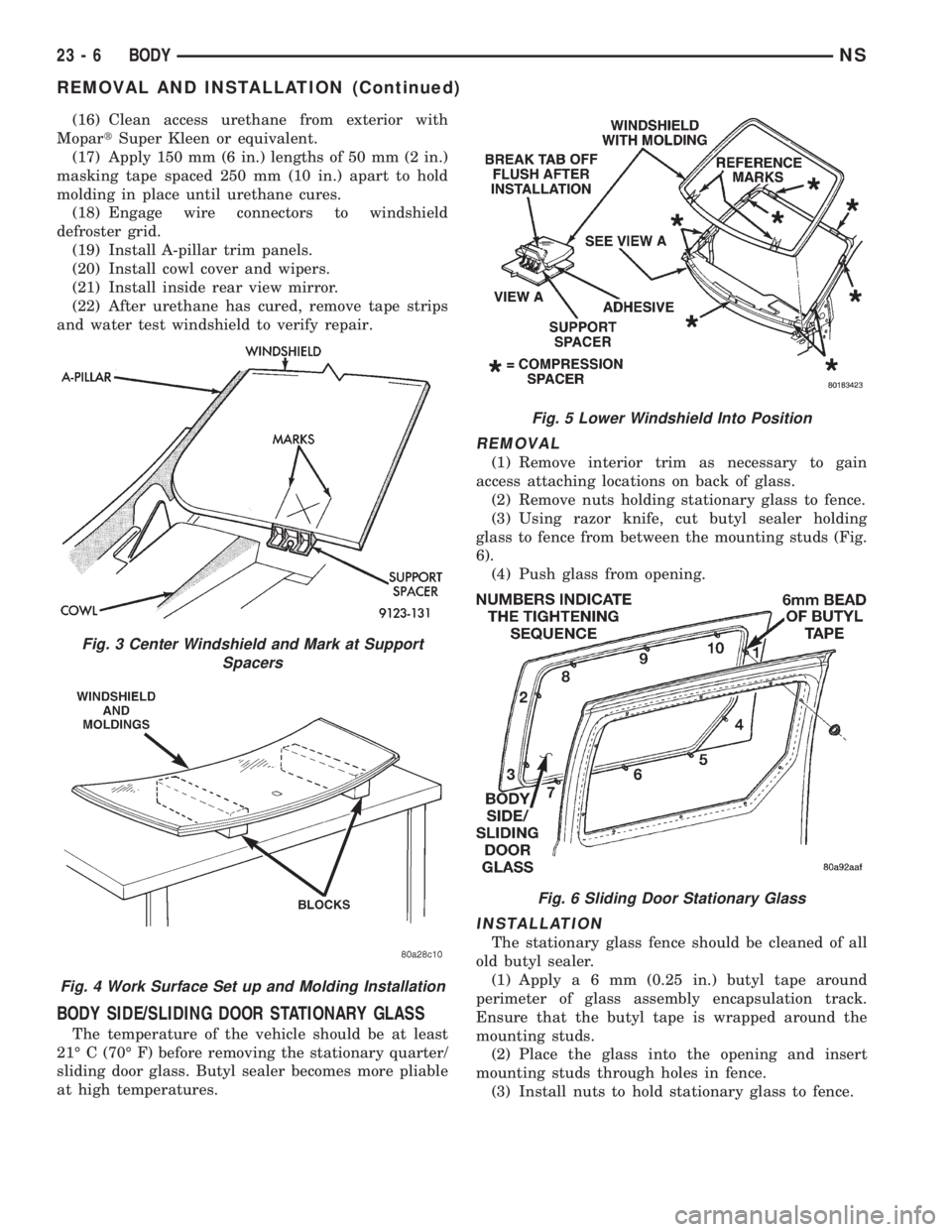
(3) Using razor knife, cut butyl sealer holding
glass to fence from between the mounting studs (Fig.
6).
(4) Push glass from opening.
INSTALLATION
The stationary glass fence should be cleaned of all
old butyl sealer.
(1) Applya6mm(0.25 in.) butyl tape around
perimeter of glass assembly encapsulation track.
Ensure that the butyl tape is wrapped around the
mounting studs.
(2) Place the glass into the opening and insert
mounting studs through holes in fence.
(3) Install nuts to hold stationary glass to fence.
Fig. 3 Center Windshield and Mark at Support
Spacers
Fig. 4 Work Surface Set up and Molding Installation
Fig. 5 Lower Windshield Into Position
Fig. 6 Sliding Door Stationary Glass
23 - 6 BODYNS
REMOVAL AND INSTALLATION (Continued)
Page 1845 of 1938
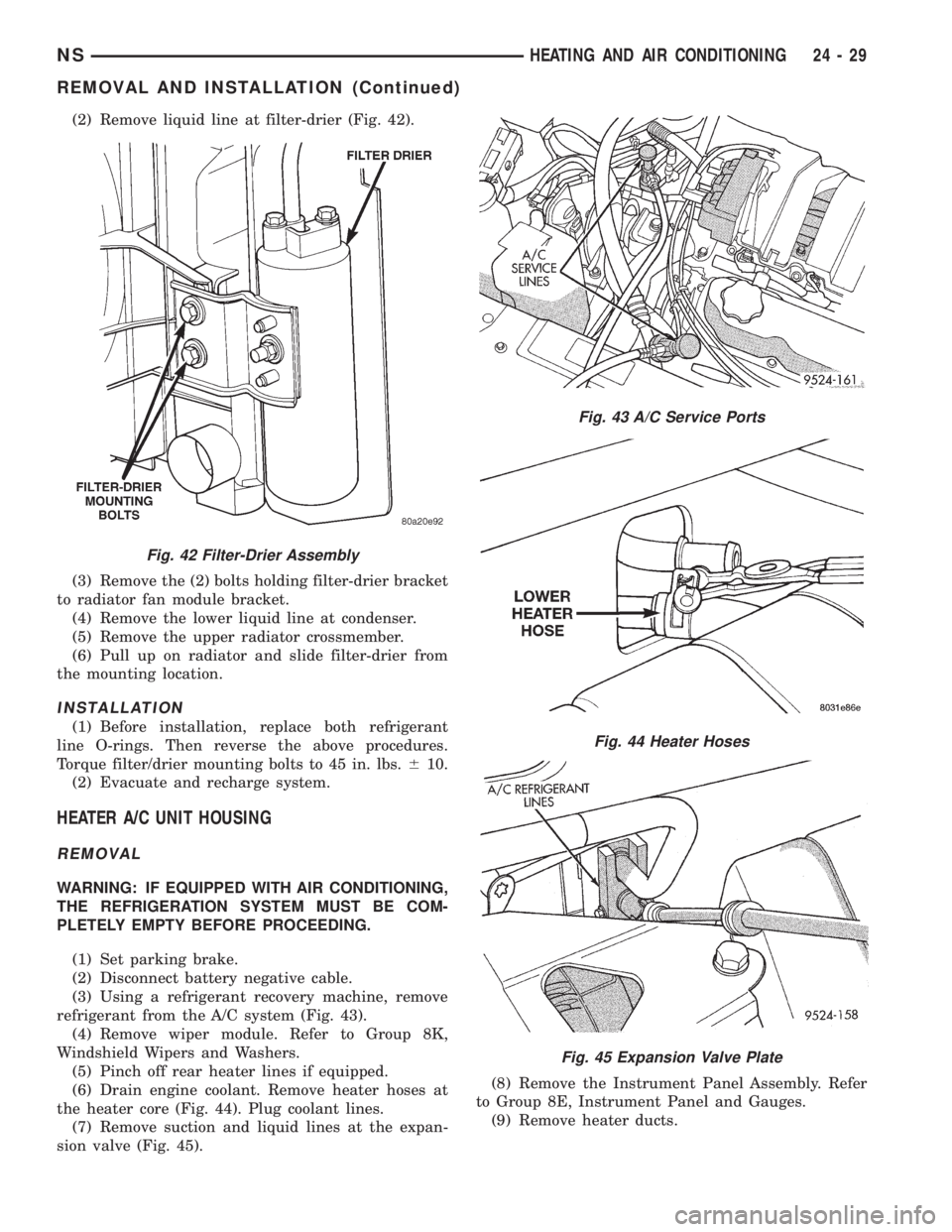
(2) Remove liquid line at filter-drier (Fig. 42).
(3) Remove the (2) bolts holding filter-drier bracket
to radiator fan module bracket.
(4) Remove the lower liquid line at condenser.
(5) Remove the upper radiator crossmember.
(6) Pull up on radiator and slide filter-drier from
the mounting location.
INSTALLATION
(1) Before installation, replace both refrigerant
line O-rings. Then reverse the above procedures.
Torque filter/drier mounting bolts to 45 in. lbs.610.
(2) Evacuate and recharge system.
HEATER A/C UNIT HOUSING
REMOVAL
WARNING: IF EQUIPPED WITH AIR CONDITIONING,
THE REFRIGERATION SYSTEM MUST BE COM-
PLETELY EMPTY BEFORE PROCEEDING.
(1) Set parking brake.
(2) Disconnect battery negative cable.
(3) Using a refrigerant recovery machine, remove
refrigerant from the A/C system (Fig. 43).
(4) Remove wiper module. Refer to Group 8K,
Windshield Wipers and Washers.
(5) Pinch off rear heater lines if equipped.
(6) Drain engine coolant. Remove heater hoses at
the heater core (Fig. 44). Plug coolant lines.
(7) Remove suction and liquid lines at the expan-
sion valve (Fig. 45).(8) Remove the Instrument Panel Assembly. Refer
to Group 8E, Instrument Panel and Gauges.
(9) Remove heater ducts.
Fig. 42 Filter-Drier Assembly
Fig. 43 A/C Service Ports
Fig. 44 Heater Hoses
Fig. 45 Expansion Valve Plate
NSHEATING AND AIR CONDITIONING 24 - 29
REMOVAL AND INSTALLATION (Continued)