Page 108 of 403
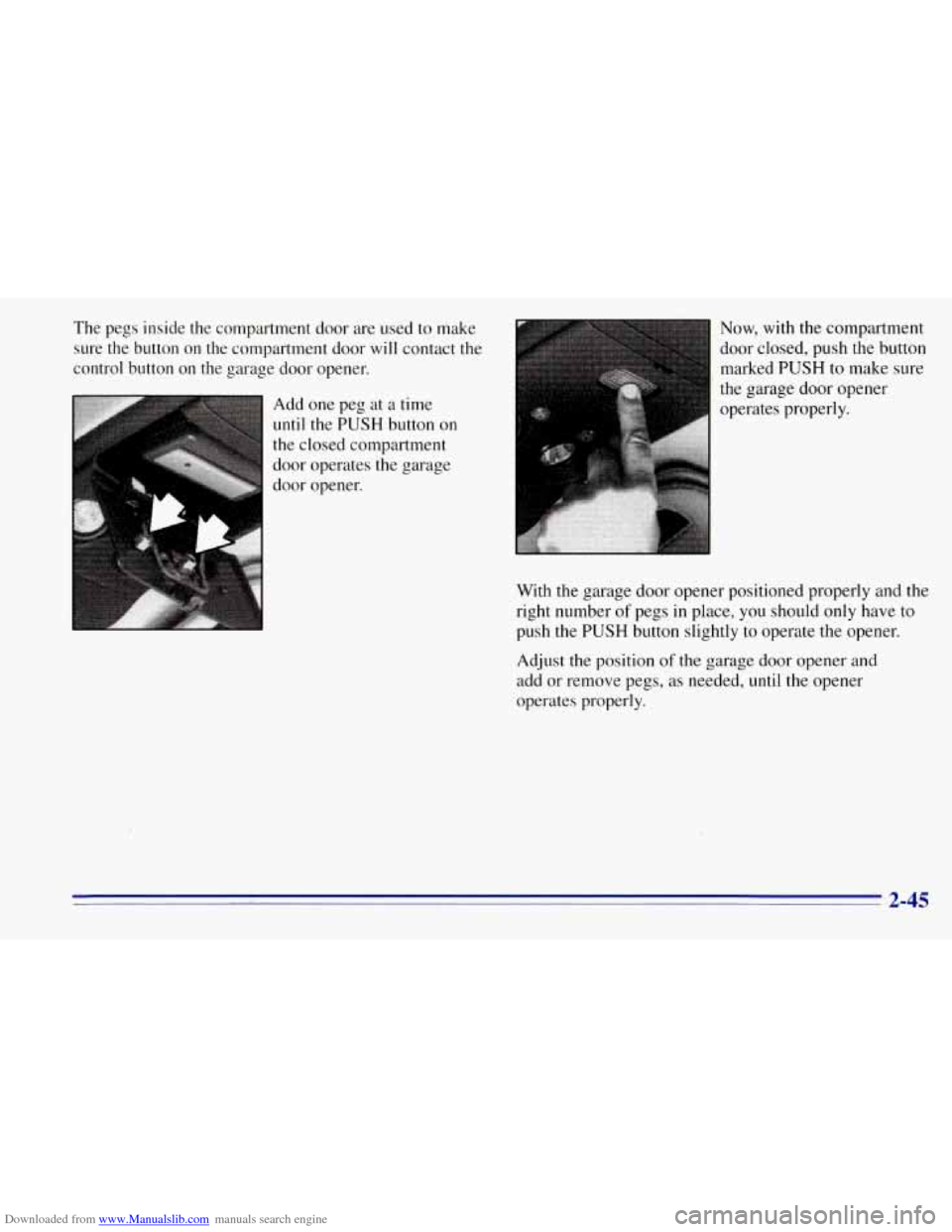
Downloaded from www.Manualslib.com manuals search engine The pegs inside the compartment door are used to make
sure the button on the compartment door will contact the
control button on the garage door opener.
Add one peg at a time
until the PUSH button on
the closed compartment
door operates the garage
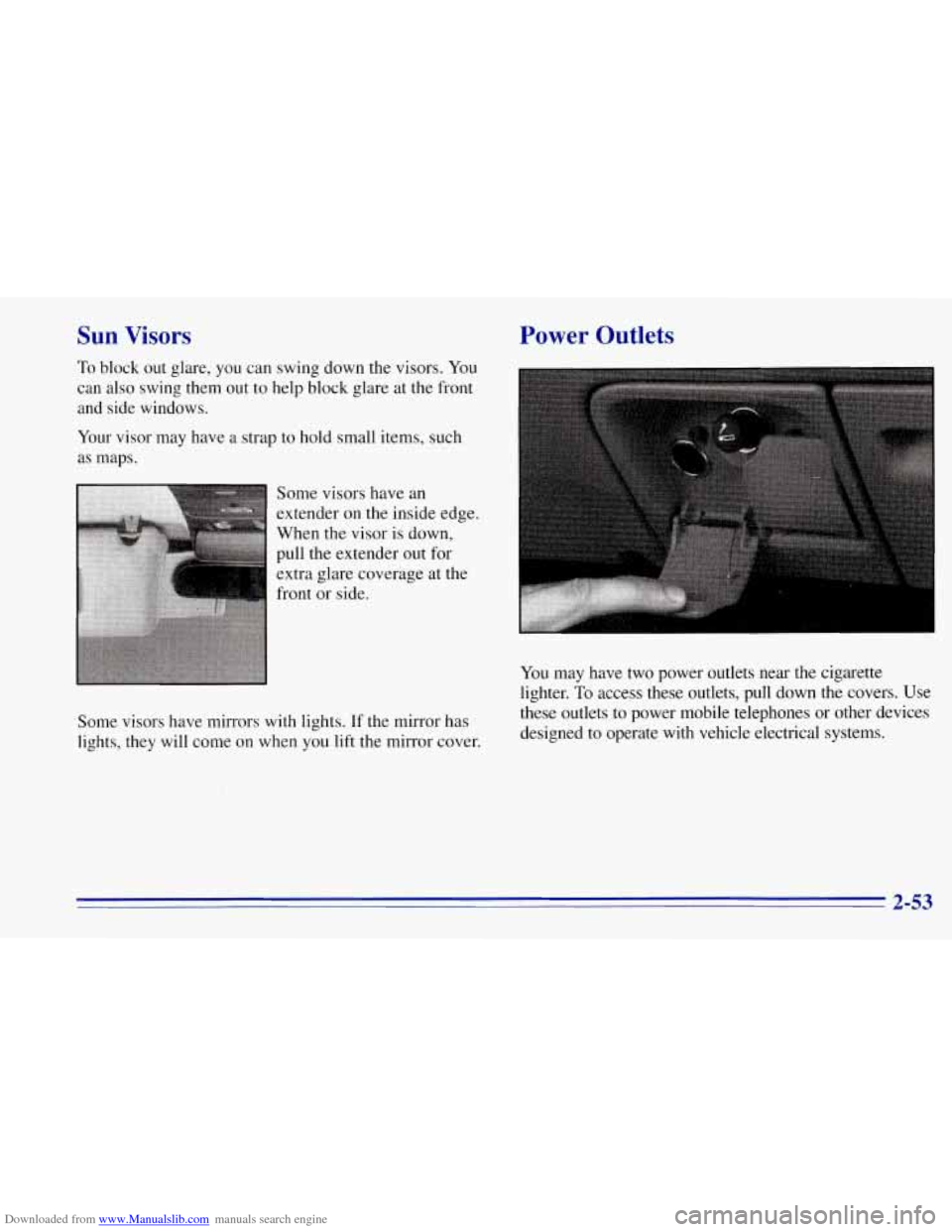
door opener. Now, with
the compartment
door closed, push the button
marked PUSH
to make sure
the garage door opener
operates properly.
With
the garage door opener positioned properly and the
right number
of pegs in place, you should only have to
push the PUSH button slightly
to operate the opener.
Adjust the position
of the garage door opener and
add or remove pegs, as needed, until the opener
operates properly.
2-45
Page 112 of 403
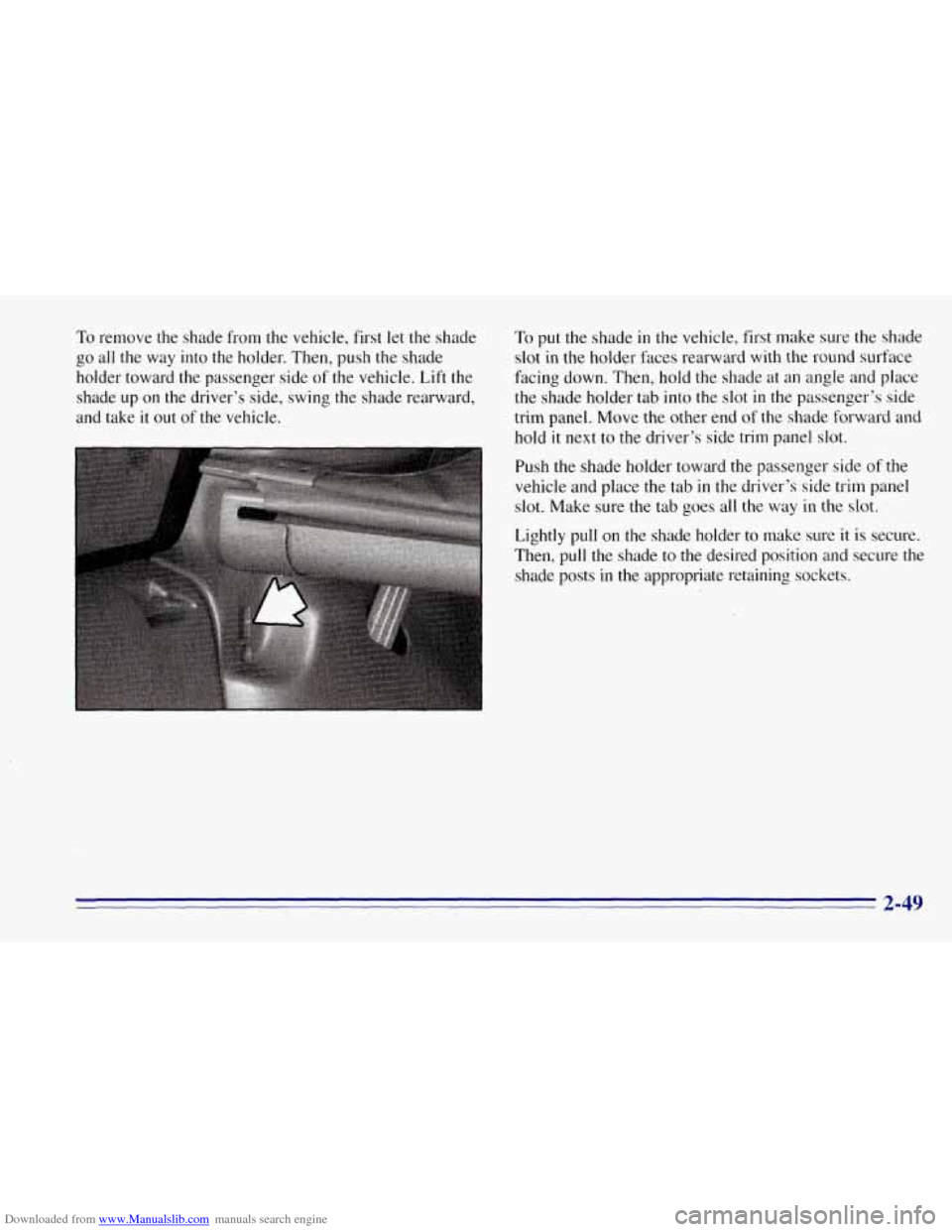
Downloaded from www.Manualslib.com manuals search engine To remove the shade from the vehicle, first let the shade
go all the way into the holder. Then, push the shade
holder toward the passenger side of the vehicle. Lift the To
put the shade in the vehicle, first make sure the shade
slot in the holder faces rearward with the round surface
facing down. Then, hold the shade at
an angle and place
shade up on the driver’s side, swing the shade rearward, the shade holder tab into
the slot in the passenger’s side
and take it out of the vehicle. trim panel. Move the other end
of the shade forward and
hold it next
to the driver’s side trim panel slot.
Push the shade holder toward the passenger side
of the
vehicle and place the tab in the driver’s side trim panel
slot. Make sure the tab goes all the way in
the slot.
Lightly pull on the shade holder to make sure it is secure.
Then, pull the shade
to the desired position and secure the
shade posts in the appropriate retaining sockets.
2-49
Page 115 of 403
Downloaded from www.Manualslib.com manuals search engine Cigarette LightedAshtrays
The front ashtray is located at the bottom of the
instrument panel. Pull on the bottom
of the ashtray door
to open it.
NOTICE:
If you store paper or other things that burn in
your ashtrays, they could be
set on fire by
cigarettes or other smoking materials. That could
cause a fire and possibly damage your ‘vehicle.
Do
not store papers and other things that burn in
your ashtrays.
To use the cigarette lighter, push it in all the way, and let
go. When it’s ready, it will pop back by itself.
NOTICE:
Holding a cigarette lighter in with your hand
while
it is heating can make it overload,
damaging the lighter and the heating element.
Just push the lighter all the
way in and let go.
When it’s done,
it will pop back by itself.
To remove the front ashtray, pull on the front of the
ashtray insert. Then slide the insert out
of the ashtray door.
To use a rear ashtray, if you have them, pull at the top of
the ashtray door
to flip the door open.
To remove a rear ashtray, if you have them, press down
on the inside tabs and open the door fully.
2-52
Page 116 of 403
Downloaded from www.Manualslib.com manuals search engine Sun Visors
To block out glare, you can swing down the visors. You
can also swing them out
to help block glare at the front
and side windows.
Your visor may have a strap to hold small items, such
as maps.
Some visors have an
extender on the inside edge.
When
the visor is down,
pull the extender out for
extra glare coverage at the
front or side.
Some visors have mirrors with lights. If the mirror has
lights, they will come on when you lift the mirror cover.
Power Outlets
You may have two power outlets near the cigarette
lighter.
To access these outlets, pull down the covers. Use
these outlets to power mobile telephones or other devices
designed
to operate with vehicle electrical systems.
2-53
Page 121 of 403
Downloaded from www.Manualslib.com manuals search engine Warning Lights, Gages
and Indicators
This part describes the warning lights and gages tha .t
may be on your vehicle. The pictures will help you
locate them.
Warning lights and gages can signal that something is
wrong before it becomes serious enough to cause an
expensive repair or replacement. Paying attention to
your warning lights and gages could also save
you or
others from injury.
Warning lights come on when there may be or is a
problem with one
of your vehicle’s functions. As you
will see in the details on the next few pages, some
warning lights come on briefly when you start the
engine just to let
you know they’re working. If you are
familiar with this section,
you should not be alarmed
when this happens.
Gages can indicate when there may be or is a problem
with one
of your vehicle’s functions. Often gages and
warning lights work together to let
you know when
there’s a problem with your vehicle. When
one
of the warning lights comes on and stays on
when you are driving, or
when one of the gages shows
there may be a problem, check the section that tells you
what to do about it. Please follow this manual’s advice.
Waiting to do repairs can be costly
-- and even
dangerous.
So please get to know your warning lights
and gages. They’re a big help.
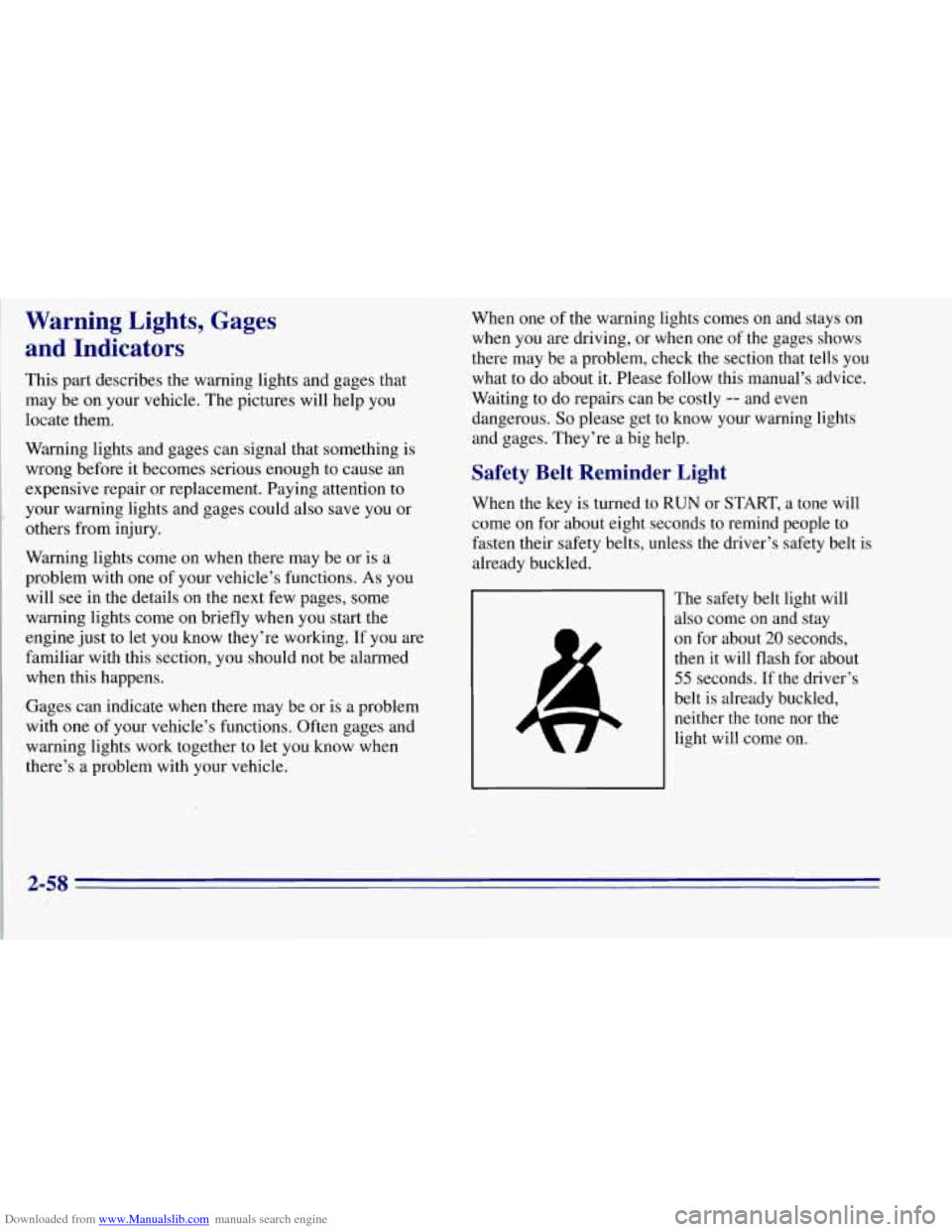
Safety Belt Reminder Light
When the key is turned to RUN or START, a tone will
come on for about eight seconds to remind people to
fasten their safety belts, unless the driver’s safety belt is
already buckled.
I
The safety belt light wilI
also come on and stay
on for about
20 seconds,
then it will flash for about
55 seconds. If the driver’s
belt is already buckled,
neither the tone nor the
light will come on.
2-58
Page 122 of 403
Downloaded from www.Manualslib.com manuals search engine Air Bag Readiness Light
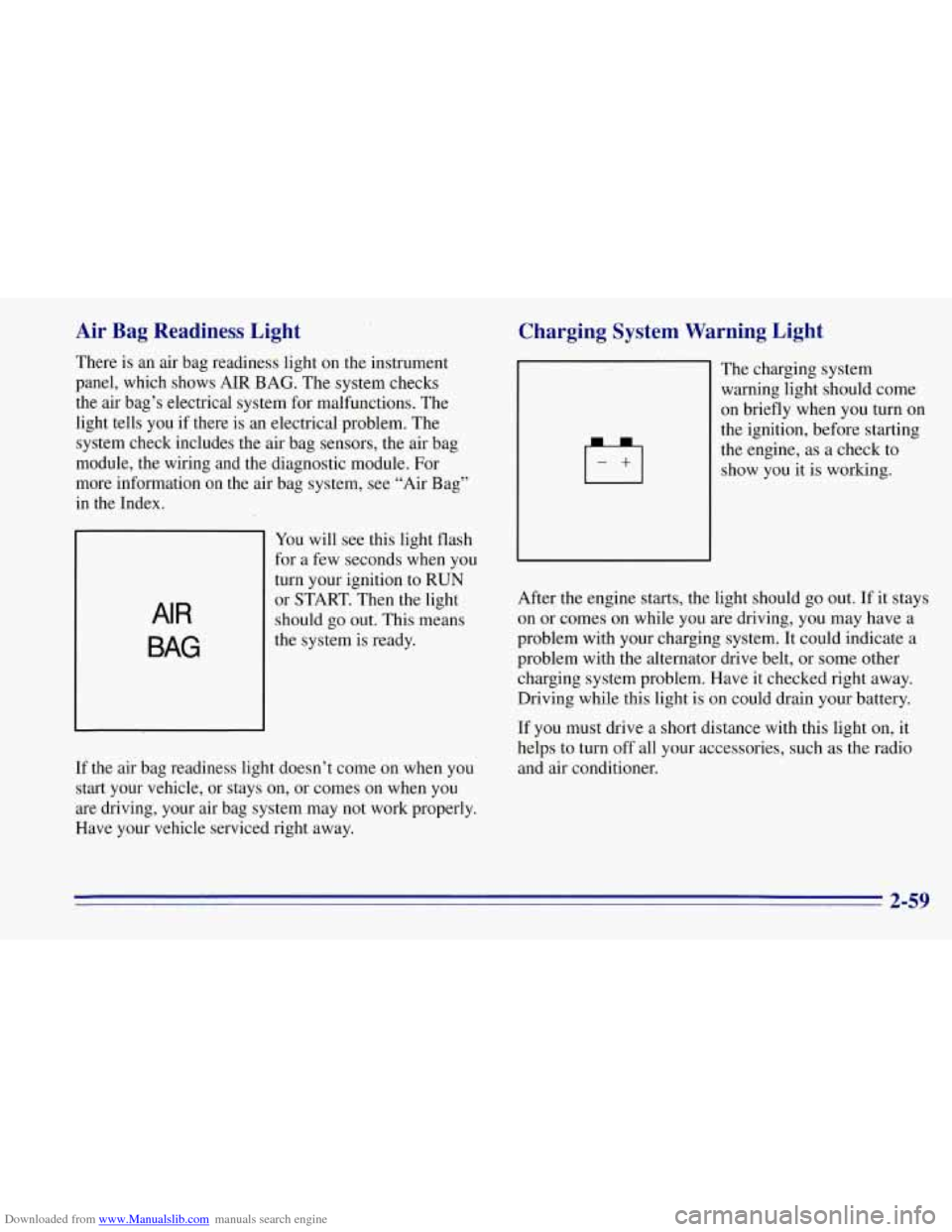
There is an air bag readiness light on the instrument
panel, which shows AIR BAG. The system checks
the air bag’s electrical system for malfunctions. The
light tells you if there is an electrical problem. The
system check includes the air bag sensors, the air bag
module, the wiring and the diagnostic module. For
more information on the air bag system, see “Air Bag”
in the Index.
AIR
BAG
You will see this light flash
for a few seconds when you
turn your ignition to
RUN
or START. Then the light
should
go out. This means
the system is ready.
If the air bag readiness light doesn’t come on when you
start your vehicle, or stays on, or comes on when you
are driving, your air bag system may not work properly.
Have your vehicle serviced right away.
Charging System Warning Light
I-+I
The charging system
warning light should come
on briefly when you turn on
the ignition, before starting
the engine, as a check to
show you it is working.
After the engine starts, the light should
go out. If it stays
on or comes on while you are driving, you may have a
problem with your charging system. It could indicate a
problem with the alternator drive belt, or some other
charging system problem. Have it checked right away.
Driving while this light is on could drain your battery.
If you must drive a short distance with this light
on, it
helps to turn off all your accessories, such as the radio
and air conditioner.
2-59
Page 124 of 403
Downloaded from www.Manualslib.com manuals search engine Brake System Warning Light
Your vehicle’s hydraulic brake system is divided into
two parts. If one part isn’t working, the other part can
still work and stop you. For good braking, though, you
need both parts working well.
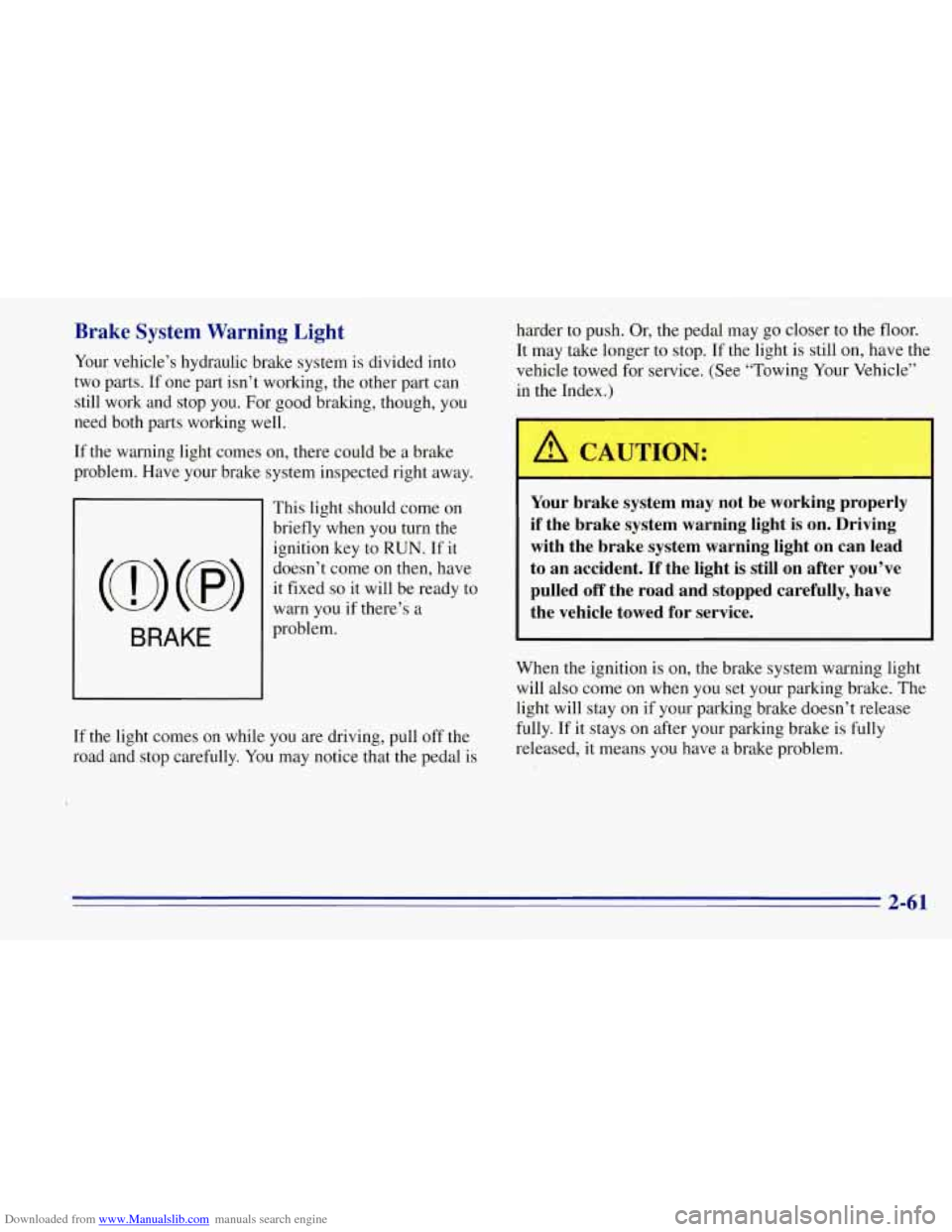
If the warning light comes on, there could be a brake
problem. Have your brake system inspected right away.
BRAKE
This light should come on
briefly when you turn the
ignition key to
RUN. If it
doesn’t come on then, have
it fixed
so it will be ready to
warn you if there’s a
problem.
If the light comes on while you are driving, pull off the
road and stop carefully. You may notice that the pedal
is
harder to push. Or, the pedal may go closer to the floor.
It may take longer to stop. If the light is still on, have the
vehicle towed for service. (See “Towing Your Vehicle”
in the Index.)
A CAUTION:
Your brake system may not be working properly
if the brake system warning light is on. Driving
with the brake system warning light
on can lead
to an accident. If the light is still on after you’ve
pulled off the road and stopped carefully, have
the vehicle towed for service.
When the ignition is on, the brake system warning light
will also come on when you set your parking brake. The
light will stay on if your parking brake doesn’t release
fully. If it stays on after your parking brake is fully
released, it means
you have a brake problem.
2-61
Page 125 of 403
Downloaded from www.Manualslib.com manuals search engine Anti-Lock Brake System Warning Light
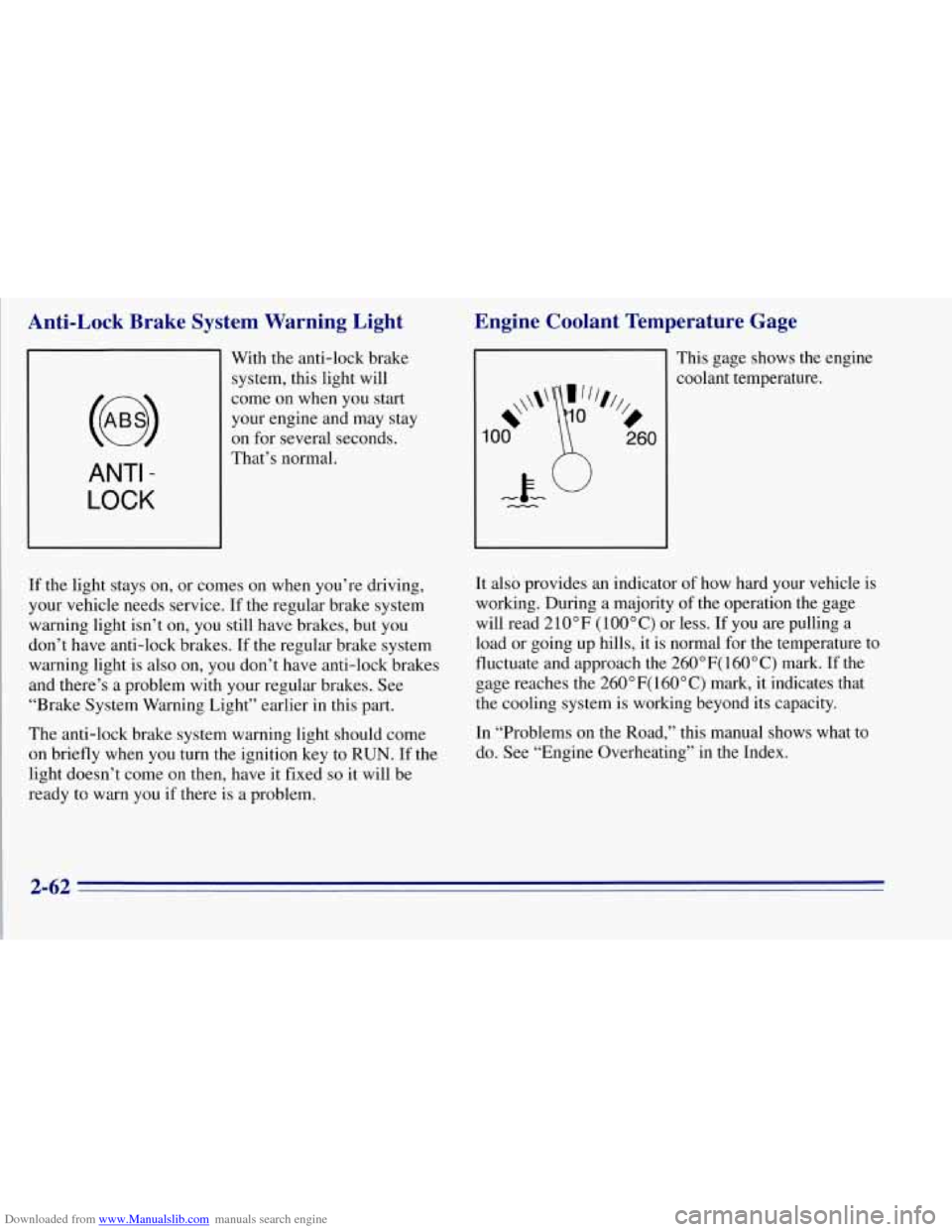
ANTI -
LOCK
With the anti-lock brake
system, this light will
come on when you start
your engine and may stay
on for several seconds.
That’s normal.
If the light stays on, or comes on when you’re driving,
your vehicle needs service. If the regular brake system
warning light isn’t
on, you still have brakes, but you
don’t have anti-lock brakes. If the regular brake system
warning light is also on, you don’t have anti-lock brakes
and there’s a problem with your regular brakes. See
“Brake System Warning Light” earlier in this part.
The anti-lock brake system warning light should come
on briefly when you turn the ignition key to RUN. If the
light doesn’t come
on then, have it fixed so it will be
ready to warn
you if there is a problem.
Engine Coolant Temperature Gage
This gage shows the engine
coolant temperature.
It also provides an indicator of how hard your vehicle is
working. During a majority of the operation the gage
will read 2
10 OF ( 100 ” C) or less. If you are pulling a
load or going up hills, it is normal for the temperature to
fluctuate and approach the 260”F( 160°C) mark. If the
gage. reaches the 260”F( 160°C) mark, it indicates that
the cooling system is working beyond its capacity.
In “Problems on the Road,” this manual shows what to
do. See “Engine Overheating” in the Index.
2-62