Page 202 of 386
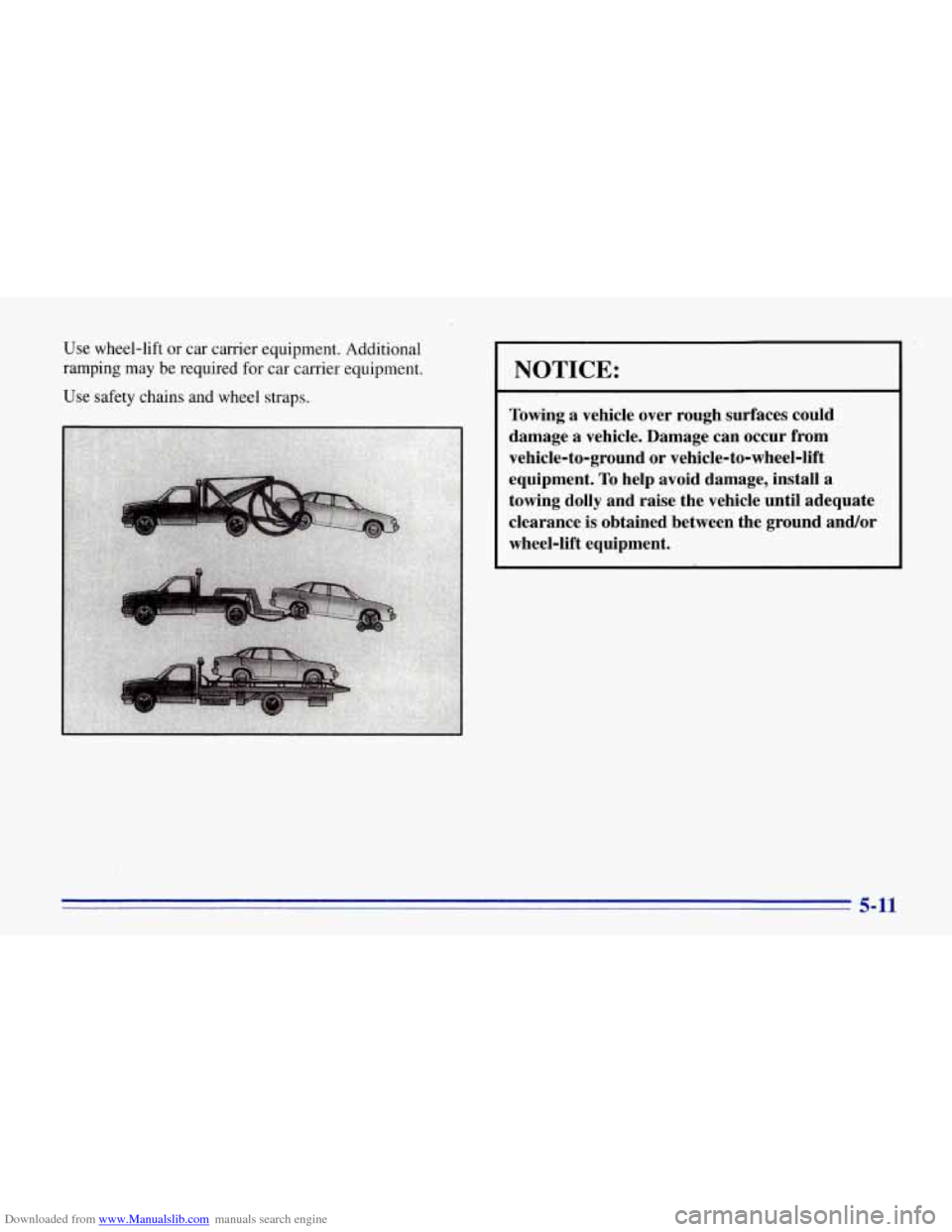
Downloaded from www.Manualslib.com manuals search engine Use wheel-lift or car carrier equipment. Additional
ramping may be required
for car carrier equipment.
Use safety chains and wheel straps.
NOTICE:
Towing a vehicle over rough surfaces could
damage a vehicle. Damage can occur from
vehicle-to-ground or vehicle-to-wheel-lift
equipment.
To help avoid damage, install a
towing dolly and raise the vehicle until adequate
clearance is obtained between- the ground and/or
wheel-lift equipment.
5-11
Page 203 of 386
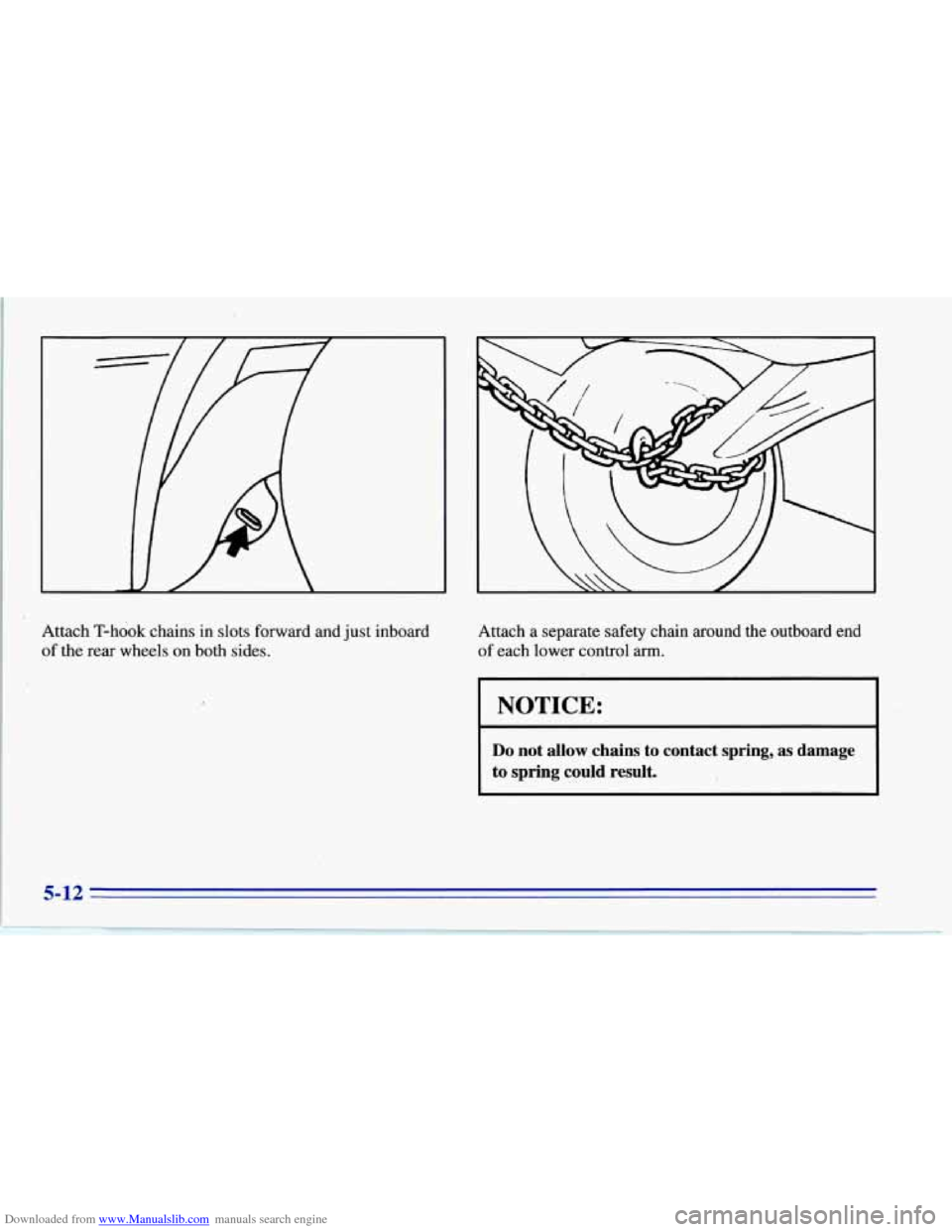
Downloaded from www.Manualslib.com manuals search engine Attach T-hook chains in slots forward and just inboard
of the rear wheels
on both sides. Attach a
separate safety chain around the outboard end of each lower control arm.
I NOTICE: I
I
~ ~~
Do not allow chains to contact spring, as damage
to spring could result.
Page 213 of 386
Downloaded from www.Manualslib.com manuals search engine If a Tire Goes Flat
It’s unusual for a tire to “blow out’’ while you’re driving,
especially if you maintain your tires properly. If air goes
out of a tire, it’s much more likely to leak out slowly.
But if you should ever have a “blowout,” here are a few
tips about what to expect and what to do:
If a front tire fails, the flat tire will create a drag that
pulls the vehicle toward that side. Take your foot
off
the accelerator pedal and grip the steering wheel firmly.
Steer to maintain lane position, and then gently brake
to
a stop well out of the traffic lane.
A rear blowout, particularly on a curve, acts much like a
skid and may require the same correction you’d use in a
skid. In any rear blowout, remove your foot from the
accelerator pedal. Get
the vehicle under control by
steering the way you want the vehicle to go. It may be
very bumpy and noisy, but you can still steer. Gently
brake to a stop
-- well off the road if possible.
If
a tire goes flat, the next part shows how to use your
jacking equipment to change a flat tire safely. If your
vehicle has Extended Mobility Tires (tires with
“EMT”
molded on the sidewalls), see “Extended Mobility Tires”
in the Index.
.Changing a Flat Tire
If a tire goes flat, avoid further tire and wheel damage
by driving slowly to a level place. Turn on your hazard
warning flashers.
A CAUTION:
3
Changing a tire can cause an injury. The vehicle
can slip off the jack and roll over you or other
people. You and they could be badly injured.
Find
a level place to change your tire. To help
prevent the vehicle from moving:
1. Set the parking brake firmly.
2. Put an automatic transmission shift lever in
PARK (P), or shift a manual transmission
to
FIRST (1) or REVERSE (R).
3. lbrn off the engine.
To
be even more certain the vehicle won’t move,
you can put blocks at the front and rear of the
tire farthest away from the one being changed.
That would be the tire on the other side of the
vehicle, at the opposite end.
Page 214 of 386
Downloaded from www.Manualslib.com manuals search engine The following steps will tell you how to use the jack and
change
a tire.
Removing the Spare Tire and Tools
Note that if you've chosen the spare tire delete option,
your vehicle is not equipped with
a jack or wheel
wrench, but does have a wheel lock key and wheel
nut socket.
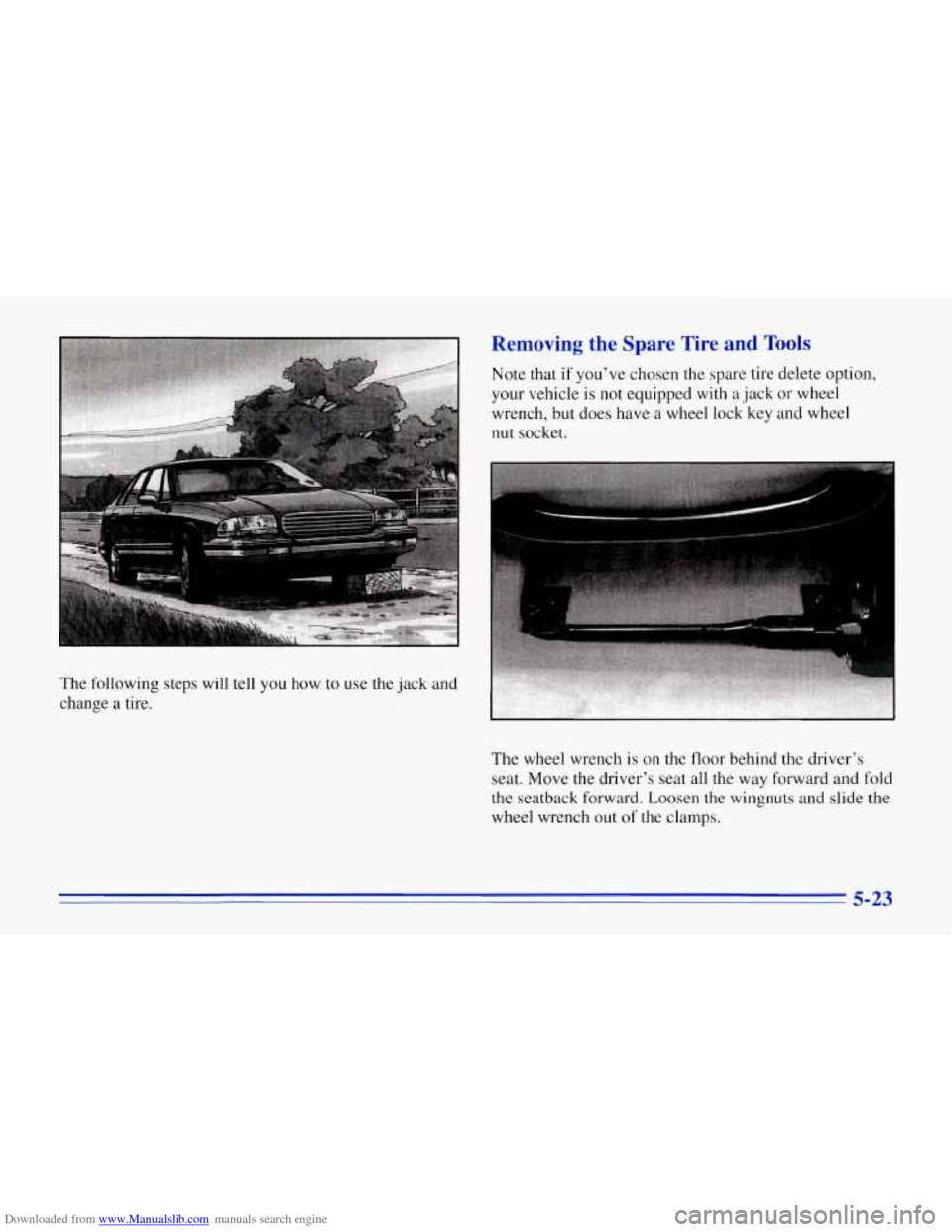
The wheel wrench is on the
floor behind the driver's
seat. Move the driver's
seat all the way forward and fold
the seatback forward. Loosen the wingnuts and slide the
wheel wrench out
of the clamps.
5-23
Page 215 of 386
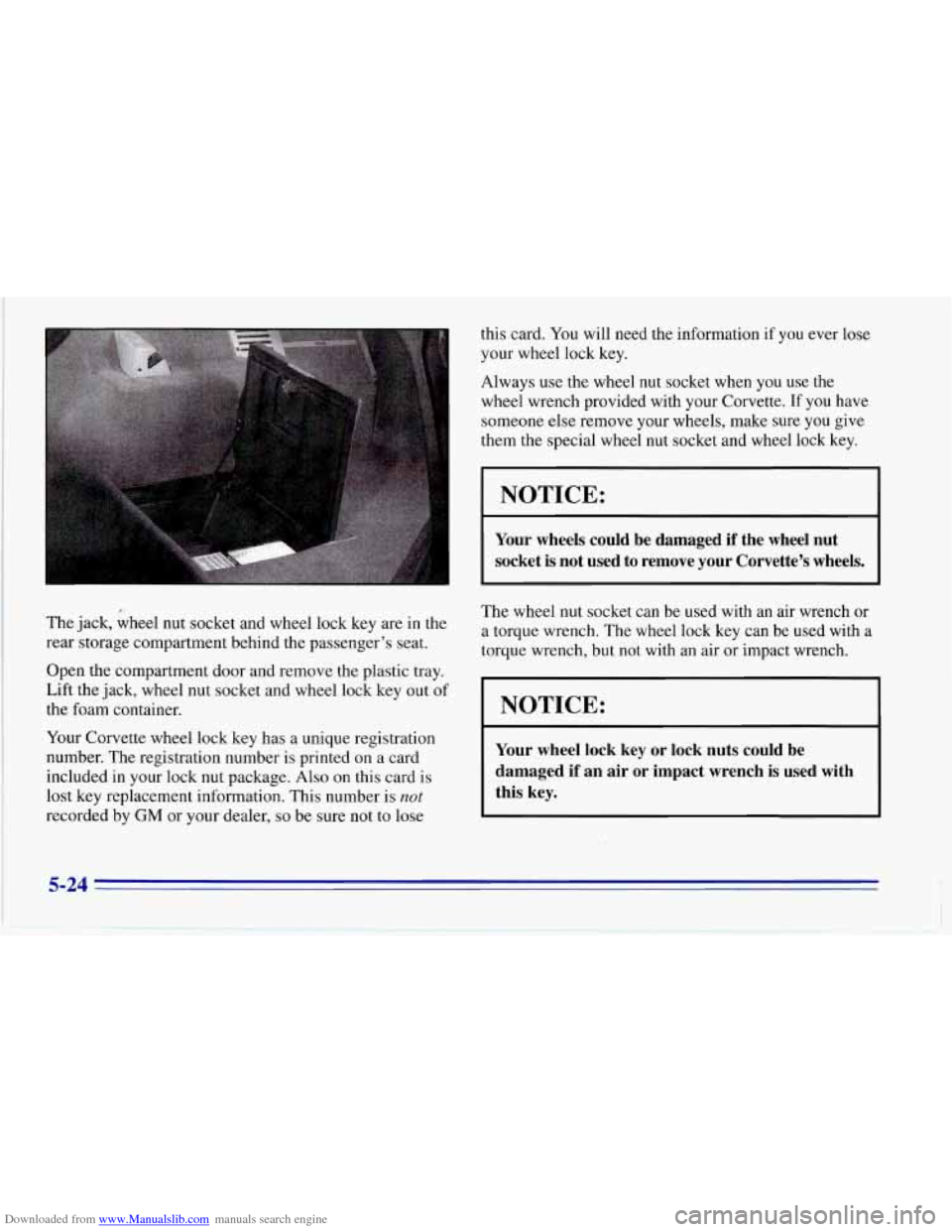
Downloaded from www.Manualslib.com manuals search engine The jack, wheel nut socket and wheel lock key are in the
rear storage compartment behind the passenger’s seat.
Open the compartment door and remove the plastic tray.
Lift the jack, wheel nut socket and wheel lock key out of
the foam container.
Your Corvette wheel lock key has a unique registration
number. The registration number is printed on a card
included in your lock nut package.
Also on this card is
lost key replacement information. This number is
not
recorded by GM or your dealer, so be sure not to lose this card.
You will need the information if you ever lose
your wheel lock key.
Always use the wheel nut socket when you use the
wheel wrench provided with your Corvette.
If you have
someone else remove your wheels, make sure you give
them the special wheel nut socket and wheel lock key.
NOTICE:
Your wheels could be damaged if the wheel nut
socket is not used to remove your Corvette’s wheels.
The wheel nut socket can be used with an air wrench or
a torque wrench. The wheel lock key can be used with a
torque wrench, but not with an air or impact wrench.
I NOTICE:
I
~~
Your wheel lock key or lock nuts could be
damaged if an air
or impact wrench is used with
this key.
5-24
Page 216 of 386
Downloaded from www.Manualslib.com manuals search engine t
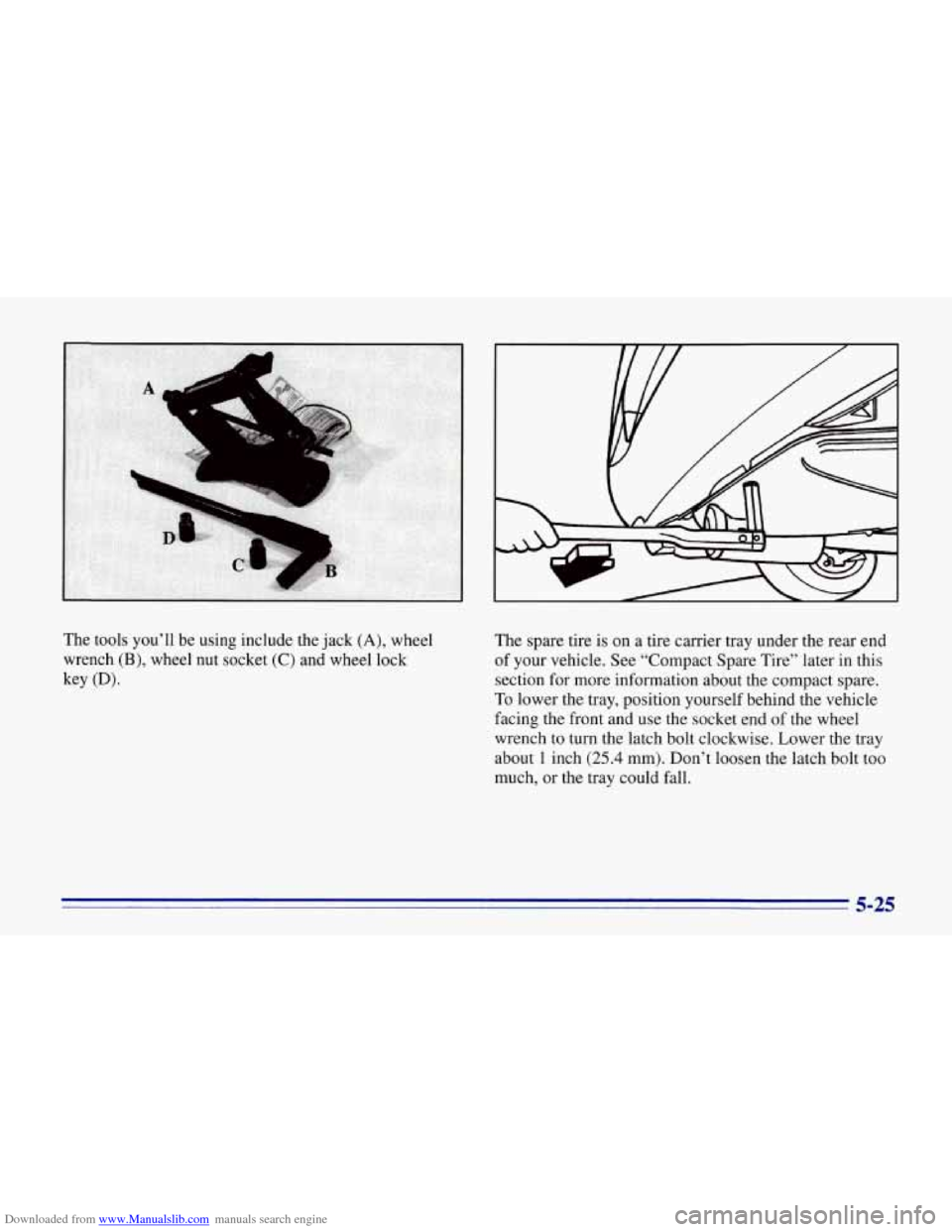
The tools you’ll be using include the jack (A), wheel
wrench
(B), wheel nut socket (C) and wheel lock
key
(Dl.
The spare tire is on a tire carrier tray under the rear end
of your vehicle. See “Compact Spare Tire” later in this
section for more information about the compact spare.
To lower the tray, position yourself behind the vehicle
facing the front and use the socket end
of the wheel
wrench to turn the latch bolt clockwise. Lower the tray
about
1 inch (25.4 mm). Don’t loosen the latch bolt too
much,
or the tray could fall.
5-25
Page 217 of 386
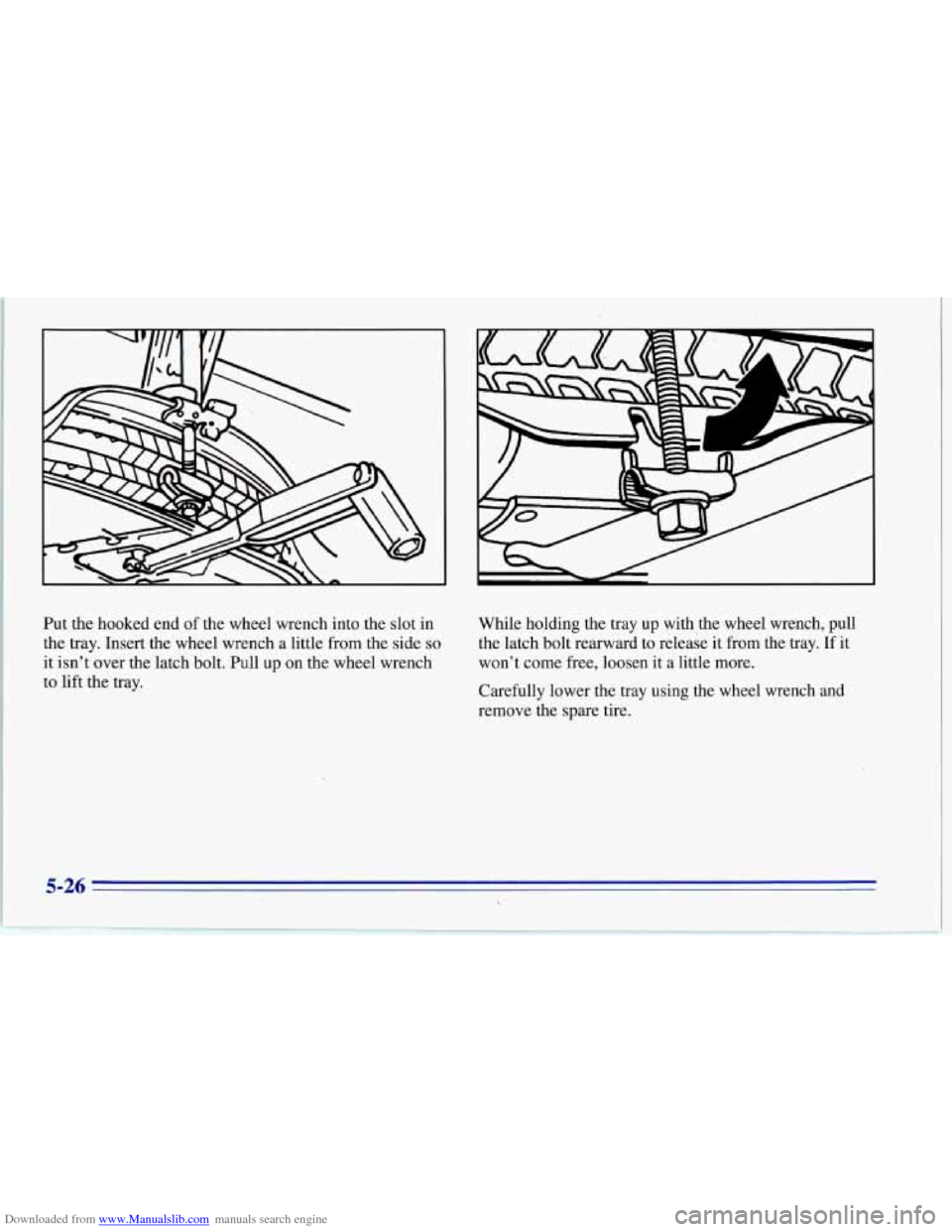
Downloaded from www.Manualslib.com manuals search engine Put the hooked end of the wheel wrench into the slot in
the tray. Insert the wheel wrench a little from the side
so
it isn’t over the latch bolt. Pull up on the wheel wrench
to lift the tray. While holding the tray
up with the wheel wrench, pull
the latch bolt rearward to release it from the tray. If it
won’t come free, loosen it a little more.
Carefully lower the tray using the wheel wrench and
remove the spare tire.
5-26
Page 218 of 386
Downloaded from www.Manualslib.com manuals search engine Removing the Flat Tire and Installing the
Spare Tire
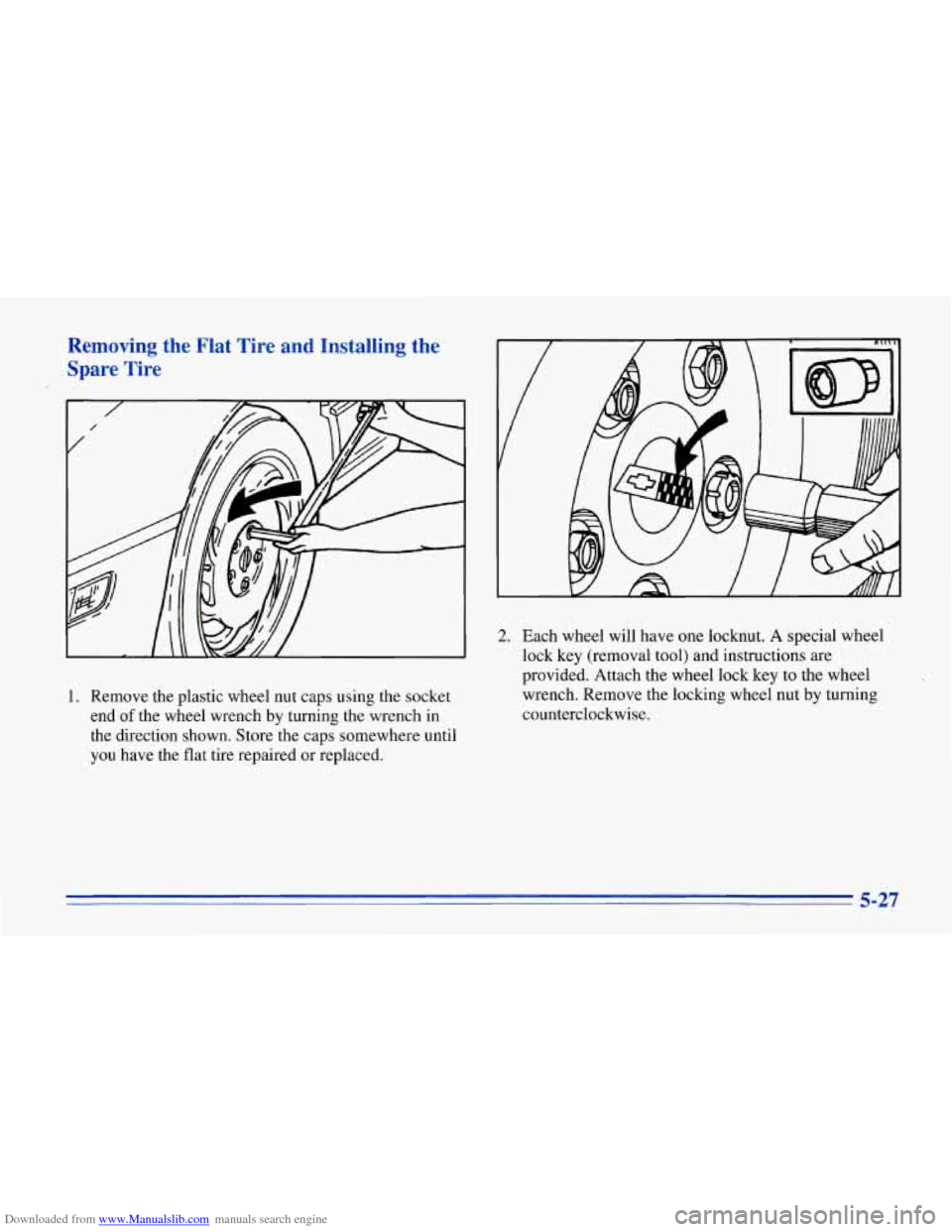
1. Remove the plastic wheel nut caps using the socket
end
of the wheel wrench by turning the wrench in
the direction shown. Store the caps somewhere until
you have the flat tire repaired or replaced.
2. Each wheel will have one locknut. A special wheel
lock key (removal tool)
and instructions are
provided. Attach the wheel lock key to the wheel
wrench. Remove the locking wheel nut by turning
counterclockwise.
5-27