Page 64 of 386
Downloaded from www.Manualslib.com manuals search engine Automatic Transmission Operation
a
R
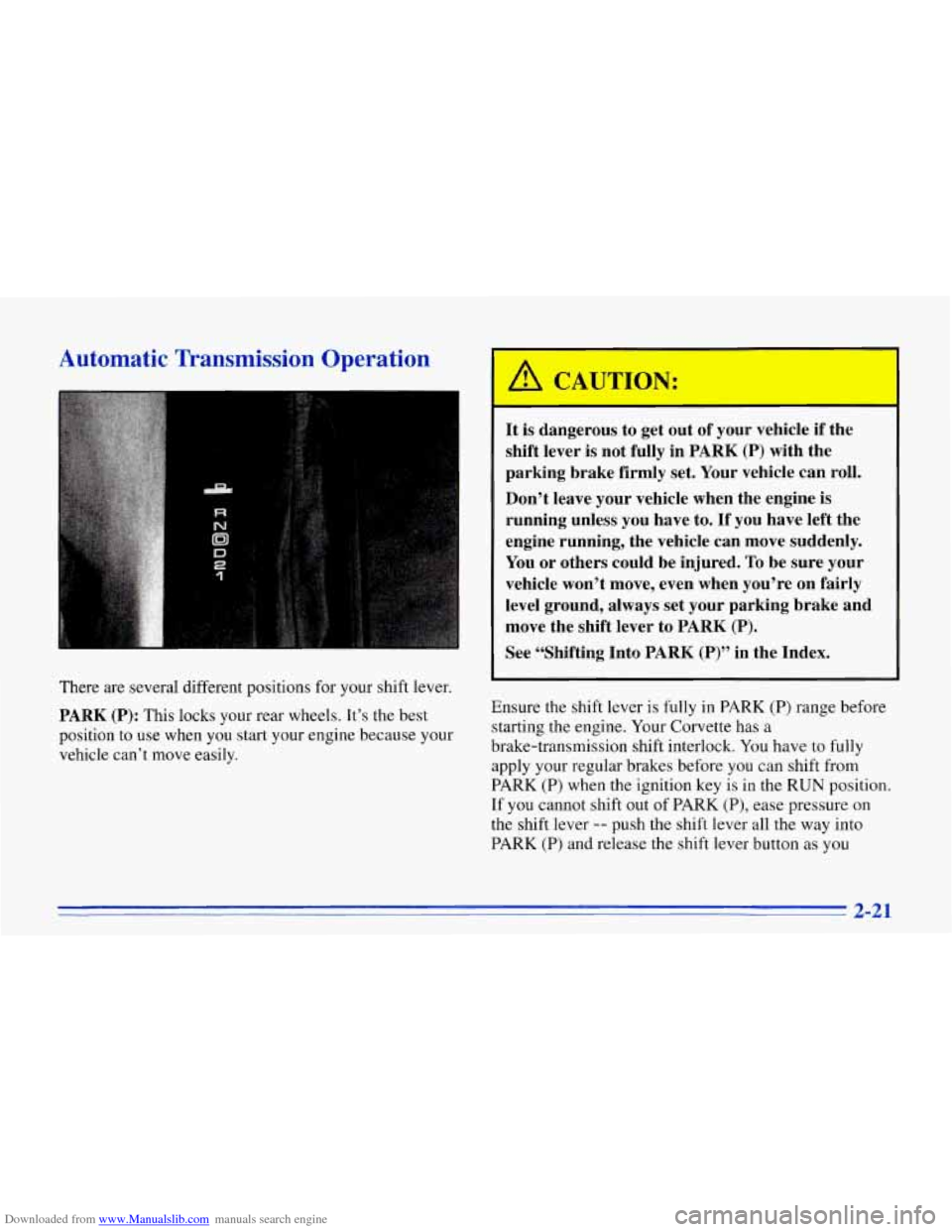
There are several different positions for your shift lever.
PARK (P): This locks your rear wheels. It’s the best
position to use when you start your engine because your
vehicle can’t move easily.
It is dangerous to get out of your vehicle if the
shift lever is not fully in
PARK (P) with the
parking brake firmly set. Your vehicle can roll.
Don’t leave your vehicle when the engine is
running unless you have to.
If you have left the
engine running, the vehicle can move suddenly.
You
or others could be injured. To be sure your
vehicle won’t move, even when you’re on fairly
level ground, always set your parking brake and
move the shift lever to
PARK (P).
See “Shifting Into PARK (P)” in the Index.
Ensure the shift lever is fully in PARK (P) range before
starting the engine. Your Corvette has
a
brake-transmission shift interlock. You have to fully
apply your regular brakes before you can shift from
PARK (P) when the ignition key is in the RUN position.
If you cannot shift out of PARK (P), ease pressure on
the shift lever -- push the shift lever all the way into
PARK (P) and release the shift lever button as you
2-21
Page 65 of 386
Downloaded from www.Manualslib.com manuals search engine maintain brake application. Then press the shift lever
button and move the shift lever into the gear you wish.
See “Shifting Out
of PARK (P)” in the Index.
REVERSE (R): Use this gear to back up.
NOTICE:
Shifting to REVERSE (R) while your vehicle is
moving forward could damage your
transmission. Shift to REVERSE (R) only after
your vehicle
is stopped.
To rock your vehicle back and forth to get out of snow,
ice or sand without damaging your transmission, see
“Stuck:
In Sand, Mud, Ice or Snow” in the Index.
NEUTRAL (N): In this position, your engine doesn’t
connect with the wheels.
To restart when you’re already
moving, use NEUTRAL
(N) only. Also, use
NEUTRAL (N) when your vehicle is being towed.
Shifting out’of PARK (P) or NEUTRAL (N) while
your engine
is “racing” (running at high speed) is
dangerous. Unless your foot is firmly on the
brake pedal, your vehicle could move very
rapidly. You could lose control and hit people or
objects. Don’t shift out of PARK
(P) or
NEUTRAL
(N) while your engine is racing.
I NOTICE:
I
~~~ ~
Damage to your transmission caused by shifting
out of PARK
(P) or NEUTRAL (N) with the
engine racing isn’t covered
by your warranty.
Page 66 of 386
Downloaded from www.Manualslib.com manuals search engine AUTOMATIC OVERDRIVE (0): This position is for
normal driving.
If you need more power for passing, and
you’re:
Going less than about 35 mph (56 km/h), push your
accelerator pedal about halfway down.
Going about 35 mph (56 km/h) or more, push the
accelerator all the way down.
You’ll shift down to the next gear and have more power.
DRIVE (D): This position is also used for normal
driving, however, it offers more power and lower fuel
economy than AUTOMATIC OVERDRIVE
(0).
Here are some times you might choose DRIVE (D)
instead
of AUTOMATIC OVERDRIVE (0):
0 When driving on hilly, winding roads
When going down a steep hill
SECOND (2): This position gives you more power but
lower fuel economy. You can use SECOND
(2) on hills.
It can help control your speed as you go down steep
mountain roads, but then you would also want to use
your brakes off and on.
FIRST (1): This position gives you even more power
(but lower fuel economy) than SECOND
(2). You can
use it on very steep hills, or in deep snow or mud. If the
selector lever is put in
FIRST (I), the transmission
won’t shift into first gear until the vehicle is going
slowly enough.
I NOTICE:
If your rear wheels can’t rotate, don’t try to
drive. This might happen
if you were stuck in
very deep sand or mud or were up against a solid
object.
You could damage your transmission.
Also, if you stop when going uphill, don’t hold
your vehicle there with only the accelerator
pedal. This could overheat and damage the
transmission. Use your brakes or shift into
PARK (P) to hold your vehicle in position
on a hill.
Maximum engine speed is limited to protect driveline
components from improper operation.
2-23
Page 71 of 386
Downloaded from www.Manualslib.com manuals search engine TOUR: Use for city and highway driving. Provides a
smooth, soft ride. Parking Brake
SPORE Use where road conditions or personal
preference demand more control. Provides more “feel,”
or response to the road conditions.
PERF’: Use for performance driving. Provides a tight,
firm ride and precise response to road conditions.
You can select a setting at any time. Based on road
conditions and your vehicle speed, the system
automatically adjusts to provide the best ride and
handling. Select a new setting whenever driving
conditions change.
The SERVICE RIDE CONTROL light monitors the
system. Refer to “Service Ride Control Light” in
the Index.
Limited-Slip Rear Axle
Your rear axle can give you additional traction on snow,
mud, ice, sand
or gravel. It works like a standard axle
most
of the time, but when one of the rear wheels has no
traction and the other does, the limited-slip feature will
allow the wheel with traction to move the vehicle. To
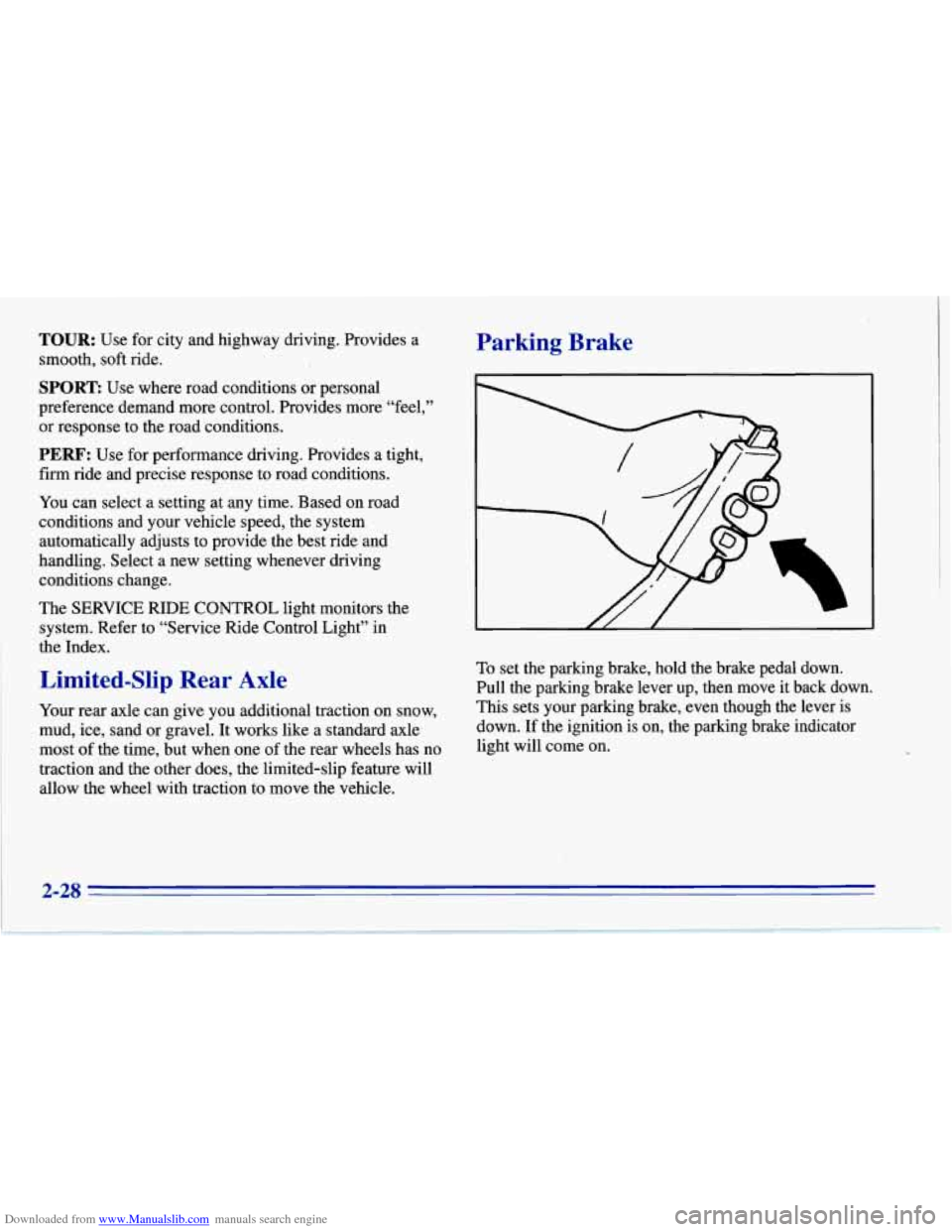
set the parking brake, hold the brake pedal down.
Pull the parking brake lever up, then move it back down.
This sets your parking brake, even though the lever is
down. If the ignition is on, the parking brake indicator
light will come on.
2-28
Page 77 of 386
Downloaded from www.Manualslib.com manuals search engine Windows
Power Windows
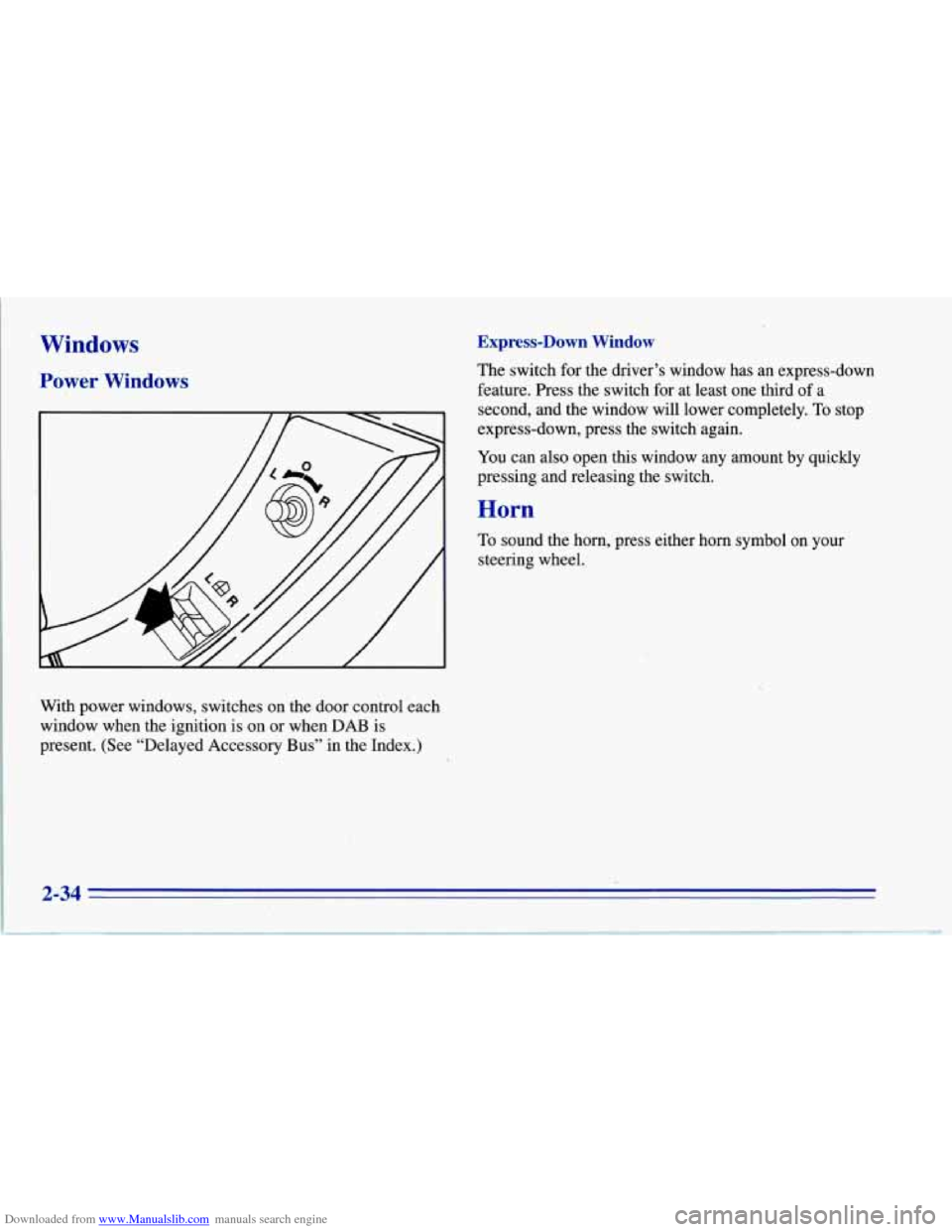
With power windows, switches on the door control each
window when the ignition is on or when DAB is
present. (See “Delayed Accessory
Bus” in the Index.)
Express-Down Window
The switch for the driver’s window has an express-down
feature. Press the switch for at least one third of
a
second, and the window will lower completely. To stop
express-down, press the switch again.
You can also open this window any amount by quickly
pressing and releasing the switch.
Horn
To sound the horn, press either horn symbol on your
steering wheel.
Page 78 of 386
Downloaded from www.Manualslib.com manuals search engine Tilt Wheel
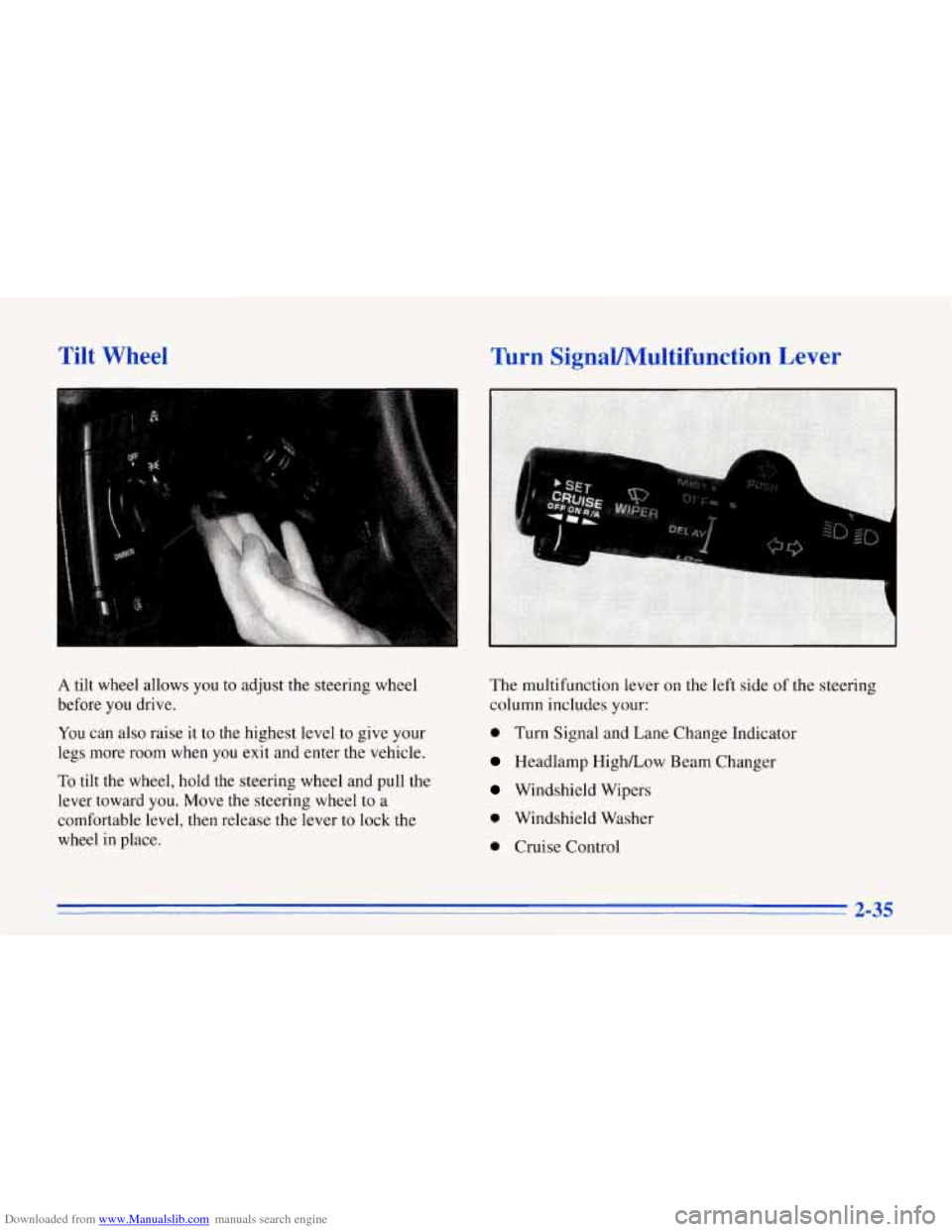
A tilt wheel allows you to adjust the steering wheel
before you drive.
You can also raise it to the highest level to give your
legs more
room when you exit and enter the vehicle,
To tilt the wheel, hold the steering wheel and pull the
lever toward you. Move the steering wheel to a
comfortable level, then release the lever to lock the
wheel in place.
Turn SignaYMultifunction Lever
The multifunction lever on the left side of the steering
column includes your:
0 Turn Signal and Lane Change Indicator
Headlamp HighLow Beam Changer
Windshield Wipers
0 Windshield Washer
0 Cruise Control
2-35
Page 82 of 386
Downloaded from www.Manualslib.com manuals search engine 1
I A CAUTION:
Cruise control can be dangerous where you
can’t drive safely at
a steady speed. So,
don’t use your cruise control on winding
roads or in heavy traffic.
slippery roads. On such roads, fast changes
in tire traction can cause needless wheel
spinning, and you could lose control. Don’t
use cruise control on slippery roads.
0 Cruise control can be dangerous on
If your vehicle is in cruise control when the ASR system
begins
to limit wheel spin, the cruise control will
automatically disengage. (See
“ASR System” in the
Index.) When road conditions allow you to safely use it
again, you may turn the cruise control back on.
Setting Cruise Contra1
If you leave your cruise control switch on when
you’re not using cruise,
you might hit a button and
go
into cruise when you don’t want to. You could
be startled and even lose control. Keep the cruise
control switch
OFF until you want to use it.
1. Turn the cruise control switch to ON.
2. Get up to the speed you want.
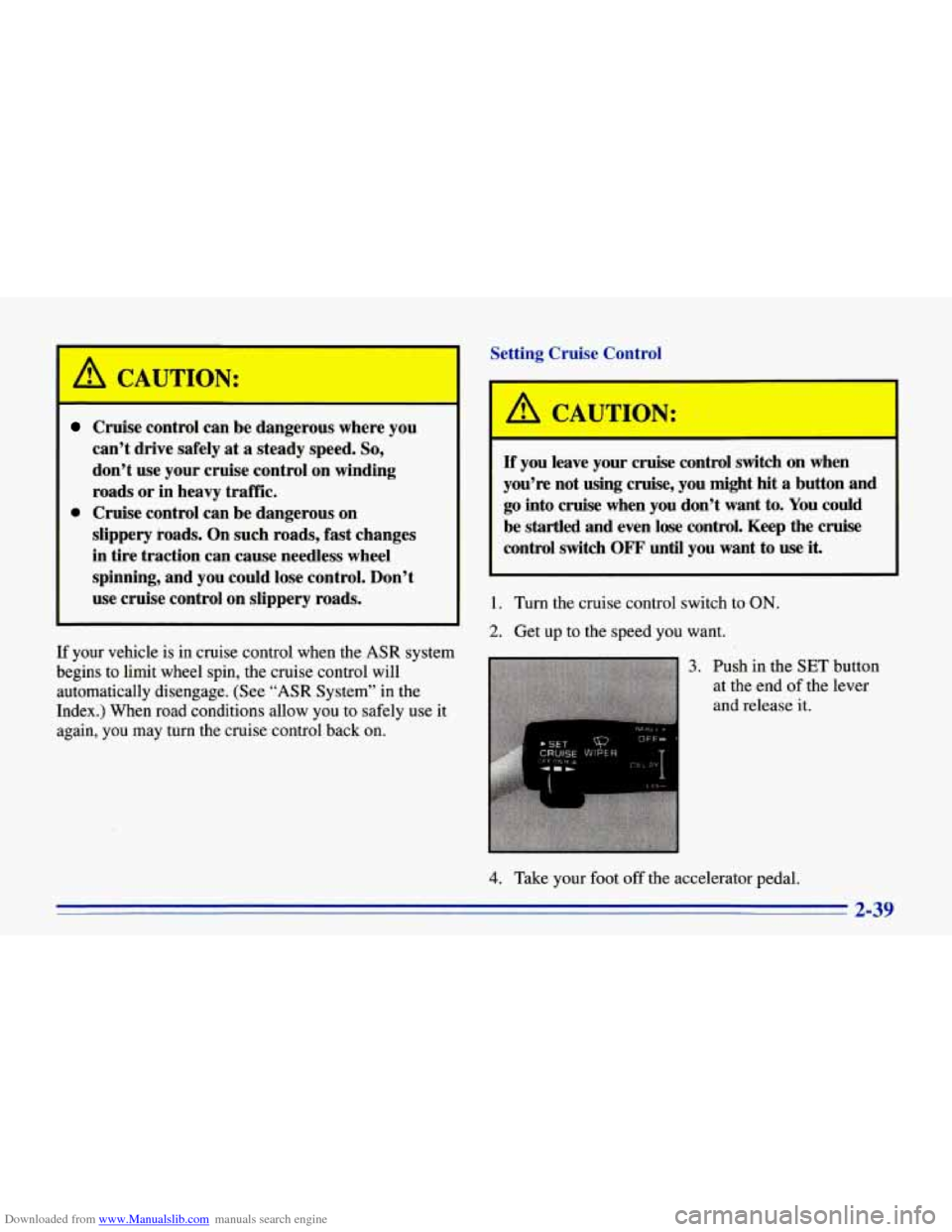
3. Push in the SET button
at the end
of the lever
and release
it.
4. Take your foot off the accelerator pedal.
2-39
Page 92 of 386
Downloaded from www.Manualslib.com manuals search engine Rear Storage
V
2. Put the ends of the shade into the slots behind
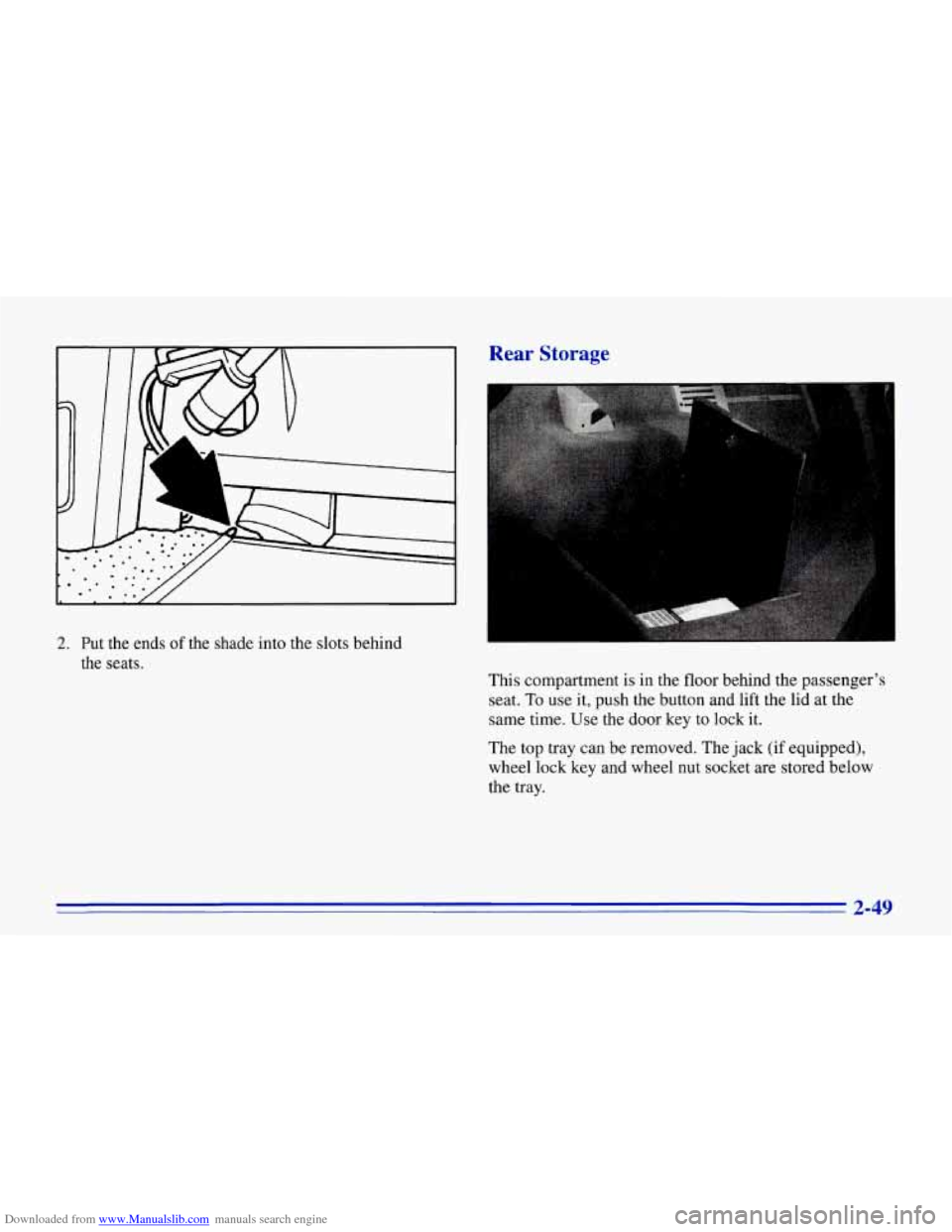
the seats. This compartment is in the floor behind the passenger’s
seat.
To use it, push the button and lift the lid at the
same time. Use the door key to lock it.
The top tray can be removed. The jack (if equipped),
wheel lock key and wheel nut socket are stored below
the tray.
2-49