1996 CHEVROLET CORVETTE wheel
[x] Cancel search: wheelPage 123 of 386
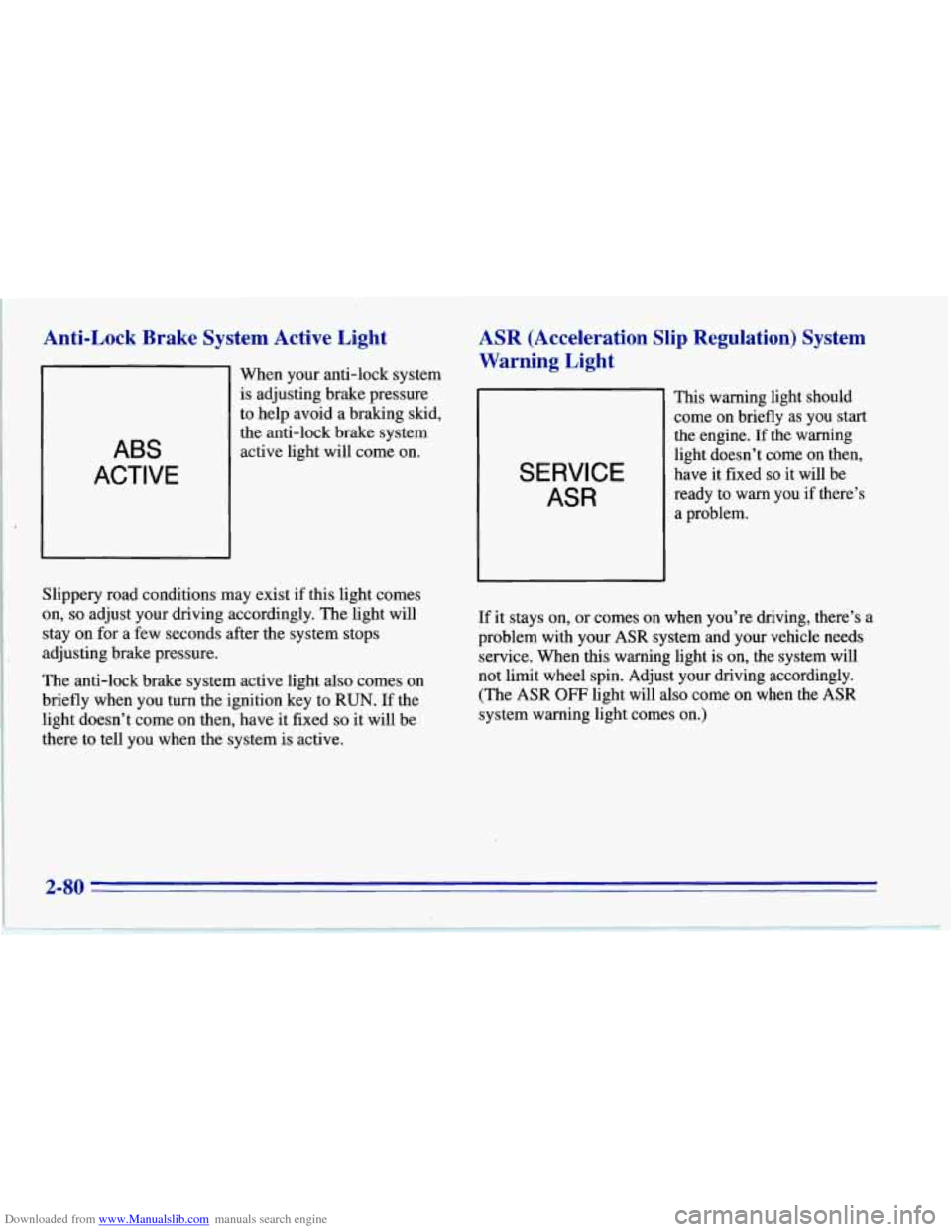
Downloaded from www.Manualslib.com manuals search engine Anti-Lock Brake System Active Light
ABS
ACTIVE
When your anti-lock system
is adjusting brake pressure
to help avoid a braking skid,
the anti-lock brake system
active light will come on.
ASR (Acceleration Slip Regulation) System
Warning Light
SERVICE
ASR
This warning light should
come on briefly as you start
the engine. If the warning
light doesn’t come on then,
have it fixed
so it-will be
ready to
warn you if there’s
a problem.
Slippery road conditions may exist if this light comes
on, so adjust your driving accordingly. The light will
stay on for a few seconds after the system stops
adjusting brake pressure.
The anti-lock brake system active light
also comes on
briefly when you turn the ignition key to
RUN. If the
light doesn’t come on then, have it fixed
so it will be
there to tell you when the system is active. If it
stays on, or comes on when you’re driving, there’s a
problem with your
ASR system and your vehicle needs
service. When this warning light is on, the system will
not limit wheel spin. Adjust your driving accordingly.
(The
ASR OFF light will also come on when the ASR
system warning light comes on.)
2-80
Page 124 of 386
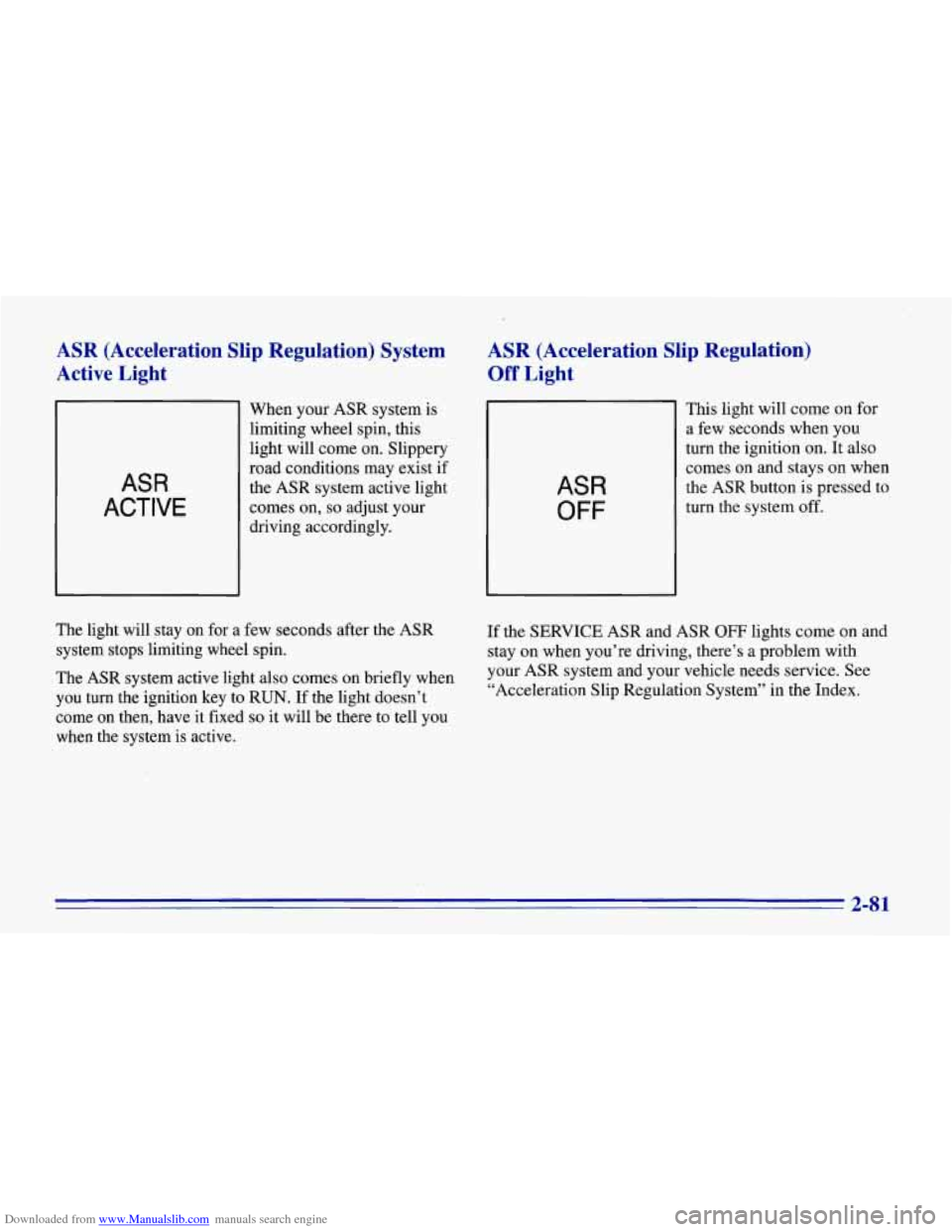
Downloaded from www.Manualslib.com manuals search engine ASR (Acceleration Slip Regulation) System
Active Light
ASR
ACTIVE
When your ASR system is
limiting wheel spin, this
light will come on. Slippery
road conditions may exist if
the ASR system active light
comes on,
so adjust your
driving accordingly.
ASR (Acceleration Slip Regulation)
Off Light
ASR
OFF
This light will come on for
a few seconds when you
turn the ignition on. It also
comes on and stays on when
the ASR button is pressed to
turn the system
off.
The light will stay on for a few seconds after the ASR
system stops limiting wheel spin.
The ASR system active light also comes on briefly when
you turn the ignition key to
RUN. If the light doesn’t
come on then, have it fixed
so it will be there to tell you
when the system is active. If
the SERVICE ASR and ASR
OFF lights come on and
stay on when you’re driving, there’s a problem with
your ASR system and your vehicle needs service.
See
“Acceleration Slip Regulation System” in the Index.
2-8 1
Page 126 of 386
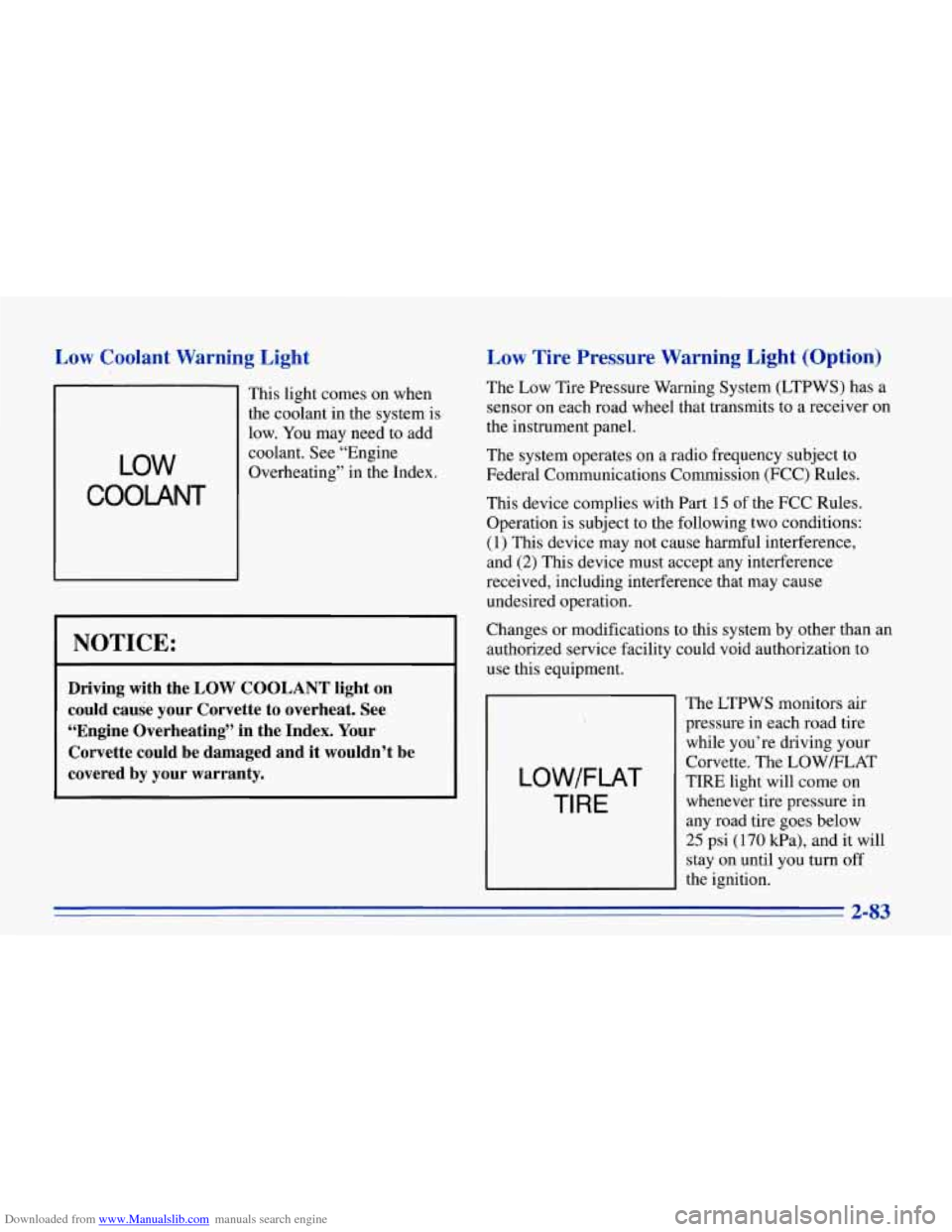
Downloaded from www.Manualslib.com manuals search engine Low Coolant Warning Light
LOW
COOLANT
This light comes on when
the coolant in the system is
~ low. You may need to add
~ coolant. See “Engine
~ Overheating” in the Index.
I NOTICE:
Driving with the LOW COOLANT light on
could cause your Corvette to overheat. See
“Engine Overheating” in the Index. Your
Corvette could be damaged and it wouldn’t be
covered by your warranty.
Low Tire Pressure Warning Light (Option)
The Low Tire Pressure Warning System (LTPWS) has a
sensor on each road wheel that transmits to a receiver on
the instrument panel.
The system operates
on a radio frequency subject to
Federal Communications Commission (FCC) Rules.
This device complies with Part
15 of the FCC Rules.
Operation is subject to the following two conditions:
(1) This device may not cause harmful interference,
and
(2) This device must accept any interference
received, including interference that may cause
undesired operation.
Changes or modifications to this system by other than an
authorized service facility could void authorization to
use this equipment.
LOW/FLAT
TI RE
The LTPWS monitors air
pressure in each road tire
while you’re driving your
Corvette. The LOWELAT
TIRE light will come on
whenever tire pressure in
any road tire goes below
25 psi (170 kPa), and it will
stay on until
you turn off
the ignition.
2-83
Page 127 of 386
Downloaded from www.Manualslib.com manuals search engine The light may come on if any LTPWS parts aren’t
working properly.
For LTPWS to work properly, you must drive your
Corvette faster than
25 mph (40 km/h) and for more
than
2 miles (4 km). The system will not warn you
before you begin to drive that a tire
is flat.
When the LOWELAT TIRE light comes on, check the
tire pressure in all four road tires as soon
as you can.
Adjust the tire pressure as needed to those shown on the
Tire-Loading Information label on the driver’s door. If
the light stays on after the tire pressure is adjusted, see
your dealer.
I
When the LOWELAT TIRE warning light is on,
your vehicle’s handling capabilities will be
reduced during severe maneuvers.
If you drive
too fast, you could lose control of your vehicle.
You or others could be injured. Don”t drive over
55 mph (90 km/h) when the LOWWLAT TIRE
warning light is on. Drive cautiously, and check
your tire pressures as soon
as you can.
NOTICE:
Driving with a flat tire may damage the tire, the
wheel or the tire pressure sensor installed inside
the tire
on the wheel rim. Using tire sealants may
also damage the sensor.
If you have EMTs, see “Extended Mobility Tires”
in the Index.
The LTPWS sensor is directly opposite the valve stem
on the tire. Take care when servicing or having your
tires serviced. The sensors may not work properly
if
damaged. To prevent damage to the sensors, see the
1996 Corvette Service Manual for correct tire mounting
and dismounting procedures.
The LOW/FLAT TIRE light may come on if your
vehicle
is close to another vehicle that has LTPWS and
has a tire with low pressure.
LTPWS can warn you about a low tire, but it does
not replace normal tire maintenance. See “Tires” in
the Index.
Page 128 of 386
Downloaded from www.Manualslib.com manuals search engine Service LTPWS Light (Option)
SERVICE
LTPWS
The SERVICE LTPWS light
comes on whenever a
LTPWS part is not working
properly. It may also come
on when you’re going less
than
25 mph (40 kmh) or in
stop-and-go traffic.
The light will go out when the electronic receiver gets a
signal from each sensor.
Check the system by turning the ignition on. The light
should come on and then go out. See your dealer
if the
light stays on or doesn’t come on. Here
are two situations that cause the SERVICE LTPWS
light to come on and stay on.
Both of these situations are
normal and do not indicate that anything is wrong with
your Corvette.
0 You turn the ignition on three times in a row within
half an hour without moving your Corvette. The light
will then come on every time you turn the ignition
on until you move your Corvette.
0 You run your Corvette three times within half an
hour while all four sensors are missing. (All the
sensors would be missing, for example, if you put
different wheels on your Corvette without
transferring the sensors.)
If
you would like to clear the SERVICE LTPWS light
from your Driver Information Center permanently, see
your dealer.
If the light comes on and stays on, even when the
vehicle is driven, there may be a problem with LTPWS.
See your dealer.
2-85
Page 168 of 386
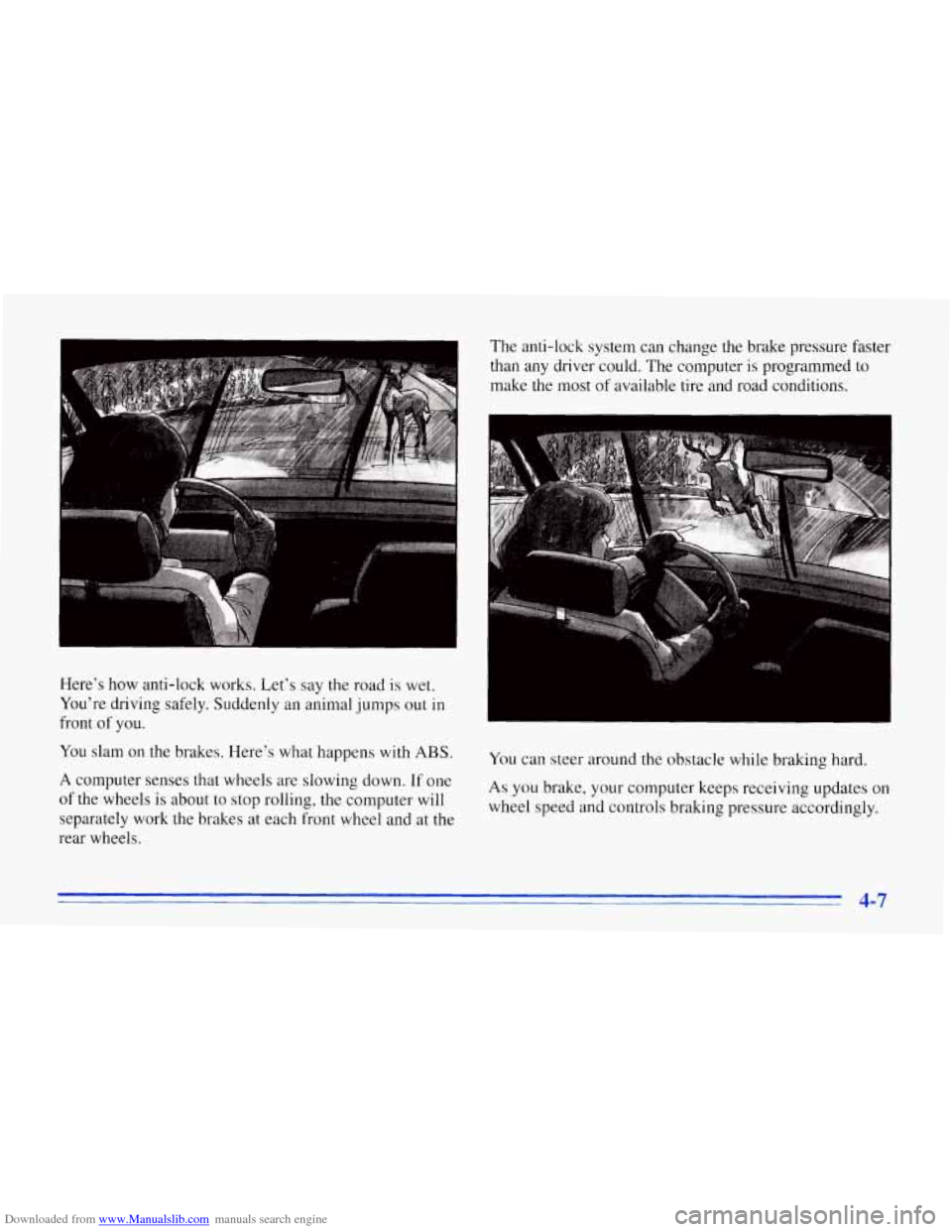
Downloaded from www.Manualslib.com manuals search engine Here’s how anti-lock works. Let’s say the road is wet. You’re driving safely. Suddenly an animal jumps out in
front
of you.
You slam on the brakes. Here’s what happens with ABS.
A computer senses that wheels are slowing down. If one
of the wheels is about to stop rolling, the computer will
separately work the brakes at each front wheel and at the
rear wheels. The anti-lock system can change the brake pressure faster
than any driver could. The computer is programmed to
make the most of available tire and road conditions.
You can steer around the obstacle while braking hard. As you brake, your computer keeps receiving updates on
wheel speed and controls braking pressure accordingly.
- 4-7
Page 169 of 386
Downloaded from www.Manualslib.com manuals search engine Remember: Anti-lock doesn’t change the time you need
to get your foot up to the brake pedal or always decrease
stopping distance. If you get too close to the vehicle in
front of you, you won’t have time to apply your brakes
if that vehicle suddenly slows or stops. Always leave
enough room up ahead to stop, even though you have
anti-lock brakes.
Using Anti-Lock
Don’t pump the brakes. Just hold the brake pedal down
and let anti-lock work for you. You may hear a motor or
clicking noid and feel the brake pedal move a little
during
a stop, but this is normal.
ABS
ACTIVE
When your anti-lock system
is adjusting brake pressure
to help avoid a braking skid,
this light will come on. See
“Anti-Lock Brake System
Active Light” in the Index.
ASR (Acceleration Slip Regulation) System
Your vehicle has a traction control system called ASR
that limits wheel spin. This is especially useful in
slippery road conditions’. The system operates only if it
senses that the rear wheels
are spinning too much or are
beginning to lose traction. When this happens, the
system works the rear brakes and reduces engine power
(by closing the throttle and managing engine spark) to
limit wheel spin.
ASR
ACTIVE
This light will come on
when the ASR system is
limiting wheel spin. See
“ASR System Active Light”
in the Index. You may feel
or hear the system working,
but this is normal.
If your vehicle is in cruise control when the ASR system
begins to limit wheel spin, the cruise control will
automatically disengage. When road conditions allow
you to safely use it again, you may re-engage the cruise
control. (See “Cruise Control” in the Index.)
J
Page 170 of 386
Downloaded from www.Manualslib.com manuals search engine SERVICE
ASR
This warning light will
come on to let you know if
there’s a problem with your
ASR system. See “ASR
System Warning Light” in
the Index.
When this warning light is on, the system will not limit
wheel spin. Adjust your driving accordingly. (The ASR
OFF light will also come on when the ASR system
warning light comes on.)
The ASR system automatically comes on whenever you
start your vehicle.
To limit wheel spin, especially in
I slippery road conditions, you should always leave the
system on. But you can
turn the ASR system off if you
ever need to. (You should turn the system off if your
vehicle ever gets stuck in sand, mud, ice or snow. See
“Rocking Your Vehicle” in the Index.) To
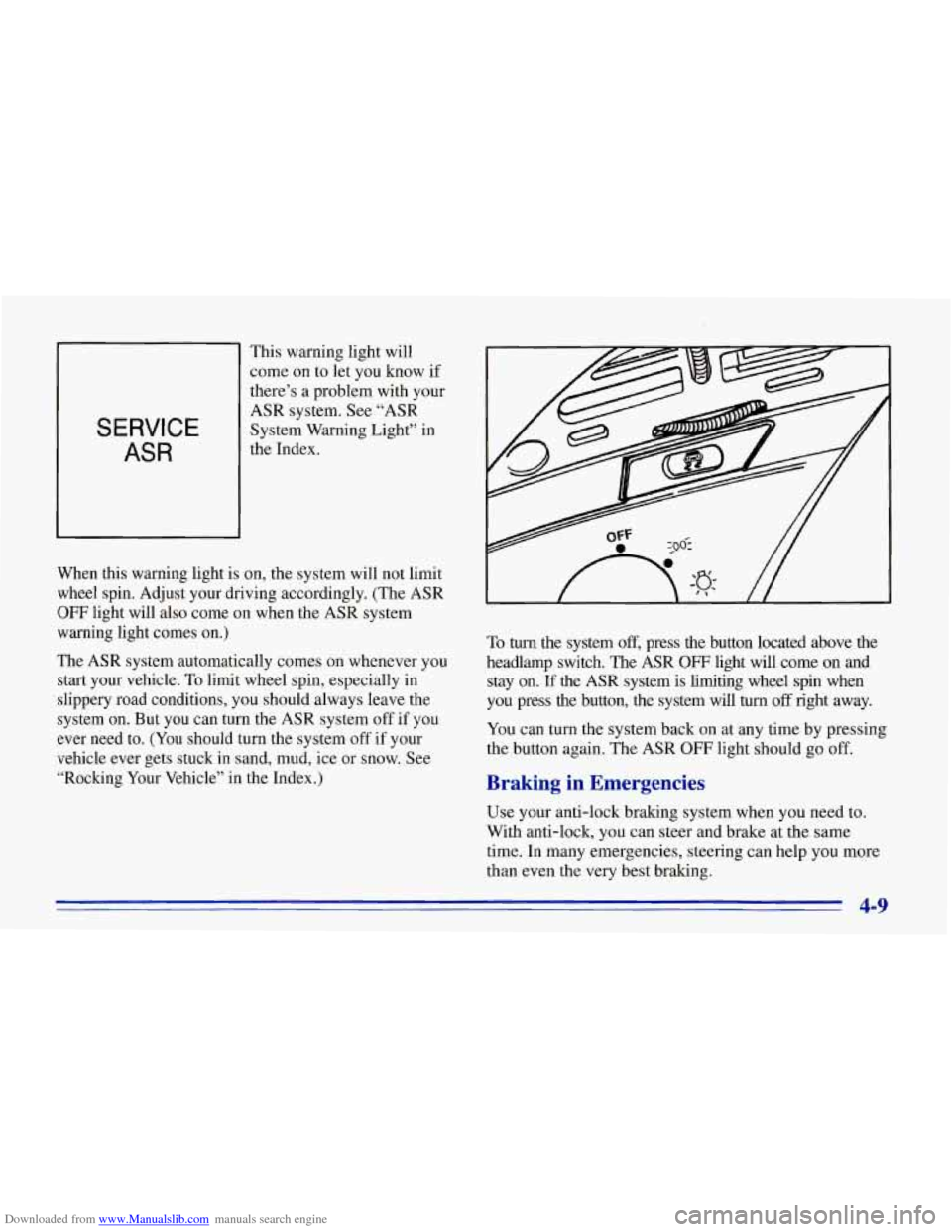
turn the system off, press the button located
above-the
headlamp switch. The ASR
OFF light will come on and
stay on.
If the ASR system is limiting wheel spin when
you press the button,
the system will turn off right away.
You can turn the system back on at any time by pressing
the button again. The ASR
OFF light should go off.
Braking in Emergencies
Use your anti-lock braking system when you need to.
With anti-lock, you can steer and brake at the same
time. In many emergencies, steering can help you more
than even the very best braking.
4-9