Page 58 of 386
Downloaded from www.Manualslib.com manuals search engine If the resistor pellet is damaged or missing, the starter
won’t work. Use the other ignition key, and see your
Chevrolet dealer or a locksmith who can service the
PASS-Key to have a new key made.
If the SECURITY light comes on while driving, have
your vehicle serviced as soon as possible.
If you lose or damage
a PASS-Key ignition key, see
your Chevrolet dealer or a locksmith who can service
PASS-Key. In an emergency, call the Chevrolet
Roadside Assistance Program at 1 -800-CHEV-USA
(1-800-243-8872).
New Vehicle “Break-In”
NOTICE:
Your modern Corvette doesn’t need an elaborate
“break-in.” But
it will perform better in the long
run if you follow these guidelines:
0 Keep your speed at 55 mph (88 km/h) or
less for the
first 500 miles (804 km).
0 Don’t drive at any one speed -- fast or
slow
-- for the first 500 miles (804 km).
Don’t make full-throttle starts.
200 miles (322 km) or so. During this time
your new brake linings aren’t yet broken
in. Hard stops with new linings can mean
premature wear and earlier replacement.
Follow this “breaking-in” guideline every
time you get new brake linings.
0 Avoid making hard stops for the first
2-15
Page 59 of 386
Downloaded from www.Manualslib.com manuals search engine Ignition Positions
C
I
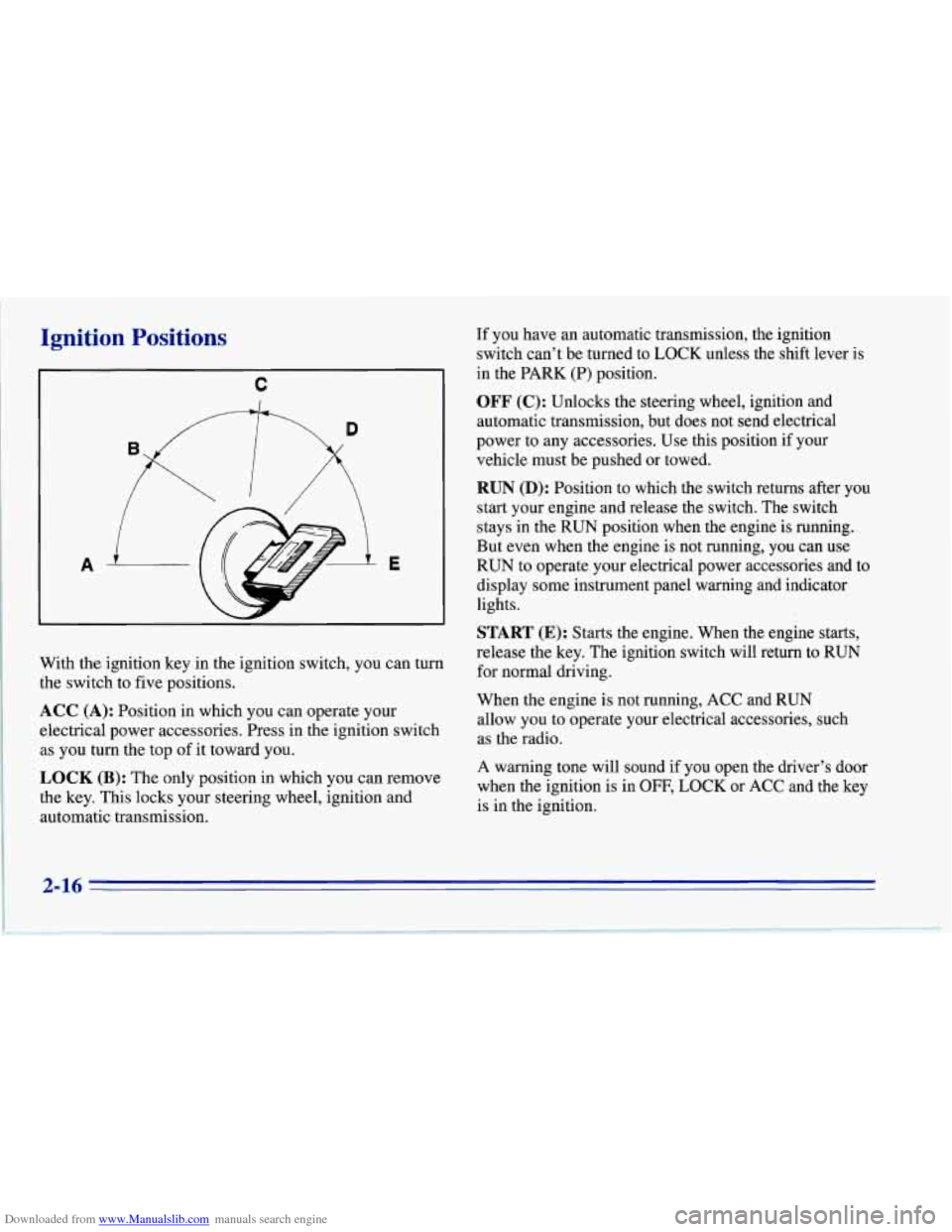
With the ignition key in the ignition switch, you can turn
the switch to five positions.
ACC (A): Position in which you can operate your
electrical power accessories. Press in the ignition switch
as you turn the top of it toward you.
OCK (B): The only position in which you can remove
the key. This locks your steering wheel, ignition and
automatic transmission. If you
have an automatic transmission, the ignition
switch can't be turned to LOCK unless the shift lever is
in the PARK (P) position.
OFF (C): Unlocks the steering wheel, ignition and
automatic transmission, but does not send electrical
power to any accessories. Use this position if your
vehicle must be pushed or towed.
RUN (D): Position to which the switch returns after you
start your engine and release the switch. The switch
stays in the RUN position when the engine is running.
But even when the engine is not running, you can use
RUN to operate your electrical power accessories and to
display some instrument panel warning and indicator
lights.
START (E): Starts the engine. When the engine starts,
release the key. The ignition switch will return to RUN
for normal driving.
When the engine is not running, ACC and RUN
allow you to operate your electrical accessories, such
as the radio.
A warning tone will sound
if you open the driver's door
when the ignition is in
OFF, LOCK or ACC and the key
is in the ignition.
2-16
Page 60 of 386
Downloaded from www.Manualslib.com manuals search engine Key Release Button
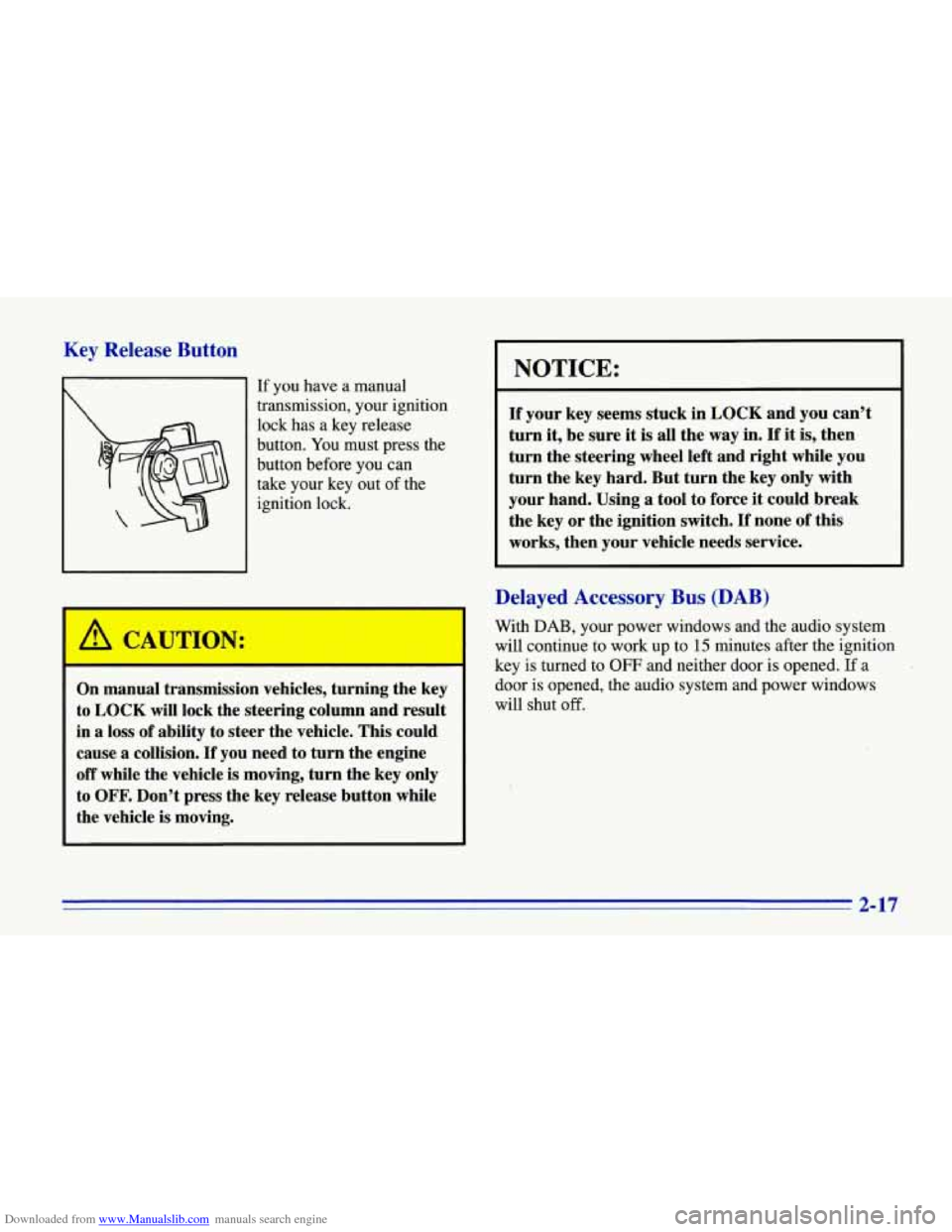
If you have a manual
transmission, your ignition
lock has a key release
button. You must press the
button before you can
take your key out
of the
ignition lock.
CAUTION:
On manual transmission vehicles, turning the key
to LOCK will lock the steering column and result
in a loss of ability to steer the vehicle. This could
cause a colIision.
If you need to turn the engine
off while the vehicle is moving, turn the key only
to
OFF. Don’t press the key release button while
the vehicle
is moving.
I NOTICE:
If your key seems stuck in LOCK and you can’t
turn
it, be sure it is all the way in. If it is, then
turn the steering wheel left and right while you
turn the key hard. But turn the key only with
your hand. Using
a tool to force it could break
the key or the ignition switch.
If none of this
works, then your vehicle needs service.
Delayed Accessory Bus (DAB)
With DAB, your power windows and the audio system
will continue to work up to
15 minutes after the ignition
key is turned to
OFF and neither door is opened. If a
door is opened, the audio system and power windows
will shut
off.
Y
2-17
Page 64 of 386
Downloaded from www.Manualslib.com manuals search engine Automatic Transmission Operation
a
R
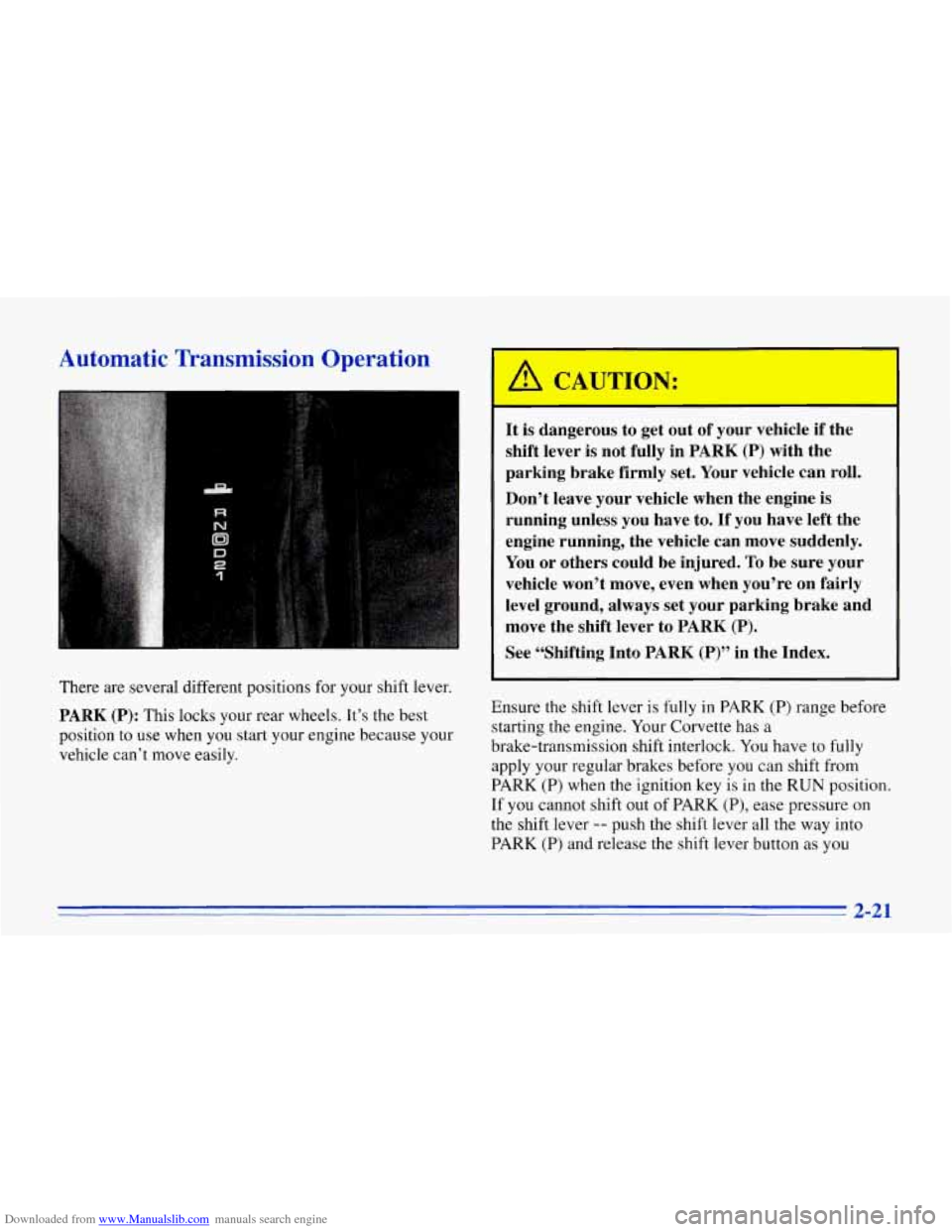
There are several different positions for your shift lever.
PARK (P): This locks your rear wheels. It’s the best
position to use when you start your engine because your
vehicle can’t move easily.
It is dangerous to get out of your vehicle if the
shift lever is not fully in
PARK (P) with the
parking brake firmly set. Your vehicle can roll.
Don’t leave your vehicle when the engine is
running unless you have to.
If you have left the
engine running, the vehicle can move suddenly.
You
or others could be injured. To be sure your
vehicle won’t move, even when you’re on fairly
level ground, always set your parking brake and
move the shift lever to
PARK (P).
See “Shifting Into PARK (P)” in the Index.
Ensure the shift lever is fully in PARK (P) range before
starting the engine. Your Corvette has
a
brake-transmission shift interlock. You have to fully
apply your regular brakes before you can shift from
PARK (P) when the ignition key is in the RUN position.
If you cannot shift out of PARK (P), ease pressure on
the shift lever -- push the shift lever all the way into
PARK (P) and release the shift lever button as you
2-21
Page 73 of 386
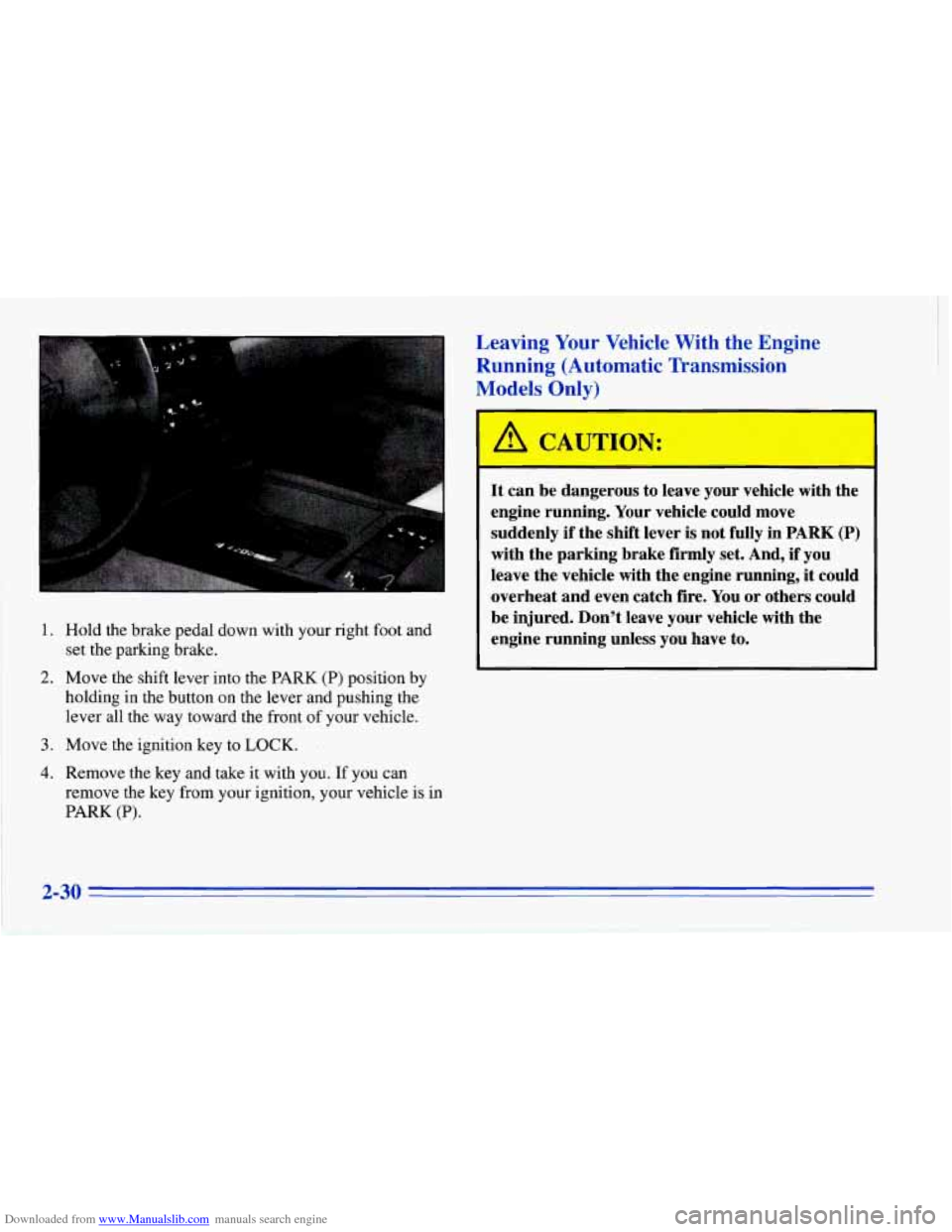
Downloaded from www.Manualslib.com manuals search engine 1. Hold the brake pedal down with your right foot and
set the parking brake.
2. Move the shift lever into the PARK (P) position by
holding in the button on the lever and pushing the
lever all the way toward the front
of your vehicle.
3. Move the ignition key to LOCK.
4. Remove the key and take it with you. If you can
remove the key from your ignition, your vehicle is in
PARK
(P).
Leaving Your Vehicle With the Engine
Running (Automatic Transmission
Models Only)
It can be dangerous to leave your vehicle with the
engine running. Your vehicle could move
suddenly
if the shift lever is not fully in PARK (P)
with the parking brake firmly set. And, if you
leave the vehicle with the engine running, it could
overheat and even catch fire. You
or others could
be injured. Don’t leave your vehicle with the
engine running unless you have to.
2-30
Page 74 of 386
Downloaded from www.Manualslib.com manuals search engine Torque Lock (Automatic Transmission)
If you are parking on a hill and you don’t shift your
transmission into PARK (P) properly, the weight of the
vehicle may put too much force on the parking pawl in
the transmission. You may find it difficult to pull the
shift lever out of PARK (P). This is called “torque lock.”
To prevent torque lock, set the parking brake and then
shift into PARK (P) properly before you leave the
driver’s seat. To find out how, see “Shifting Into
PARK
(P)” in the Index.
When you
are ready to drive, move the shift lever out of
PARK (P) before you release the parking brake.
If torque lock does occur, you may need to have another
vehicle push yours a little uphill to take some of the
pressure from the transmission,
so you can pull the shift
lever out of PARK (P).
Shifting Out of PARK (P)
(Automatic Transmission)
Your Corvette has a brake-transmission shift interlock.
You have to fully apply your regular brake before you
can shift from PARK (P) when the ignition is in the
RUN position. See “Automatic Transmission Operation”
in the Index. If you
cannot shift out of PARK (P), ease pressure on
the shift lever
-- push the shift lever all the way into
PARK (P) and release the shift lever button as you
maintain brake application. Then press the shift lever
button and move the shift lever into the gear you wish.
If
you ever hold the brake pedal down but still can’t
shift out of PARK (P), try this:
1. Turn the key to the
OFF position.
2. Apply and hold the brake until the end of Step 4.
3. Shift to NEUTRAL (N).
4. Start the engine and then shift to the drive gear
you want.
5. Have the vehicle fixed as soon as you can.
Parking Your Vehicle
(Manual Transmission)
Before you get out of your vehicle, put your manual
transmission in
REVERSE (R) and firmly apply the
parking brake.
2-31
Page 78 of 386
Downloaded from www.Manualslib.com manuals search engine Tilt Wheel
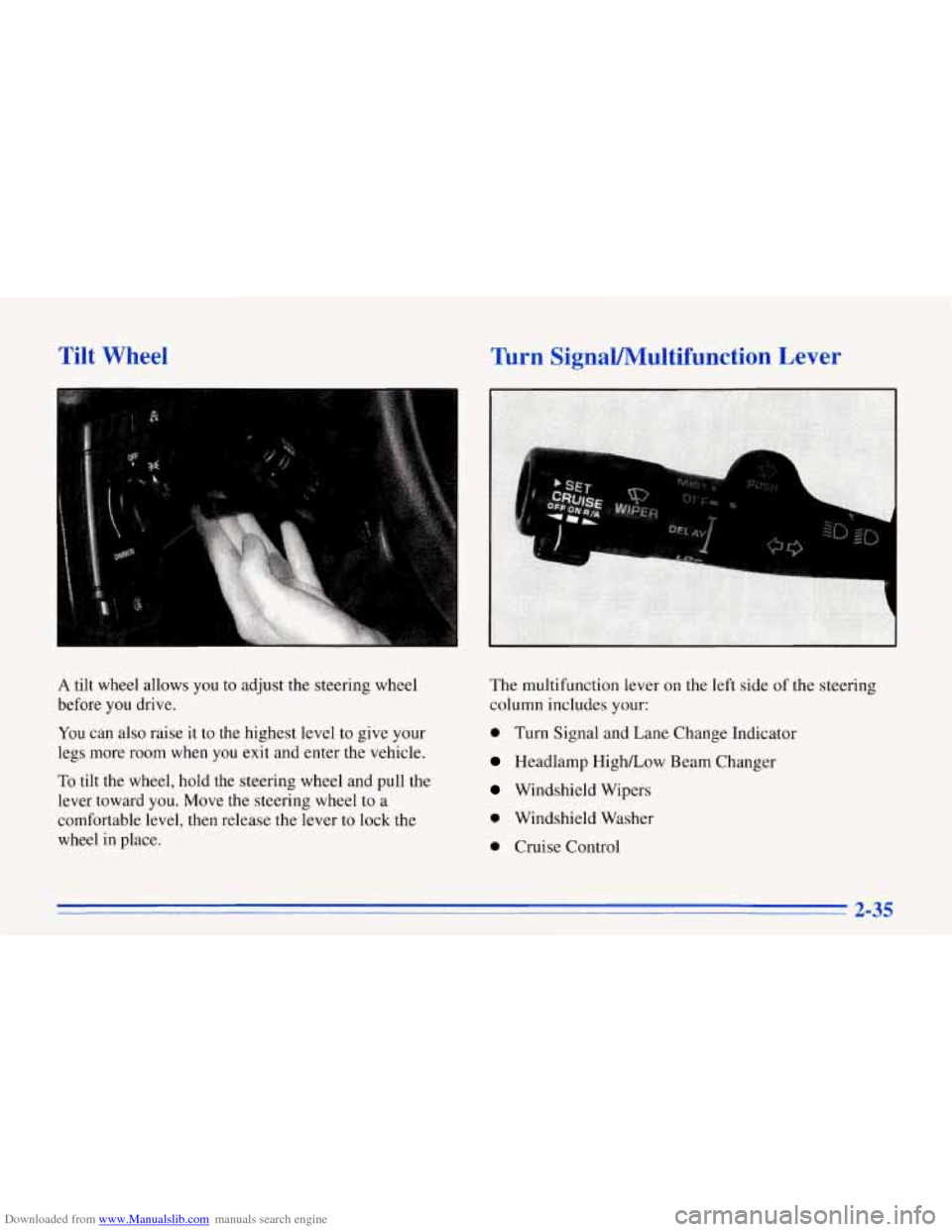
A tilt wheel allows you to adjust the steering wheel
before you drive.
You can also raise it to the highest level to give your
legs more
room when you exit and enter the vehicle,
To tilt the wheel, hold the steering wheel and pull the
lever toward you. Move the steering wheel to a
comfortable level, then release the lever to lock the
wheel in place.
Turn SignaYMultifunction Lever
The multifunction lever on the left side of the steering
column includes your:
0 Turn Signal and Lane Change Indicator
Headlamp HighLow Beam Changer
Windshield Wipers
0 Windshield Washer
0 Cruise Control
2-35
Page 81 of 386
Downloaded from www.Manualslib.com manuals search engine Windshield Washer
At the top of the turn signal lever there’s a paddle with
the word
PUSH on it. To spray washer fluid on the
windshield, just push the paddle for less than a second.
If you hold the paddle for more than a second, the
washer will spray until you release the paddle. The
wipers will clear the window and stop
or return to the
previous setting.
c
In freezing weather, don’t use your washer until
the windshield is warmed. Otherwise the washer
fluid can form ice on the windshield, blocking
your vision.
For information on the correct washer fluid mixture to
use, see “Windshield Washer Fluid” in the Index.
Cruise Control
t LU-
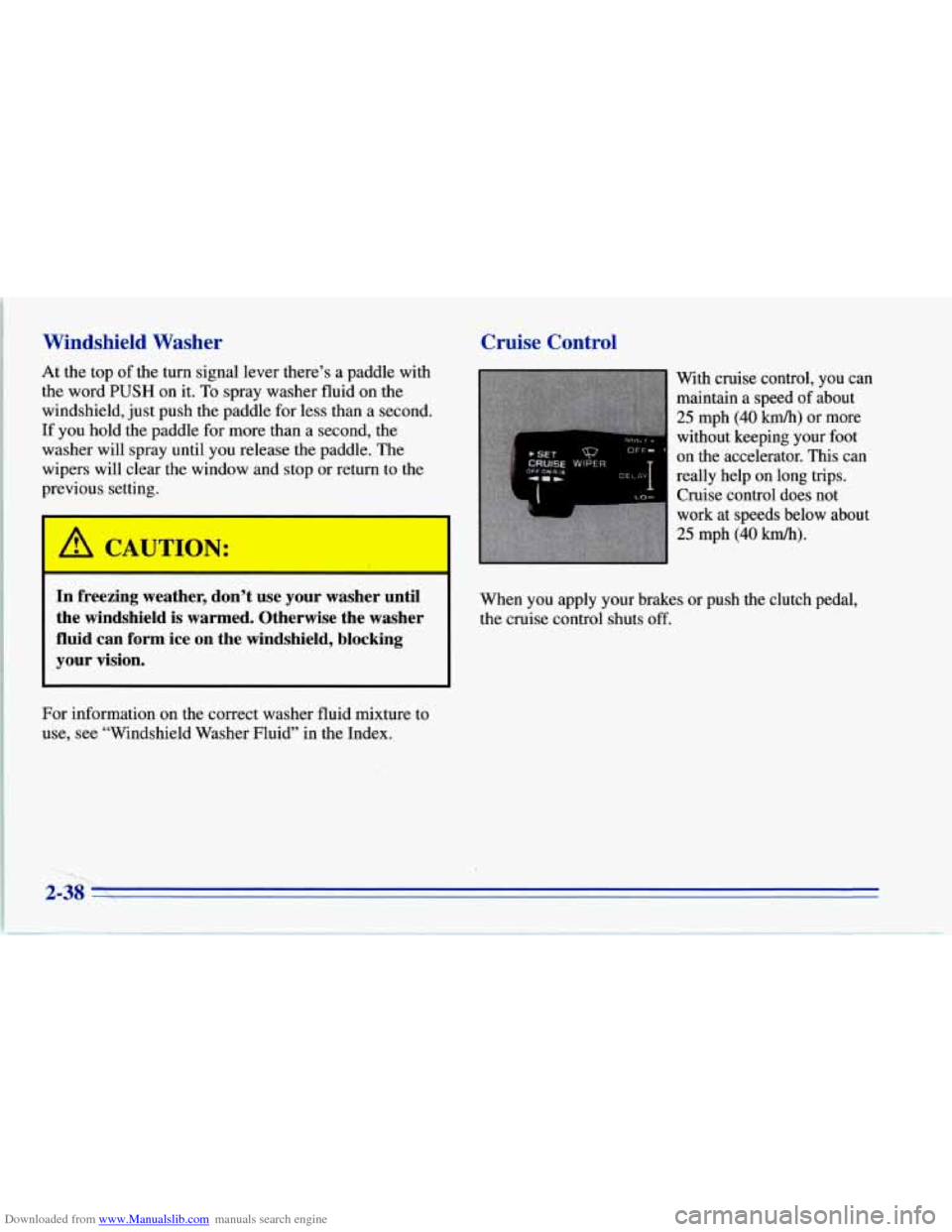
With cruise control, you can
maintain a speed of about
25 mph (40 km/h) or more
without keeping your foot
on the accelerator. This can
really help on long trips.
Cruise control does not
work at speeds below about
25 mph (40 km/h).
When you apply your brakes or push the clutch pedal,
the cruise control shuts
off.