1996 CHEVROLET CORVETTE fog light
[x] Cancel search: fog lightPage 11 of 386
Downloaded from www.Manualslib.com manuals search engine Vehicle Symbols
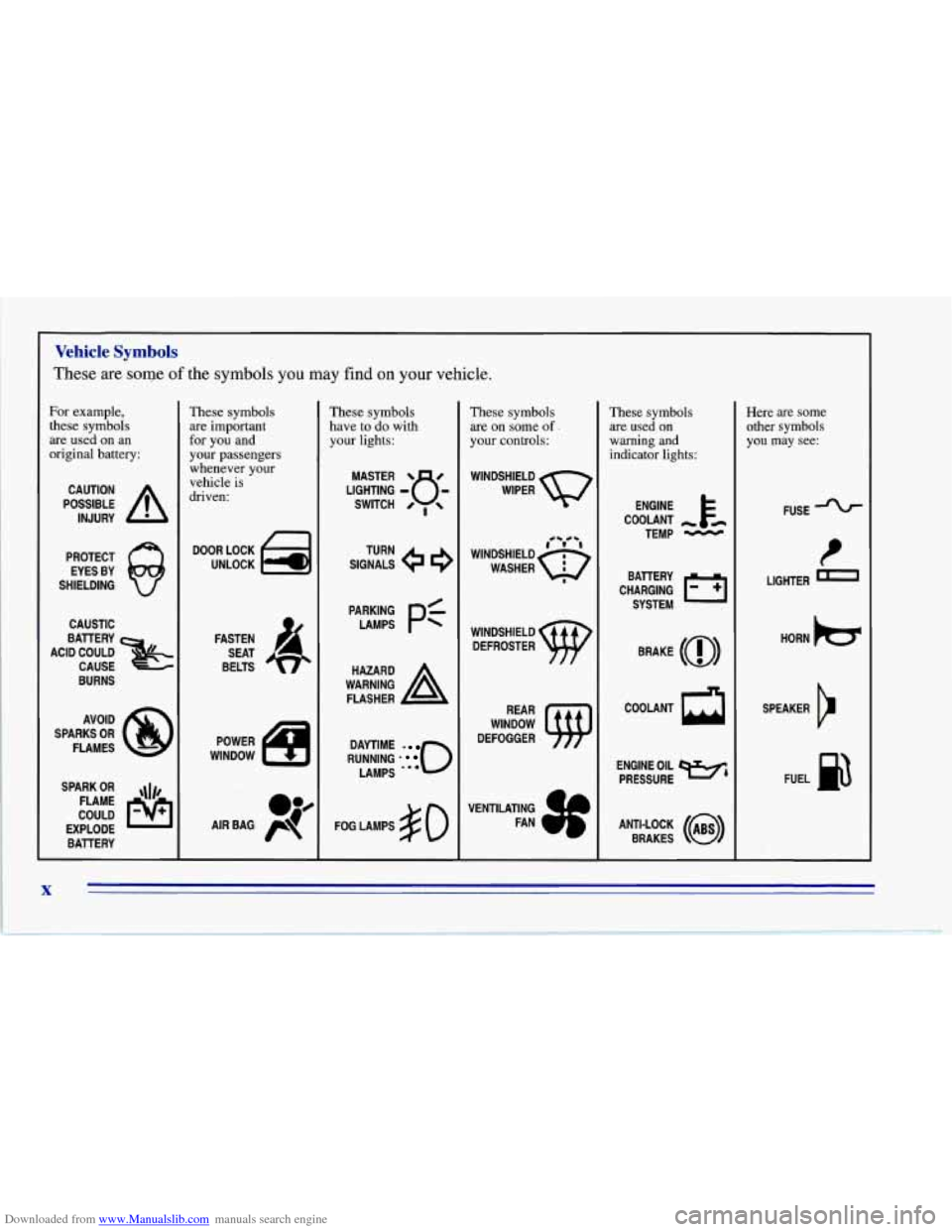
These are some of the symbols you may find on your vehicle.
For example,
these symbols
are used on an
original battery:
POSSIBLE A
CAUTION
INJURY
PROTECT EYES BY
SHIELDING
Q
CAUSTIC
ACID COULD BATTERY
CAUSE
BURNS
AVOID
SPARKS
OR
FLAMES
SPARK
OR ,\I/,
COULD FLAME
EXPLODE BAllERY
These symbols
are important
for you and
your passengers
whenever your
vehicle is
driven:
UNLOCK El
FASTEN
SEAT
BELTS
POWER
WINDOW
These symbols
have to
do with
your lights:
SIGNALS e e
TURN
RUNNING
* 0
DAYTIME *
LAMPS -**
FOG LAMPS $0
These symbols
are on some of.
your controls:
WINDSHIELD
DEFROSTER
VENTILATING FAN
These symbols
are used on
warning and
indicator lights:
COOLANT -,F-
TEMP -
ENGINE
BRAKE
(0)
ENGINE OIL w,
PRESSURE
ANTI-LOCK
(a)
BRAKES
1
Here are some
other symbols
you may see:
FUSE +
LIGHTER -
HORN )cr
SPEAKER
b
FUEL p3
X
Page 87 of 386
Downloaded from www.Manualslib.com manuals search engine Daytime Running Lamps (Canada Only)
Daytime Running Lamps (Dm) can make it easier for
others to see the front of your vehicle during the day.
DRL can be helpful in many different driving
conditions, but they can be especially helpful in the
short periods after dawn and before sunset.
A light sensor on top of the instrument panel makes the
DRL work,
so be sure it isn’t covered.
The DlU system will make your front turn signal lamps
come on when:
0 The ignition is on,
0 The headlamp switch is off, and
0 The parking brake is released.
When
the DRL are on, only your front turn signal lamps
will be on. The taillamps, sidemarker and other lamps won’t be on. Your instrument panel won’t
be lit up either.
When it’s dark enough outside, your front
turn signal lamps
will go out and your headlamps will come on. The other
lamps that come on with your headlamps will
also come on.
When it’s bright enough outside, the regular lamps will
go
off, and your front turn signal lamps come on.
As with any vehicle, you should turn on the regular
headlamp system when you need it.
Fog Lamps
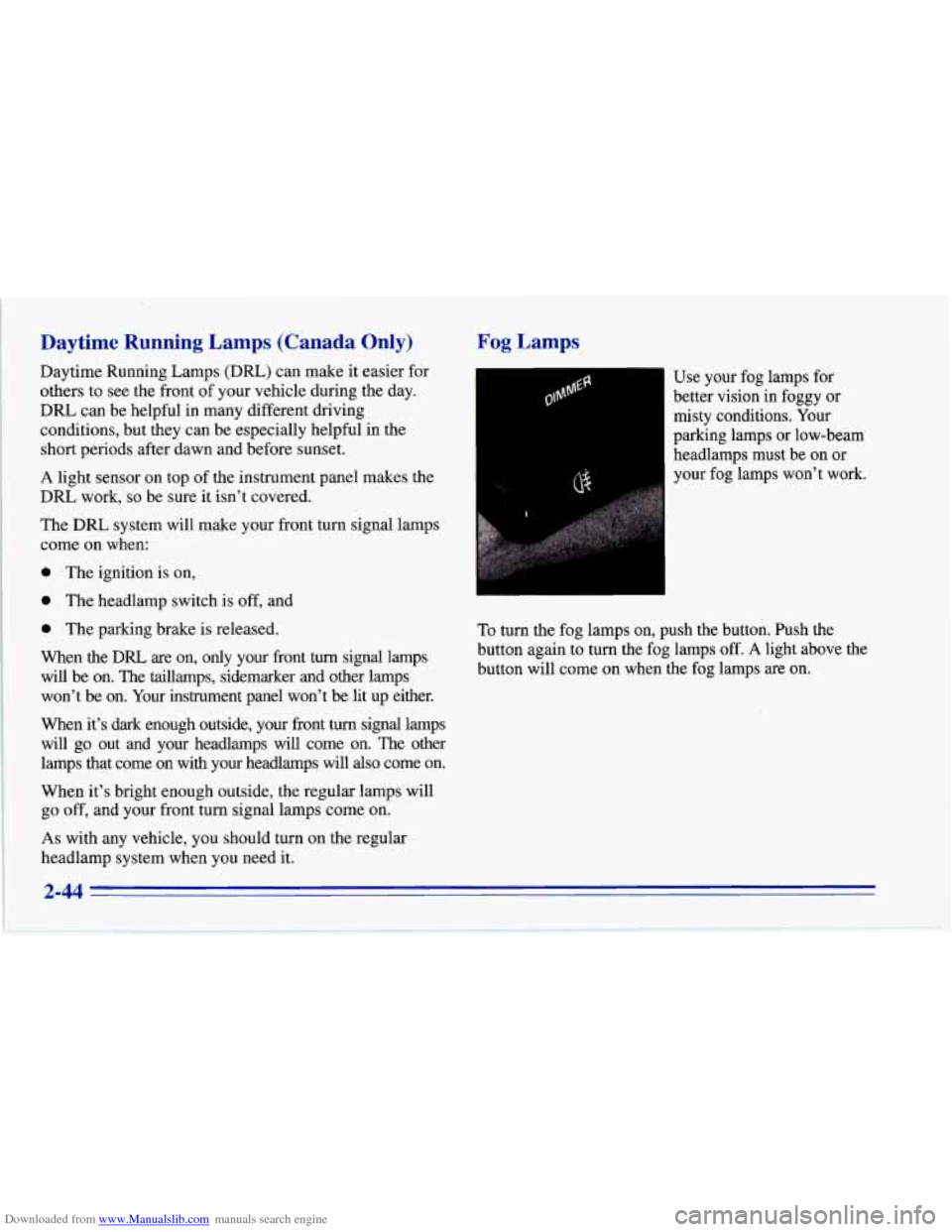
I-1 Use your fog lamps for
better vision in foggy or
misty conditions. Your
parking lamps or low-beam
headlamps must be on or
your fog lamps won’t work.
To turn the fog lamps on, push the button. Push the
button again to turn the fog lamps
off. A light above the
button will come on when the fog lamps are on.
2-44
Page 109 of 386
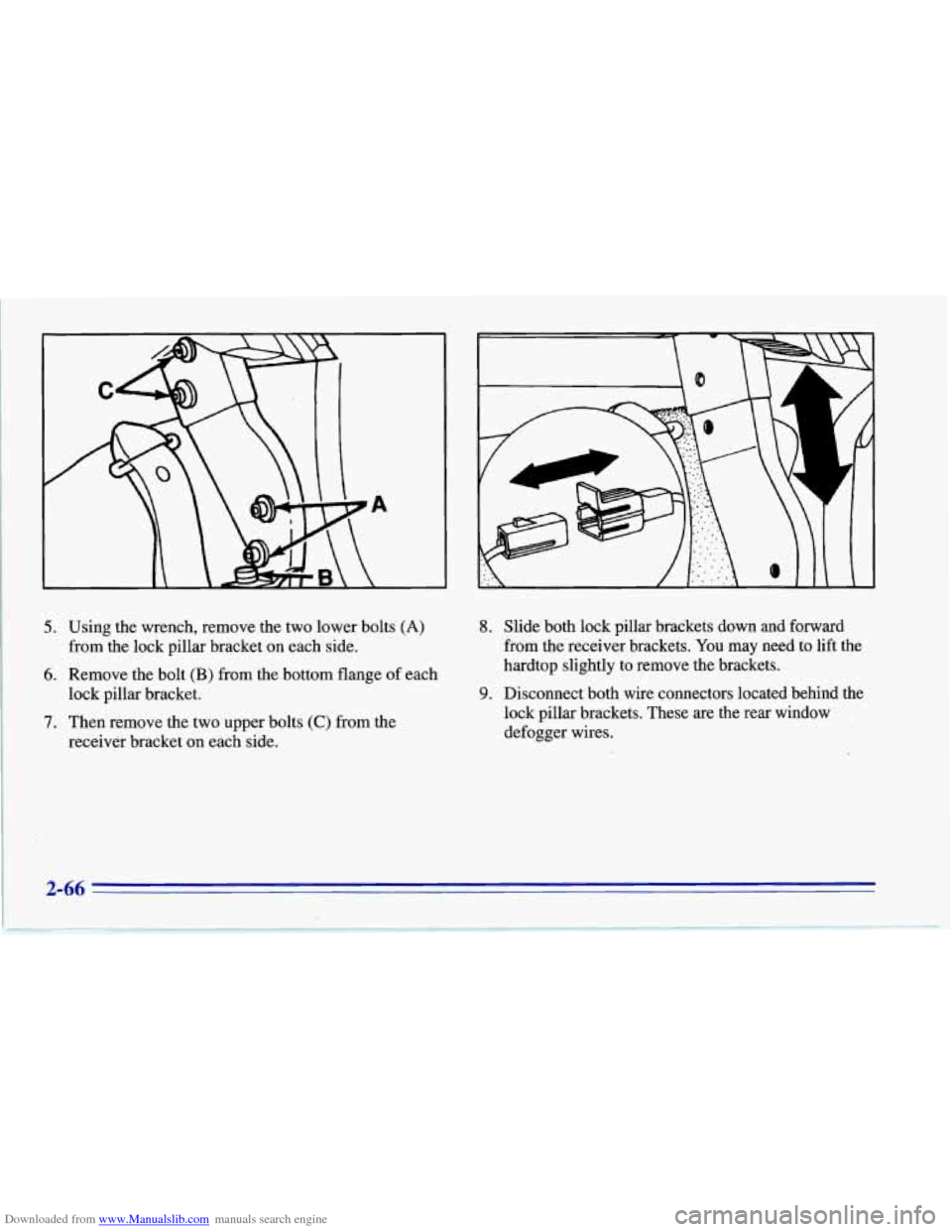
Downloaded from www.Manualslib.com manuals search engine 5. Using the wrench, remove the two lower bolts (A)
from the lock pillar bracket on each side.
6. Remove the bolt (B) from the bottom flange of each
lock pillar bracket.
7. Then remove the two upper bolts (C) from the
receiver bracket on each side.
8. Slide both lock pillar brackets down and forward
from the receiver brackets.
You may need to lift the
hardtop slightly to remove the brackets.
9. Disconnect both wire connectors located behind the
lock pillar brackets. These
are the rear window
defogger wires.
2-66
Page 111 of 386
Downloaded from www.Manualslib.com manuals search engine Installing Your Convertible Hardtop
1. Park on a level surface, set the parking brake firmly
and shift an automatic transmission into
PARK (P).
Shift a manual transmission into REVERSE (R).
Lower both windows and sunshades. Turn off the
radio to lower the power antenna and turn the
ignition key to the
LOCK position.
2. Disconnect both rear window defogger electrical
3. Lower the convertible top. Refer to “Convertible
connectors
behind the lock pillar.
Top” in the Index.
This procedure will require the use of the storage
compartment lid release button behind the driver’s seat
or the center console release switch. The fuse that
enables these releases is not installed at the assembly
plant and should
be in your center console. See
“Instrument Panel Fuse Block” in the Index for
location of the fuse. The fuse is labeled HATCH (45). 4. With
one person on each side, carefully position the
hardtop over the vehicle. Lower the hardtop slowly,
aligning the rear bolt spacers onto the bezels, and
front conical nuts into the tapered receivers. Realign
the hardtop, if necessary.
NOTICE:
To help avoid damage, don’t force the rear
of the hardtop
down. The hardtop may rest
slightly above the storage compartment lid
until the release lever
is pulled. See Step 8 in
this procedure.
5. Move both seatbacks forward. Slide the lock pillar
bracket into the receiver bracket until the scribed line
is even with the lower edge of the receiver bracket.
6. Connect the electrical connectors and make sure they
are inside the vehicle.
Page 114 of 386

Downloaded from www.Manualslib.com manuals search engine 1. Acceleration Slip Regulation (ASR) Switch
2. Side Window Defogger Vent
3. Side Air Vent
4. Turn SignaVMultifunction Lever
5. Tilt Lever
6. Instrument Cluster
7. Ignition Switch
8. Trip Monitor Controls
9. Solar Sensor
10. Center Air Vent
1
1. Driver Information Center 12.
Comfort Controls
13. Fuse Panel
14. Audio System
15.
Ashtray/Lighter/Cupholder
16. Ride Control (Option)
17. Power Seat Control (Option)
18. Shift Lever (Automatic Shown)
19. Horn
20. Main Lamp Control
21. Fog Lamp Switch
2-71
Page 143 of 386
Downloaded from www.Manualslib.com manuals search engine "'"J NORMAL NC: Use for normal cooling on hot
days. This setting cools outside air and directs it through
the instrument panel vents.
The air conditioning compressor operates in NORMAL
A/C, as well as RECIRCULATE, BI-LEVEL and
DEFROST. It only works when the outside temperature
is above freezing. When the air conditioning compressor
is on, you may sometimes notice slight changes in
your vehicle's engine speed and power. This
is normal
because the system is designed to cycle the compressor
on and
off to keep the desired cooling and help
fuel economy.
+,d BI-LEVEL: This setting cools or heats outside air
and directs it through the instrument panel vents and the
floor ducts.
de
do
do /I VENT: Air flows through the instrument panel
vents. The air conditioning compressor does not run in
VENT mode.
wg HEATER: This setting directs most of the air
through the floor ducts and some of the air through the
defroster vents. The air conditioning compressor does
not run in HEATER mode.
DEFROST: This setting directs most of the
air through the windshield defroster and side window
defogger vents and some of the air through the
floor ducts.
Heating
The heater works best if you keep your windows closed
while using it.
Press HEATER and
FAN UP, then slide the temperature
control lever to a comfortable setting.
If your vehicle has an engine coolant heater and you
use it in cold weather,
0°F (- 18 "C) or lower, your
heating system can provide heat more quickly because
the engine coolant is already warmed. See "Engine
Coolant Heater" in the Index.
Page 144 of 386
Downloaded from www.Manualslib.com manuals search engine Bi-Level
You may want to use BI-LEVEL on cool, but sunny
days. This setting directs outside air through the
instrument panel vents and the floor ducts.
Press BI-LEVEL and FAN UP, then slide the
temperature control lever to a comfortable setting.
Ventilation
For mild outside temperatures, when little heating or
cooling is needed, you can still direct outside air through
your vehicle.
Press VENT and FAN UP, then slide the temperature
control lever to a comfortable setting.
Defogging and Defrosting
Your vehicle has several settings for clearing your
windows. The air conditioning compressor will run to
help remove moisture from the air.
To defrost the windshield quickly, press DEFROST and
FAN UP, then slide the temperature control lever all the
way
to the right or to the FULL HOT position. To
defrost the side windows quickly, press BI-LEVEL
and FAN UP. Then slide the temperature control lever
all the way
to the right. Direct airflow through the air
conditioning outlets closest to the side windows.
Cooling
The air conditioner works best if you keep your
windows closed. On very hot days, open the windows
just long enough for the hot air to escape.
Press RECIRCULATE and FAN UP. Then slide the
temperature control lever to a comfortable setting.
Direct airflow through the air conditioning outlets
closest to the side windows.
After cool-down, adjust the air control buttons to
another setting. The compressor works in all settings
except VENT and HEATER and at all temperatures
above freezing.
When the air conditioning compressor is on, you may
notice slight changes in your vehicle’s engine speed and
power. This is normal because the system is designed to
cycle the compressor
on and off to keep the desired
temperature and help fuel economy.
3-3
Page 146 of 386
Downloaded from www.Manualslib.com manuals search engine wJ HEATER: This setting directs all of the air
through the floor ducts.
DEFROST This setting directs most of the
air through the windshield defroster and side window
defogger vents and some
of the'air through the
floor ducts.
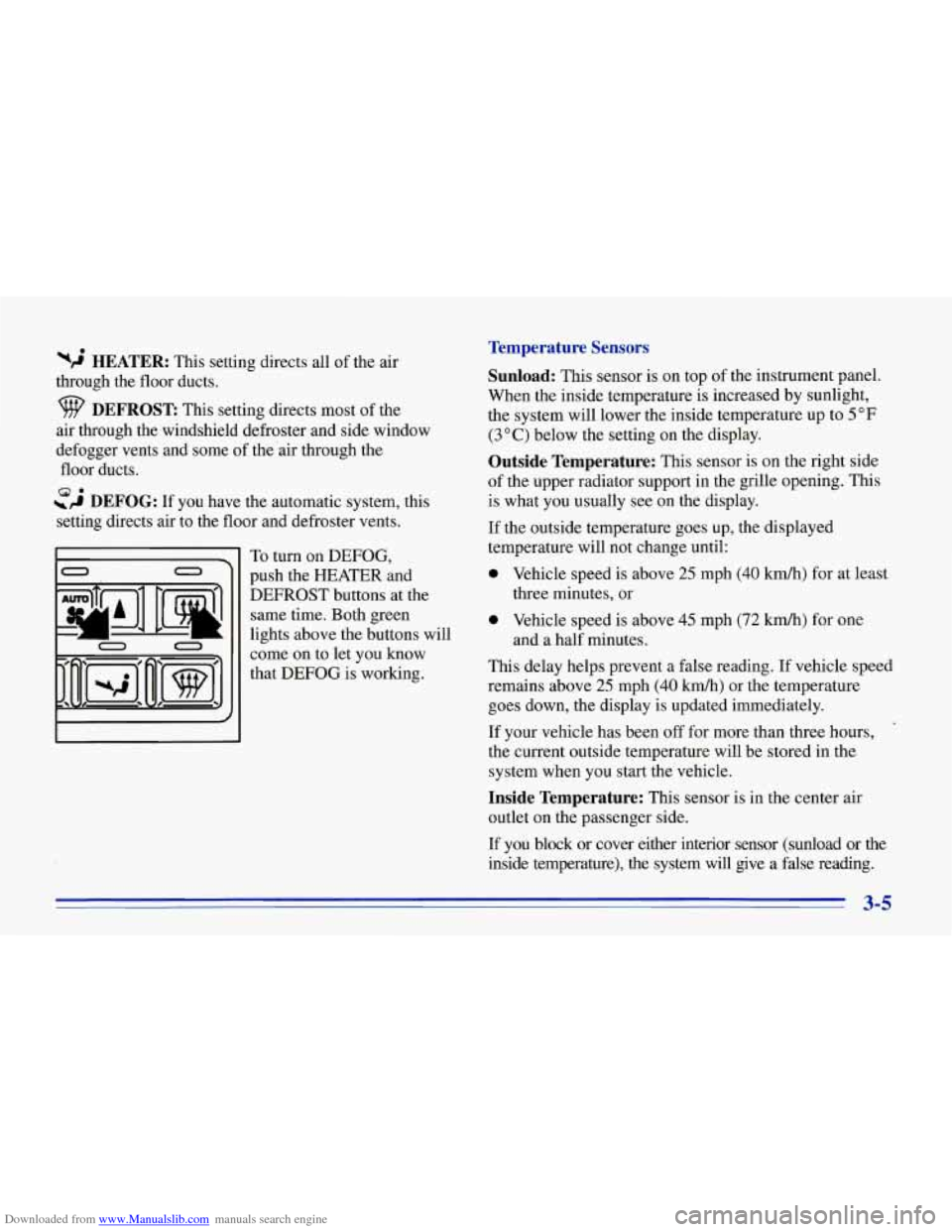
~,4 DEFOG: If you have the automatic system, this
setting directs air to the floor and defroster vents. 8.
To turn on DEFOG,
push the HEATER and
DEFROST buttons at the same time. Both green
lights above the buttons will
come on to let you know
that DEFOG is working.
Temperature Sensors
Sunload:
This sensor is on top of the instrument panel.
When the inside temperature is increased by sunlight,
the system will lower the inside temperature up to 5
OF
(3 O C) below the setting on the display.
Outside Temperature: This sensor is on the right side
of the upper radiator support in the grille opening. This
is what you usually see on the display.
If the outside temperature goes up, the displayed
temperature will not change until:
0 Vehicle speed is above 25 mph (40 km/h) for at least
0 Vehicle speed is above 45 mph (72 km/h) for one
This delay helps prevent a false reading. If vehicle speed
remains above 25 mph
(40 kmh) or the temperature
goes down, the display is updated immediately.
If your vehicle has been off for more than three hours,
the current outside temperature will be stored in the
system when you start the vehicle.
three minutes, or
and a half minutes.
Inside Temperature: This sensor is in the center air
outlet on the passenger side.
I€ you block or cover either interior sensor (sunload or the
inside temperature), the system will give a false reading.
3-5