Page 169 of 392
Downloaded from www.Manualslib.com manuals search engine Before You Go Off-Roading
There are some things to do before you go out. For
example, be sure
to have all necessary maintenance and
service work done. Check to make sure all underbody
shields (if
so equipped) are properly attached. Be sure
you read
all the information about your four-wheel-drive
vehicle
in this manual. Is there enough fuel? Is the spare
tire
fully inflated? Are the fluid levels up where they
should be? What are the local laws that apply to
off-roading where you’ll be driving? If you don’t know,
you should check with law enforcement people
in the
area. Will you be
on someone’s private land? If so, be
sure to get the necessary permission.
Loading Your Vehicle for Off-Road Driving
There are some important things to remember about
how to load your vehicle.
0 The heaviest things should be on the load floor and
forward of your rear axle. Put heavier items as far
forward as you can.
Be sure the load is secured properly, so driving on
the off-road terrain doesn’t toss things around.
A CAUTION:
0 Cargo on the load floor piled higher than
the seatbacks can be thrown forward
during a sudden stop. You or your
passengers could be injured. Keep cargo
below the top of the seatbacks.
Unsecured cargo on the load floor can
be tossed about when driving over rough
terrain. You or your passengers can
be struck by flying objects. Secure the
cargo properly,
Heavy loads on the roof raise the vehicle’s
center of gravity, making it more likely to
roll over. You can be seriously
or fatally
injured if the vehicle rolls over, Put heavy
loads inside the cargo area, not on the roof,
Keep cargo in the cargo area as far forward
and low as possible.
You’ll find other important information in
this manual.
See “Vehicle Loading,” “Luggage Carrier” and “Tires”
in the Index.
I
4-15
Page 234 of 392
Downloaded from www.Manualslib.com manuals search engine Removing the Spare Tire and Tools
The jacking equipment you'll need is stored along the
driver's rear wall. In some cases, you may have to
remove the spare tire
in order to reach the jack. Your
vehicle is also equipped with work gloves and
a plastic
ground mat to assist in the changing
of a flat tire.
To remove your jack cover,
pull up on the latch at the
end of
the cover, near the
endgate and the latch on the
top
of the cover. Remove
the wheel blocks, jack and
wheel wrench.
*
The following instructions explain how to remove
the spare tire, depending
on where it is mounted on
your vehicle.
NOTICE:
I
Never remove or restow a tire frodto a
stowage position under the vehicle while the
vehicle is supported by a
jack. Always tighten
the tire fully against the underside of the vehicle when restowing.
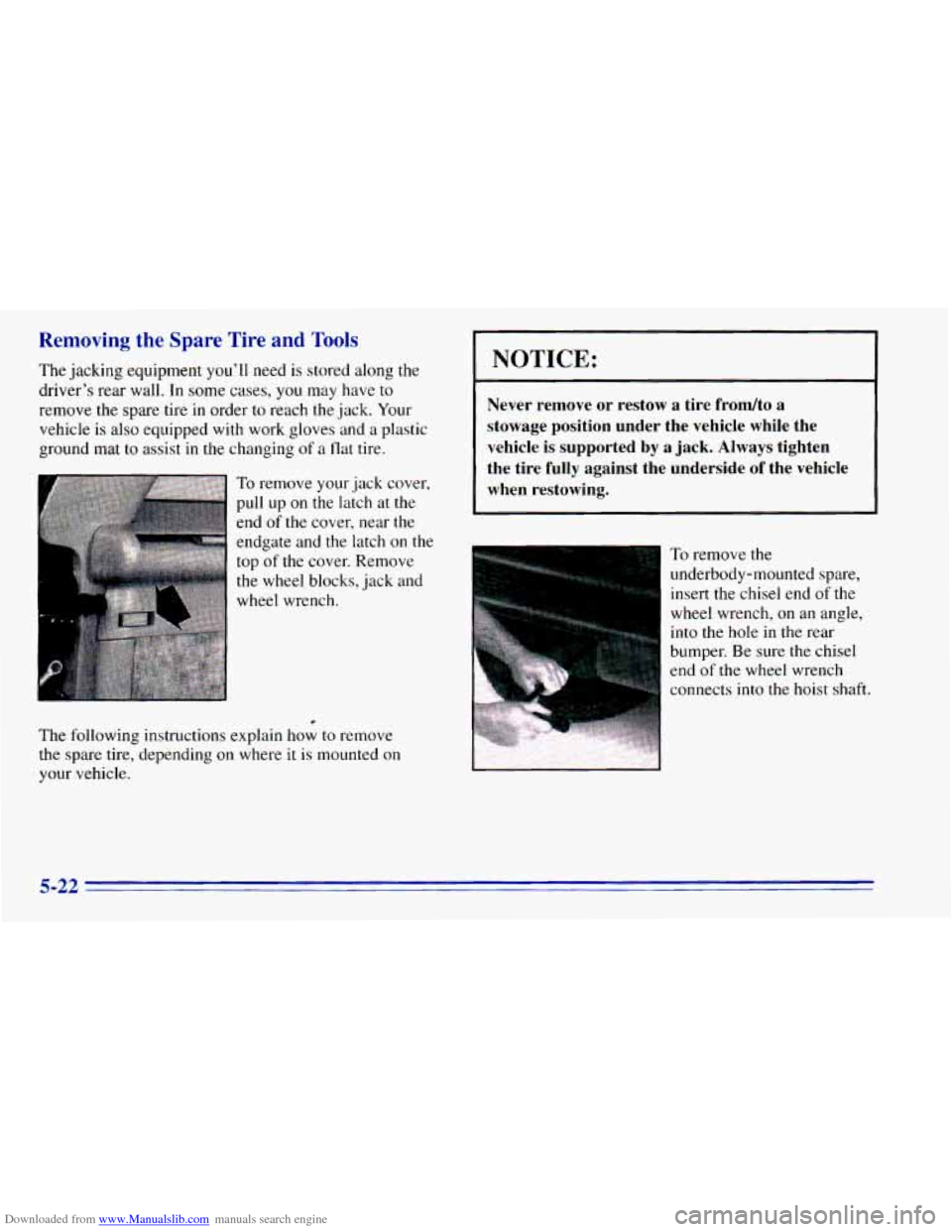
To remove the
underbody-mounted spare,
insert the chisel end
of the
wheel wrench, on an angle, into the hole in
the rear
bumper.
Be sure the chisel
end
of the wheel wrench
connects into the hoist shaft.
5-22
Page 235 of 392
Downloaded from www.Manualslib.com manuals search engine Turn the wheel wrench counterclockwise to lower the
spare tire. Keep turning the wheel wrench until the spare
tire can be pulled
out from under the vehicle.
When the tire has been completely lowered,
tilt the
retainer at
the end of the cable and pull it through the
wheel opening. Pull the tire out from under
the vehicle.
I NOTICE:
I
To help avoid vehicle damage, do not drive the
vehicle before the cable
is restored.
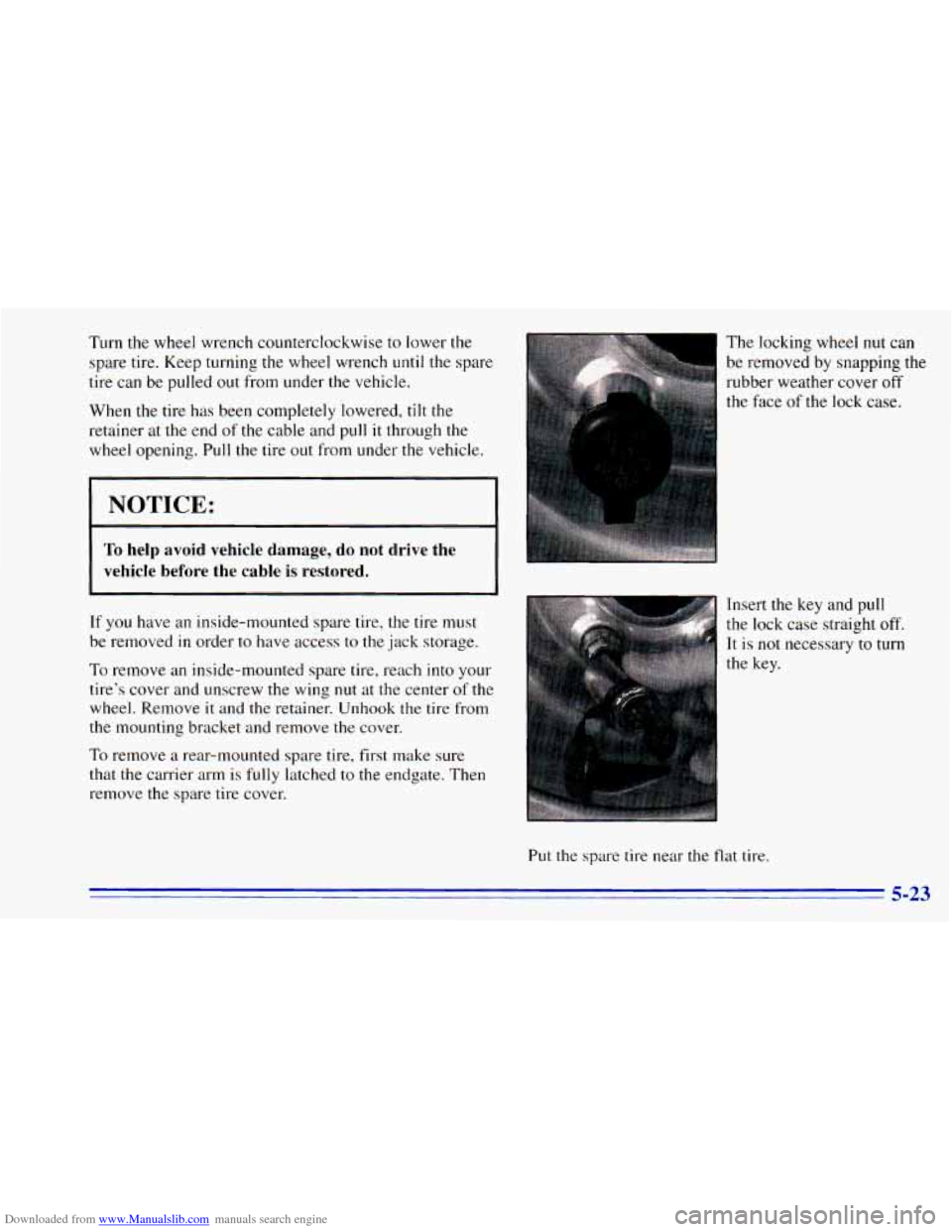
If you have an inside-mounted spare tire, the tire must
be removed
in order to have access to the jack storage. The
locking wheel nut can
be removed by snapping
the
rubber weather cover off
the face
of the lock case.
Insert the key and pull
the lock case straight off.
It is
not necessary to turn
To remove an inside-mounted spare tire, reach into your
tire’s cover and unscrew
the wing nut at the center of the
wheel. Remove
it and the retainer. Unhook the tire from
the mounting bracket and remove
the cover.
To remove a rear-mounted spare tire, first make sure
that the carrier arm
is fully latched to the endgate. Then
remove the spare tire cover.
Put the spare tire near the flat tire.
5-23
Page 237 of 392
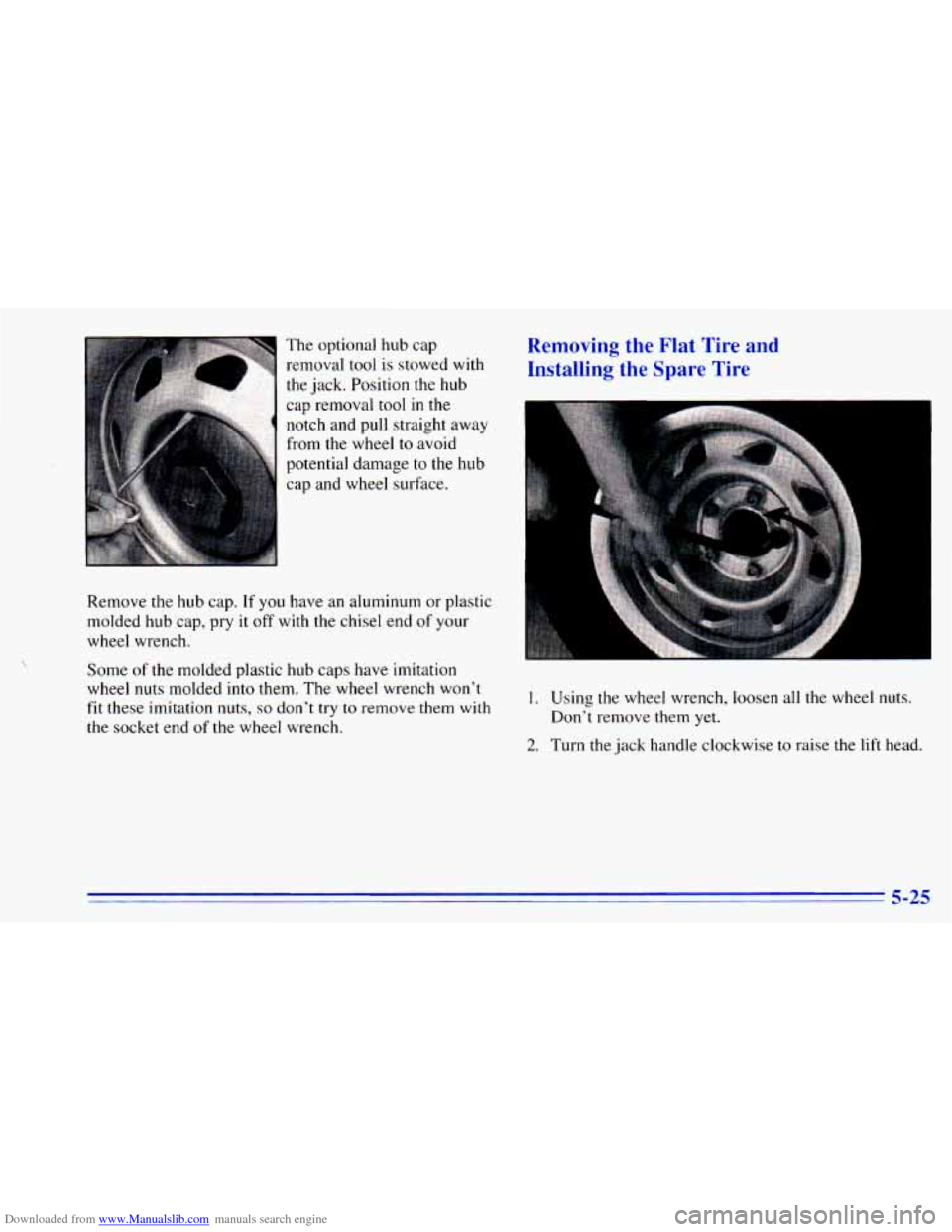
Downloaded from www.Manualslib.com manuals search engine The optional hub cap
removal tool
is stowed with
the jack. Position the hub
cap removal tool in the
notch and pull straight away
from
the wheel to avoid
potential damage
to the hub
cap and wheel surface.
Remove the hub cap.
If you have an aluminum or plastic
molded hub cap, pry
it off with the chisel end of your
wheel wrench.
Some of the molded plastic hub caps have imitation
wheel nuts molded into them. The wheel wrench won't
fit these imitation nuts,
so don't try to remove them with
the socket end of the wheel wrench.
Removing the Flat Tire and
Installing the Spare Tire
1. Using the wheel wrench, loosen all the wheel nuts.
2. Turn the jack handle clockwise to raise the lift head.
Don't
remove them
yet.
5-25
Page 239 of 392
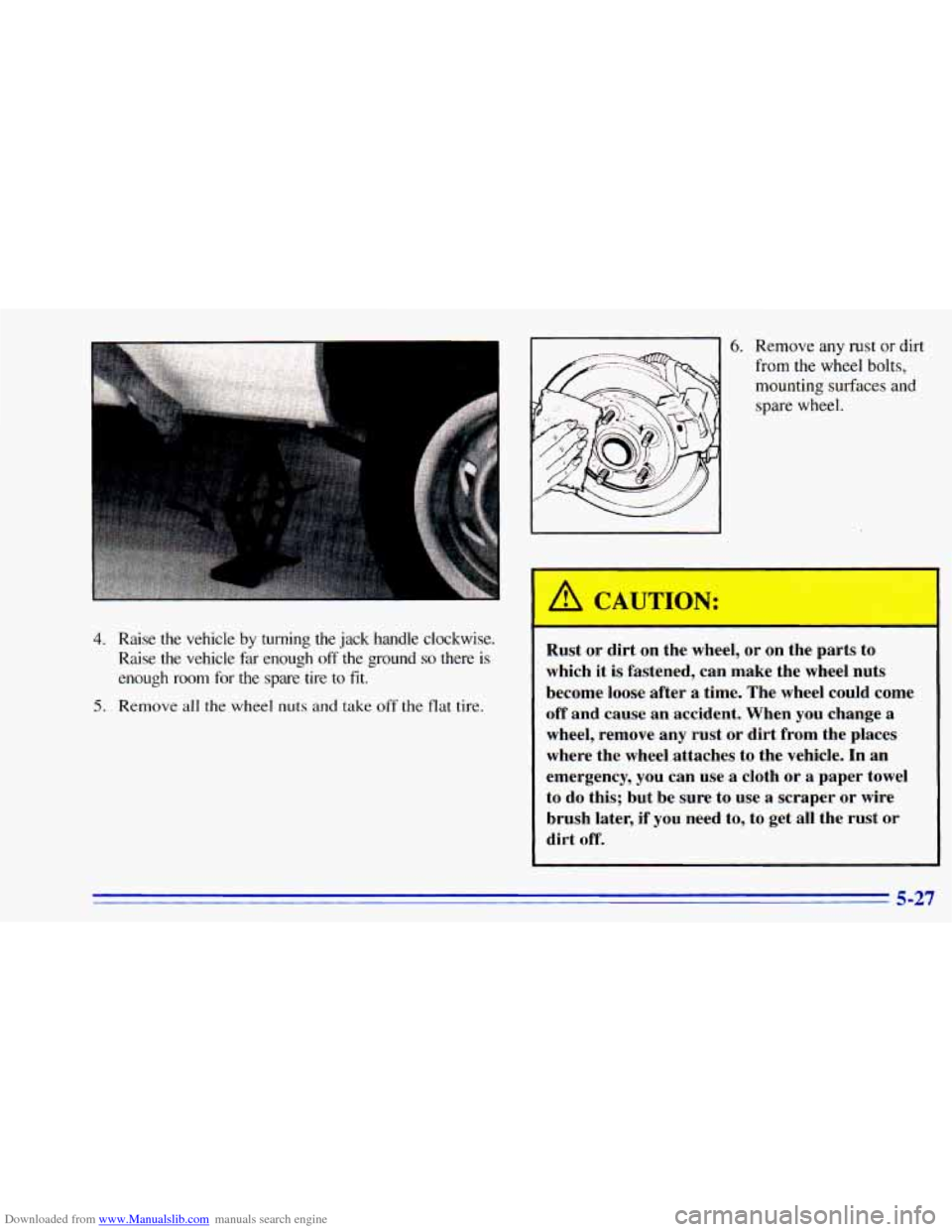
Downloaded from www.Manualslib.com manuals search engine 4. Raise the vehicle by turning the jack handle clockwise.
Raise the vehicle far enough
off the ground so there is
enough room for
the spare tire to fit.
5. Remove all the wheel nuts and take off the flat tire.
6. Remove any rust or dirt
from the wheel bolts,
mounting surfaces
and
spare wheel.
A CAUTION:
Rust or dirt on the wheel, or on the parts to
which it is fastened, can make the wheel nuts
become loose after a time. The wheel could come
off and cause an accident. When you change a
wheel, remove any rust or dirt from the places
where the wheel attaches to the vehicle. In an
emergency, you can use a cloth or a paper towel
to do this; but be sure to use a scraper or wire
brush later, if you need to, to get all the rust or
dirt
off.
5-27
Page 240 of 392
Downloaded from www.Manualslib.com manuals search engine '
A CAUTION:
Never use oil or grease on studs or nuts. If you
do, the nuts might come loose. Your wheel could
fall off, causing
a serious accident.
1
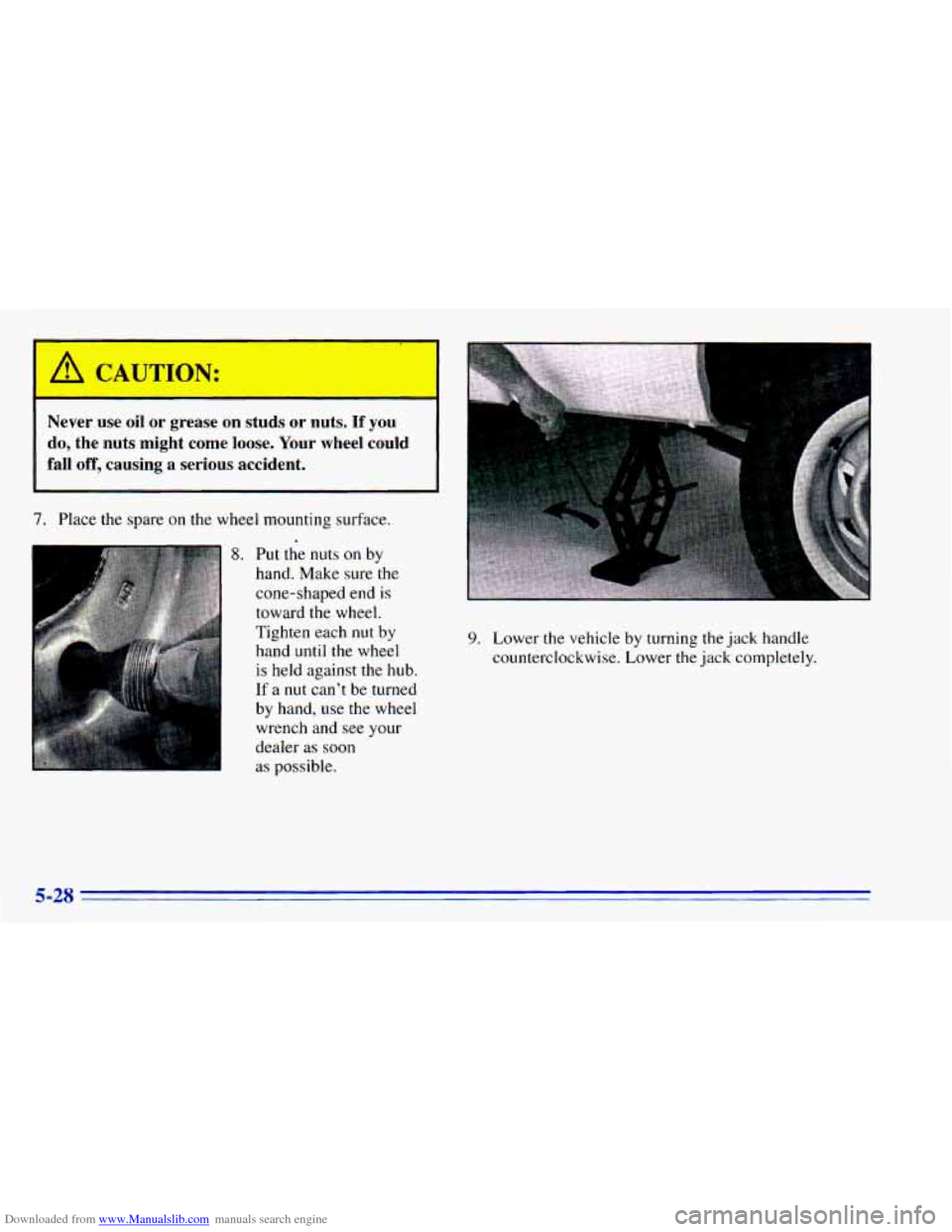
7. Place the spare on the wheel mounting surface.
8. Put the nuts on by
hand. Make sure
the
cone-shaped end is
toward the wheel.
Tighten each
nut by
hand until the wheel
is held against the hub.
If a nut can't be turned
by hand,
use the wheel
wrench and see your
dealer as soon
as possible.
9. Lower the vehicle by turning the jack handle
counterclockwise. Lower the jack completely.
5-28
Page 242 of 392
Downloaded from www.Manualslib.com manuals search engine Storing a Flat or Spare Tire -..ne Tn4s
Storing a jack, a tire or other equipment in the
passenger compartment
of the vehicle could
cause injury. In a sudden
stop or collision, loose
equipment could strike someone. Store all these in the proper place.
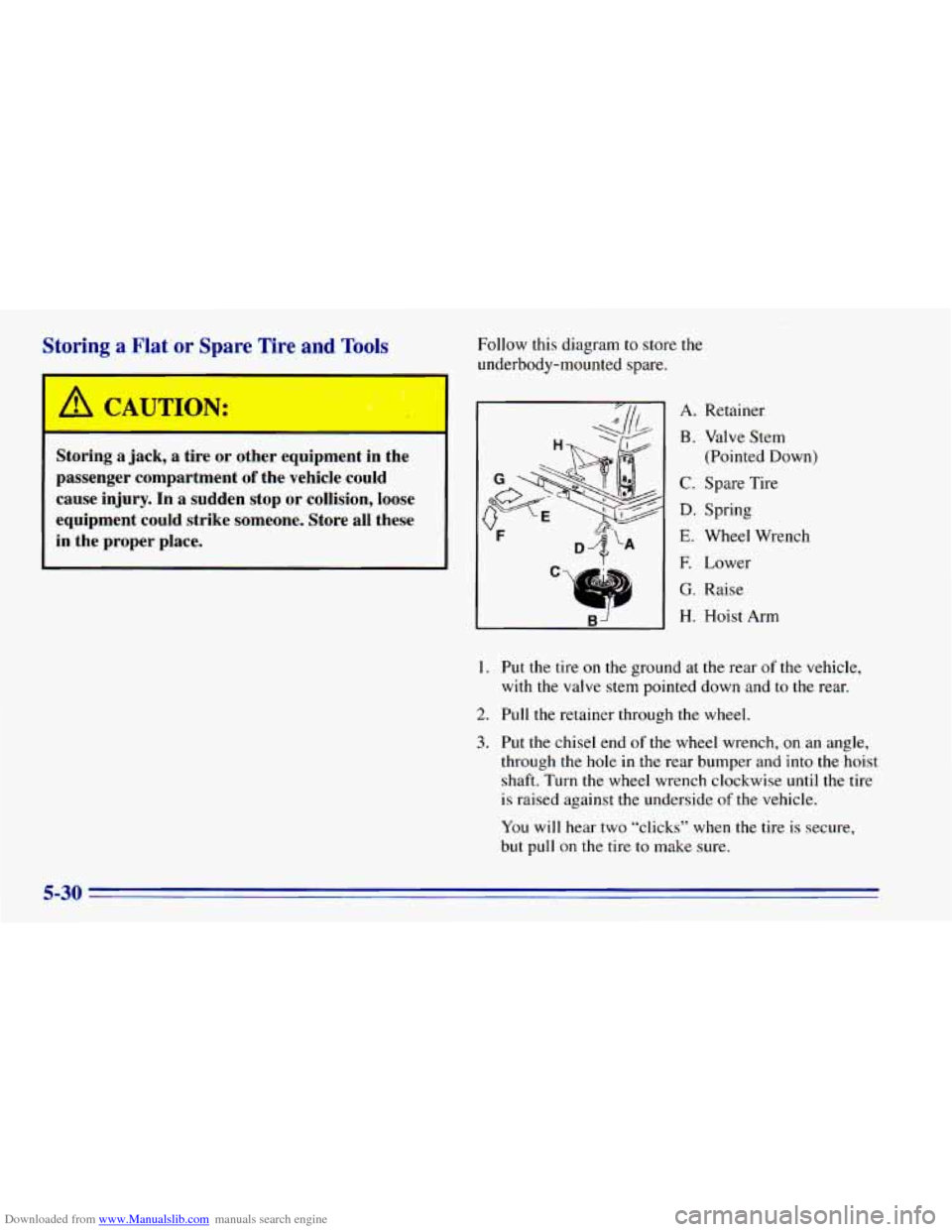
Follow this diagram to store the
underbody-mounted spare.
cTD B
A. Retainer
B. Valve Stem
(Pointed Down)
C. Spare Tire
D. Spring
E. Wheel Wrench
E Lower
G. Raise
H. Hoist Arm
1. Put the tire on the ground at the rear of the vehicle,
with the valve stem pointed down and
to the rear.
2. Pull the retainer through the wheel.
3. Put the chisel end of the wheel wrench, on an angle,
through the hole
in the rear bumper and into the hoist
shaft. Turn the wheel wrench clockwise until the tire
is raised against
the underside of the vehicle.
You will hear two “clicks” when the tire is secure,
but
pull on the tire to make sure.
5-30
Page 243 of 392
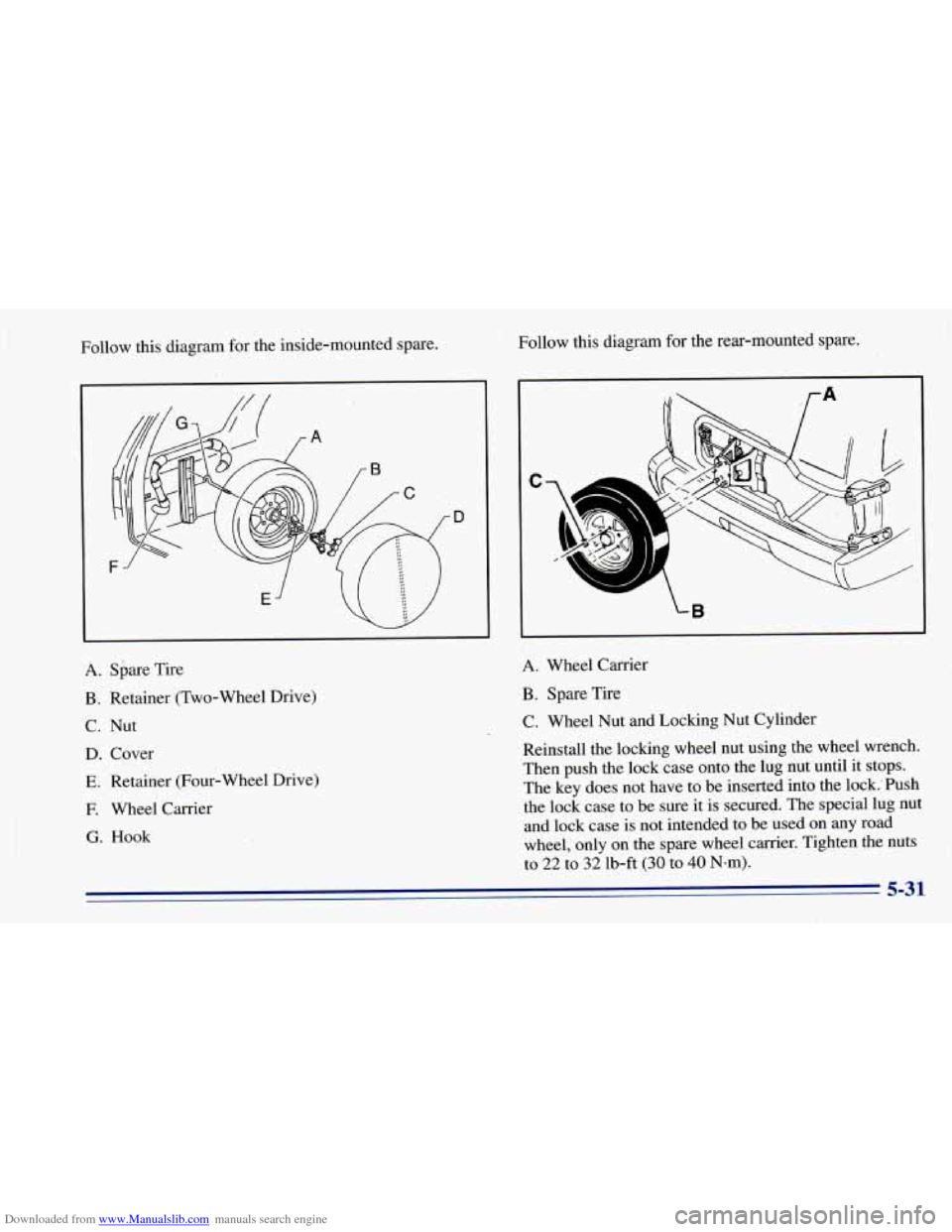
Downloaded from www.Manualslib.com manuals search engine Follow this diagram for the inside-mounted spare.
D
A. Spare Tire
B. Retainer (Two-Wheel Drive)
C. Nut
D. Cover
E. Retainer (Four-wheel Drive)
E Wheel Carrier
G. Hook Follow this diagram
for the rear-mounted spare.
A. Wheel Carrier
B. Spare Tire
C. Wheel Nut and Locking Nut Cylinder
Reinstall the locking wheel nut using the wheel wrench.
Then push the lock case onto the lug nut until it stops.
The key does not have to be inserted into. the 1ock:Push
the lock case
to be sure it is secured. The special lug nut
and lock case is not intended to be used on
any road
wheel, only on the spare wheel carrier. Tighten the nuts
to
22 to 32 lb-ft (30 to 40 N-m).
5-31