Page 218 of 388
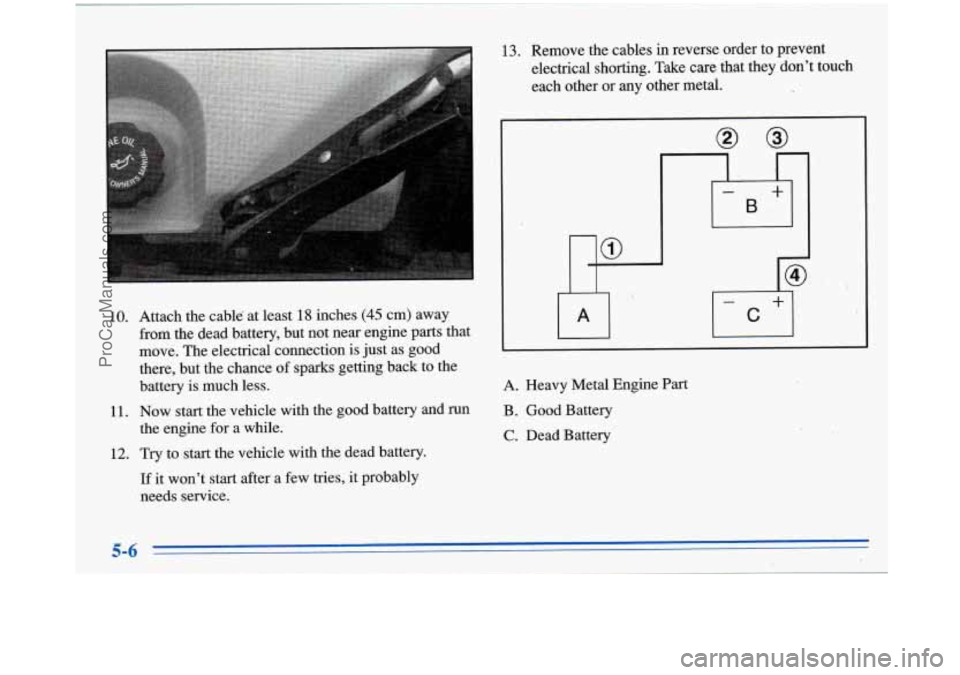
10.
11. 12.
Attach the cable at least 18 inches (45 cm) away
from the dead battery, but not near engine parts that
move. The electrical connection is just as good
there, but the chance of sparks getting back to the
battery is much less.
Now start the vehicle with the good battery and run
the engine for a while.
Try to-start the vehicle with the dead battery.
If it won’t start after a few tries, it probably
needs service.
13. Remove the cables in reverse order to prevent
electrical shorting. Take care that they don’t touch
each other or
any other metal.
A. Heavy Metal Engine Part
B
. Good Battery
C. Dead Battery
ProCarManuals.com
Page 219 of 388
Towing Your Vehicle
Try to have a GM dealer or a professional towing
service tow your Buick.
If your vehicle has been changed or modified since it
was factory-new by adding after-market items like fog
lamps, aero skirting, or special tires and wheels, these
instructions and illustrations may not be correct.
Before
you do anything, turn on the hazard
warning flashers.
When
you call, tell the towing service:
0
0
0
0
0
That your vehicle can only be towed with certain
equipment, as described later in this section.
That your vehicle has front-wheel drive.
The make, model and year of your vehicle.
Whether
you can still move the shift lever.
If there was an accident, what was damaged.
When the towing service arrives, let the tow operator
know that this manual contains detailed towing
instructions and illustrations. The operator may want to
see them.
A CAUTION:
To help avoid injury to you or others:
0 Never let passengers ride in a vehicle that is
0 Never tow faster than safe or posted speeds.
0 Never tow with damaged parts not fully
secured.
0 Never get under your vehicle after it has
been lifted by the tow truck.
Always secure the vehicle on each side with
separate safety chains when towing it.
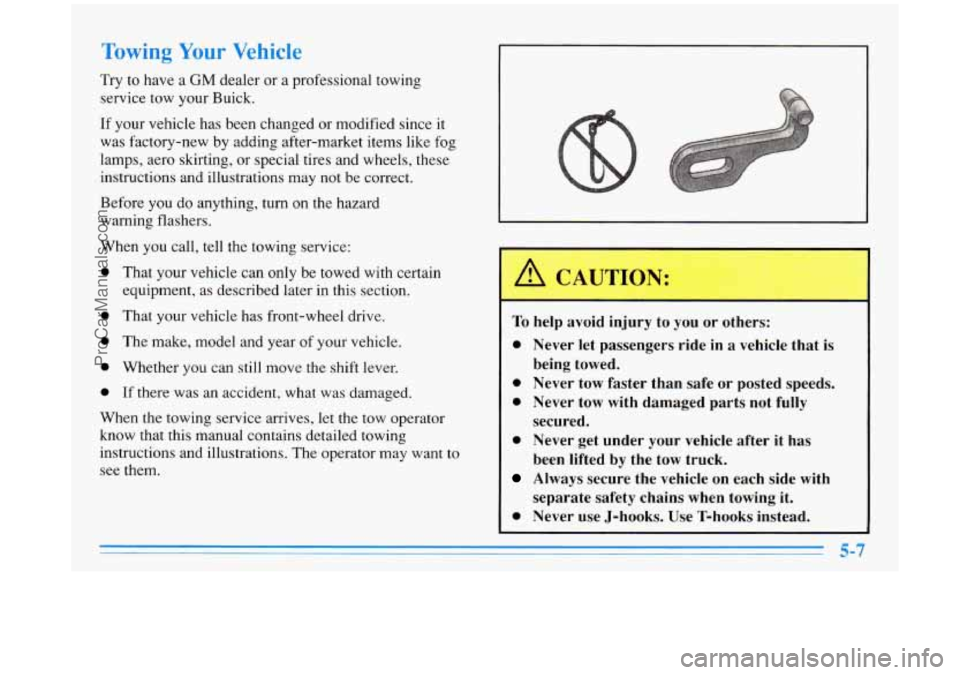
0 Never use J-hooks. Use T-hooks instead.
being towed.
5-7
ProCarManuals.com
Page 220 of 388
L
A vehicle can fall from a car carrier if it isn’t
adequately secured. This can cause
a collision,
serious personal injury and vehicle damage. The
vehicle should be tightly secured with chains or
steel cables before it is transported.
Don’t use substitutes (ropes, leather straps,
canvas webbing, etc.) that can be cut
by sharp
edges underneath the towed vehicle. Always use
T-hooks inserted in the T-hook slots. Never use
J-hooks. They
will damage drivetrain and
suspension components. When your vehicle
is being towed, have
the ignition
key in the
OFF position. The steering wheel should
be clamped in a straight-ahead position, with
a
clamping device designed for towing service. Do not
use the vehicle’s steering column lock for this. The
transaxle should be in
NEUTRAL (N) and the parking
brake released.
Don’t have your vehicle towed on the front wheels,
unless you must. If the vehicle must
be towed on the
front wheels, be sure to follow the speed and distance
restrictions later in this section or your transaxle will be
damaged.
If these limits must be exceeded, then the
front wheels have to be supported
on a dolly.
ProCarManuals.com
Page 225 of 388
If No Steam Is Coming From Your Engine
If you get the overheat warning but see or hear no
steam, the problem may not be too serious. Sometimes
the engine can get a little
too hot when you:
0 Climb a long hill on a hot day.
Stop after high-speed driving.
Idle for long periods in traffic.
@ Tow a trailer.
If you get the overheat warning with no sign of steam,
try this for a minute or
so:
1. Turn off your air conditioner.
2. Turn on your heater to full hot at the highest fan
speed and open
the window as necessary.
3. If you’re in a traffic jam, shift to NEUTRAL (N);
otherwise, shift to the highest gear while
driving
-- AUTOMATIC OVERDRIVE (a)
or THIRD (3).
If you no longer have the overheat warning, you
can drive. Just to be safe, drive slower for about
10 minutes. If the warning doesn’t come back on,
you can drive normally.
If the warning continues, pull over, stop, and park your
vehicle right away.
If there’s still no sign of steam, you can idle the engine
for two or three minutes while you’re parked, to see if
the warning stops. But then, if you still have the
warning,
turn off the engine and get evejyone out of the
vehicle
until it cools down.
You may decide not to lift the hood but to get service
help right away.
ProCarManuals.com
Page 227 of 388
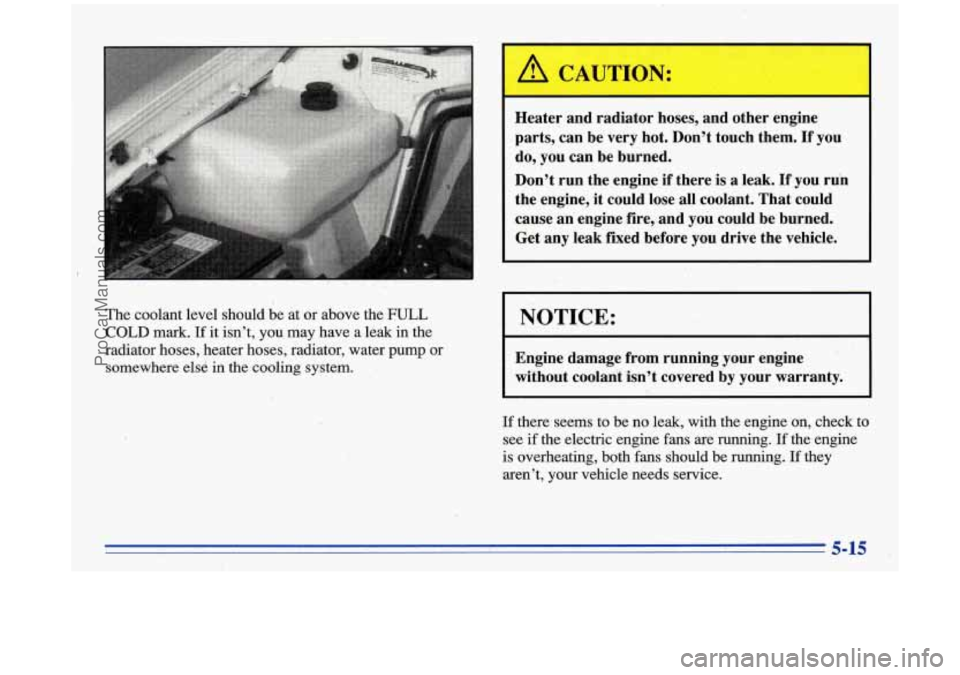
The coolant level should be at or above the FULL
COLD mark. If it isn't, you may have a leak in the
radiator hoses, heater hoses, radiator, water
purnp or
somewhere elsC
in the-cooling system..
I A CAUTION:
I
Heater and radiator hoses, and other engine
parts, can be very hot. Don't touch them.
If you
do, you can be burned.
Don't run the engine
if there is a leak. If you run
the engine, it could lose all coolant. That could
cause an' engine fire, -and you could be burned.
Get any leak fixed before you drive the vehicle.
I NOTICE:
Engine damage from running your engine
without coolant isn't covered
by your warranty.
If there seems to be no leak, with the engine on, check to
see if the electric engine fans are running.
If the engine
is overheating, both fans should be running.
If they
aren't, your vehicle needs service.
5-15 ,
ProCarManuals.com
Page 249 of 388
Section 6 Service and Appearance Care
Here you will find information about the care of your
Buick. This section begins with service and fuel
information, and then it shows how to check important
fluid and lubricant levels. There is also technical
information about your vehicle, and a part devoted to its
appearance care.
Service
Your Buick dealer knows your vehicle best and wants
you to be happy with it. We hope you’ll
go to your
dealer for all your service needs. You’ll get genuine GM
parts and GM-trained and supported service people. We
hope you’ll want to keep your GM vehicle all GM.
Genuine GM parts have one of these marks:
Delco
....
6-1
ProCarManuals.com
Page 250 of 388
Doing Your Own Service Work
If you want to do some of your own service work, you’ll
want to get the proper Buick Service Manual. It tells you
much more about how to service your Buick than this
manual can.
To order the proper service manual, see
“Service and Owner Publications” in the Index.
Your vehicle has an air bag system. Before attempting to
do your own service work, see “Servicing Your Air
Bag-Equipped Buick” in the Index.
You should keep a record with all parts receipts and list
the mileage and the date
of any service work you
perform. See “Maintenance Record” in the Index.
You can be injured and your vehicle could be
damaged
if you try to do service work on a
vehicle without knowing enough about it.
Be sure you have sufficient knowledge,
experience, and the proper replacement parts and tools before you attempt any
vehicle maintenance task.
Be sure to use the proper nuts, bolts and
other fasteners. “English” and “metric”
fasteners can be easily confused.
If you use
the wrong fasteners, parts can later break
or
fall off. You could be hurt.
6-2
ProCarManuals.com
Page 251 of 388
Fuel
The 8th digit of your vehicle identification number
(VIN) shows the code letter for your engine. You will
find the
VIN at the top left of your instrument panel.
(See “Vehicle Identification Number” in the Index.)
If you don’t have the 3800 Supercharged engine (VIN
Code l), use regular unleaded gasoline rated at 87 octane
or higher.
If you have the 3800 Supercharged engine, use premium
unleaded gasoline rated at 91 octane or higher.
At a minimum, the gasoline you use should meet
specifications ASTM D4814 in the United States and
CGSB 3.5-M93 in Canada. Improved gasoline
specifications have- been developed by the American
Automobile Manufacturers Association (AAMA) for
’ better vehicle performance and engine protection.
Gasolines meeting ihe AAMA specification could
, ’ provide improved driveability and emission control
system protection compared to other gasolines.
Be sure the posted octane for premium is at least 91
(at least 89 for middle grade and
87 for regular). If the
i octane is, less than 87, you may get a heavy knocking
noise when you drive.
If it’s bad enough, it can damage
your engine.
,
If you have the 3800 Supercharged engine, in an
emergency, you may be able to use .a lower octane
-- as
low as 87
-- if heavy knocking does not occur. If you
are using 91 or higher octane unleaded gasoline and you
still heq heavy knocking, your engine needs service.
,
If you’re using fuel rated at the recommended octane or
higher and you still hear heavy knocking, your engine
needs service. But don’t worry
if you hear a little
pinging noise when you’re accelerating or driving up a
hill. That’s normal, and you don’t have to buy a higher
octane fuel to get rid of pinging. It’s the heavy, constant
knock that means you have a problem.
If your vehicle is certified to meet California Emission
Standards (indicated on the underhood tune-up label), it
is designed to operate’on fuels that meet California
specifications. If such fuels are not available in states
adopting California emissions standards, your vehicle
will operate satisfactorily on fuels meeting federal
specifications, but emission control system performance
may be affected. The malfunction indicator lamp on
your instrument panel may turn on and/or your vehicle
may fail a smog-check test.
If this occurs, return to your
authorized Buick dealer for diagnosis to determine,the
cause of failure.
In the event it is determined that the
cause of the condition is the type of
fuels used, repairs
may not be covered by your warranty.
6-3
ProCarManuals.com