Page 134 of 388
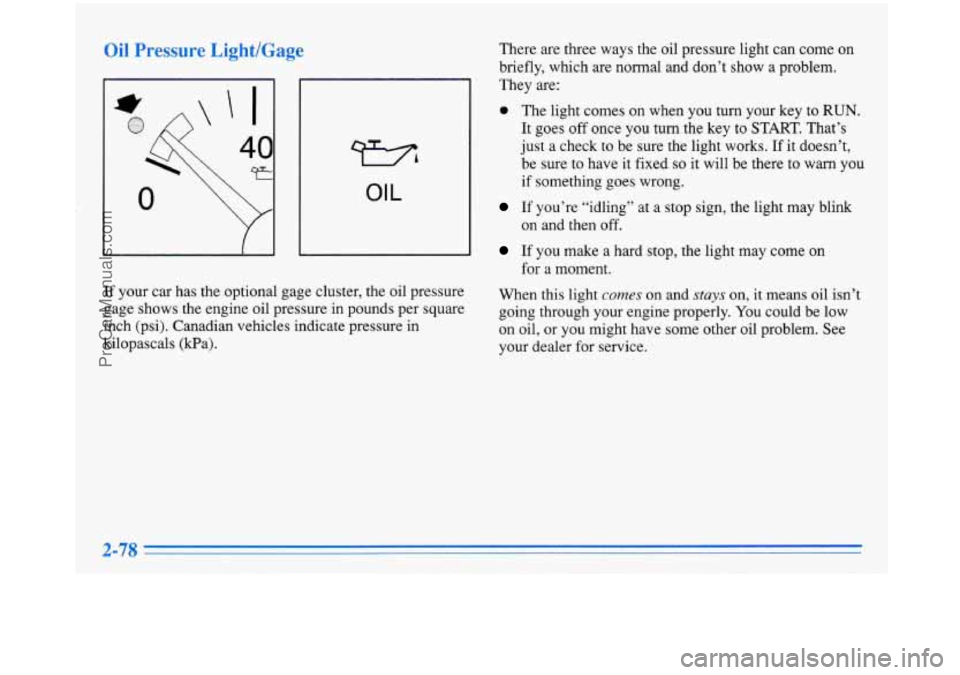
Oil Pressure Light/Gage
FZ
OIL
If your car has the optional gage cluster, the oil pressure
gage shows the engine oil pressure in pounds per square
inch (psi). Canadian vehicles indicate pressure in
kilopascals (Pa). There
are three ways the oil pressure light can come on
briefly, which are normal and don’t
show a problem.
They are:
0 The light comes on when you turn your key to RUN.
It goes off once you turn the key to START. That’s
just a check to be sure the light works. If it doesn’t,
be sure to have it fixed
so it will be there to warn you
if something goes wrong.
If you’re “idling” at a stop sign, the light may blink
on and then off.
If you make a hard stop, the light may come on
for a moment.
When this light
comes on and stays on, it means oil isn’t
going through your engine properly.
You could be low
on oil, or you might have some other oil problem. See
your dealer for service.
2-78
ProCarManuals.com
Page 135 of 388
Don’t keep driving if the oil pressure is low. If
you do, your engine can become so hot that it
catches fire.
You or others could be burned.
Check your oil as soon as possible and have your
vehicle serviced.
NOTICE:
Damage to your engine from neglected oil
problems can be costly and
is not covered by
your warranty.
Check Oil Level Light (Option)
CHECK
OIL LEVEL
The CHECK OIL LEVEL
light comes on for three
seconds as a bulb check
each time the ignition key is
turned to the
RUN position.
If the light doesn’t come on,
have your vehicle serviced.
If the engine oil is more than one quart low, the light
will come on briefly, then go off for
15-25 seconds, and
then come back on for
20-40 seconds.
However, the system will not register low engine oil if it
has not been more than eight minutes since the engine
was last shut off.
If the CHECK OIL LEVEL light comes back on, the
engine oil should be checked at the dipstick then
brought up to the proper level if necessary. See “Engine
Oil” in the Index.
2-79
ProCarManuals.com
Page 136 of 388
Change Oil Soon Light (Option)
CHANGE
OIL SOON
This light is activated by the
Engine Oil Life Monitor
System. The system
determines the condition of
the engine oil and lets you
know when the oil should be changed. (See “Engine
Oil” in the Index.)
It does this by using information about engine speed
(revolutions per minute), coolant temperature and
vehicle speed. The system uses this data to determine
how much the oil has degraded. When to
change your oil depends on driving habits and
conditions because these directly affect engine speed,
coolant temperature and vehicle speed. Because of this,
the CHANGE OIL SOON light may come
on as early as
2,000 miles or less for harsh conditions.
The CHANGE
OIL SOON light comes on for five
seconds as a bulb check each time the ignition key
is turned
to the RUN position. It will stay on for
60 seconds once 90% of the oil life has been used
and each time the engine is started after that.
If the
CHANGE
OIL SOON light is on continuously, there
is a problem with the Oil Life Monitor System and
service is required.
After changing the engine oil, the system should be
reset. This will cause the CHANGE
OIL SOON light to
be lit again for the bulb check period
of three seconds.
2-80
ProCarManuals.com
Page 143 of 388
Dual Automatic ComforTemp
Climate Control (Option)
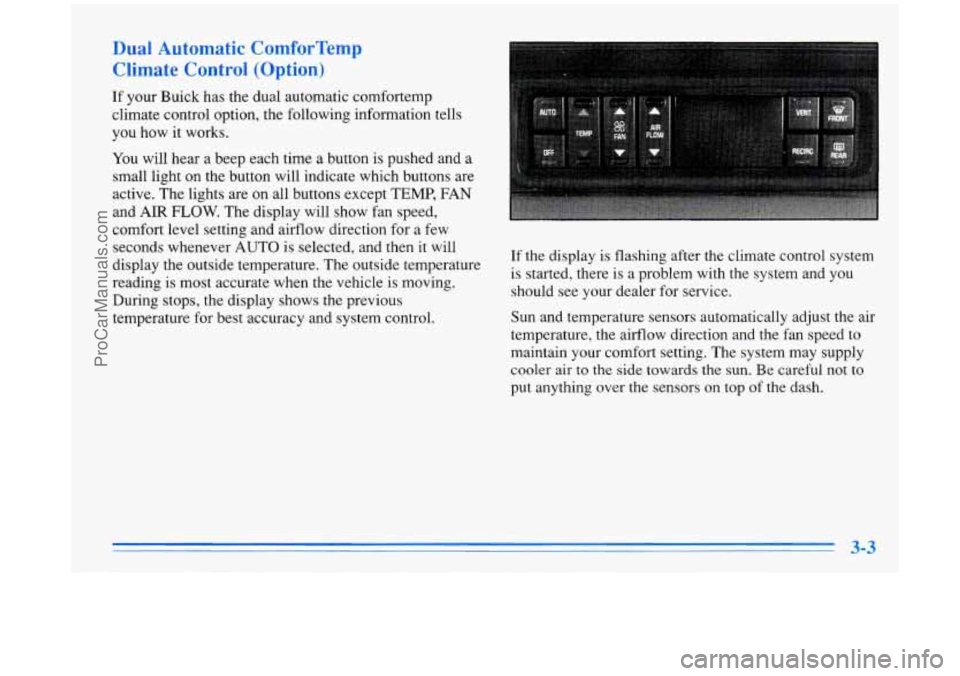
If your Buick has the dual automatic comfortemp
climate control option, the following information tells
you how it works.
You will hear a beep each time a button is pushed and a
small light on the button will indicate which buttons are
active. The lights are on all buttons except TEMP, FAN
and AIR
FLOW. The display will show fan speed,
comfort level setting and airflow direction for a few
seconds whenever AUTO is selected, and then it will
display the outside temperature. The outside temperature
reading is most accurate when the vehicle
is moving.
During stops, the display shows the previous
temperature for best accuracy and system control. If the display
is flashing after the climate control system
is started, there is a problem with the system and you
should see your dealer for service.
Sun and temperature sensors automatically adjust the air
temperature, the airflow direction and the fan speed to
maintain your comfort setting. The system may supply
cooler air to the
side towards the sun. Be careful not to
put anything over the sensors on top of the dash.
ProCarManuals.com
Page 171 of 388
Care of Your Cassette Tape Player
A tape player that is not cleaned regularly can cause
reduced sound quality, ruined cassettes or a damaged
mechanism. Cassette tapes should be stored in their
cases away from contaminants, direct sunlight and
extreme heat. If they aren’t,
they may not operate
properly or may cause failure
of the tape player.
Your tape player should be cleaned regularly after every
50 hours of use. Your radio may display CLN to indicate
that you have used your tape player for
50 hours without
resetting the tape clean timer.
If you notice a reduction
in sound quality, try a known good cassette to see if
the tape or the tape player is at fault. If this other
cassette has no improvement in sound quality, clean
the tape player.
Cleaning may be done with a scrubbing action,
non-abrasive cleaning cassette with pads which scrub
the tape head as the hubs
of the cleaner cassette turn. It
is normal for the cassette to eject while cleaning. Insert
the cassette at least three times to ensure thorough
cleaning.
A scrubbing action cleaning cassette is
available through your Buick dealer. You
may also choose
a non-scrubbing action, wet-type
cleaner which uses a cassette with a fabric belt to clean
the tape head. This type of cleaning cassette will not
eject. It may not clean as thoroughly as the scrubbing
type cleaner.
Cassettes are subject to wear and the sound quality may
degrade over time. Always make sure that the cassette
tape is in good condition before you have your tape
player serviced.
Care of Your Compact Discs
Handle discs carefully. Store them in their original cases
or other protective cases and away from direct sunlight
and dust. If the surface of a disc is soiled, dampen a
clean, soft cloth in a mild, neutral detergent solution and
clean
it, wiping from the center to the edge.
Be sure never
to touch the signal surface when handling
discs. Pick up discs by grasping
the outer edges or the
edge
of the hole and the outer edge.
ProCarManuals.com
Page 195 of 388
The exit speed is usually posted.
Reduce your speed according to your speedometer, not
to your sense of motion. After driving for any distance
at higher speeds, you may tend to think you are going
slower than you actually are.
Before Leaving on a Long Trip
Make sure you’re ready. Try to be well rested. If you
must start when you’re not fresh
-- such as after a day’s
work
-- don’t plan to make too many miles that first part
of the journey. Wear comfortable clothing and shoes you
can easily drive
in.
Is your vehicle ready for a long trip? If you keep it
serviced and maintained, it’s ready to go.
If it needs
service, have
it done before starting out. Of course,
you’ll find experienced and able service experts in
Buick dealerships all across
North America. They’ll be
ready and willing
to help if you need it. Here
are some things
you can check before a trip:
0
0
0
0
0
0
0
Windshield Washer Fluid: Is the reservoir full? Are
all windows clean inside and outside?
Wiper Blades: Are they in good shape?
Fuel, Engine Oil, Other Fluids: Have you checked
all levels?
Lamps: Are they all working? Are the lenses clean?
Tires: They are vitally important to a safe,
trouble-free trip.
Is the tread good enough for
long-distance driving? Are the tires all inflated to the
recommended pressure?
Weather Forecasts: What’s the weather outlook
along your route? Should you delay your trip a short
time to avoid a major storm system?
Maps: Do you have up-to-date maps?
ProCarManuals.com
Page 196 of 388

Highway Hypn~s
Is there actually such a condition as “highway hypnosis”?
Or is
it just plain falling asleep at the wheel? Call it
highway hypnosis, lack of awareness, or whatever.
There
is something about an easy stretch of road with
the same scenery, along with the
hum of the tires on
the road, the drone of the engine, and the rush
of the
wind against the vehicle that can make you sleepy.
Don’t let it happen to you! If it does, your vehicle can
leave the road in
less than a second, and you could
crash and be injured.
What can you do about highway hypnosis? First, be
aware that it can happen.
Then here
are some tips:
0
Make sure your vehicle is well ventilated, with a
comfortably cool interior.
Keep your eyes moving. Scan the road ahead and
to
the sides. Check your rearview mirrors and your
instruments frequently.
If you get sleepy, pull off the road into a rest, service
or parking area and take a nap, get some exercise, or
both. For safety, treat drowsiness
on the highway as
an emergency.
Hil lnd Mountain Roads
Driving on steep hills or mountains is different from
driving in flat or rolling terrain.
4-22
ProCarManuals.com
Page 211 of 388
When You Are Ready to Leave After
Parking on a Hill
1. Apply your regular brakes and hold the pedal down
while you:
Start your engine;
Shift into a gear; and
e Release the parking brake.
2. Let up on the brake pedal.
3. Drive slowly until the trailer is clear of the chocks.
4. Stop and have someone pick up and store the chocks.
Maintenance When Trailer Towing
Your vehicle will need service more often when you’re
pulling a trailer. See the Maintenance Schedule for more
on this. Things that are especially important in trailer
operation are automatic transaxle fluid (don’t overfill),
engine oil, belts, cooling system and brake adjustment.
Each
of these is covered in this manual, and the Index
will help
you find them quickly. If you’re trailering, it’s
a good idea to review these sections before you start
your trip.
Check periodically to see that all hitch nuts and bolts
are tight.
ProCarManuals.com