1996 BUICK PARK AVENUE warning light
[x] Cancel search: warning lightPage 12 of 388
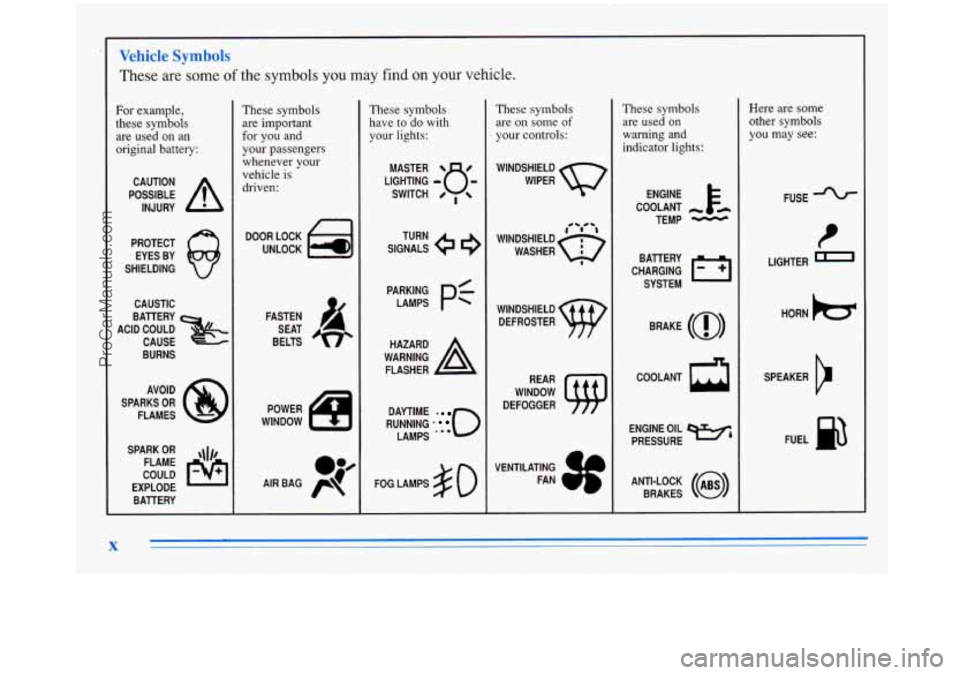
Vehicle Symbols
These are some of the symbols you may find on your vehicle.
For example,
these symbols
are used on an
original battery:
POSSIBLE A
CAUTION
INJURY
PROTECT EYES BY
SHIELDING
CAUSTIC
BURNS AVOID
SPARKS
OR
FLAMES
SPARK
OR ,\I/,
COULD FLAME
EXPLODE BATTERY
These symbols
are important
for you and
your passengers
whenever your
vehicle is driven:
DOOR LOCK
UNLOCK
FASTEN SEAT
BELTS
POWER
WINDOW
These symbols
have to do with
your lights:
SIGNALS e e
TURN
WARNING
A
HAZARD
FLASHER
RUNNING
0
DAYTIME -
LAMPS '**
FOG LAMPS $0
These symbols
are on
some of
your controls:
WINDSHIELD
WIPER
WINDSHIELD DEFROSTER
WINDOW
DEFOGGER
VENTILATING FAN
These symbols are used
on
warning and
indicator lights:
COOLANT
TEMP
-
CHARGING I-1
BATTERY
SYSTEM
BRAKE
(0)
ENGINE OIL e,
PRESSURE
ANTI-LOCK
(@)
BRAKES
Here are some
other symbols you may see:
FUSE
I
LIGHTER I
HORN h=r
SPEAKER
b
FUEL n3
X
ProCarManuals.com
Page 76 of 388
I.
I
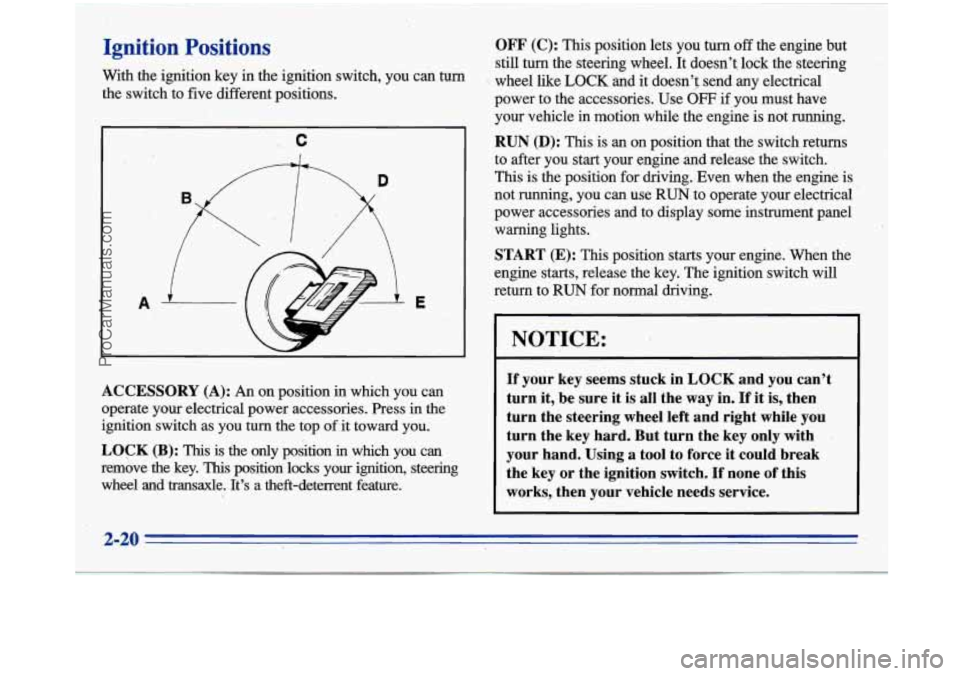
Ignition Positions
With the ignition key in the ignition switch, you can turn
the switch to five different positions.
.. c
I
A E
ACCESSORY (A): An on position in which you can
operate your electrical power accessories. Press in the
ignition switch as you
hun the top of it toward you.
LOCK
(B): This is the only position in which yqu can
remove
the key. This position locks your ignition, steering
wheel and transaxle. It’s a theft-deterrent feature.
.. ,
OFF (C): This position lets you turn off the engine but
still turn the steering wheel. It doesn’t lock the steering
-.
wheel like LOCK and it doesn’f send any electrical
power to the accessories. Use
OFF if you must have
your vehicle
in motion while the engine is not running.
RUN (D): This is- an on position that the switch returns
to after you start your engine and release the switch.
This is the position for driving.-Even when the engine is
not running, you can use RUN to operate your electrical ’
power accessories and to display some instrument panel
warning lights.
START (E): This position starts your engine. When the
engine starts, release the key. The ignition switch
will
return to RUN for normal driving.
NOTICE:
If your key seems stuck in LOCK and you can’t
turn it, be sure it is all the
way in. If it is, then
turn the steering wheel left and right while you
turn the key hard. But turn the key only with
your hand. Using
a tool to force it could break
the key or the ignition switch.
If none of this
works, then your vehicle needs service.
ProCarManuals.com
Page 83 of 388
Pal _____
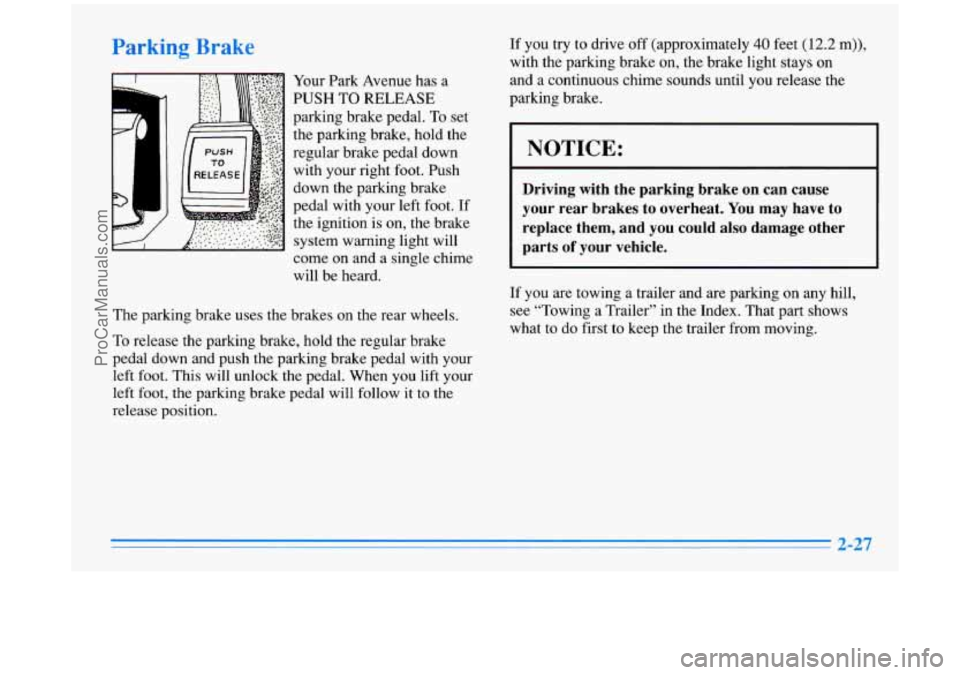
Your Park Avenue has a
PUSHTORELEASE
parking brake pedal.
To set
the parking brake, hold the
regular brake pedal down with your right foot. Push
down the parking brake
pedal with your left foot.
If
the ignition is on, the brake
system warning light will
come on and a single chime
will be heard.
The parking brake uses the brakes on the rear wheels.
To release the parking brake, hold the regular brake
pedal down and push the parking brake pedal with your
left foot. This will unlock the pedal. When you lift your
left foot, the parking brake pedal will follow it to the
release position. If
you try to drive
off (approximately 40 feet (12.2 m)),
with the parking brake on, the brake light stays
on
and a continuous chime sounds until you release the
parking brake.
NOTICE:
Driving with the parking brake on can cause
your rear brakes
to overheat. You may have to
replace them, and you could also damage other
parts
of your vehicle.
If you are towing a trailer and are parking on any hill,
see “Towing a Trailer” in the Index. That part shows
what to do first to keep the trailer from moving.
ProCarManuals.com
Page 100 of 388
Press the LIGHTS switch to turn the headlamps on.
Press it again to turn them
off.
Press the PARK switch to turn the parking lamps on.
Press it again
to turn them off. (If the parking lamps
were turned on with the PARK switch, they must be
turned off with that switch.)
Lamps On Reminder
If you leave the manual headlamp or parking lamp
switch on, remove the key from the ignition and open
the driver’s door, you will hear a continuous warning
chime. The chime will turn
off when the lamps are
turned
off.
Daytime Running Lamps (Canada Only)
Daytime Running Lamps (DRL) can make it easier for
others to see the front of your vehicle during the day.
DRL can be’helpful in many different driving
conditions, but they can be especially helpful in the
short periods after dawn and before sunset.
A light sensor on top of the instrument panel monitors
the exterior light level
for the operation of DRL and
twilight sentinel,
so be sure it isn’t covered. The
DRL system will make your low-beam headlamps
come on at reduced brightness in daylight when:
The ignition is on,
0 The headlamp switch is off, and
0 The transaxle is not in PARK (P).
When DRL are on, only your low-beam headlamps will
be on. The parking lamps, taillamps, sidemarker and
other lamps won’t be on. Your instrument panel won’t
be lit up either.
When it’s dark enough outside, your low-beam
headlamps will change to full brightness. The other
lamps that turn on with your headlamps, will also turn
on. When it’s bright enough outside, the regular lamps
will turn
off, and your low-beam headlamps change to
the reduced brightness of
DRL.
To idle your vehicle with the DRL off, shift the
transaxle into PARK
(P). The DRL will stay off until
you shift out of PARK (P).
To turn off all exterior lighting at night when you are
parked, turn
off the headlamps and move the twilight
sentinel control all the way toward
MIN.
As with any vehicle, you should turn on the regular
headlamp system when you need it.
ProCarManuals.com
Page 121 of 388
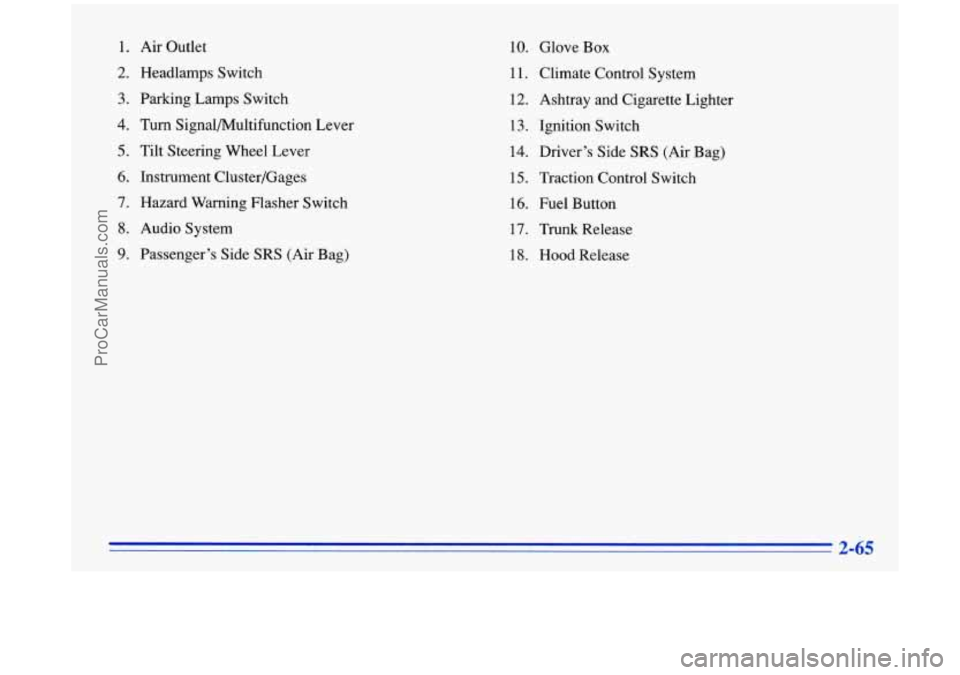
1. Air Outlet
2. Headlamps Switch
3. Parking Lamps Switch
4. Turn Signal/Multifunction Lever
5. Tilt Steering Wheel Lever
6. Instrument Cluster/Gages
7. Hazard Warning Flasher Switch
8. Audio System
9. Passenger’s Side SRS (Air Bag)
10. Glove Box
11. Climate Control System
12. Ashtray and Cigarette Lighter
13. Ignition Switch
14. Driver’s Side
SRS (Air Bag)
15. Traction Control Switch
16. Fuel Button
17.
Trunk Release
18. Hood Release
ProCarManuals.com
Page 122 of 388
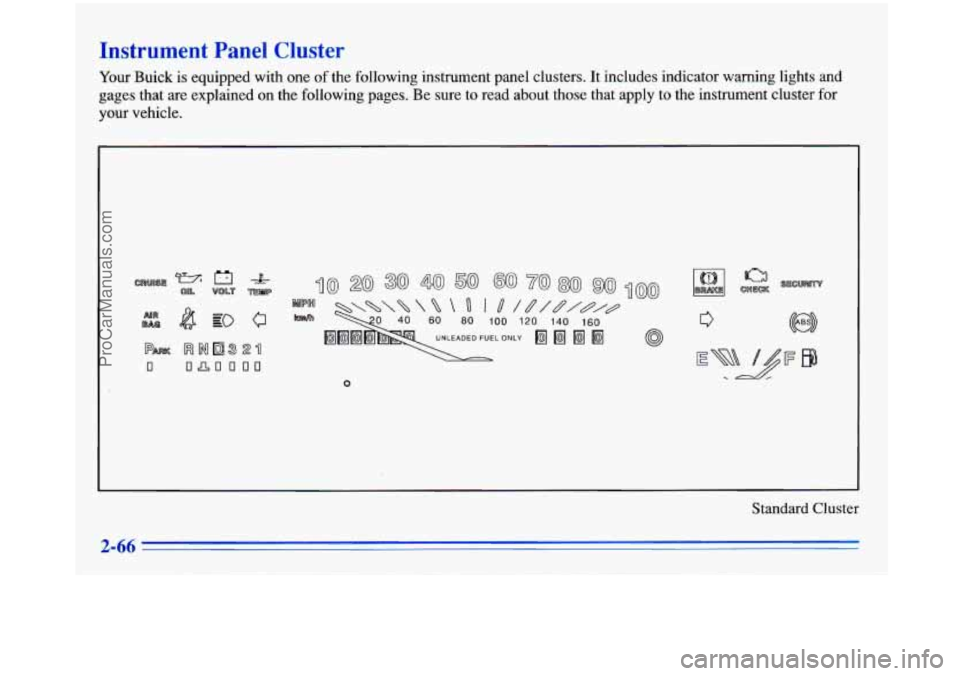
Instrument Panel Cluster
Your Buick is equipped with one of the following instrument panel clusters. It includes indicator warning lights and
gages that are explained on the following pages. Be sure to read about those that apply to the instrument cluster
for
your vehicle.
c3
Standard Cluster
ProCarManuals.com
Page 125 of 388
Warning Lights, Gages and Indicators
This part describes the warning lights and gages that may
be on your vehicle. The pictures will help you locate them.
Warning lights and gages can signal that something is
wrong before it becomes serious enough to cause an
expensive repair or replacement. Paying attention to your warning lights and gages could also save you or
others from injury.
Warning lights come
on when there may be or is a
problem with one of your vehicle’s functions.
As you will
see
in the details on the next few pages, some warning
lights come on briefly when you start the engine just to let
you know they’re working. If you are familiar with this
section, you should not be alarmed when this happens.
Gages can indicate when there may be or is a problem
with one
of your vehicle’s functions. Often gages and
warning lights work together to let
you know when
there’s a problem with your vehicle.
When one
of the warning lights comes on and stays on
when you are driving, or when one of the gages shows
there may be a problem, check the section that tells you
what to do about
it. Please follow this manual’s advice.
Waiting to do repairs can be costly
-- and even
dangerous.
So please get to know your warning lights
and gages. They’re a big help.
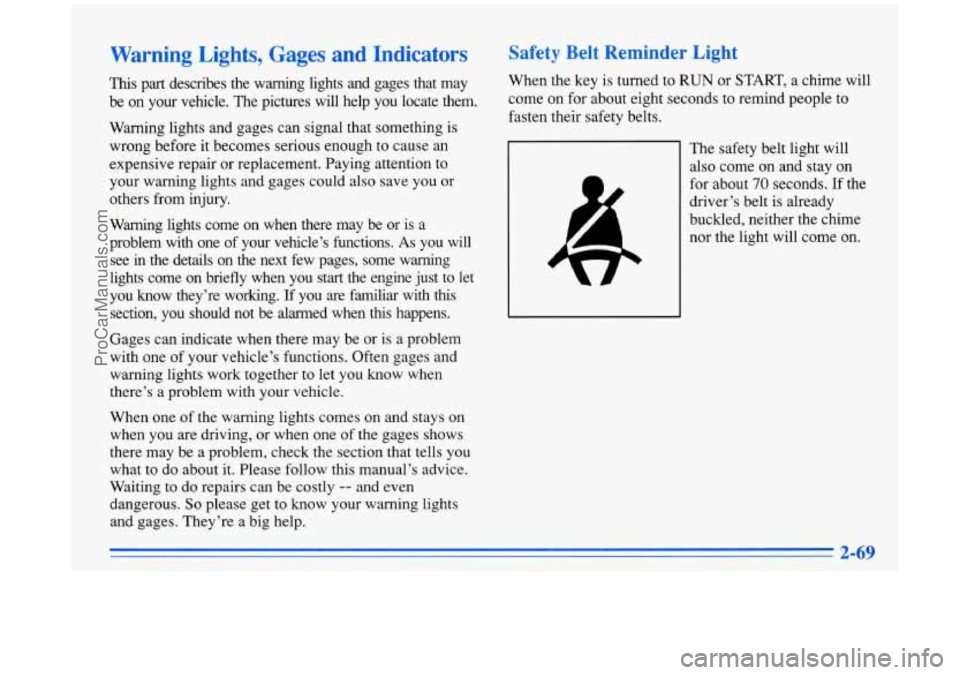
Safety Belt Reminder Light
When the key is turned to RUN or START, a chime will
come on for about eight seconds to remind people to
fasten their safety belts.
The safety belt light will
also come on and stay on
for about
70 seconds. If the
driver’s belt is already
buckled, neither the chime
nor the light will come on.
ProCarManuals.com
Page 126 of 388
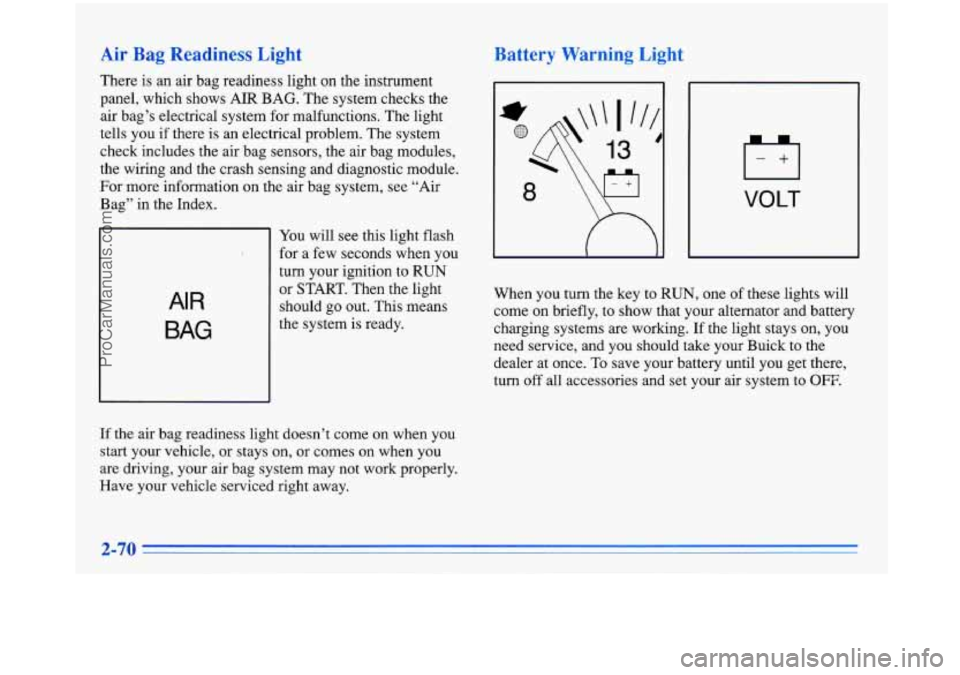
Air Bag Readiness Light
There is an air bag readiness light on the instrument
panel, which shows AIR BAG. The system checks the
air bag’s electrical system for malfunctions. The light
tells you
if there is an electrical problem. The system
check includes the air bag sensors, the air bag modules,
the wiring and the crash sensing and diagnostic module.
For more information on the air bag system, see “Air
Bag” in the Index.
AI R
BAG
You will see this light flash
for a few seconds when you
turn your ignition to
RUN
or START. Then the light
should go out. This means
the system is ready.
If the air bag readiness light doesn’t come on when you
start your vehicle, or stays on, or comes on when
you
are driving, your air bag system may not work properly.
Have your vehicle serviced right away.
Battery Warning Light
VOLT
When you turn the key to RUN, one of these lights will
come on briefly, to show that your alternator and battery
charging systems
are working. If the light stays on, you
need service, and you should take your Buick
to the
dealer at once.
To save your battery until you get there,
turn
off all accessories and set your air system to OFF.
ProCarManuals.com