Page 1691 of 2543
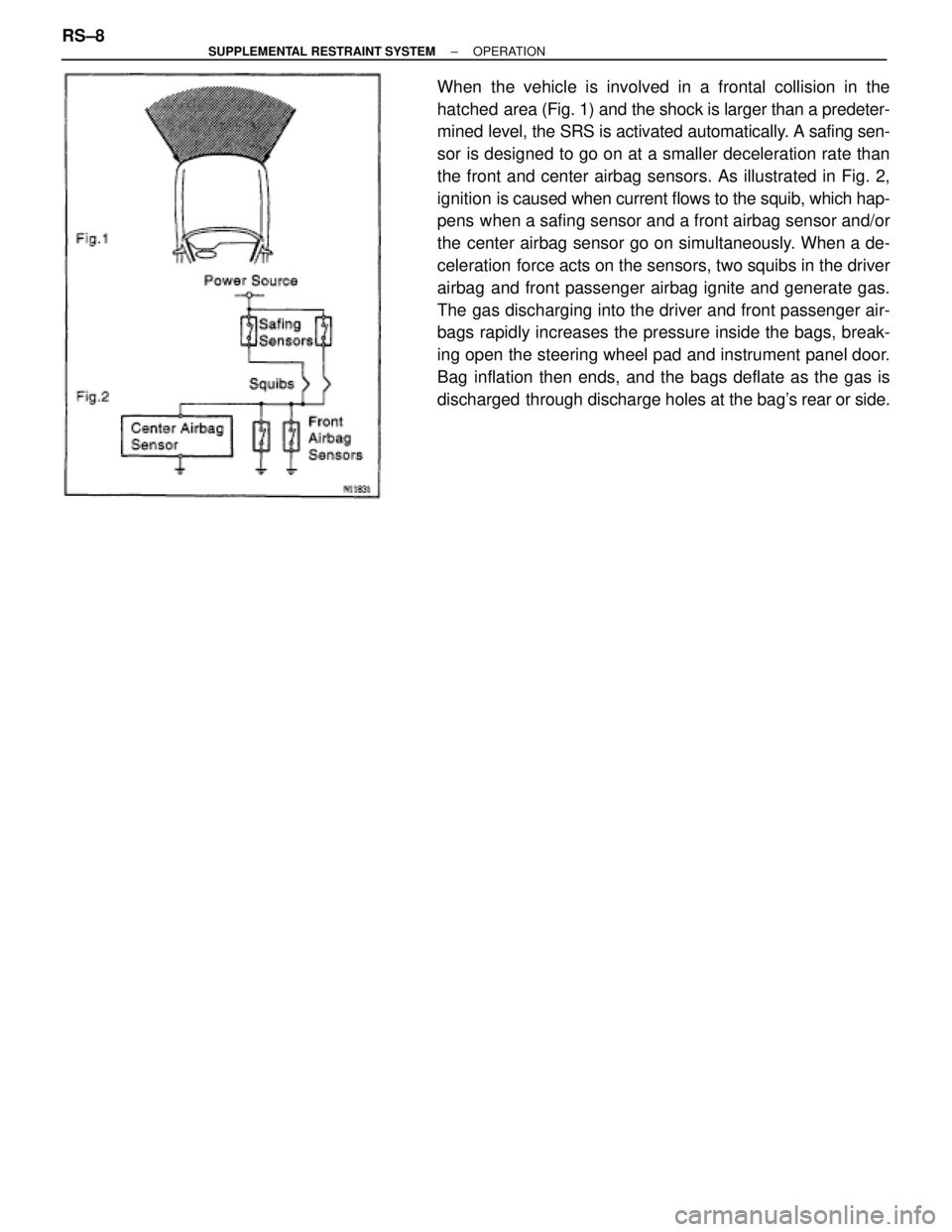
When the vehicle is involved in a frontal collision in the
hatched area (Fig. 1) and the shock is larger than a predeter-
mined level, the SRS is activated automatically. A safing sen-
sor is designed to go on at a smaller deceleration rate than
the front and center airbag sensors. As illustrated in Fig. 2,
ignition is caused when current flows to the squib, which hap-
pens when a safing sensor and a front airbag sensor and/or
the center airbag sensor go on simultaneously. When a de-
celeration force acts on the sensors, two squibs in the driver
airbag and front passenger airbag ignite and generate gas.
The gas discharging into the driver and front passenger air-
bags rapidly increases the pressure inside the bags, break-
ing open the steering wheel pad and instrument panel door.
Bag inflation then ends, and the bags deflate as the gas is
discharged through discharge holes at the bag's rear or side. RS±8
± SUPPLEMENTAL RESTRAINT SYSTEMOPERATION
Page 1787 of 2543
SA±3SA±3SA±4SA±21
SA±85SA±32
SA±96SA±32
SA±96SA±26,29
SA±89,92SA±13
SA±35SA±20
SA±83SA±3
See Page
Parts
Name
Trouble
Wander / pulls
Bottoming
Sways / pitches
Front wheel shimmy
Abnormal tire wear
Cold tire inflation pressureTiresWheel alignmentSpringsStabilizer barShock absorberBall jointHub bearingsSteering linkageSteering gearSuspension partsOverloadWheel balance
TROUBLESHOOTING
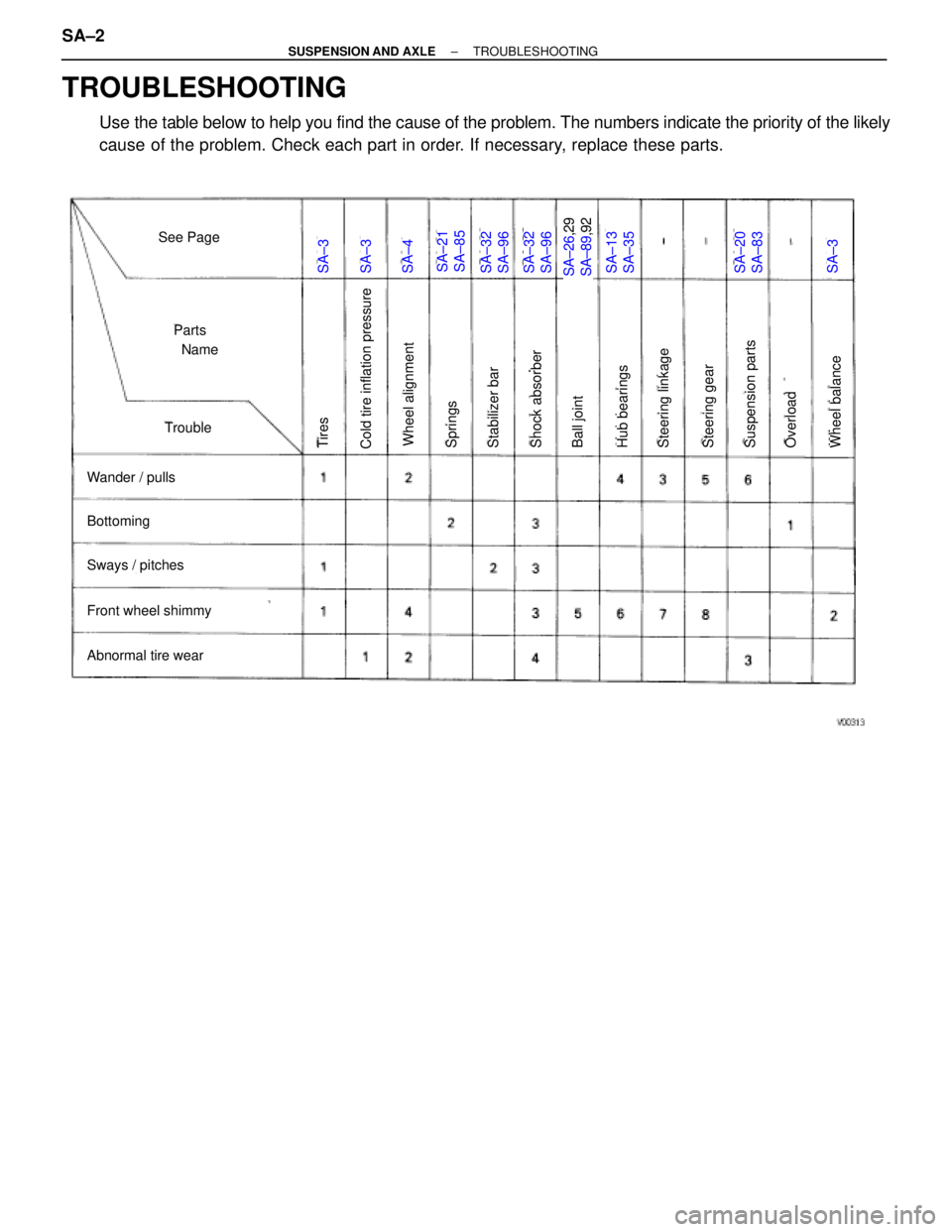
Use the table below to help you find the cause of the problem. The numbers indicate the priority of the likely
cause of the problem. Check each part in order. If necessary, replace these parts. SA±2
± SUSPENSION AND AXLETROUBLESHOOTING
Page 1788 of 2543
GENERAL INSPECTION
1. INSPECT TIRE
(a) Check the tires for wear and for the proper inflation pressure.
Cold tire inflation pressure (2JZ±GE)
�������� �
������� ��������Tire size�������� �
������� ��������
Front
kPa (kgf/cm2, psi)
�������� �
������� ��������
Rear
kPa (kgf/cm2, psi)
�������� ��������225/50ZR16�������� ��������230 (2.3, 33)�������� ��������±±
�������� ��������245/50ZR16�������� ��������±±�������� ��������250 (2.5, 36)
Cold tire inflation pressure (2JZ±GTE)
�������� �
������� ��������
Tire size�������� �
������� ��������
Front
kPa (kgf/cm2, psi)
�������� �
������� ��������
Rear
kPa (kgf/cm2, psi)
�������� ��������235/45ZR17�������� ��������250 (2.5, 36)�������� ��������±±
�������� ��������255/40ZR17�������� ��������±±�������� ��������250 (2.5, 36)
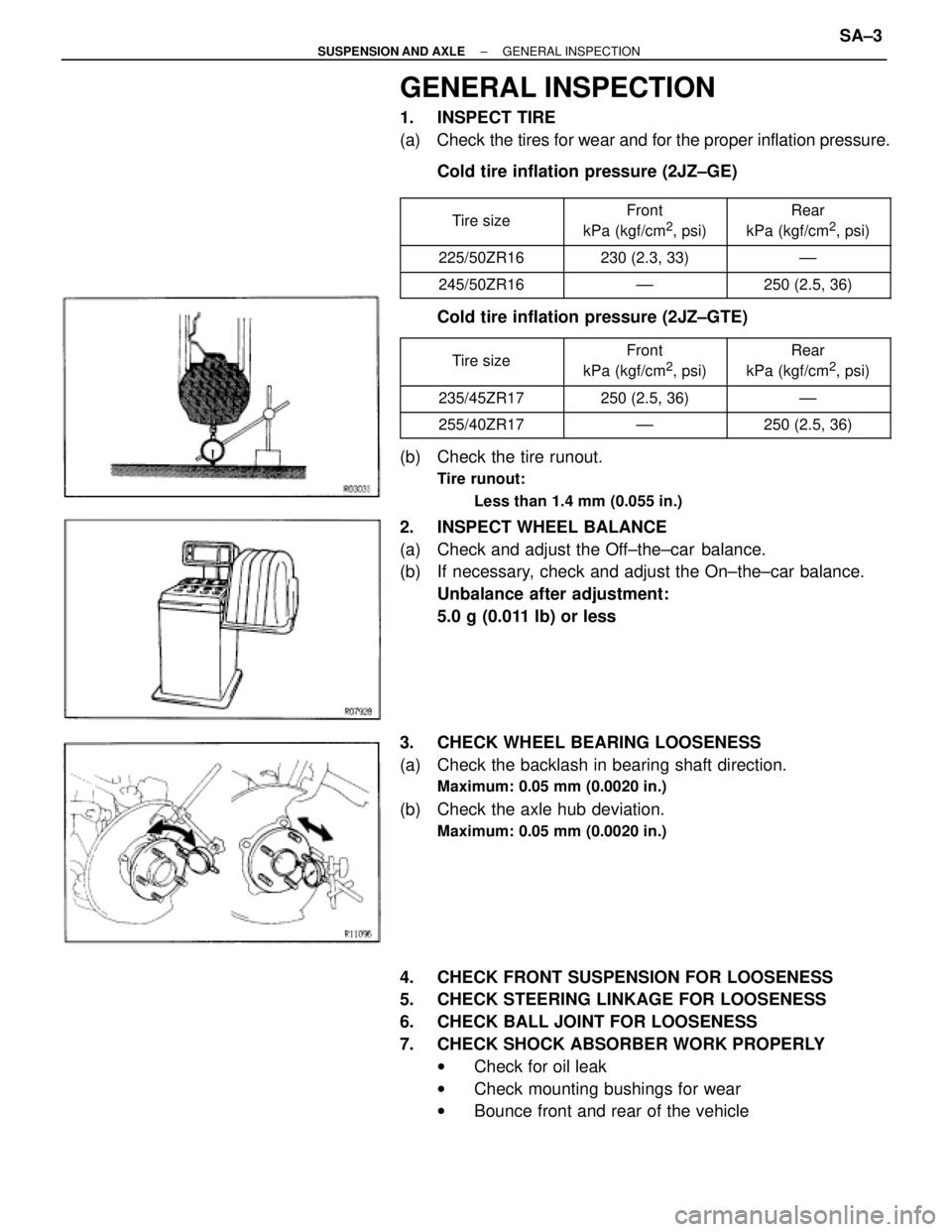
(b) Check the tire runout.
Tire runout:
Less than 1.4 mm (0.055 in.)
2. INSPECT WHEEL BALANCE
(a) Check and adjust the Off±the±car balance.
(b) If necessary, check and adjust the On±the±car balance.
Unbalance after adjustment:
5.0 g (0.011 lb) or less
3. CHECK WHEEL BEARING LOOSENESS
(a) Check the backlash in bearing shaft direction.
Maximum: 0.05 mm (0.0020 in.)
(b) Check the axle hub deviation.
Maximum: 0.05 mm (0.0020 in.)
4. CHECK FRONT SUSPENSION FOR LOOSENESS
5. CHECK STEERING LINKAGE FOR LOOSENESS
6. CHECK BALL JOINT FOR LOOSENESS
7. CHECK SHOCK ABSORBER WORK PROPERLY
wCheck for oil leak
wCheck mounting bushings for wear
wBounce front and rear of the vehicle
± SUSPENSION AND AXLEGENERAL INSPECTIONSA±3
Page 1884 of 2543
Cold tire
inflation
pressure
Vehicle height
Front wheel
alignment
Front axle hub
Front
suspension
Rear wheel
alignment
Rear axle hub
Rear
suspension
Rear
drive shaft
Toe±in
Camber
Caster
Steering axis
inclination
Wheel angle
(Max.)
Tie rod end left±right error
Bearing axial direction play
Upper ball joint turning torque
Axle hub flange runout
Bearing axial direction play
Stabilizer bar link ball joint turning torque
Lower ball joint turning torque
Axle hub flange runout
Stabilizer bar link ball joint turning torque
Lower ball joint turning torque
Lower ball joint turning torque
Toe±in
Camber
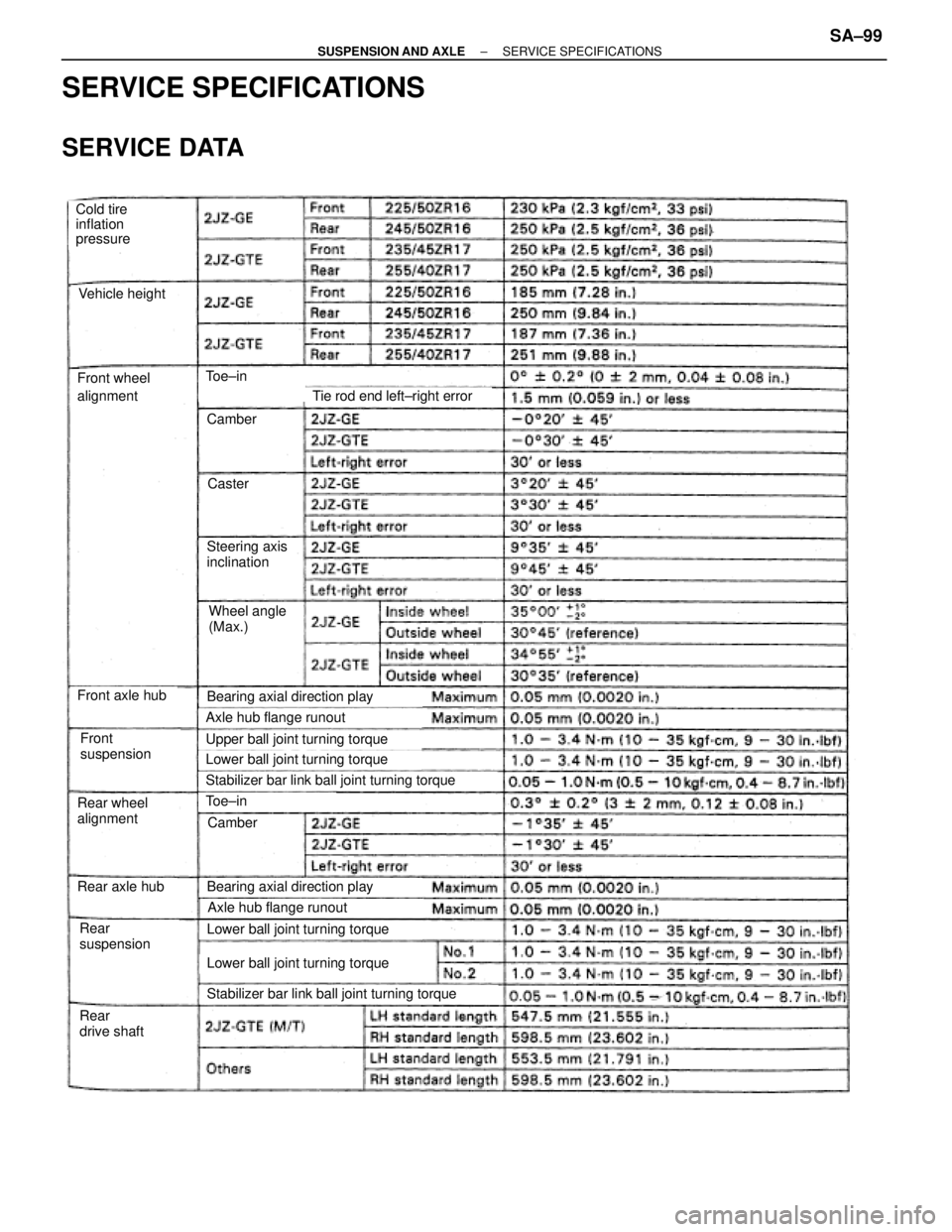
SERVICE SPECIFICATIONS
SERVICE DATA
± SUSPENSION AND AXLESERVICE SPECIFICATIONSSA±99