1995 PONTIAC BONNEVILLE fuel pump
[x] Cancel search: fuel pumpPage 114 of 338
Fuel Gage
Your fuel gage tells you about how much fuel you have
left, when the ignition is on. When the gage reads in the
yellow band, a warning chime will sound and the
CHECK GAGES warning light will go on, if you have
this option.
Here are five things that some owners ask about. None
of these show
a problem with your fuel gage:
0
0
0
0
0
At the service station, the gas pump shuts off before
the gage reads full.
It takes a little more or less fuel to
fill up than the
gage indicated. For example, the gage may have
indicated the tank was half full, but it actually took a
little more or less than half the tank's capacity to fill
the tank.
The gage moves a little when
you turn a corner,
speed up, or make a hard stop.
The gage doesn't go back to empty when you turn
off
the ignition.
If you have the large span (220") gage, the needle
moves more for
a given amount of fuel. This does
not indicate excessive fuel consumption, and is
normal.
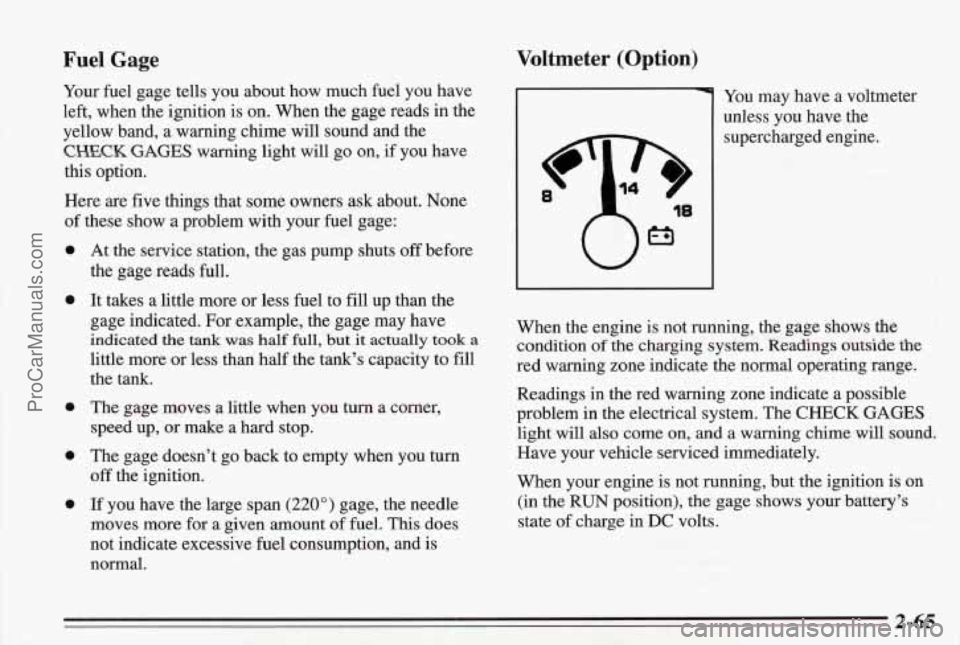
Voltmeter (Option)
You may have a voltmeter
unless you have the
supercharged engine.
When the engine is not running, the gage shows the
condition
of the charging system. Readings outside the
red warning zone indicate the normal operating range.
Readings in the red warning zone indicate a possible
problem in the electrical system. The
CHECK GAGES
light will also come on, and a warning chime will sound.
Have your vehicle serviced immediately.
When your engine is not running, but the ignition is on
(in the RUN position),
the gage shows your battery's
state of charge in
DC volts.
2-65
ProCarManuals.com
Page 150 of 338

The anti-lock system can change the brake pressure
faster than any driver could. The computer is
programmed to make the most of available tire
and
road conditions.
You can steer around the obstacle while braking hard.
As you brake, your computer keeps receiving updates on
wheel speed and controls braking pressure accordingly.
Remember: Anti-lock doesn’t change the time you need
to get your foot up to the brake pedal. If you get too close to
the vehicle in front of you,
you won’t have time
to apply your brakes if that vehicle suddenly slows or
stops. Always leave enough room up ahead
to stop, even
though you have anti-lock brakes.
To Use Anti-Lock
Don’t pump the brakes. Just hold the brake pedal down
and let anti-lock work for you.
You may hear a motor or
clicking noise during a hard stop, but this is normal.
Traction Control System (Option)
Your vehicle may have a traction control system that
limits wheel
spin. This is especially useful in slippery
road conditions. The system operates only if it senses
that one or
both of the front wheels are spinning or
beginning to lose traction. When this happens, the
system works the front brakes and reduces engine power
(by shutting off fuel injectors and managing engine
spark) to limit wheel spin.
You may feel the system working, or you may notice
some noise, but this is normal. If your vehicle is in
cruise control when the traction control system begins to
limit wheel spin, the cruise control will automatically
disengage. When road conditions allow you
to safely
use it again, you may re-engage the cruise control. (See
“Cruise Control” in the Index.)
4-7
ProCarManuals.com
Page 216 of 338

Fuel
3800 Engine (Code K)
The 8th digit of your vehicle identification number
(VIN) shows the code letter for your engine. You will
find the VIN at the top left of your instrument panel.
(See “Vehicle Identification Number” in the Index.)
Use regular unleaded gasoline rated at
87 octane or
higher. It should meet specifications ASTM
D48 14 in
the United States and CGSB 3.5-92 in Canada. These
fuels should have the proper additives,
so you should not
have to add anything to the fuel.
In the United States and Canada, it’s easy
to be sure you
get the right kind of gasoline (unleaded). You’ll see
UNLEADED right on the pump. And only unleaded
nozzles will fit into your vehicle’s filler neck.
Be sure the posted octane is at least
87. If the octane is
less than
87, you may get a heavy knocking noise when
you drive. If it’s bad enough, it can damage your engine.
If you’re using fuel rated at 87 octane or higher and you
still hear heavy knocking, your engine needs service.
But don’t
worry if you hear a little pinging noise when
you’re accelerating
or driving up a hill. That’s normal,
and you don’t have to buy
a higher octane fuel to get rid
of pinging. It’s the heavy, constant knock that means
you have
a problem.
What about gasoline with blending materials that
contain oxygen (oxygenates), such as
MTBE or alcohol?
MTBE is “methyl tertiary-butyl ether.” Fuel that is no
more than 15% MTBE is fine for your vehicle.
Ethanol is ethyl or grain alcohol. Properly-blended fuel
that is no more than
10% ethanol is fine for your
vehicle.
Methanol is methyl or wood alcohol.
NOTICE:
Fuel that is more than 5% methanol is bad for
your vehicle. Don’t use it. It can corrode metal
parts in your fuel system and also damage plastic
and rubber parts. That damage wouldn’t be
covered under your warranty. And even at
5% or
less, there must be “cosolvents” and corrosion
preventers in this fuel to help avoid these
problems.
ProCarManuals.com
Page 217 of 338

Gasolines for Cleaner Air
Your use of gasoline with deposit control additives will
help prevent deposits from forming in your engine and
fuel system. That helps keep
your engine in tune and
your emission control system working properly. It’s
good
for your vehicle, and you’ll be doing your R&.fQr
cleaner air.
Many gasolines are now blended with oxygenates.
General Motors recommends that you use gasolines with
these blending materials, such as
MTBE and ethanol. By
doing
so, you can help clean the air, especially in those
parts of the country that have high carbon monoxide
levels.
In addition, some gasoline suppliers
are now producing
reformulated gasolines. These gasolines are specially
designed to reduce vehicle emissions. General Motors
recommends that you use reformulated gasoline.
By
doing so, you can help clean the air, especially in those
parts of the country that have high ozone levels.
You
should ask your service station operators if their
gasolines contain deposit control additives
and
oxygenates, an’d if they have been reformulated to
reduce vehicle emissions.
Fuel
3808 Supercharged Engine (Code 1)
The 8th digit of your vehicle identification number
(VIN) shows the code letter for your engine. You will
find the VIN at the top left
of your instrument panel.
(See “Vehicle Identification Number” in the Index.)
Use premium unleaded gasoline rated at
91 octane or
higher. You may use middle grade or regular unleaded
gasolines, but your vehicle
may not accelerate as well.
The gasoline you use should meet specifications
ASTlM D4814 in the United States and CGSB 3.5-92
in Canada. These fuels should have the proper additives,
so you should not have to add anything to the fuel.
In
the United States and Canada, it’s easy to be sure you
get the right kind of gasoline (unleaded). You’ll see
UNLEADED right on the pump. And only unleaded
nozzles will fit into your vehicle’s
filler neck.
Be sure the posted octane for premium is at least 91
(at least 89 for middle grade and 87 for regular). If the
octane is less than 87, you may get a heavy knocking
noise when
you drive. If it’s bad enough, it can damage
your engine.
6-4
ProCarManuals.com
Page 224 of 338

Engine Accessory Belt
A
C
The 3800 (L36) engine uses an engine accessory belt.
This diagram shows the features connected by the belt
routing. See “Maintenance Schedule” in the Index for
when to check the belt.
A. Power Steering
B . Alternator
C. Air Conditioning
D. Crank
E. Coolant Pump
E Tensioner
3800 Supercharged (L67) Engine
(Option)
Your Bonneville may have a 3800 Supercharged engine.
The Supercharger is
a device which is designed to pump
more air into the engine than it would normally
use.
This air mixed with fuel, creates increased engine
power. Since the Supercharger is a pump and is driven
from an engine accessory drive belt, increased pressure
is available at all driving conditions.
The powertrain control module
(PCM), works with a
vacuum control to regulate the increased pressure
required during specific driving conditions. When this
increased pressure or boost is not desired, such as during
idling
and light throttle cruising, the excess air that the
Supercharger is pumping is routed through a bypass.
All
of these controls, working together provide high
performance character
and fuel efficiency in the
3800 V6 Supercharged engine.
The power steering pump uses a remote reservoir
mounted on the throttle and cruise control cable bracket.
See “Maintenance Schedule”
in the Index for when you
should check the fluid.
6-11
ProCarManuals.com
Page 265 of 338

Right Side Fuse Panel: Additional fuses are located in
the relay center, on the far right side, below the
instrument panel.
You must remove the sound insulator
on the right side
of the passenger foot well to replace
these fuses.
Replacing these fuses
is difficult. We recommend that
you see your dealer
if you need one replaced.
Position Circuitry
1 Door Locks
2 Power Antenna, Lock Switch
3 Horns
4 Not Used
5 Cruise Control, Misc. Engine
Controls
6 Fuel Pump
7 Injectors
8 Electronic Control Module,
9 Not Used
10 Not Used
11 A/C Programmer PASS-Key
@I1
12 Not Used
POSITIONS
r---------- I FUSE I I POSITIONS I
6-52
ProCarManuals.com
Page 268 of 338

Capacities and Specifications for Engine Code K (L36) and Code 1 (L67)
Automatic Transaxle AT 4T60E (Overdrive)
When draining or replacing torque convertec more fluid may be needed.
Pan Removal and Replacement .............................. 6 1/2 quarts 6.00 L
After Complete Overhaul ..................................... 11 quarts 10.50 L
Coolingsystem .............................................. 13 quarts 12.00 L
Air Conditioning Refrigerant (R134a) ........................... See refrigerant charge label under hood.
...............................
4.75 L
Not all air conditioning refrigerants are the same. If the air conditioning system in your vehicle needs refrigerant, be sure the
proper refrigerant is used.
If you’re not sure, ask your Pontiac dealel: For additional information see your “Warranty and
Owner Assistance Information
” booklet.
Enginecrankcase ........................................... 5 quarts
Fuel Tank ................. 18 gallons
Power Steering
Oil change with filter change.
Pump Only ..... ................. 1 pint 0.50 L
Complete System ........................................... 1 11’2 pints 0.75 L
68.00 L
Tire Pressures, Sizes .......................................... See Tire-Loading Information label on
Wheel Nut Torque ... 100 lb-ft
driver’s
door. ,.. ... (140 Nam)
NOTE: All capacities are approximate. When adding, be sure to fill to the appropriate level, as recommended in this manual.
ProCarManuals.com