Page 67 of 372
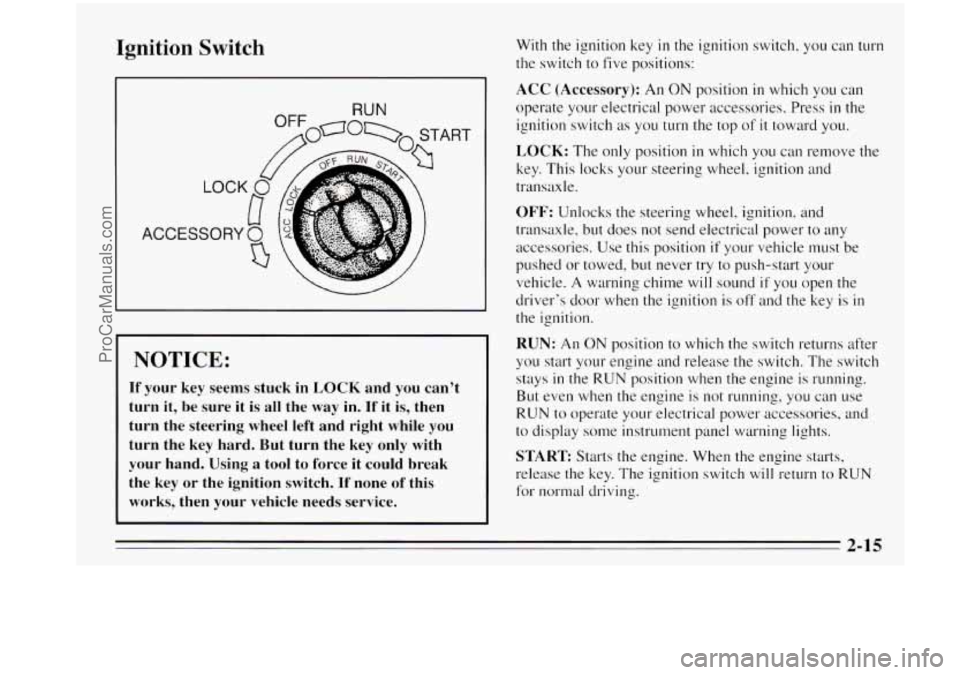
Ignition Switch
RUN
ACCESSORY
W
I NOTICE:
If your key seems stuck in LOCK and you can’t
turn it, be sure it
is all the way in. If it is, then
turn the steering wheel left and right while you
turn the key hard. But turn the key only with
your hand. Using a tool to force
it could break
the key or the ignition switch.
If none of this
works, then your vehicle needs service. With
the ignition key
in the ignition switch, you can turn
the switch to five positions:
ACC (Accessory): An ON position in which you can
operate your electrical power accessories. Press
in the
ignition switch as you turn the top of
it toward you.
LOCK: The only position in which you can remove the
key. This locks your steering wheel, ignition and
transaxle.
OFF: Unlocks the steering wheel, ignition, and
transaxle, but does not send electrical power to any
accessories. Use this position
if your vehicle must be
pushed or towed, but never
try to push-start your
vehicle.
A warning chime will sound if you open the
driver’s door when
the ignition is off and the key is in
the ignition.
RUN: An ON position to which the switch returns after
you start your engine and release the switch. The switch
stays
in the RUN position when the engine is running.
But even when the engine is not running, you can use
RUN to operate your electrical power accessories, and
to display some instrument panel warning lights.
START: Starts the engine. When the engine starts,
release the key. The ignition switch will return to
RUN
for norlnal driving.
ProCarManuals.com
Page 70 of 372
Driving Through Deep Standing
Water
NOTICE:
If you drive too quickly through deep puddles or
standing water, water can come in through your
engine's air intake and badly damage your
engine. Never drive through water that is slightly
lower than the underbody
of your vehicle. If you
can't avoid deep puddles or standing water, drive
through them very slowly.
Engine Coolant Heater (Option)
I
In very cold weather, 0" F (- 1 8°C) or colder, the engine
coolant heater can help. You'll get easier starting and
better fuel economy during engine warm-up. Usually,
the coolant heater should be plugged in a minimum of
four hours prior to starting your vehicle.
2-1s
ProCarManuals.com
Page 76 of 372

Parking Brake
To set the parking brake,
hold the regular brake pedal
down with your right foot.
Push down the parking
brake pedal with your
left
foot. If the ignition is on,
the parking brake indicator
light will come on.
If
you try to drive off with the parking brake on, the
parking brake indicator light stays on. The PARK
BRAKE SET message will appear in the Driver
Information Center, and a chime will sound until you
release the parking brake
or recycle the ignition. This
vehicle has
a PUSH TO RELEASE parking brake
pedal. To release
the parking brake, hold the regular
brake down and push
the parking brake pedal with your
left foot. This will unlock the pedal. When you lift your
left foot, the parking brake pedal will follow it
to the
released position.
NOTICE:
Driving with the parking brake on can cause
your rear brakes to overheat. You may have
to
replace them, and you could also damage other
parts
of your vehicle.
If you are towing a trailer and are parking on any hill,
see “Towing a Trailer” in the Index. That part shows
what
to do first to keep the trailer from moving.
2-24
ProCarManuals.com
Page 83 of 372

Windshield Wipers
The lever on the right side of your steering column
controls your windshield wipers.
For a single wiping cycle, move the lever up to MIST.
Hold
it there until the wipers start, then let go. The
wipers
will stop after one cycle. If you want more
cycles, hold the lever to
MIST longer.
For steady wiping at low speed, push the lever down to
the
LO position. For high speed wiping, push the lever
down further, to
HI. To stop the wipers, move the lever
to
OFF.
YOLI can set the wiper speed for a long or short delay
between wiper cycles. This can be very useful
in light
rain or snow. Push the lever down to the first detent,
DELAY. Turn the band closer to the short lines for fewer
wiper passes per minute.
As you turn the band toward
the long lines, the wiper cycles per minute will increase.
Remember that damaged wiper blades may prevent you
from seeing well enough
to drive safely. To avoid damage,
be sure to clear ice and snow from the wiper blades before
using them.
If they're frozen to the windshield, carefully
loosen or thaw them.
If your blades do become damaged,
get new blades
or blade inserts.
Heavy snow or ice can overload your wipers.
A circuit
breaker will stop them
until the motor cools. Clear away
snow or ice to prevent
an overload.
2-31
ProCarManuals.com
Page 88 of 372
2. Get up to the speed you want. To Resume a Set Speed
3. Push in the SET button at the end of the lever and
release
it. The CRUISE light on your instrument
panel will come on.
4. Take your foot off the accelerator pedal. Suppose
you set your cruise control at
a desired speed
and then you apply the brake. This,
of course, shuts off
the cruise control. But you don’t need to reset it. Once
you’re going about
25 mph (40 km/h) or more, you can
move the cruise control switch from
ON to RES/ACC
(Resume/Accelerate) for about half a second.
You’ll
go right back up to your chosen speed and stay
there.
If you hold the switch at RES/ACC longer than half a
second, the vehicle will keep going faster until you
release the switch or apply
the brake. You could be
startled and even lose control.
So unless you want to go
faster, don’t hold the switch at REWACC.
2-36
ProCarManuals.com
Page 90 of 372
Using Cruise Control on Hills
How well your cruise control will work on hills depends
upon your speed, load, and the steepness of the hills.
When going up steep hills, you may have to step on the
accelerator pedal to maintain your speed. When going
downhill, you may have to brake or shift to a lower gear to
keep your speed down. Of course, applying the brake takes
yon out of cruise control. Many drivers find this to be
too
much trouble and don’t use cruise control on steep hills.
To Get Out of Cruise Control
There are two ways to turn off the cruise control:
Step lightly on the brake pedal; or
Move the cruise switch to OFF. (The CRUISE light
will go out.)
To Erase Cruise Control Memory
When you turn off the cruise control or the ignition, or
shift into
PARK (P), your cruise control set speed
memory is erased.
2-38
ProCarManuals.com
Page 91 of 372
Headlamps
300: Turn the band to this symbol to turn on:
Parking Lamps
%
0 Side Marker Lamps
0 Taillamps
Instrument Panel Lights
License Plate Lamps
/, Turn the band to this symbol to turn on:
Headlamps
-'Q-
Parking Lamps
Side Marker Lamps
0 Taillamps
Instrument Panel Lights
License Plate Lamps
Turn the band to
OFF to turn off the lamps/lights.
Headlamp High-Low Beam
To change the headlamps
from low beam to high or
high to low, pull the turn
signal lever all the way
toward you. Then release
it.
When the high beams are on, a blue light on the
instrument panel also will be on.
2-39
ProCarManuals.com
Page 92 of 372
Flash-To-Pass Feature
This feature lets you use your high beam headlamps to
signal a driver in front of you that you want to pass. It
works even
if your headlamps are off.
To use it, pull the turn signal lever toward you.
If your headlamps are off, your high beam headlamps
will turn on. They’ll stay on as long as you hold the
lever there. Release the lever to turn them off.
If your headlamps are on, but on low beam, the system
works normally. Just pull the lever until it clicks. Your
headlamps will shift to high beam and stay there. To
return to low beam, just pull the lever toward you.
If your headlamps are on, and on high beam, your
headlamps will switch to low beam.
To get back to high
beam, pull the lever toward you.
Cornering Lamps
I
The cornering lamps are designed to come on when you
signal a turn. This will provide more light for cornering
at night.
2-40
ProCarManuals.com


