Page 131 of 240
Towing a Trailer
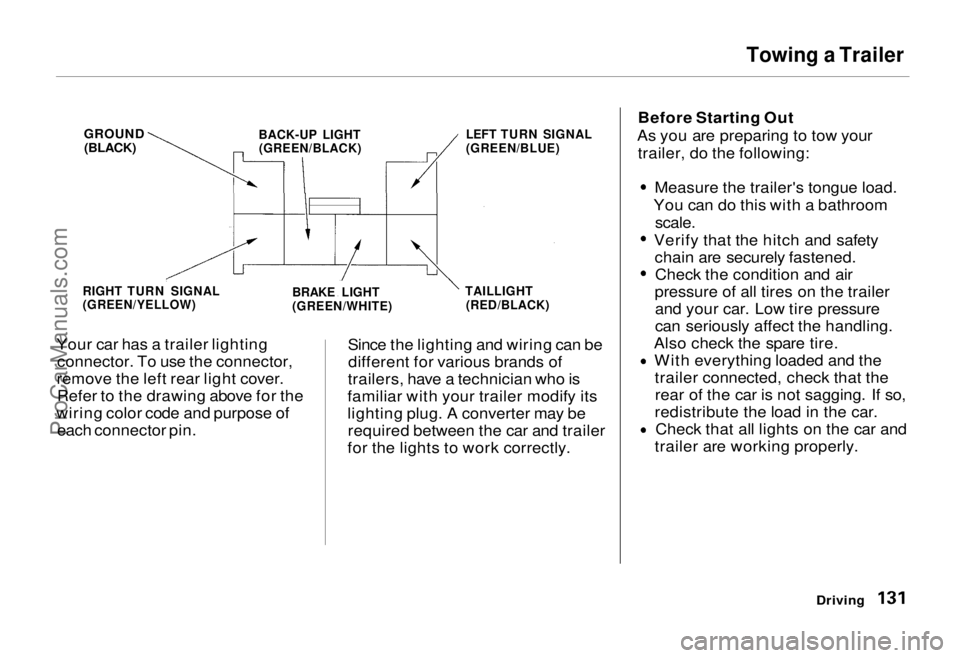
Your car has a trailer lighting connector. To use the connector,
remove the left rear light cover. Refer to the drawing above for the
wiring color code and purpose of each connector pin. Since the lighting and wiring can be
different for various brands of
trailers, have a technician who is
familiar with your trailer modify its
lighting plug. A converter may be required between the car and trailer
for the lights to work correctly. Before Starting Out
As you are preparing to tow your trailer, do the following:
Measure the trailer's tongue load.
You can do this with a bathroom
scale.
Verify that the hitch and safety chain are securely fastened.Check the condition and air
pressure of all tires on the trailer and your car. Low tire pressure
can seriously affect the handling.
Also check the spare tire. With everything loaded and thetrailer connected, check that therear of the car is not sagging. If so,
redistribute the load in the car. Check that all lights on the car and
trailer are working properly.
Driving
RIGHT TURN SIGNAL
(GREEN/YELLOW)
BRAKE LIGHT
(GREEN/WHITE)TAILLIGHT
(RED/BLACK) LEFT TURN SIGNAL
(GREEN/BLUE)
BACK-UP LIGHT
(GREEN/BLACK)
GROUND
(BLACK)ProCarManuals.comMain Menu Table of Contents s t
Page 169 of 240
Tires
Inflation
Keeping the tires properly inflated
provides the best combination of
handling, tread life and riding comfort. Underinflated tires wear
unevenly, adversely affect handling
and fuel economy, and are more
likely to fail from being overheated. Overinflated tires can make your car
ride more harshly, are more prone to damage from road hazards, and wear
unevenly.
We recommend that you visually check your tires every clay and use a
gauge to measure the air pressure at
least once a month. If you think a tire
might be low, check it immediately.Remember to check the spare tire at
the same time you check all the
other tires.
Check the pressure in the tires when
they are cold. This means the car
has been parked for at least three
hours. If you have to drive the car
before checking the tire pressure,
the tires can still be considered
"cold" if you drive less than 1.6 km
(1 mile).
If you check the pressure when the
tires are hot (the car has been driven several miles), you will see readings
28 to 41 kPa (0.3 to 0.4 kg/cm2, 4 to
6 psi) higher than the cold reading.
This is normal. Do not let air out to match the specified cold pressure.
The tire will be underinflated.
Recommended Tire Pressures forNormal Driving
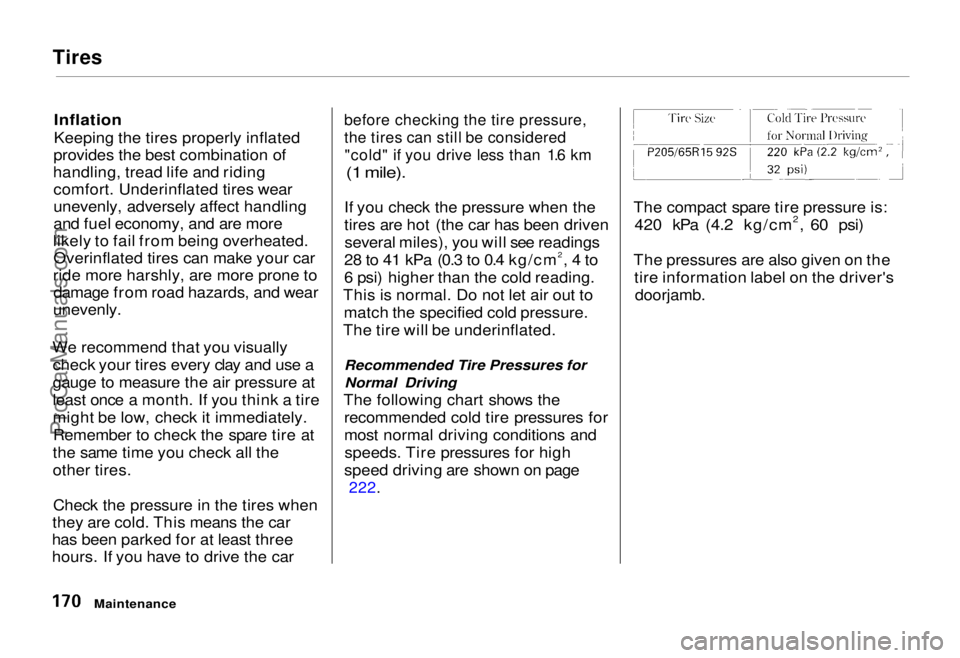
The following chart shows the recommended cold tire pressures for
most normal driving conditions andspeeds. Tire pressures for high
speed driving are shown on page
222.
The compact spare tire pressure is:
420 kPa (4.2 kg/cm2, 60 psi)
The pressure
s
are also given on the
tire information label on the driver's
doorjamb.
MaintenanceProCarManuals.comMain Menu Table of Contents s t
Page 178 of 240
Lights
Replacing Rear Bulbs
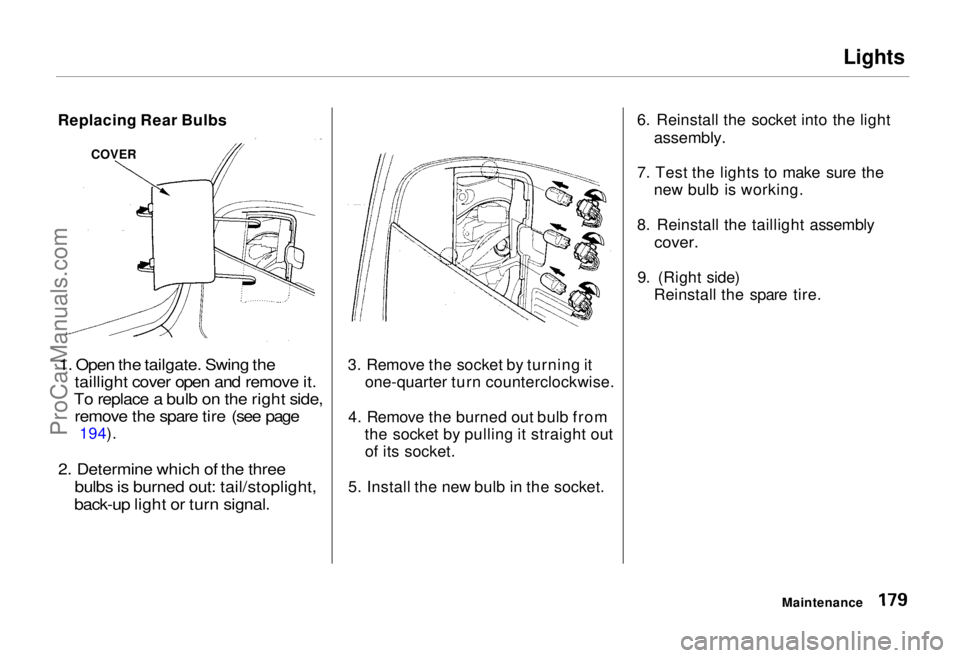
1. Open the tailgate. Swing the taillight cover open and remove it.
To replace a bulb on the right side, remove the spare tire (see page
194).
2. Determine which of the three bulbs is burned out: tail/stoplight,
back-up light or turn signal.
3. Remove the socket by turning it
one-quarter turn counterclockwise.
4. Remove the burned out bulb from the socket by pulling it straight outof its socket.
5. Install the new bulb in the socket. 6. Reinstall the socket into the light
assembly.
7. Test the lights to make sure the new bulb is working.
8. Reinstall the taillight assembly
cover.
9. (Right side) Reinstall the spare tire.
Maintenance
COVERProCarManuals.comMain Menu Table of Contents s t
Page 190 of 240
Taking Care of the Unexpected
This section covers the more- common problems that motorists
experience with their cars. It gives
you information about how to safely evaluate the problem and what to do
to correct it. If the problem has stranded you on the side of the road,
you may be able to get going again. If not, you will also find instructions
on getting your car towed. Compact Spare Tire....................... 192
Changing a Flat Tire..................... 193
If Your Engine Won't Start........... 199 Nothing Happens....................... 199
The Starter Operates
Normally................................ 200
Jump Starting................................. 200 If Your Engine Overheats............. 202Low Oil Pressure........................... 204
Charging System Indication......... 205
Malfunction Indicator Lamp/ Check Engine Light.................. 206
Closing the Sunroof....................... 207
Fuses............................................... 208
Checking and Replacing........... 209
Towing............................................ 213
Taking Care of the UnexpectedProCarManuals.comMain Menu s t
Page 191 of 240
Compact Spare Tire
Your car has a compact spare tire that takes up less space. Use this
spare tire as a temporary replace-
ment only. Get your regular tire
repaired or replaced and put back on
your car as soon as you can.
Check the inflation pressure of the
compact spare tire every time you
check the other tires. It should be
inflated to:420 kPa (4.2 kg/cm2, 60 psi)
Follow these
precautions whenever
you are using the compact spare tire:
Do not exceed 50 mph (80 km/h)
under any circumstances.
This tire gives a harsher ride and
less traction on some road sur-
faces than the regular tire. Use
greater caution while driving on
this tire.
Do not mount snow chains on the
compact spare.
The wheel of the compact spare tire is designed especially to fit
your car. Do not use your spare tire on another car unless it is thesame make and model. The compact spare tire has a shorter
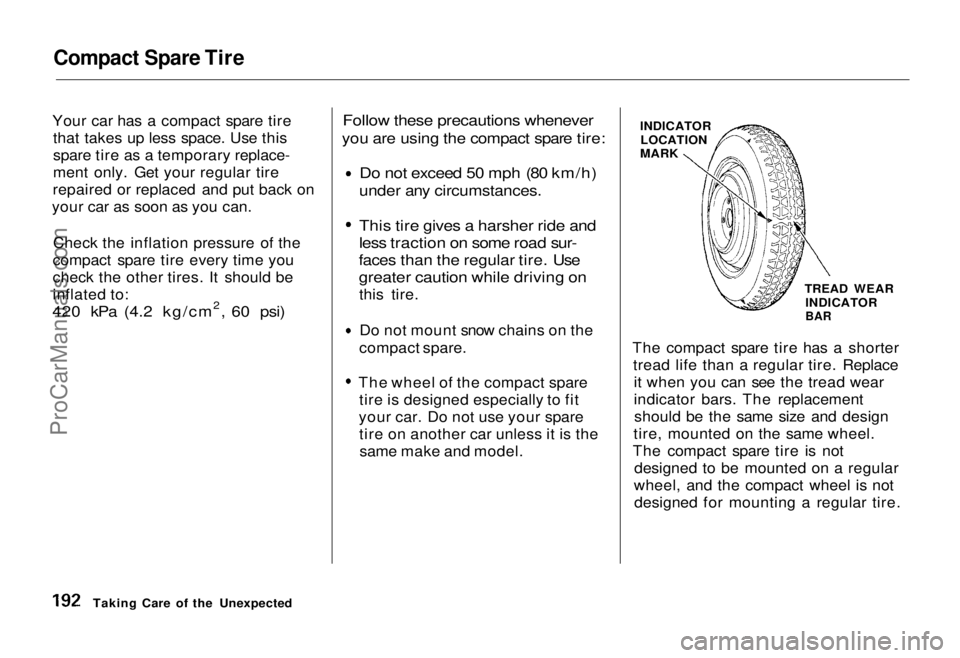
tread life than a regular tire. Replaceit when you can see the tread wear
indicator bars. The replacementshould be the same size and design
tire, mounted on the same wheel.
The compact spare tire is not designed to be mounted on a regular
wheel, and the compact wheel is not designed for mounting a regular tire.
Taking Care of the Unexpected INDICATOR
LOCATION
MARK
TREAD WEARINDICATOR
BARProCarManuals.comMain Menu Table of Contents s t
Page 192 of 240
Changing a Flat Tire
If you have a flat tire while driving, stop in a safe place to change it.
Stopping in traffic or on the shoulder of a busy road is dangerous. Drive
slowly along the shoulder until you
get to an exit or an area to stop that
is far away from the traffic lanes.
1. Park the car on firm, level groundaway from traffic. Turn on the
hazard warning lights and turn the ignition to LOCK (0).
2. Put the transmission in Park. Set the parking brake. 3. Open the tailgate. Fold down the
third seat's seat-back (see page
62).
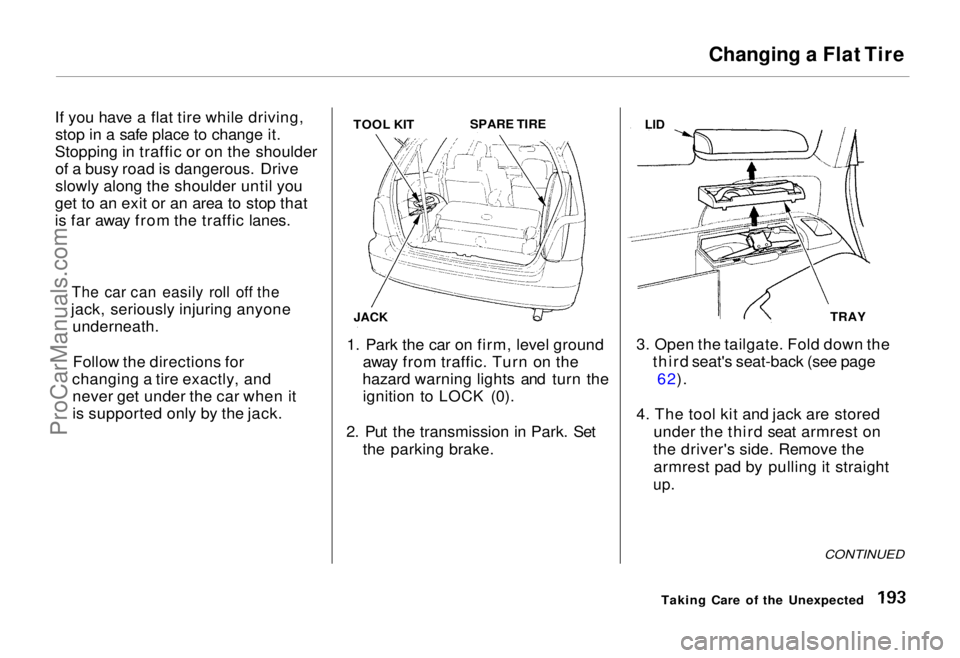
4. The tool kit and jack are stored under the third seat armrest on
the driver's side. Remove the armrest pad by pulling it straight
up.
Taking Care of the Unexpected
CONTINUED
The car can easily roll off the
jack, seriously injuring anyone underneath.
Follow the directions for
changing a tire exactly, and never get under the car when it
is supported only by the jack. TOOL KIT
JACK
SPARE TIRE
TRAY
LIDProCarManuals.comMain Menu Table of Contents s t
Page 193 of 240
Changing a Flat Tire
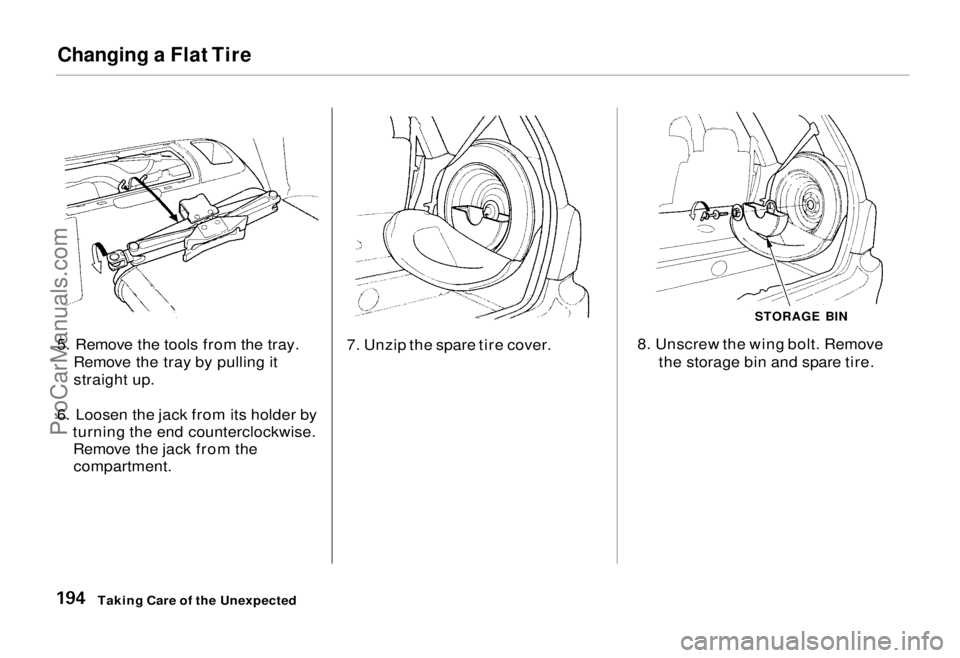
5. Remove the tools from the tray. Remove the tray by pulling it
straight up.
6. Loosen the jack from its holder by turning the end counterclockwise.Remove the jack from thecompartment. 7. Unzip the spare tire cover.
8. Unscrew the wing bolt. Remove
the storage bin and spare tire.
Taking Care of the Unexpected
STORAGE BINProCarManuals.comMain Menu Table of Contents s t
Page 195 of 240
Changing a Flat Tire
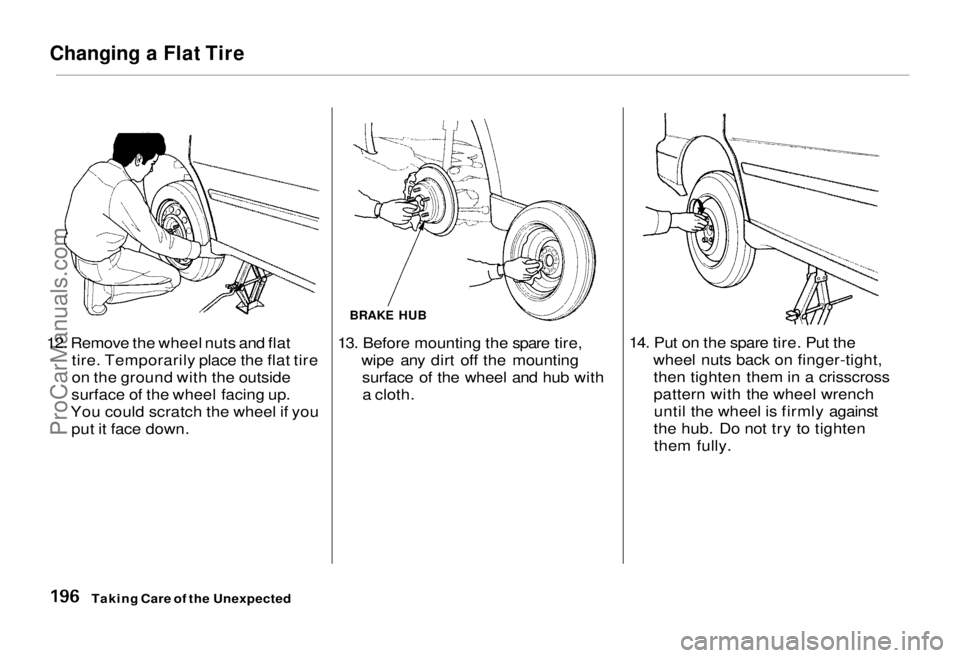
12. Remove the wheel nuts and flat tire. Temporarily place the flat tire on the ground with the outside
surface of the wheel facing up.
You could scratch the wheel if you put it face down. 13. Before mounting the spare tire,
wipe any dirt off the mounting surface of the wheel and hub with
a cloth. 14. Put on the spare tire. Put the
wheel nuts back on finger-tight, then tighten them in a crisscross
pattern with the wheel wrench until the wheel is firmly against
the hub. Do not try to tighten
them fully.
Taking Care of the Unexpected
BRAKE HUBProCarManuals.comMain Menu Table of Contents s t