Page 149 of 240
Engine Oil, Cooling System
If you change Your own oil, please
dispose of the used oil properly. Put it
in a sealed container and take it to a
recycling center. Do not discard it in a
trash bin or dump it on the ground.
The oil and filter should be changed every 6 months or 12,000 km (7,500
miles), whichever comes first. Under severe driving conditions, they
should be changed every 3 months
or 6,000 km (3,750 miles). See page 137 for a description of severe
driving conditions. Checking the Engine Coolant
Level
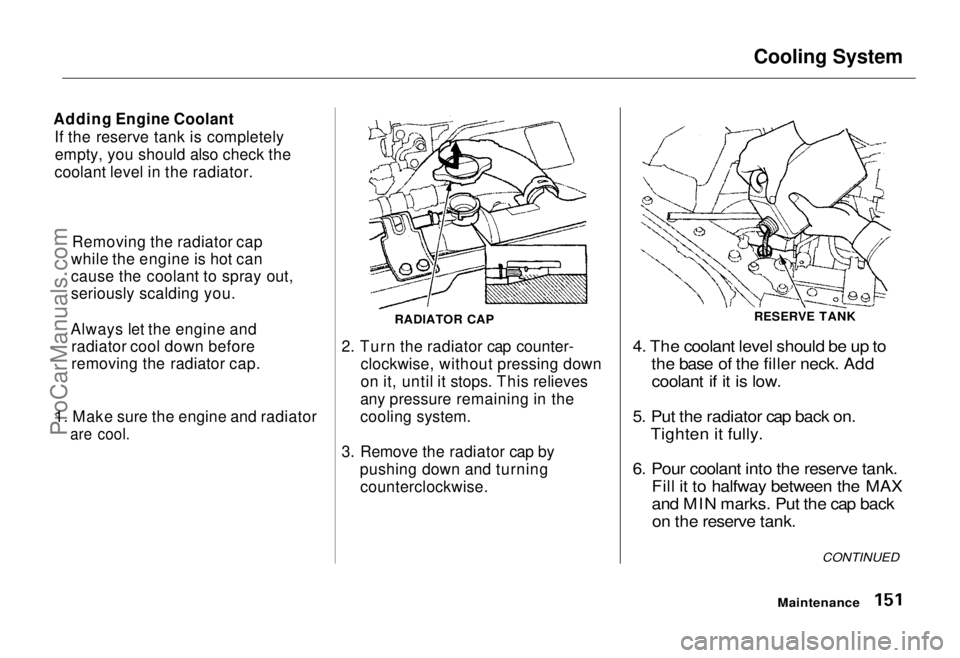
Check the level of the engine coolant
by looking at the radiator reserve
tank next to the battery. If the level
is at or below the MIN line, add
coolant to bring it up to the MAX line.
Inspect the cooling system for leaks.
This coolant should always be a mixture of 50% antifreeze and 50%
water. Never add straight antifreeze or plain water. Always use Genuine Honda Anti-
freeze/Coolant. The cooling systemcontains many aluminum compo-
nents which can corrode if animproper antifreeze is used. Someantifreeze, even though labeled as
safe for aluminum parts, may not
provide adequate protection.
Maintenance
NOTICE
RESERVE TANK
MIN
MAX
ProCarManuals.comMain Menu Table of Contents s t
Page 150 of 240
Cooling System
Adding Engine Coolant If the reserve tank is completelyempty, you should also check the
coolant level in the radiator.
1. Make sure the engine and radiator
are cool.
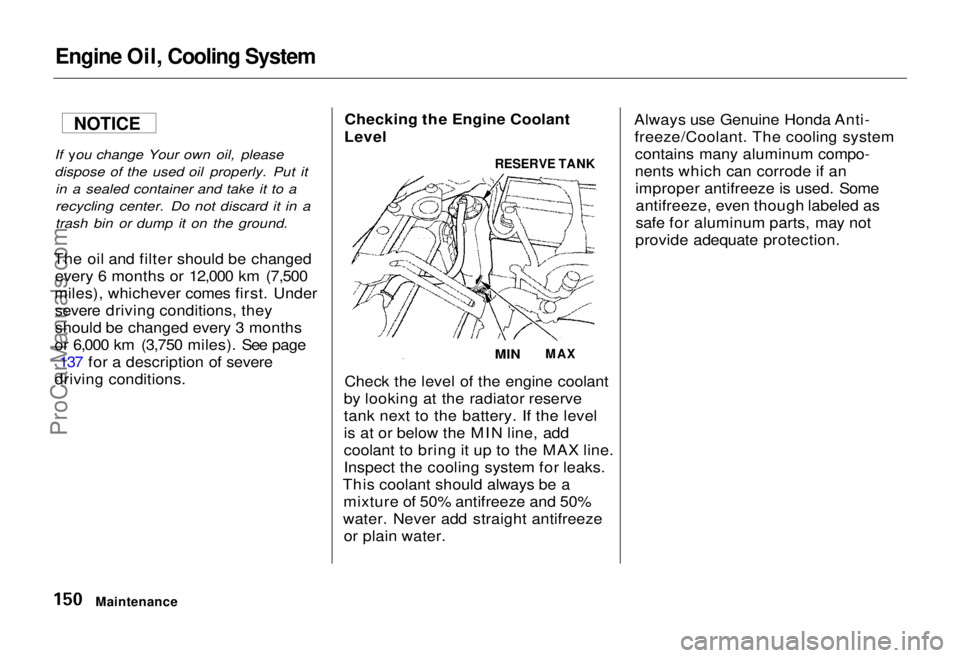
RADIATOR CAP
2. Turn the radiator cap counter- clockwise, without pressing down
on it, until it stops. This relieves
any pressure remaining in the
cooling system.
3. Remove the radiator cap by pushing down and turningcounterclockwise.
4. The coolant level should be up to
the base of the filler neck. Addcoolant if it is low.
5. Put the radiator cap back on. Tighten it fully.
6. Pour coolant into the reserve tank. Fill it to halfway between the MAX
and MIN marks. Put the cap backon the reserve tank.
Maintenance
RESERVE TANK
Removing the radiator cap
while the engine is hot can
cause the coolant to spray out,
seriously scalding you.
Always let the engine and radiator cool down before
removing the radiator cap.
CONTINUEDProCarManuals.comMain Menu Table of Contents s t
Page 153 of 240
Cooling System, Windshield Washers
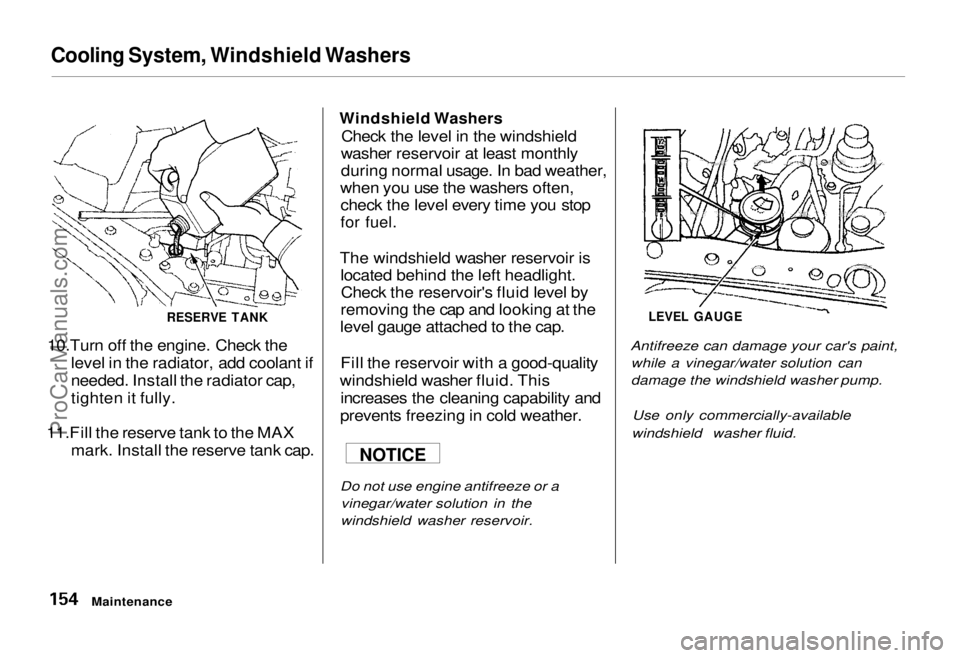
10.Turn off the engine. Check the level in the radiator, add coolant if needed. Install the radiator cap,
tighten it fully.
11.Fill the reserve tank to the MAX mark. Install the reserve tank cap.
Windshield Washers
Check the level in the windshield
washer reservoir at least monthly
during normal usage. In bad weather,
when you use the washers often, check the level every time you stop
for fuel.
The windshield washer reservoir is located behind the left headlight.Check the reservoir's fluid level by
removing the cap and looking at the
level gauge attached to the cap.
Fill the reservoir with a good-quality
windshield washer fluid. This increases the cleaning capability and
prevents freezing in cold weather.
Do not use engine antifreeze or a vinegar/water solution in the
windshield washer reservoir.
LEVEL GAUGE
Antifreeze can damage your car's paint, while a vinegar/water solution can
damage the windshield washer pump.
Use only commercially-available
windshield washer fluid.
Maintenance
RESERVE TANK
NOTICEProCarManuals.comMain Menu Table of Contents s t
Page 154 of 240
Automatic Transmission Fluid
Check the fluid level with the engine
at normal operating temperature.
1. Park the car on level ground. Shut off the engine.
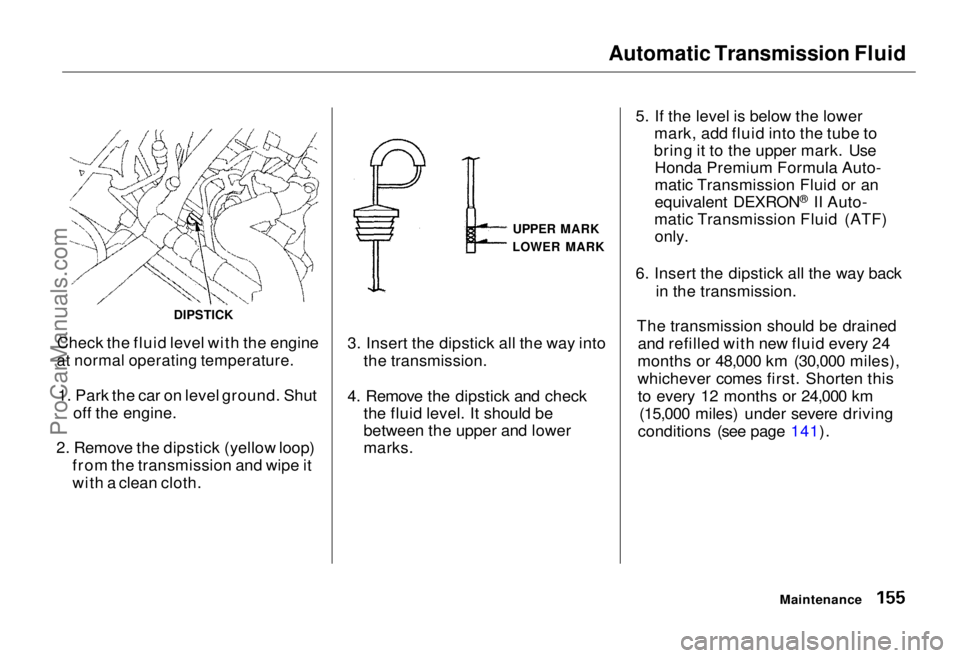
2. Remove the dipstick (yellow loop) from the transmission and wipe it
with a clean cloth.
UPPER MARK
3. Insert the dipstick all the way into the transmission.
4. Remove the dipstick and check the fluid level. It should be
between the upper and lower
marks. 5. If the level is below the lower
mark, add fluid into the tube to
bring it to the upper mark. Use Honda Premium Formula Auto-
matic Transmission Fluid or an
equivalent DEXRON ®
II Auto-
matic Transmission Fluid (ATF) only.
6. Insert the dipstick all the way back in the transmission.
The transmission should be drained and refilled with new fluid every 24
months or 48,000 km (30,000 miles),
whichever comes first. Shorten this to every 12 months or 24,000 km (15,000 miles) under severe driving
conditions (see page 141).
Maintenance
DIPSTICK
LOWER MARKProCarManuals.comMain Menu Table of Contents s t
Page 156 of 240
Brake Fluid, Power Steering
Anti-lock Brake System
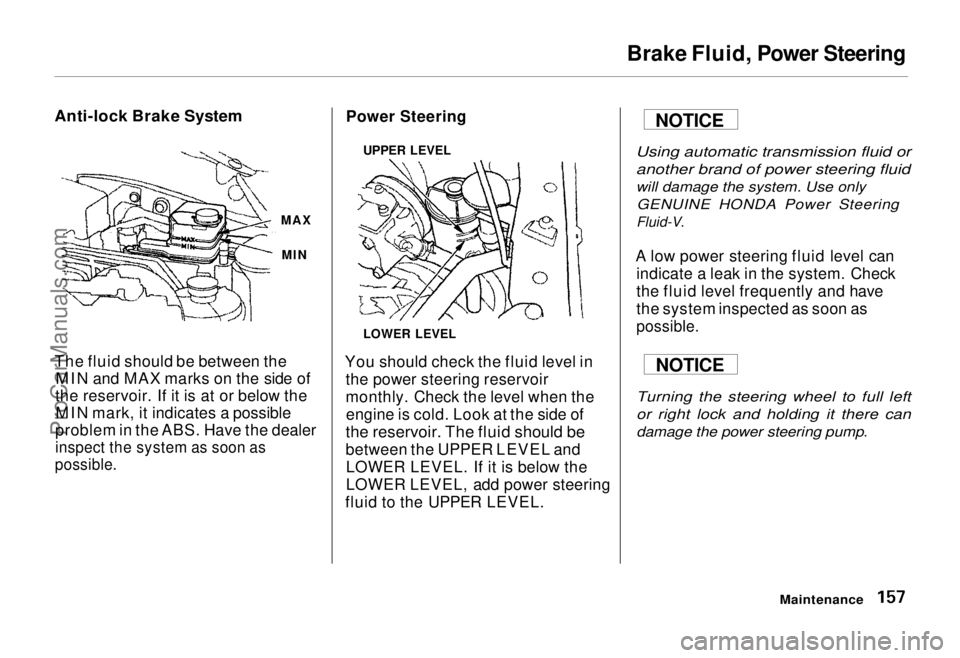
The fluid should be between the MIN and MAX marks on the side of
the reservoir. If it is at or below the MIN mark, it indicates a possible
problem in the ABS. Have the dealer
inspect the system as soon as
possible.
Power Steering
You should check the fluid level in the power steering reservoir
monthly. Check the level when theengine is cold. Look at the side of
the reservoir. The fluid should be
between the UPPER LEVEL and LOWER LEVEL. If it is below the
LOWER LEVEL, add power steering
fluid to the UPPER LEVEL. A low power steering fluid level can
indicate a leak in the system. Check
the fluid level frequently and have
the system inspected as soon as
possible.
Maintenance
NOTICETurning the steering wheel to full left
or right lock and holding it there can
damage the power steering pump.
NOTICE
UPPER LEVE
L
MAX MIN
LOWER LEVEL
Using automatic transmission fluid or
another brand of power steering fluid
will damage the system. Use only
GENUINE HONDA Power Steering
Fluid-V.
ProCarManuals.comMain Menu Table of Contents s t
Page 167 of 240
Air Conditioning
Your car's air conditioning is a sealed system. Any major maintenance,
such as recharging, should be done
by
a qualified technician. There are a
couple of things you can do to make sure the air conditioning works
efficiently.
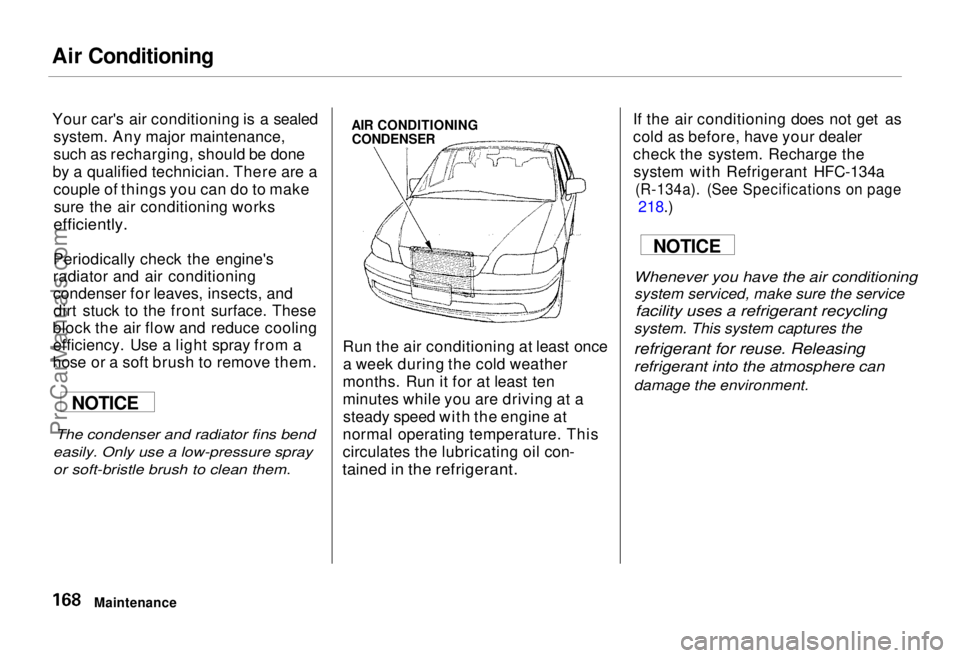
Periodically check the engine's
radiator and air conditioning
condenser for leaves, insects
, and
dirt stuck to the front surface.
These
block the air flow and reduce cooling efficiency. Use a light spray from a
hose or
a soft brush to remove them. Run the air conditioning at least once
a week during the cold weather
months
. Run it for at least ten
minutes while you are driving at a steady speed with the engin
e at
normal operating temperature. This
circulates
the lubricating oil con-
tained in the refrigerant.
If th
e air conditioning does not get as
cold
as before, have your dealer
chec
k the system. Recharge the
syste
m with Refrigerant HFC-134a
(R-134a). (See Specifications on page
218.)
Whenever you have the air conditioning
system. This system captures the
refrigerant for reuse. Releasing
refrigerant into the atmosphere can
damage the environment.
Maintenance
AIR CONDITIONING
CONDENSER
The condenser and radiator fins bend
easily. Only use a low-pressure spray
or soft-bristle brush to clean them.
NOTICE NOTICE
system serviced, make sure the service
facility uses a refrigerant recycling
ProCarManuals.comMain Menu Table of Contents s t
Page 190 of 240
Taking Care of the Unexpected
This section covers the more- common problems that motorists
experience with their cars. It gives
you information about how to safely evaluate the problem and what to do
to correct it. If the problem has stranded you on the side of the road,
you may be able to get going again. If not, you will also find instructions
on getting your car towed. Compact Spare Tire....................... 192
Changing a Flat Tire..................... 193
If Your Engine Won't Start........... 199 Nothing Happens....................... 199
The Starter Operates
Normally................................ 200
Jump Starting................................. 200 If Your Engine Overheats............. 202Low Oil Pressure........................... 204
Charging System Indication......... 205
Malfunction Indicator Lamp/ Check Engine Light.................. 206
Closing the Sunroof....................... 207
Fuses............................................... 208
Checking and Replacing........... 209
Towing............................................ 213
Taking Care of the UnexpectedProCarManuals.comMain Menu s t
Page 198 of 240
If Your Engine Won't Start
Diagnosing why your engine won't
start falls into two areas, depending
on what you hear when you turn the
key to START (III):
You hear nothing, or almostnothing. The engine's starter
motor does not operate at all, or operates very slowly.
You can hear the starter motor operating normally, but the engine
does not start up and run. Nothing Happens or the Starter
Motor Operates Very Slowly
When you turn the ignition switch to START (III), you do not hear the
normal noise of the engine trying to start. You may hear a clicking sound
or series of clicks, or nothing at all.
Check these things:
Check the transmission interlock.
The transmission must be in Park or Neutral or the starter will not
operate.
Turn the ignition switch to ON (II).
Turn on the headlights and check their brightness. If the headlights
are very dim or don't light at all,
the battery is discharged. See
Jump Starting on page 200 .
Turn the ignition switch to START
(III). If the headlights do not dim,
check the condition of the fuses. If
the fuses are OK, there is proba-
bly something wrong with the electrical circuit for the ignition
switch or starter motor. You will
need a qualified technician to determine the problem. (See
Towing on page 213 .)
If the headlights dim noticeably or
go out when you try to start the engine, either the battery is dis-
charged or the connections are
corroded. Check the condition of
the battery and terminal connec-
tions (see page 162 ). You can
then try jump starting the car from a booster battery (see page 200 ).
Taking Care of the UnexpectedProCarManuals.comMain Menu Table of Contents s t