Page 350 of 488
Service Replacement Part and Filter
Recommendations
- Gasoline Engines
Engine 4.3L
VTN Z
Oil Filter PFS2
Air Cleaner
A 178CW
Filter
PCV Valve CV789C
Spark
Plugs* .CR43TS
Fuel Filter GF48
1
Radiator Cap
RC36
5.0L
H
PF12183-
A348C
cv774c
.CR43TS
GF48
1
RC36
5.7L
K
PF1218q A348C
cv774c
.CR43TS GF38
1
RC36
+Four Wheel Drive Vehicle
- use a PFS2 oil filter
Wse AC copper-cored resistor type spark plugs
Service Replacement Part and Filter
Recommendations
- Diesel Engines
Engine 6.5L 6.5L
VIN P S
Oil Filter PF1218
PF1218
Air Cleaner A644C
A 1236C
Fuel Filter TP
1006 TP
1 006
Surge
Tank Cap RC33 RC33
7.41
N
PF1218
A348C
cv774c
.CR43TS GF48
I
RC36
6.51
F
PF1218
A 1236C
TP
I006
RC33
6-84
ProCarManuals.com
Page 353 of 488
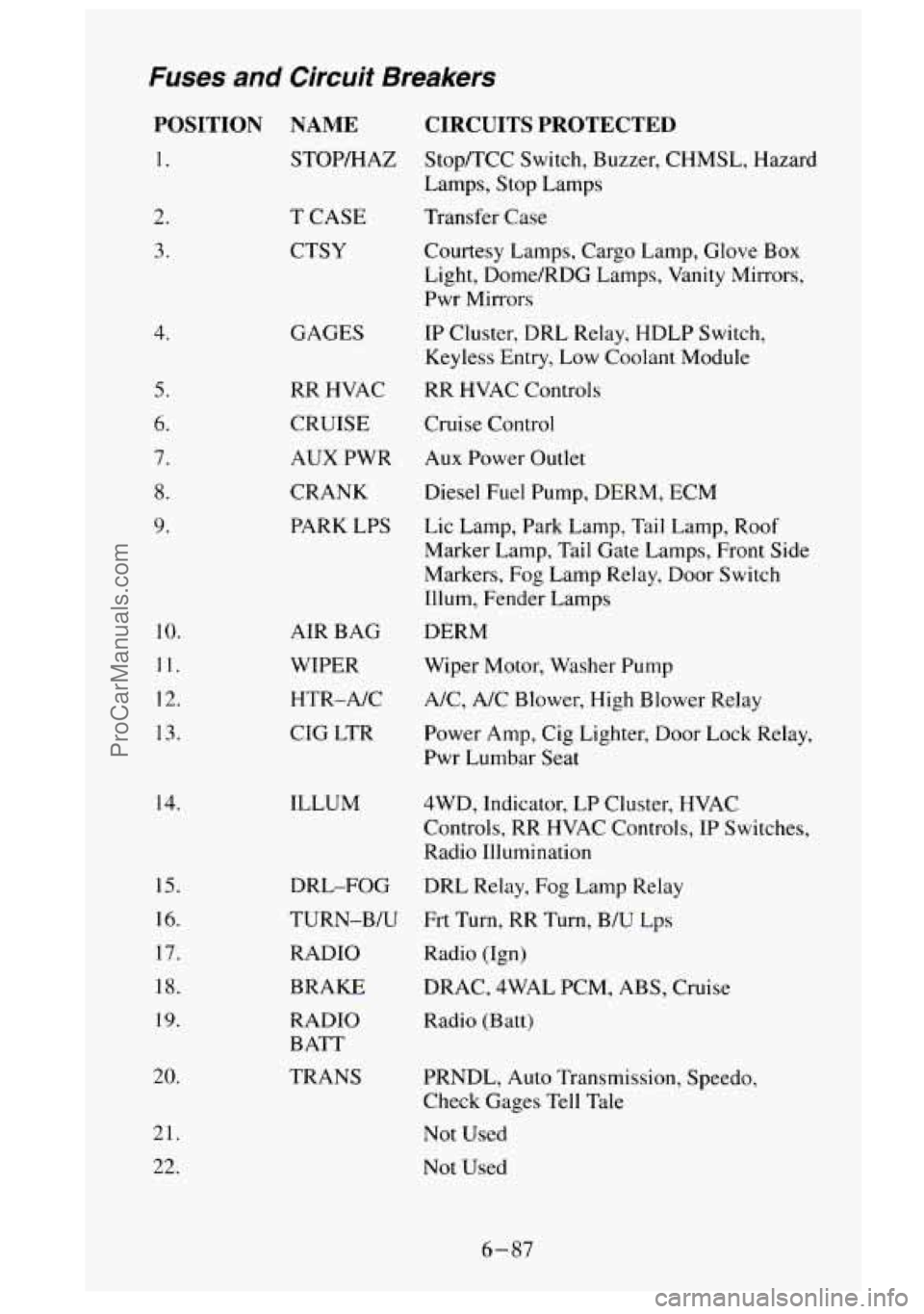
Fuses and Circuit Breakers
POSITION NAME
1. STOP/HAZ
2.
3.
4.
5.
6.
7.
8.
9.
10.
11.
12.
13.
14.
IS.
16.
17.
18.
19.
20.
21. 22.
T CASE
CTSY
GAGES
RR HVAC
CRUISE
AUX PWR
CRANK
PARK LPS
AIR BAG
WIPER HTR-A/C
CIG LTR
ILLUM
DRL-FOG
TURN-B/U RADIO
BRAKE RADIO
BATT
TRANS
CIRCUITS PROTECTED
Stop/TCC Switch, Buzzer, CHMSL, Hazard
Lamps, Stop Lamps
Transfer Case
Courtesy Lamps, Cargo Lamp, Glove Box
Light, Dome/RDG Lamps, Vanity Mirrors,
Pwr Mirrors
IP Cluster, DRL Relay, HDLP Switch,
Keyless Entry, Low Coolant Module
RR HVAC Controls
Cruise Control
Aux Power Outlet
Diesel Fuel Pump, DERM, ECM
Lic Lamp, Park Lamp, Tail Lamp, Roof
Marker Lamp, Tail Gate Lamps, Front Side
Markers, Fog Lamp Relay, Door Switch
Illum, Fender Lamps
DERM
Wiper Motor, Washer Pump
A/C, A/C Blower, High Blower Relay
Power Amp, Cig Lighter, Door Lock Relay,
Pwr Lumbar Seat
4WD, Indicator, LP Cluster, HVAC
Controls,
RR HVAC Controls, IP Switches,
Radio Illumination
DRL Relay, Fog Lamp Relay
Frt Turn, RR Turn, B/U Lps
Radio (Ign)
DRAC, 4WAL PCM, ABS, Cruise
Radio (Batt)
PRNDL, Auto Transmission, Speedo,
Check Gages
Tell Tale
Not Used
Not Used
6-87
ProCarManuals.com
Page 356 of 488
LAMP OR BULB
INSTRUMENT
PANEL
Daytime Running
Lamps Indicator?
Charging System
Indicator Lamp
Instrument Cluster
Illumination
Headlamp Beam
Indicator
Directional Signal
Indicator
Brake Warning
Indicator
SIR (Air Bag)
Safety Belt Warning
Check Gages Indicator
Malfunction Indicator
(“Service Engine
Soon”) Lamp
Upshift Indicator Glow Plugs Lamp**
Low Coolant Lamp**
Water in Fuel Lamp**
Service Throttle Soon
Lamp**
**Diesel only
“fanadian Vehicles only
TRADE NO.
74
74
194
74
74
74
74
74
74
74
74
74
74
74
74
1
I
6
1
2
1
6-90
ProCarManuals.com
Page 358 of 488
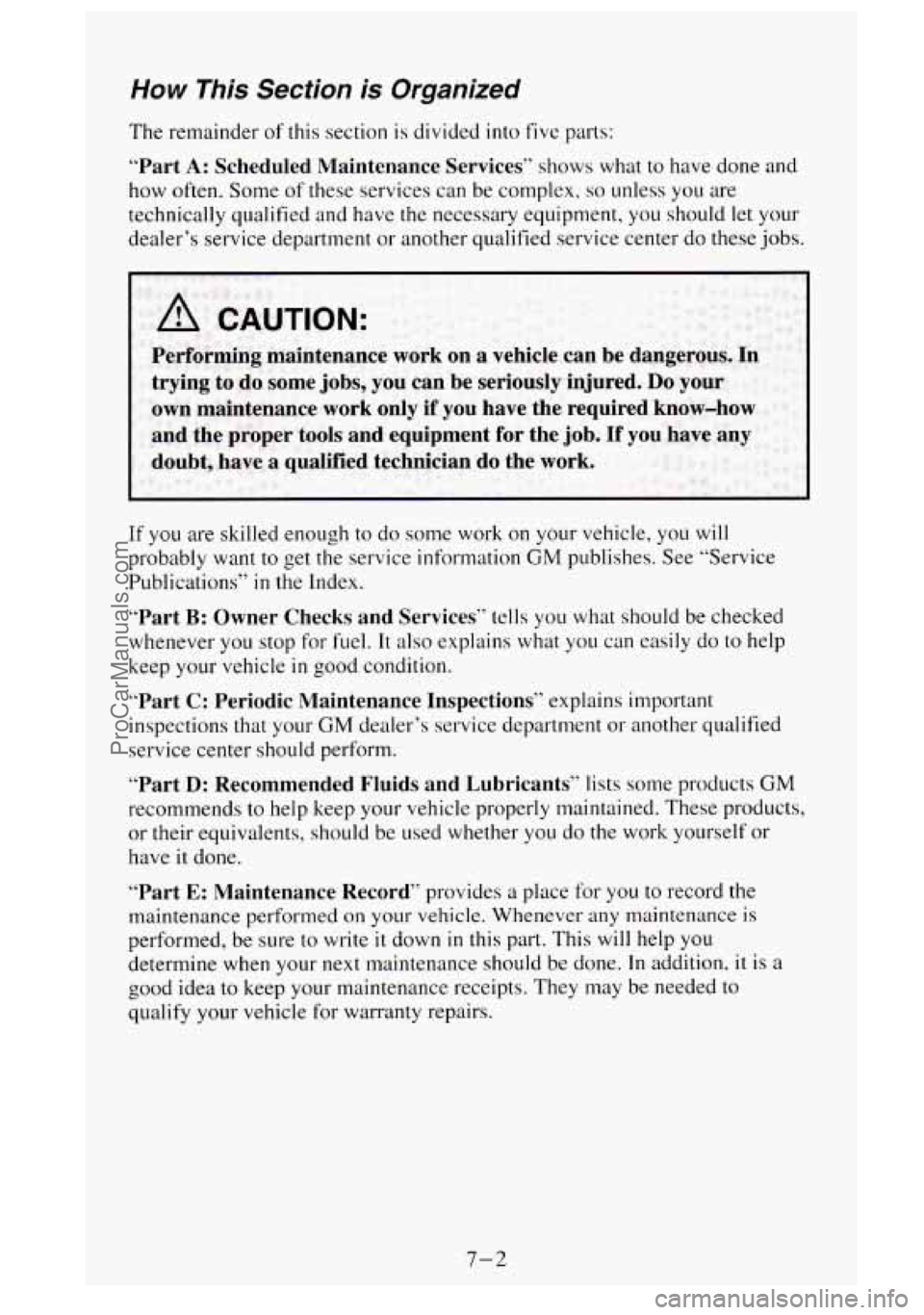
How This Section is Organized
The remainder of this section is divided into five parts:
“Part A: Scheduled Maintenance Services” shows what to have done and
how often. Some
of these services can be complex, so unless you are
technically qualified and have the necessary equipment, you should let your
dealer’s service department or another qualified service center do these
jobs.
If you are skilled enough to do some work on your vehicle, you will
probably want to get the service information
GM publishes. See “Service
Publications”
in the Index.
“Part B: Owner Checks and Services” tells you what should be checked
whenever you stop for fuel.
It also explains what you can easily do to help
keep
your vehicle in good condition.
“Part C: Periodic Maintenance Inspections” explains important
inspections that your
GM dealer’s service department or another qualified
service center should perform.
“Part D: Recommended Fluids and Lubricants” lists some products GM
recommends to help keep your vehicle properly maintained. These products,
or their equivalents, should be used whether you do the work yourself or
have it done.
“Part E: Maintenance Record” provides a place for you to record the
maintenance performed on your vehicle. Whenever any maintenance
is
performed, be sure to write it down in this part. This will help you
determine when your next maintenance should be done.
In addition, it is a
good idea to keep your maintenance receipts. They may be needed to
qualify your vehicle for warranty repairs.
7-2
ProCarManuals.com
Page 359 of 488
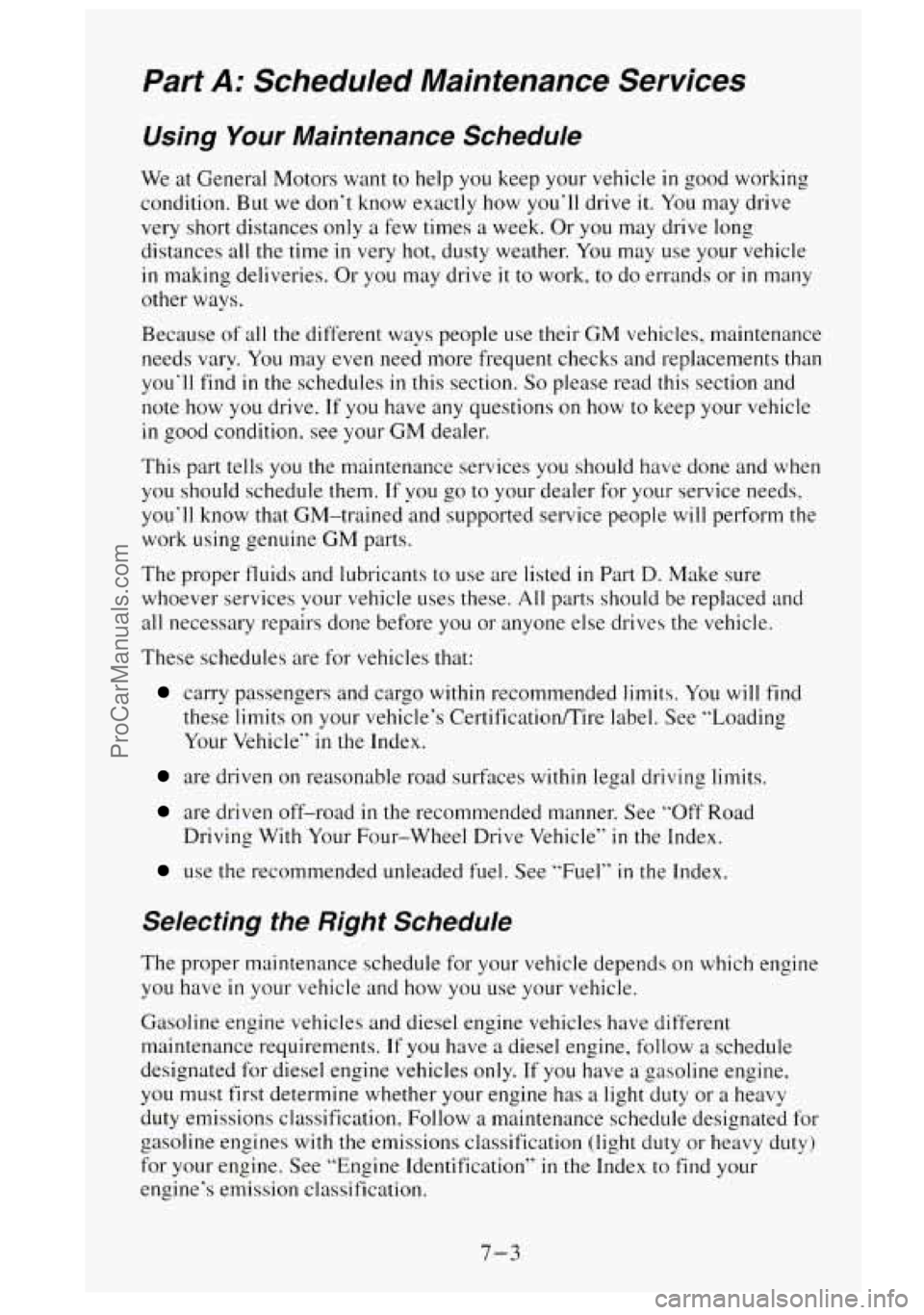
Part A: Scheduled Maintenance Services
Using Your Maintenance Schedule
We at General Motors want to help you keep your vehicle in good working
condition. But we don’t know exactly how you’ll drive it. You may drive
very short distances only
a few times a week. Or you may drive long
distances all the time
in very hot, dusty weather. You may use your vehicle
in making deliveries. Or you may drive it to work, to do errands or in many
other ways.
Because
of all the different ways people use their GM vehicles, maintenance
needs varv.
You may even need more frequent checks and replacements than
you‘ll find
in the schedules in this section. So please read this section and
note how you drive. If you have any questions on how to keep your vehicle
in good condition. see your GM dealer.
This part tells you the maintenance services you should have done and
when
you should schedule them. If you go to your dealer for your service needs,
you’ll know that GM-trained and supported service people
will perform the
work using genuine
GM parts.
The proper fluids and lubricants to use are listed
in Part D. Make sure
whoever services your vehicle uses these.
All parts should be replaced and
all necessary repairs done before you or anyone else drives the vehicle.
These schedules are for vehicles that:
carry passengers and cargo within recommended limits. You will find
these limits on your vehicle’s CertificatiodTire label. See “Loading
Your Vehicle“
in the Index.
are driven on reasonable road surfxes within legal driving limits.
are driven off-road in the recommended manner. See “Off Road
Driving With Your Four-wheel Drive Vehicle”
in the Index.
use the recommended unleaded fuel. See “Fuel” in the index.
Selecting the Right Schedule
The proper maintenance schedule for your vehicle depends on which engine
you have
in your vehicle and how you use your vehicle.
Gasoline engine vehicles and diesel engine vehicles have different
maintenance requirements.
If you have a diesel engine, follow a schedule
designated for diesel engine vehicles only. If you have
a gasoline engine.
you must first determine whether your engine has
a light duty or a heavy
duty emissions classification. Follow a maintenance schedule designated
for
for your engine. See “Engine Identification” in the Index to find your
engine‘s emission classification.
c easoline engines with the emissions classification (light duty or heavy duty)
7-3
ProCarManuals.com
Page 361 of 488
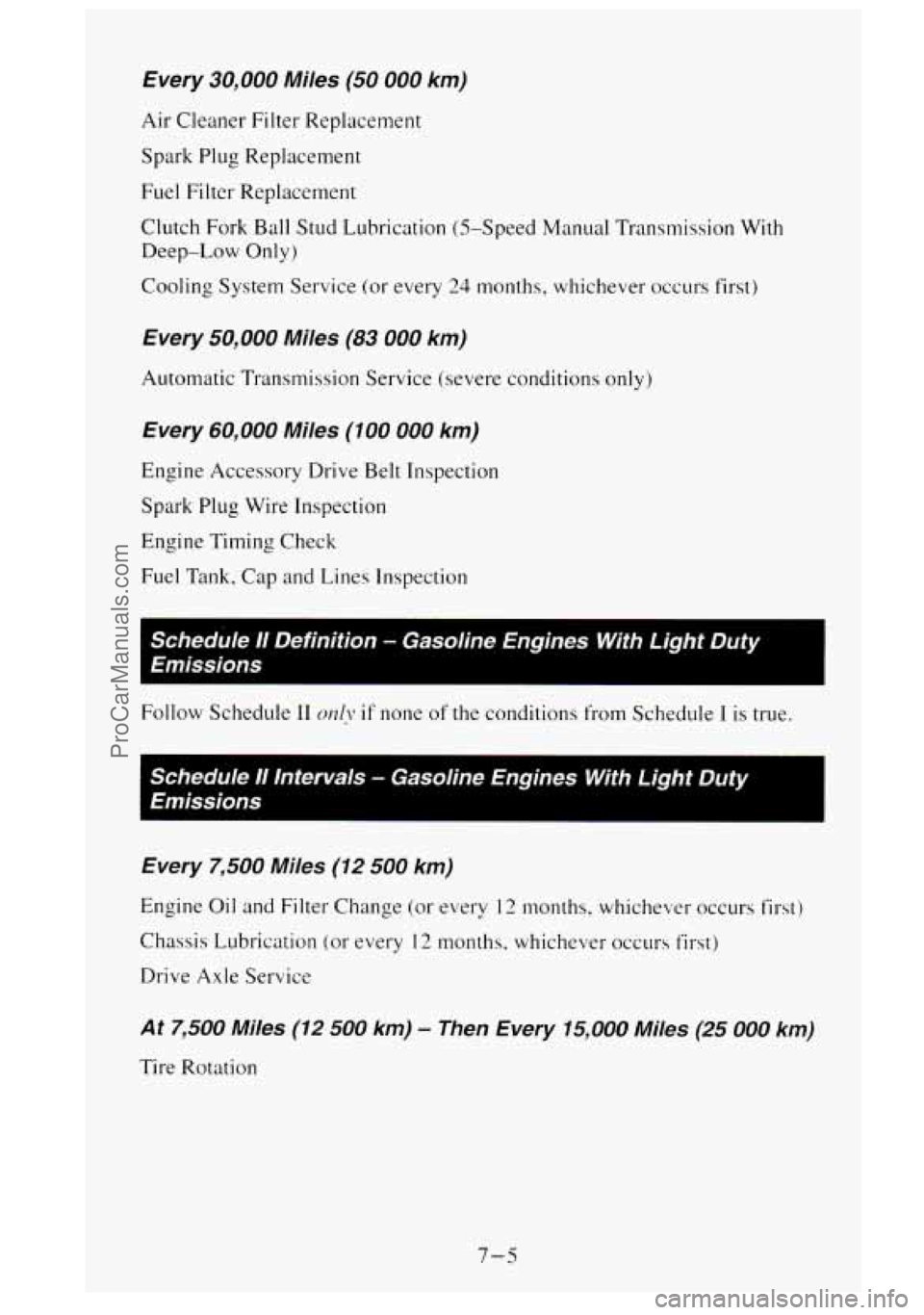
Every 30,000 Miles (50 000 km)
Air Cleaner Filter Replacement
Spark Plug Replacement
Fuel Filter Replacement
Clutch
Fork Ball Stud Lubrication (5-Speed Manual Transmission With
Deep-Low Only)
Cooling System Service (or every
24 months, whichever occurs first)
Every 50,000 Miles (83 000 km)
Automatic Transmission Service (severe conditions only)
Every 60,000 Miles (100 000 km)
Engine Accessory Drive Belt Inspection
Spark Plug Wire Inspection
Engine Timing Check
Fuel Tank, Cap and Lines Inspection
Schedule 11 Definition - Gasoline Engines With Light Duty
Emissions
Follow Schedule I1 only if none of the conditions from Schedule I is true.
Schedule I1 Intervals - Gasoline Engines With Light Duty
Emissions
Every
7,500 Miles (12 500 km)
Engine Oil and Filter Change (or every 12 months, whichever occurs first)
Chassis Lubrication (or every
12 months, whichever occurs first)
Drive Axle Service
At 7,500 Miles (12 500 km) - Then Every 15,000 Miles (25 000 km)
Tire Rotation
7-5
ProCarManuals.com
Page 362 of 488
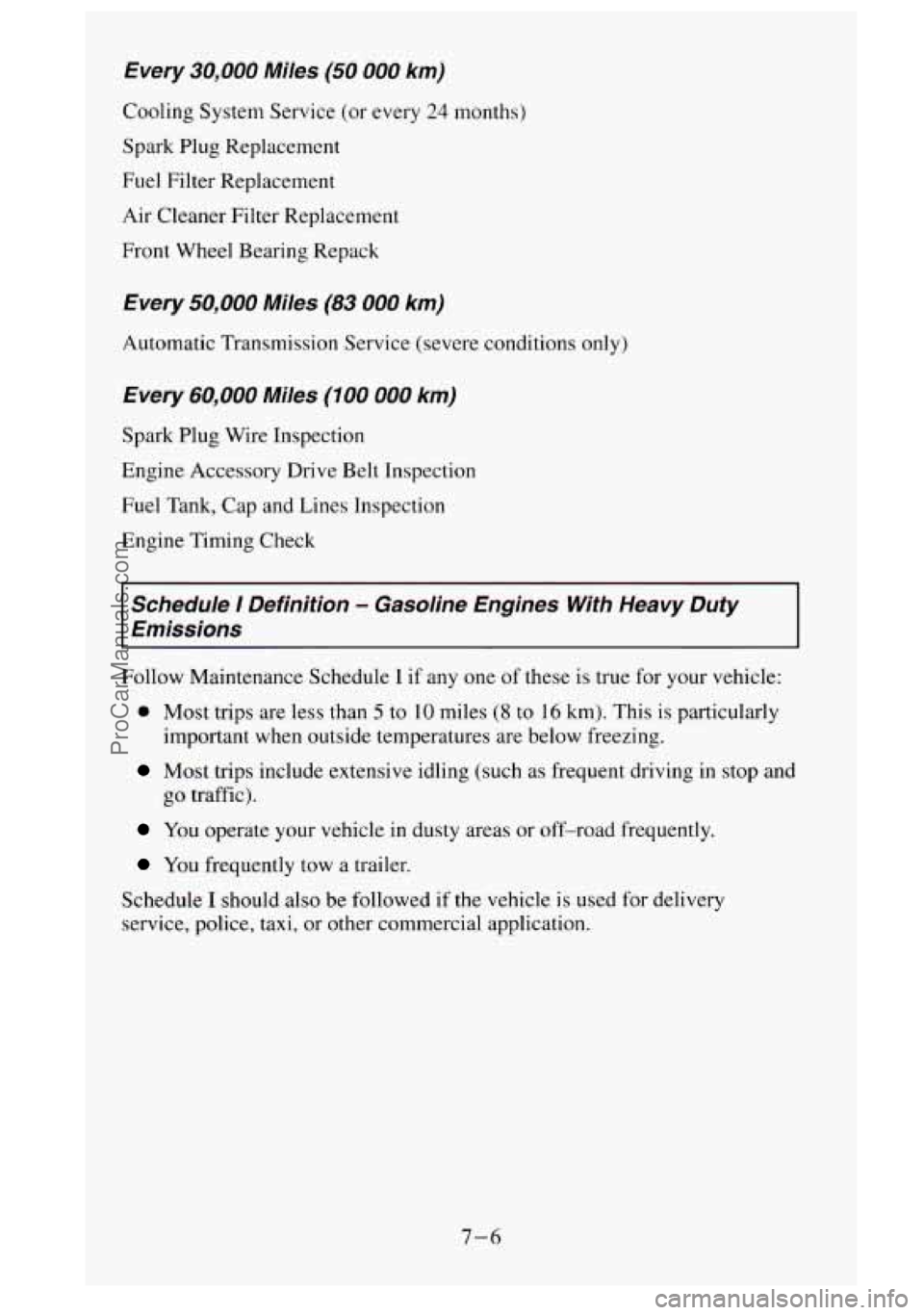
Every 30,000 Miles (50 000 km)
Cooling System Service (or every 24 months)
Spark Plug Replacement
Fuel Filter Replacement
Air Cleaner Filter Replacement
Front Wheel Bearing Repack
Every 50,000 Miles (83 000 km)
Automatic Transmission Service (severe conditions only)
Every 60,000 Miles (100 000 km)
Spark Plug Wire Inspection
Engine Accessory Drive Belt Inspection
Fuel Tank,
Cap and Lines Inspection
Engine Timing Check
Schedule 1 Definition - Gasoline Engines With Heavy Duiy
Emissions
I
Follow Maintenance Schedule I if any one of these is true for your vehicle:
0 Most trips are less than 5 to 10 miles (8 to 16 km). This is particularly
important when outside temperatures are below freezing.
Most trips include extensive idling (such as frequent driving in stop and
go traffic).
You operate your vehicle in dusty areas or off-road frequently.
You frequently tow a trailer.
Schedule
I should also be followed if the vehicle is used for delivery
service, police, taxi, or other commercial application.
7-6
ProCarManuals.com
Page 363 of 488

Schedule I Intervals - Gasoline Engines with Heavy Duty
Emissions
Every
3,000 Miles (5 000 km)
Engine Oil and Filter Change (or every 3 months, whichever occurs first)
Chassis Lubrication (or every
3 months, whichever occurs first)
Drive Axle Service
At 6,000 Miles (10 000 km) - Then Every 12,000 Miles (25 000 km)
Tire Rotation
Every 12,000 Miles (20 000 km)
Air Cleaner Filter Inspection, if Driving in Dusty Conditions
Front Wheel Bearing Repack (or at Each Brake Relining) (2-Wheel Drive
Only
1
Fuel Filter Replacement
Engine Accessory Drive Belt Inspection
Shields
and Underhood Insulation Inspection
Thermostatically Controlled Engine Cooling Fan Check (or every
12
months, whichever occurs first)
Every 24,000 Miles (40 000 km)
Cooling System Service (or every 24 months, whichever occurs first)
Air Cleaner Filter Replacement
Engine Timing Check
Thermostatically Controlled Air Cleaner Inspection
Air Intake System Inspection
Every 27,000 Miles (45 000 km)
Spark Plugs Replacement
Every 30,000 Miles (50 000 km)
Clutch Fork Ball Stud Lubrication (%Speed Transmission with Deep-Low
Only)
7-7
ProCarManuals.com

