1995 GMC SIERRA maintenance schedule
[x] Cancel search: maintenance schedulePage 357 of 488
Scheduled Maintenance Services
KEEP ENGINE OIL
AT THE PROPER
LEVEL AND CHANGE
AS RECOMMENDED
Section
This section covers the maintenance required for your vehicle. Your vehicle
needs these services to retain its safety, dependability and emission control
performance.
I protection
Plan
I
Introduction
Your Vehicle and the Environment
Proper vehicle maintenance not only helps to keep your vehicle in good
working condition, but also helps the environment. All recommended
maintenance procedures are important. Improper vehicle maintenance or the
removal
of important components can significantly affect the quality of the
air we breathe. Improper
fluid levels or even the wrong tire inflation can
increase the level of emissions from your vehicle.
To help protect our
environment, and
to help keep your vehicle in good condition, please
maintain your vehicle properly.
7-1
ProCarManuals.com
Page 358 of 488
How This Section is Organized
The remainder of this section is divided into five parts:
“Part A: Scheduled Maintenance Services” shows what to have done and
how often. Some
of these services can be complex, so unless you are
technically qualified and have the necessary equipment, you should let your
dealer’s service department or another qualified service center do these
jobs.
If you are skilled enough to do some work on your vehicle, you will
probably want to get the service information
GM publishes. See “Service
Publications”
in the Index.
“Part B: Owner Checks and Services” tells you what should be checked
whenever you stop for fuel.
It also explains what you can easily do to help
keep
your vehicle in good condition.
“Part C: Periodic Maintenance Inspections” explains important
inspections that your
GM dealer’s service department or another qualified
service center should perform.
“Part D: Recommended Fluids and Lubricants” lists some products GM
recommends to help keep your vehicle properly maintained. These products,
or their equivalents, should be used whether you do the work yourself or
have it done.
“Part E: Maintenance Record” provides a place for you to record the
maintenance performed on your vehicle. Whenever any maintenance
is
performed, be sure to write it down in this part. This will help you
determine when your next maintenance should be done.
In addition, it is a
good idea to keep your maintenance receipts. They may be needed to
qualify your vehicle for warranty repairs.
7-2
ProCarManuals.com
Page 359 of 488
Part A: Scheduled Maintenance Services
Using Your Maintenance Schedule
We at General Motors want to help you keep your vehicle in good working
condition. But we don’t know exactly how you’ll drive it. You may drive
very short distances only
a few times a week. Or you may drive long
distances all the time
in very hot, dusty weather. You may use your vehicle
in making deliveries. Or you may drive it to work, to do errands or in many
other ways.
Because
of all the different ways people use their GM vehicles, maintenance
needs varv.
You may even need more frequent checks and replacements than
you‘ll find
in the schedules in this section. So please read this section and
note how you drive. If you have any questions on how to keep your vehicle
in good condition. see your GM dealer.
This part tells you the maintenance services you should have done and
when
you should schedule them. If you go to your dealer for your service needs,
you’ll know that GM-trained and supported service people
will perform the
work using genuine
GM parts.
The proper fluids and lubricants to use are listed
in Part D. Make sure
whoever services your vehicle uses these.
All parts should be replaced and
all necessary repairs done before you or anyone else drives the vehicle.
These schedules are for vehicles that:
carry passengers and cargo within recommended limits. You will find
these limits on your vehicle’s CertificatiodTire label. See “Loading
Your Vehicle“
in the Index.
are driven on reasonable road surfxes within legal driving limits.
are driven off-road in the recommended manner. See “Off Road
Driving With Your Four-wheel Drive Vehicle”
in the Index.
use the recommended unleaded fuel. See “Fuel” in the index.
Selecting the Right Schedule
The proper maintenance schedule for your vehicle depends on which engine
you have
in your vehicle and how you use your vehicle.
Gasoline engine vehicles and diesel engine vehicles have different
maintenance requirements.
If you have a diesel engine, follow a schedule
designated for diesel engine vehicles only. If you have
a gasoline engine.
you must first determine whether your engine has
a light duty or a heavy
duty emissions classification. Follow a maintenance schedule designated
for
for your engine. See “Engine Identification” in the Index to find your
engine‘s emission classification.
c easoline engines with the emissions classification (light duty or heavy duty)
7-3
ProCarManuals.com
Page 360 of 488
If your engine has more than one emissions classification, the classification
is determined by the Gross Vehicle Weight Rating (GVWR) of your vehicle
as shown on the Certification Label. See “Loading Your Vehicle”
in the
Index.
Once you’ve determined your engine type and,
if necessary, emissions
classification, you’ll need to decide which of the two schedules is right for
your vehicle. See Definitions for Maintenance Schedule
I and Maintenance
Schedule
I1 following.
Schedule I Definition - Gasoline Engines With Light Duty
Emissions
Follow Maintenance Schedule I if any one of these is true for your vehicle:
iII Most trips are less than 5 to 10 miles (8 to 16 km). This is particularly
important when outside temperatures are below freezing.
0 Most trips include extensive idling (such as frequent driving in
stop-and-go traffic).
You operate your vehicle in dusty areas or off-road frequently.
0 You frequently tow a trailer.
Schedule
I should also be followed if the vehicle is used for delivery
service, police, taxi, or other commercial application.
Schedule I Intervals - Gasoline Engines With Light Duty
Emissions
Every
3,000 Miles (5 000 km) or 3 Months, Whichever Occurs First
Engine Oil and Filter Change
Chassis Lubrication
Drive Axle Service
At 6,000 Miles (10 000 km) - Then Every 12,000 Miles (25 000 km)
Tire Rotation
Every 75,000 Miles (25 000 km)
Air Cleaner Filter Inspection, if driving in dusty conditions
Front Wheel Bearing Repack
(or at each brake relining) (2WD Only)
7-4
ProCarManuals.com
Page 362 of 488
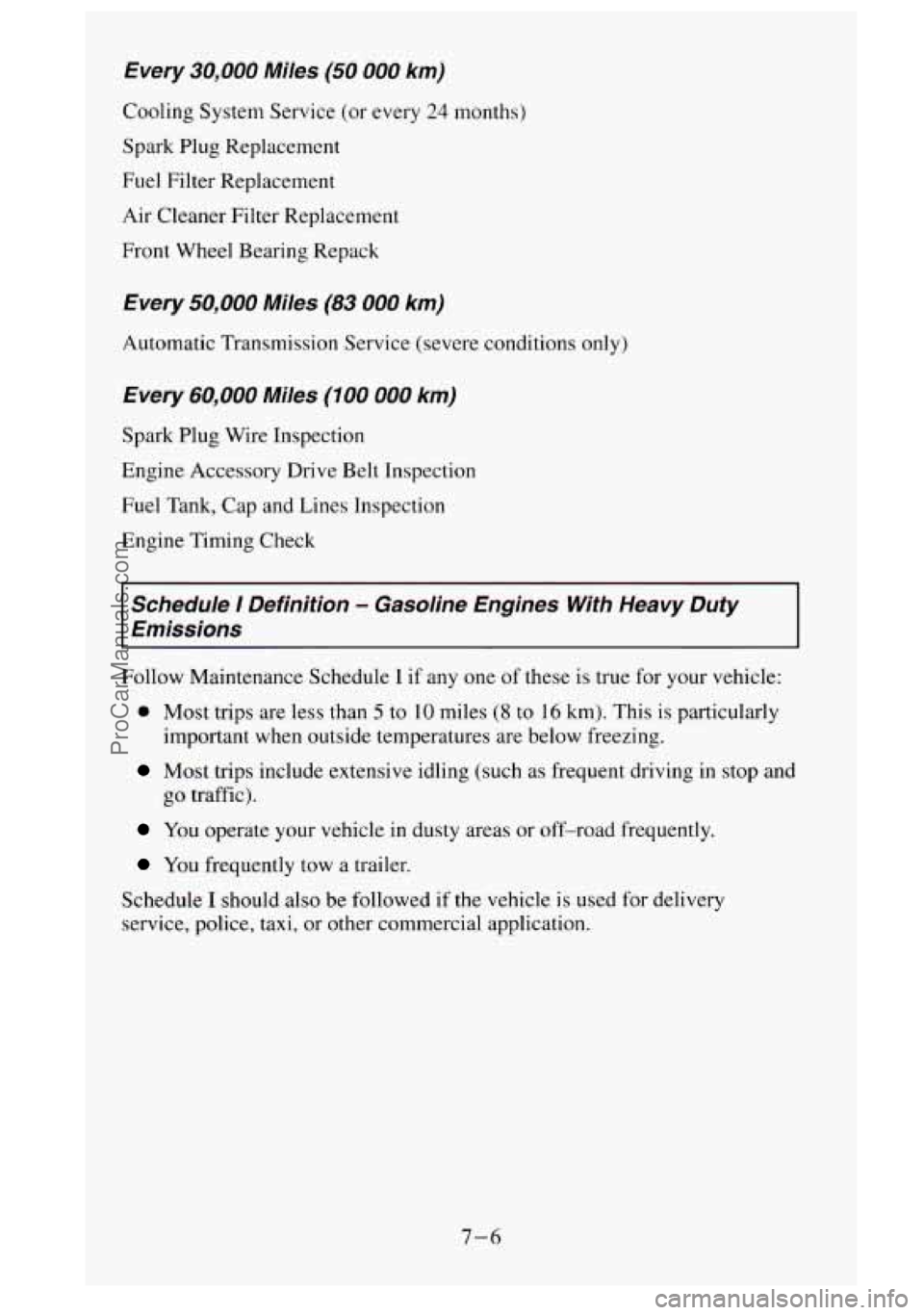
Every 30,000 Miles (50 000 km)
Cooling System Service (or every 24 months)
Spark Plug Replacement
Fuel Filter Replacement
Air Cleaner Filter Replacement
Front Wheel Bearing Repack
Every 50,000 Miles (83 000 km)
Automatic Transmission Service (severe conditions only)
Every 60,000 Miles (100 000 km)
Spark Plug Wire Inspection
Engine Accessory Drive Belt Inspection
Fuel Tank,
Cap and Lines Inspection
Engine Timing Check
Schedule 1 Definition - Gasoline Engines With Heavy Duiy
Emissions
I
Follow Maintenance Schedule I if any one of these is true for your vehicle:
0 Most trips are less than 5 to 10 miles (8 to 16 km). This is particularly
important when outside temperatures are below freezing.
Most trips include extensive idling (such as frequent driving in stop and
go traffic).
You operate your vehicle in dusty areas or off-road frequently.
You frequently tow a trailer.
Schedule
I should also be followed if the vehicle is used for delivery
service, police, taxi, or other commercial application.
7-6
ProCarManuals.com
Page 365 of 488

Every 24,000 Miles (40 000 km)
Cooling System Service (or every 24 months, whichever occurs first)
Air Cleaner Filter Replacement
Front Wheel Bearing Repack (or at Each Brake Relining) (2-Wheel Drive
Only
1
Fuel Filter Replacement
Engine Timing Check
Thermostatically Controlled Air Cleaner Inspection
Air Intake System Inspection
Every 27,000 Miles (45 000 km)
Spark Plugs Replacement
Every 30,000 Miles (50 000 km)
Clutch Fork Ball Stud Lubrication (5-Speed Transmission with Deep-Low
Only)
Every 50,000 Miles (83 000 km)
Automatic Transmission Service
Every 60,000 Miles (100 000 km)
Spark Plug Wire Inspection
Exhaust
Gas Recirculation (EGR) System Inspection
Fuel Tank, Cap and Lines Inspection
Evaporative Emission Control System Inspection
Electronic Vacuum Regulator Valve (EVRV) Inspection
Schedule I Definition - Diesel Engines
Follow Maintenance Schedule I if any one of these is true for your vehicle:
0
0
0
0
Most trips are less than 5 to 10 miles (8 to 16 km). This is particularly
important when outside temperatures are below freezing.
Most trips include extensive idling (such as frequent driving
in stop and
go traffic).
You operate your vehicle
in dusty areas or off-road frequently.
You frequently tow
a trailer.
Schedule I should also be followed if the vehicle is used for delivery
service. Dolice, taxi,
or other commercial application.
7-9
ProCarManuals.com
Page 368 of 488
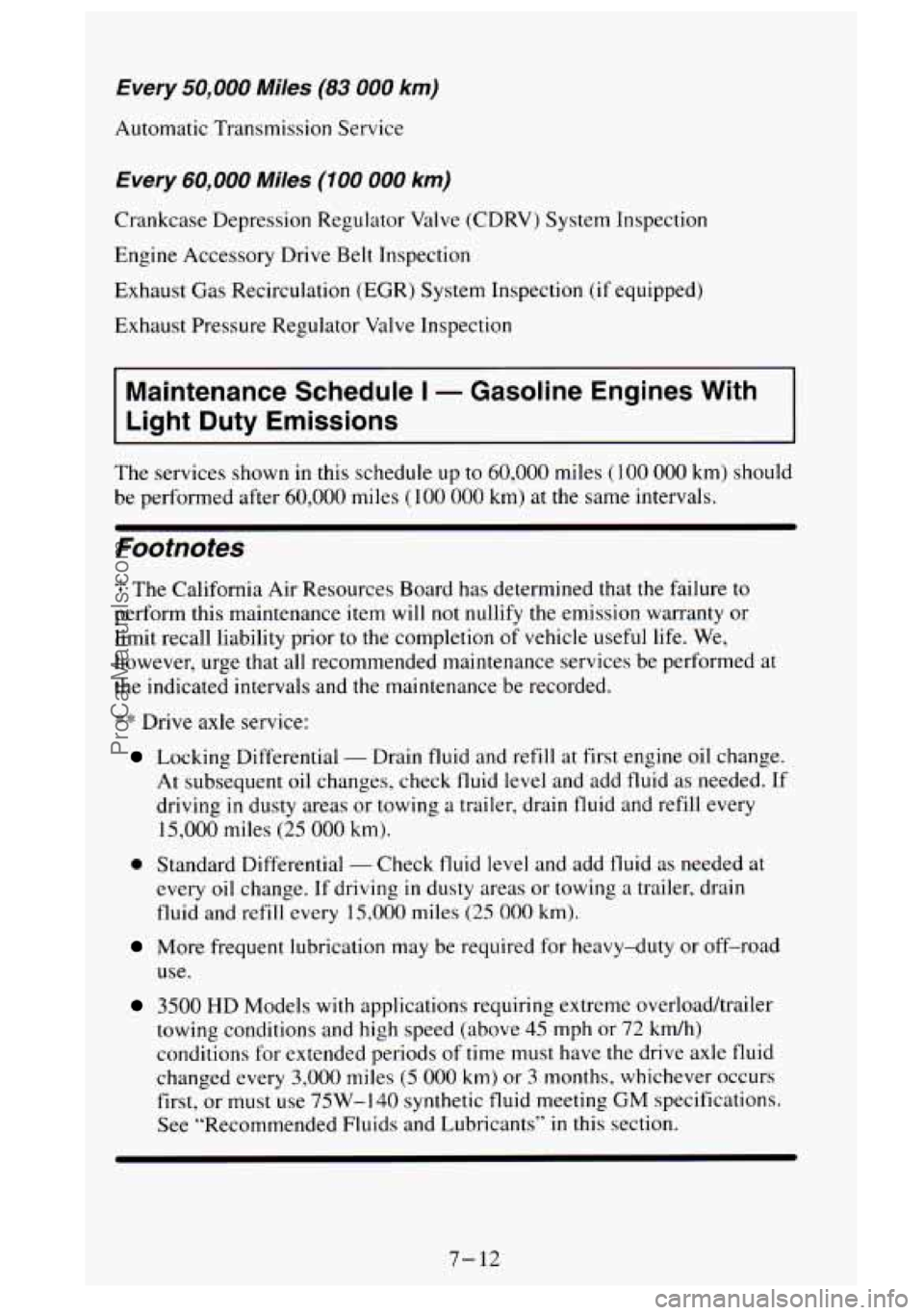
Every 50,000 Miles (83 000 km)
Automatic Transmission Service
Every 60,000 Miles (100 000 km)
Crankcase Depression Regulator Valve (CDRV) System Inspection
Engine Accessory Drive Belt Inspection
Exhaust Gas Recirculation (EGR) System Inspection
(if equipped)
Exhaust Pressure Regulator Valve Inspection
Maintenance Schedule I - Gasoline Engines With
Light
Duty Emissions
The services shown in this schedule up to 60,000 miles (1 00 000 km) should
be performed after
60,000 miles (100 000 km) at the same intervals.
Footnotes
3 The California Air Resources Board has determined that the failure to
perform this maintenance item will not nullify the emission warranty or
limit recall liability prior to the completion of vehicle useful life. We,
however, urge that all recommended maintenance services be performed at
the indicated intervals and the maintenance be recorded.
:$* Drive axle service:
Locking Differential - Drain fluid and refill at first engine oil change.
At subsequent oil changes, check fluid level and add fluid
as needed. If
driving in dusty areas or towing a trailer, drain fluid and refill every
15,000 miles (25 000 km).
0 Standard Differential - Check fluid level and add fluid as needed at
every oil change.
If driving in dusty areas or towing a trailer, drain
fluid and refill every 15,000 miles (25 000 km).
More frequent lubrication may be required for heavy-duty or off-road
use.
3500 HD Models with applications requiring extreme overload/trailer
towing conditions and high speed (above
45 mph or 72 kmh)
conditions for extended periods of time must have the drive axle fluid
changed every
3,000 miles (5 000 km) or 3 months, whichever occurs
first, or must use
75W-140 synthetic fluid meeting GM specifications.
See “Recommended Fluids and Lubricants”
in this section.
7-12
ProCarManuals.com
Page 369 of 488
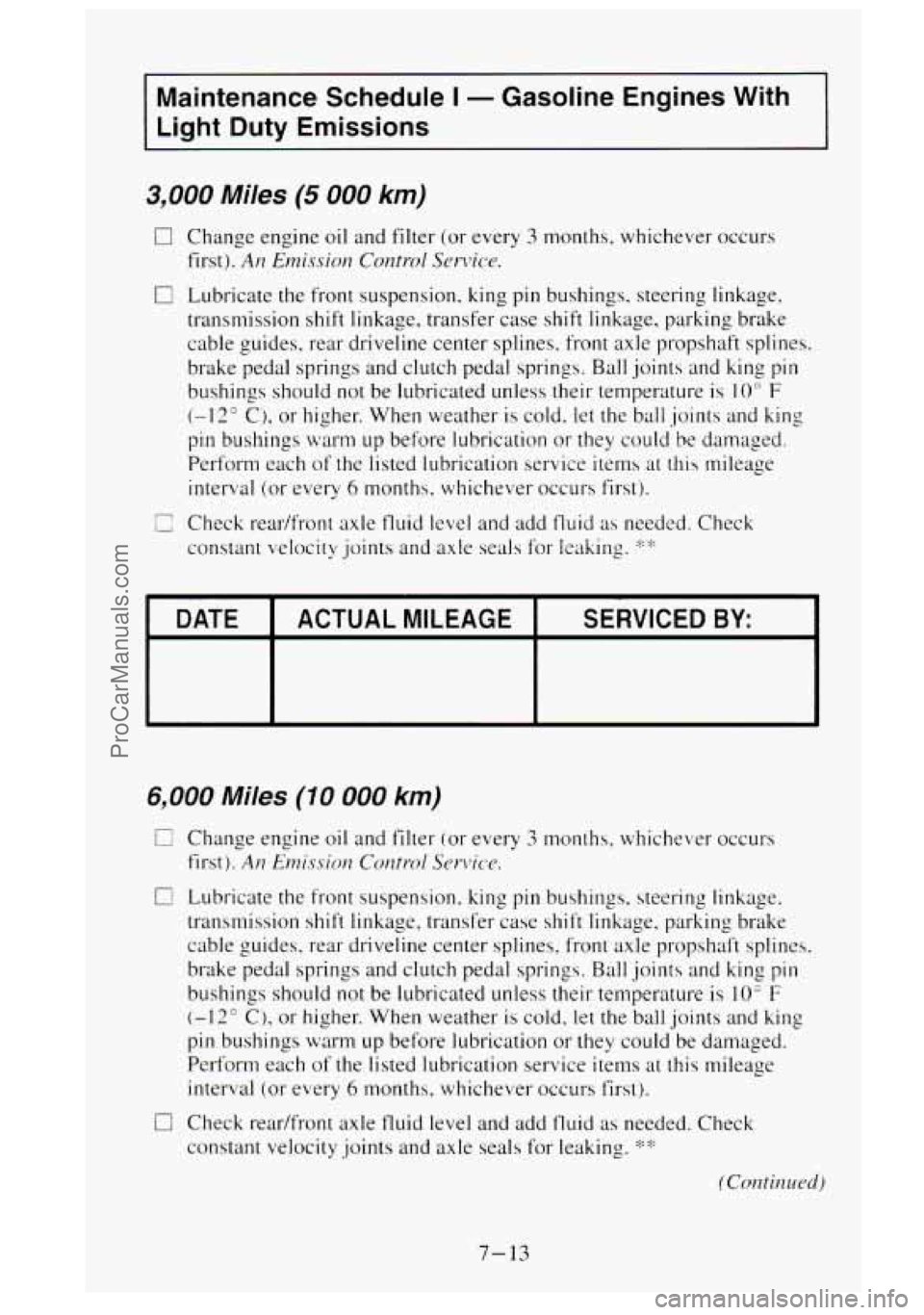
Maintenance Schedule I - Gasoline Engines With
Light Duty Emissions
3,000 Miles (5 000 km)
[7 Change engine oil and filter (or every 3 months, whichever occurs
first).
An Emission Control Sen7ic.e.
0 Lubricate the front suspension, king pin bushings, steering linkage,
transmission shift linkage. transfer case shift linkage, parking brake
cable guides, rear driveline center splines. front axle propshaft splines.
brake pedal springs and clutch pedal springs. Ball joints and king pin
bushings should not be lubricated unless their temperature is
10" F
(-1 2" C), or higher. When weather is cold, let the ball -joints and king
pin bushings warm up before lubrication or they could be damaged.
Perform each of the listed lubrication service items at this mileage
interval (or every
6 months, whichever occurs first).
C Check rear/front axle fluid level and add -fluid as needed. Check
constant velocity joints and
axle seals for leaking. *'*
DATE SERVICED BY: ACTUAL MILEAGE I
6,000 Miles (10 000 km)
iI Change engine oil and filter (or every 3 months, whichever occurs
first).
AI? Emission Confro1 Ser\lic.e.
Lubricate the front suspension, king pin bushings, steering linkage,
transmission shift linkage, transfer case shift linkage, parking brake
cable guides, rear driveline center splines, front axle propshaft splines.
brake pedal springs and clutch pedal springs. Ball joints and king pin
bushings should not be lubricated unless their temperature
is 10" E
(,-12" C), or higher. When weather is cold, let the ball joints and king
pin bushings warm up before lubrication
or they could be damaged.
Perform each of the listed lubrication service items at this mileage
interval (or every
6 months, whichever occurs first).
0 Check readfront axle fluid level and add fluid as needed. Check
constant velocity joints and axle seals for leaking.
*'$
(Contiwed)
7-13
ProCarManuals.com