Page 315 of 354
I Maintenance Schedule I1
45,000 Miles (75 000 km)
0 Change engine oil and filter (or every
7.5 months, whichever occurs first).
An Emission Control Service.
0 Clean and repack the front wheel bearings
(or at each brake relining, whichever occurs
first).
0 Rotate tires. See “Tire Inspection and
Rotation” in the Index for proper rotation
pattern and additional information.
0 Inspect the locking front hubs (if equipped)
for correct operation (or every
3 months,
whichever occurs first). Repair
or replace if
necessary.
0 Inspect the valve lash and adjust if
necessary. An Emission Control Service.
0 Check engine idle speed and adjust it to
underhood label specifications.
An Emission
Control Sewice.
0 Inspect propeller shafts and u-joints for
looseness and damage (or every 15 months,
whichever occurs first). Inspect more
frequently
if used off-road or for pulling a
trailer. Tighten u-joint flange bolts if
necessary.
I I I 1
1
ACTUAL MILEAGE SERVICED BY
7-38
ProCarManuals.com
Page 317 of 354

52,500 Miles (87 500 km)
Change engine oil and filter (or every
7.5 months, whichever occurs first).
An Emission Control Service.
0 Rotate tires. See “Tire Inspection and
Rotation”
in the Index for proper rotation
pattern and additional information.
0 Inspect the locking front hubs (if equipped)
for correct operation (or every
3 months,
whichever occurs first). Repair or replace
if
necessary.
DATE
SERVICED BY ACTUAL MILEAGE
60,000 Miles (100 000 km)
0 Change engine oil and filter (or every
7.5 months, whichever occurs first).
An Emkyiolq Control Service.
0 Clean and repack the front wheel bearings (or at
each brake relining, whichever occurs first).
0 Rotate tires. See “Tire Inspection and
Rotation” in the Index for proper rotation
pattern and additional information.
every
24 months, whichever occurs first).
An Emission Control Service.
0 Drain, flush and refill cooling system (or
every
30 months, whichever occurs first).
See “Engine Coolant” in the Index for what
to use. Inspect hoses. Clean radiator,
condenser, pressure cap and neck. Pressure
test the cooling
system and pressure cap.
An E1??issinn Control Service.
Inspect engine accessory drive belts (or
7-40
.- ProCarManuals.com
Page 319 of 354
60,000 Miles (100 000 km) (Continued)
0 Inspect the underhood wiring harness for
loose connections, chafed wires and
damage (or every
60 months, whichever
occurs first).
An Emission Control Service.
0 Replace spark plug wires (or every
60 months, whichever occurs first).
An Emission Contra1 Service.
0 Drain, refill and bleed the brake system.
Replace the camshaft timing belt. Inspect
after
30,000 miles (50 000 km). AII Ewtission
Control Service.
I I 1 3
DATE SERVICED BY ACTUAL MILEAGE
67,500 Miles (112 500 km)
0 Change engine oil and filter (or every
7.5 months, whichever occurs first).
0 Rotate tires. See “Tire Inspection and
Rotation”
in the Index for proper rotation
pattern
and additional information.
0 Inspect the locking front hubs (if equipped)
for correct operation (or every
3 months,
whichever occurs first). Repair or replace if
necessary.
An Emission Control Service.
DATE SERVICED BY ACTUAL MILEAGE
ProCarManuals.com
Page 320 of 354
I Maintenance Schedule I1
75,000 Miles (125 000 km)
0 Change engine oil and filter (or every
7.5 months, whichever occurs first).
An Emission Control Service.
0 Clean and repack the front wheel bearings
(or at each brake relining, whichever occurs
first).
0 Rotate tires. See “Tire Inspection and
Rotation’’ in the Index for proper rotation
pattern and additional information.
0 Inspect the locking front hubs (if equipped)
for correct operation (or every 3 months,
whichever occurs first). Repair or replace if
necessary.
0 Inspect the valve lash and adjust if
necessary.
An Emission Control Service.
0 Check engine idle speed and adjust it to
underhood label specifications.
An Emission
Control Service.
0 Inspect propeller shafts and u-joints for
looseness and damage (or every
15 months,
whichever occurs first). Inspect more
frequently if used off-road or for pulling a
trailer. Tighten u-joint flange bolts if
necessary.
I DATE I ACTUALMILEAGE ISERVICED BY:^
ProCarManuals.com
Page 321 of 354
I Maintenance Schedule I1 I
82,500 Miles (137 500 km)
Change engine oil and filter (or every
7.5 months, whichever occurs first).
0 Rotate tires. See “Tire Inspection and
Rotation” in the Index
for proper rotation
pattern and additional information.
An Emission Control Service.
0 Inspect the locking front hubs (if equipped)
for correct operation (or every
3 months,
whichever occurs first). Repair or replace if
necessary.
90,000 Miles (150 000 km)
0 Change engine oil and filter (or every
7.5 months, whichever occurs first).
An Emission Control Service.
0 Clean and repack the front wheel bearings
(or at each brake relining, whichever occurs
first).
every
24 months, whichever occurs first).
0 Inspect engine accessory drive belts (or
An Emission Control Service.
0 Inspect camshaft timing belt, An Emission
Control Service.
ProCarManuals.com
Page 326 of 354

At Least mice a Year Starter Switch
Fluid Level Check
Check the transfer case, axle differential(s) and
automatic or manual transmission fluid levels and add
as needed.
See “Transfer Case,” “Axle, Rear,” “Axle,
Front” and “Automatic Transmission” or “Manual
Transmission” in the Index.
A fluid loss in these systems
could indicate
a problem. Have the system inspected and
repaired at
once.
At Least Once a Year
Key Lock Cylinders
Lubricate the key lock cylinders with the lubricant
specified
in Part D.
Body Lubrication
Lubricate all body door hinges. Also lubricate all hinges
and latches, including those for the hood, rear
compartment, glove box door, console door and any
folding seat hardware. Part
D tells you what to use.
More frequent lubrication may be required when
exposed
to a corrosive environment.
1. Before you start, be sure you have enough room
around the vehicle.
2. Firmly apply both the parking brake (see “Parking
Brake”
in the Index if necessary) and the regular brake.
NOTE:
Do not use the accelerator pedal, and be
ready to turn
off the engine immediately if it starts.
3. On automatic transmission vehicles, try to start the
engine in each gear. The starter should work only in
PARK (P) or NEUTRAL (N). If the starter works in
any other position, your vehicle needs service.
On manual transmission vehicles, put the shift lever
in
NEUTRAL (N), push the clutch down halfway
and try
to start the engine. The starter should work
only when the clutch is pushed down all the way to
the floor. If the starter works when the clutch isn’t
pushed
all the way down, your vehicle needs service.
7-49
ProCarManuals.com
Page 327 of 354
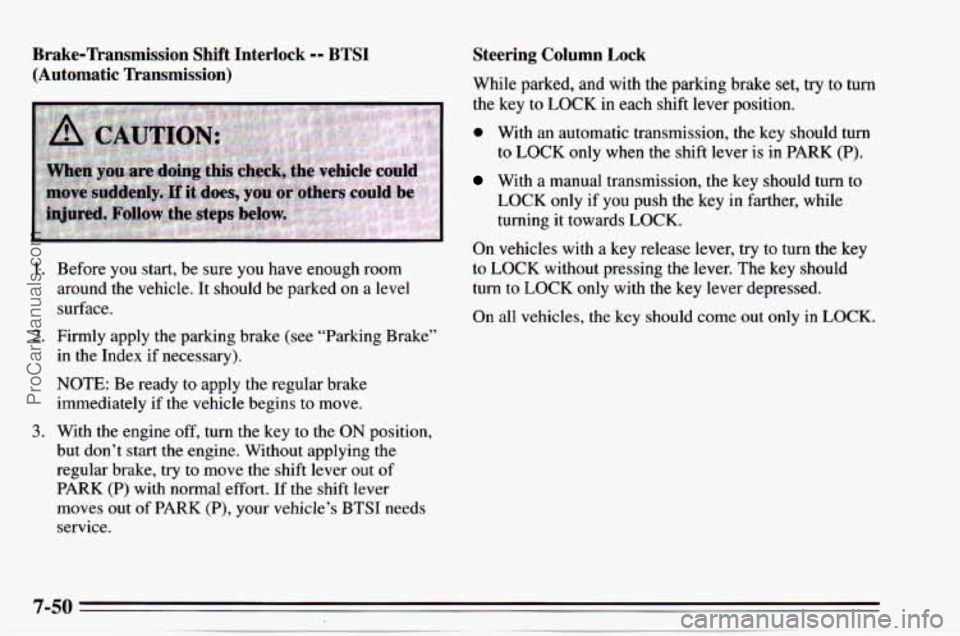
Brake-Transmission Shift Interlock -- BTSI
(Automatic Transmission)
1.
2.
3.
Before you start, be sure you have enough room
around the vehicle. It should be parked on a level
surface.
Firmly apply the parking brake
(see “Parking Brake”
in the Index if necessary).
NOTE: Be ready to apply the regular brake
immediately if the vehicle begins to move.
With the engine off, turn the key
to the ON position,
but don’t start the engine. Without applying the
regular brake, try to move the shift lever out of
PARK
(P) with normal effort. If the shift lever
moves out of PARK (P), your vehicle’s BTSI needs
service.
Steering Column Lock
While parked, and with the parking brake set, try to turn
the key to
LOCK in each shift lever position.
0 With an automatic transmission, the key should turn
to
LOCK only when the shift lever is in PARK (P).
With a manual transmission, the key should turn to
LOCK only if you push the key in farther, while
turning it towards
LOCK.
On vehicles with a key release lever, try to turn the key
to
LOCK without pressing the lever. The key should
turn to
LOCK only with the key lever depressed.
On all vehicles, the key should come out only in LOCK.
ProCarManuals.com
Page 328 of 354
Parking Brake and Automatic Ikansmission PARK Underbody Flushing \
(P) Mechanism Check At least every spring, use plain water to flush any
corrosive materials from
the underbody. Take care to
clean thoroughly any areas where mud and other debris
can collect.
.-
Park on a fairly steep hill, with the vehicle facing
downhill. Keeping your foot
on the regular brake, set the
parking brake.
0 To check the parking brake: With the engine running
and transmission
in NEUTRAL (N), slowly remove
foot pressure from the regular brake pedal.
Do this
until the vehicle is held by the parking brake only.
0 To check the PARK (P) mechanism's holding ability:
Shift to
PARK (P). Then release all brakes. If your
vehicle is four-wheel drive, be sure the transfer case
is not in NEUTRAL (N).
ProCarManuals.com


 Mechanism Check At least every spring, use plain water to flush any
corrosive materials from
the underbody. Take")