1995 CHEVROLET TRACKER fuel pressure
[x] Cancel search: fuel pressurePage 6 of 354
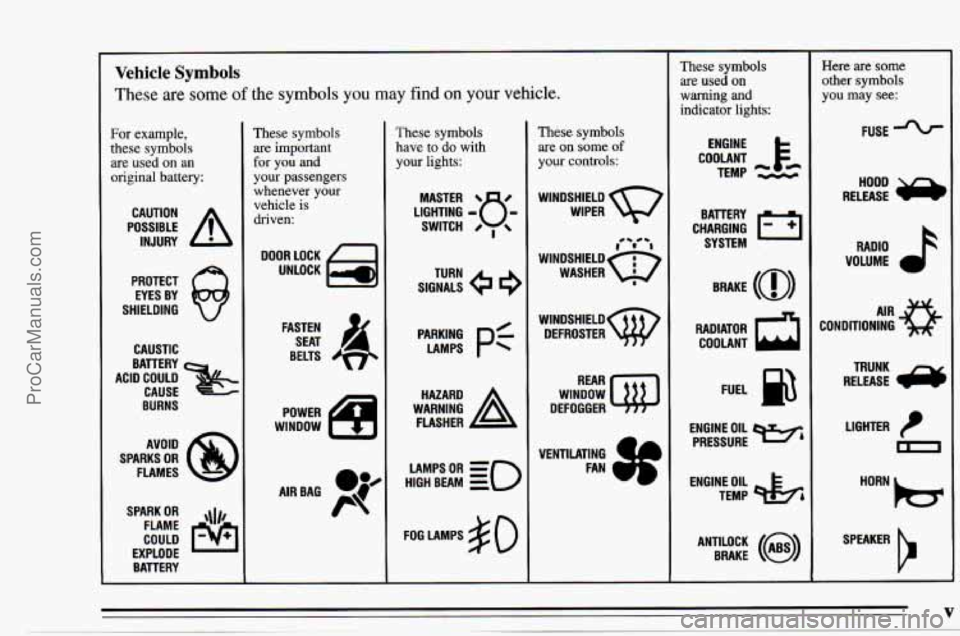
~~ Vehicle Symbols
These are some of the symbols you may find on your vehicle.
For example,
these symbols
are used on an
original battery:
POSSIBLE A
CAUTION
INJURY
PROTECT EYES BY
SHIELDING
CAUSTIC
ACID COULD BATTERY
CAUSE
BURNS
SPARK
OR ,\(I,
COULD FLAME
EXPLODE BAVERY
These symbols are important
for
you and
your passengers
whenever your
vehicle
is
driven:
DOOR LOCK
UNLOCK
FASTEN SEAT
&,
BELTS
POWER
WINDOW
LR
AIRBAG P@K
These symbols
have to
do with
your
lights:
SIGNALS e
TURN
PyN;
pf
WARNING A
HAZARD
FLASHER
HIGH
LAMPSoR BEAM = =o
FOG LAMPS $0
These symbols
are on some of
your controls:
WINDSHIELD
WIPER
,-/ 'I
WINDSHIELDQ
WASHER 8
wlNDSHIELDw DEFROSTER
WINDOW
DEFOGGER
These symbols are used on
warning and
indicator lights:
COOLANT F-
TEMP --
ENGINE
CHARGING
I-1
BATTERY SYSTEM
BRAKE
(a)
RADIATOR a
COOLANT
FUEL
ENGINE OIL
e,
PRESSURE
TEMP
OIL pk;
ANTIU)CK BRAKE (i)
~
Here are some
other symbols
you may see:
FUSE -%-
RADIO h
VOLUME a
CONDITIONING AIR 43
LIGHTER
m
SPEAKER
b
V
. ~ ProCarManuals.com
Page 158 of 354

The exit ramp can be curved, sometimes quite sharply.
The
exit speed is usually posted.
Reduce your speed according to your speedometer, not
to your sense of motion. After driving for any distance
at higher speeds, you may tend to think
you are going
slower than
you actually are.
Before Leaving on a Long Trip
Make sure you’re ready. Try to be well rested. If you
must start when you’re not fresh
-- such as after a day’s
work
-- don’t plan to make too many miles that first part
of the journey. Wear comfortable clothing and shoes you
can easily drive in.
Is your vehicle ready for a long trip? If you keep it
serviced and maintained, it’s ready to go. If
it needs
service, have it done before starting out. Of course,
you’ll find experienced and able service experts
in
ChevroletlGeo dealerships all across North America.
They’ll be ready and willing to help if
you need it.
Here are some things you can check before a trip:
0 Windshield Washer Fluid: Is the reservoir full? Are
all windows clean inside and outside?
0 Wiper Blades: Are they in good shape?
0
0
0
0
0
Fuel, Engine Oil, Other Fluids: Have you checked
all levels?
Lamps: Are they all working? Are the lenses clean?
Tires: They are vitally important to a safe,
trouble-free trip.
Is the tread good enough for
long-distance driving? Are the tires all inflated to the
recommended pressure?
Weather Forecasts: What’s the weather outlook
along your route? Should you delay your trip a short
time to avoid a major storm system?
Maps: Do you have up-to-date maps?
Highway Hypnosis
Is there actually such a condition as “highway
hypnosis”? Or is it just plain falling asleep at the wheel?
Call
it highway hypnosis, lack of awareness, or
whatever.
There is something about an easy stretch of road with
the same scenery, along with the hum of the tires on the
road, the drone of the engine, and the rush of the wind
against the vehicle that can make you sleepy. Don’t let
it
happen to you! If it does, your vehicle can leave the
road in
less than a second, and you could crash and be
injured.
ProCarManuals.com
Page 253 of 354
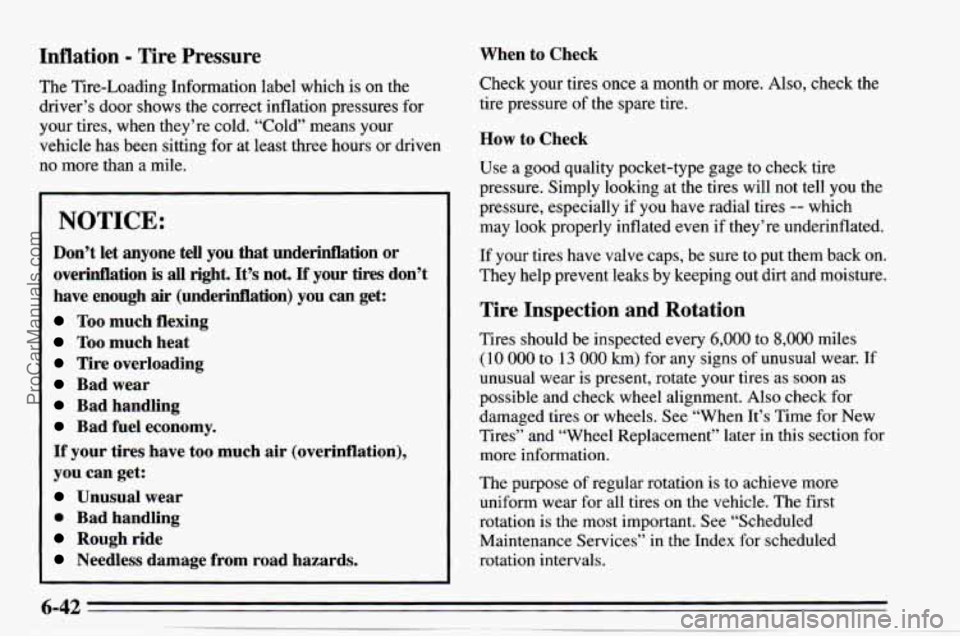
Inflation - Tire Pressure
The Tire-Loading Information label which is on the
driver’s door shows the correct inflation pressures for
your tires, when they’re cold.
“Cold” means your
vehicle has been sitting for at least three hours or driven
no more than
a mile.
I
’ NOTICE:
Don’t let anyone tell you that underidation or
~ overinflation is all right. It’s not. If your tires don’t
~ have enough air (underinflation) you can get:
Too much flexing
Too much heat
Tire overloading
Bad wear
Bad handling
Bad fuel economy.
If your tires have too much air (overinflation),
you can get:
Unusual wear
0 Bad handling
Rough ride
Needless damage from road hazards. When to Check
Check your
tires once a month or more. Also, check the
tire pressure of
the spare tire.
How to Check
Use a good quality pocket-type gage to check tire
pressure. Simply looking at the tires will
not tell you the
pressure, especially if you have radial tires
-- which
may look properly inflated even
if they’re underinflated.
If your tires have valve caps, be sure to put them back on.
They help prevent leaks by keeping out dirt and moisture.
Tire Inspection and Rotation
Tires should be inspected every 6,000 to 8,000 miles
(10 000 to 13 000 km) for any signs of unusual wear. If
unusual wear is present, rotate your tires as
soon as
possible and check wheel alignment. Also check for
damaged tires or wheels. See “When It’s Time for New
Tires” and “Wheel Replacement” later in this section for
more information.
The purpose
of regular rotation is to achieve more
uniform wear for all tires on the vehicle. The first
rotation is the most important. See “Scheduled
Maintenance Services” in
the Index for scheduled
rotation intervals.
ProCarManuals.com
Page 274 of 354

7 8
9
10 11
12
13
14 Lighter;
Radio
Ignition System; Warning and Indicator Lights
Turn Signal Lamps; Back-up Lamps
WiperNasher
Rear Defogger
Heater
Rear Wheel Anti-Lock Main Relay
Electronic Fuel Injection Main Relay Replacement Bulbs
Back-up .................................... 1156
Center High-Mounted Stop
...................... 921
Dome
............ GM Part No. 9605 1559 or equivalent
Front Parking and Turn Signal
............... 1157 NA
Headlamp (Halogen) .......................... 9004
GM Part
No. 944173 1 or equivalent
GM Part
No. 96052599 or equivalent
Heater
or Air
Conditioning Control ...................
Indicator and Warning
Brake
........... GM Part No. 9433184 or equivalent
Check Engine
..... GM Part No. 9433184 or equivalent
4WD ........... GM Part No. 9433184 or equivalent
................ GM Part No. 9433184 or equivalent
Safety Belt
....... GM Part No. 9433184 or equivalent
Turn Signal
...... GM Part No. 9433 184 or equivalent
Charging System
. . GM Part No. 9433184
or equivalent
Engine Oil Pressure GM Part
No. 9433184 or equivalent
Headlamp High Beam
Instrument Cluster GM Part
No. 9605 1561 or equivalent
6-63
ProCarManuals.com
Page 275 of 354

Replacement Bulbs Continued
License Plate ................................. 194
GM Part No. 96053203 or equivalent
Lighter
............ GM Part No. 9433 184 or equivalent
Rear Defogger Switch
.............................
GM Part No. 96061736 or equivalent
GM Part No. 96051557 or equivalent
Rear Hazard and
Turn Signal .................... 1156
Rear Parking and Stop
......................... 1157
GM Part No. 96051558 or equivalent
Rear Wipermasher Switch
.........................
GM Part No. 96061736 or equivalent
Sidemarker
................................... 194
GM Part No. 96053293 or equivalent
Capacities and Specifications
Engine
Type ......................................... L4
Compression Ratio 8-Valve Engine
............................ 8.9: 1
16-Valve Engine ........................... 9.5: 1
Firing Order
.............................. 1-3-4-2
Fuel Delivery
......................... Fuel Injection
Piston Displacement
................... 97 CID (1.6L)
Valve Arrangement ................ In-Head “V” Type
AC Belt Tension
.............. Deflect Belt 0.24-0.3 in.
(6-9
mm) @ 22 lbs. (10 kg.) Pressure
Fan Belt Tension
Inspection
............... Deflect Belt 0.24-0.32 in.
Replacement
............. Deflect Belt 0.20-0.28 in.
(6-8
mm)
0 22 lbs. (10 kg.) Pressure
(5-7 mm)
@ 22 lbs. (10 kg.) Pressure
Thermostat Temperature Specification
.... 180°F (82°C)
ProCarManuals.com
Page 299 of 354

Maintenance Schedule I
60,000 Miles (100 000 km) (Continued)
test the cooling system and pressure cap.
An Emission Control Service.
0 Replace spark plugs. An Emission Control
Replace spark plug wires (or every
60 months, whichever occurs first).
0 Replace fuel filter (or every 30 months,
Service.
An Emission Control Service.
whichever occurs first, or sooner if filter is
clogged). An Emission Control Service.
0 Inspect the underhood wiring harness for
loose connections, chafed wires and
damage
(or every 60 months, whichever
occurs first).
An Emission Control Service.
0 Drain, refill and bleed the brake system.
0 Replace air cleaner filter. Replace filter
more often under dusty conditions.
An Emission Control Service.
0 Inspect fuel tank, cap and lines for damage
or leaks. Inspect fuel cap gasket
for any
damage. Replace parts as needed.
0 Rotate tires. See “Tire Inspection and
Rotation” in the Index for proper rotation
pattern
and additional information.
Change manual transmission fluid (or
every
15 months, whichever occurs first).
0 Inspect the valve lash and adjust if
necessary.
An Emission Control Service.
0 Check engine idle speed and adjust it to
underhood label specifications.
An Emission Control Service.?
An Emission Control Service. 3-
0 Inspect the locking front hubs (if equipped)
for correct operation (or every
3 months,
whichever occurs first). Repair or replace as
necessary.
7-22
ProCarManuals.com
Page 306 of 354

I Maintenance Schedule I 1
0 Drain, flush and refill cooling system (or
every
30 months, whichever occurs first).
See “Engine Coolant” in the Index for what
to use. Inspect hoses. Clean radiator,
condenser, pressure cap and neck. Pressure
test the cooling system and pressure cap.
An Emission Control Service.
0 Replace spark plugs. An Emission Control
0 Replace air cleaner filter. Replace filter
Service.
more often under dusty conditions.
An Emission Control Service.
0 Inspect fuel tank, cap and lines for damage
or leaks. Inspect fuel cap gasket for any
damage. Replace parts as needed.
An Emission Control Service.
0 Rotate tires. See “Tire Inspection and
Rotation” in the Index for proper rotation
pattern and additional information.
0 Change manual transmission fluid (or every
15 months, whichever occurs first).
0 Inspect the valve lash and adjust if
necessary.
An Emission Control Service.
0 Replace fuel filter (or every 30 months,
whichever occurs first, or sooner if filter is
clogged).
An Emission Control Service.
underhood label specifications. An Emission
Control Service.
0 Inspect the locking front hubs (if equipped)
for correct operation (or every
3 months,
whichever occurs first). Repair or replace as
necessary.
0 Check engine idle speed and adjust it to
(Continued)
ProCarManuals.com
Page 313 of 354

30,000 Miles (50 000 km) (Continued)
0 Drain, flush and refill cooling system (or
every
30 months, whichever occurs first).
See “Engine Coolant”
in the Index for what
to use. Inspect hoses. Clean radiator,
condenser, pressure cap and neck. Pressure
test the cooling system and pressure cap.
An Emission Control Service.
Replace spark plugs. An Emission Control
0 Replace air cleaner filter. An Emission Control
0 Inspect fuel tank, cap and lines for damage
or leaks. Inspect fuel cap gasket for any
damage. Replace parts
as needed.
Service.
Service.
An Elnission
Control Service.
0 Change manual transmission fluid (or every
30 months, whichever occurs first).
0 Replace fuel filter (or every 30 months,
whichever occurs first, or sooner if filter
is
clogged). An Emission Control Service.
0 Inspect the locking front hubs (if equipped)
for correct operation (or every
3 months,
whichever occurs first). Repair or replace
if
necessary.
0 Inspect the valve lash and adjust if
necessary.
An Emission Control Service.
0 Check engine idle speed and adjust it to
underhood label specifications.
An Emission
Control Service.
ProCarManuals.com