Page 6 of 354
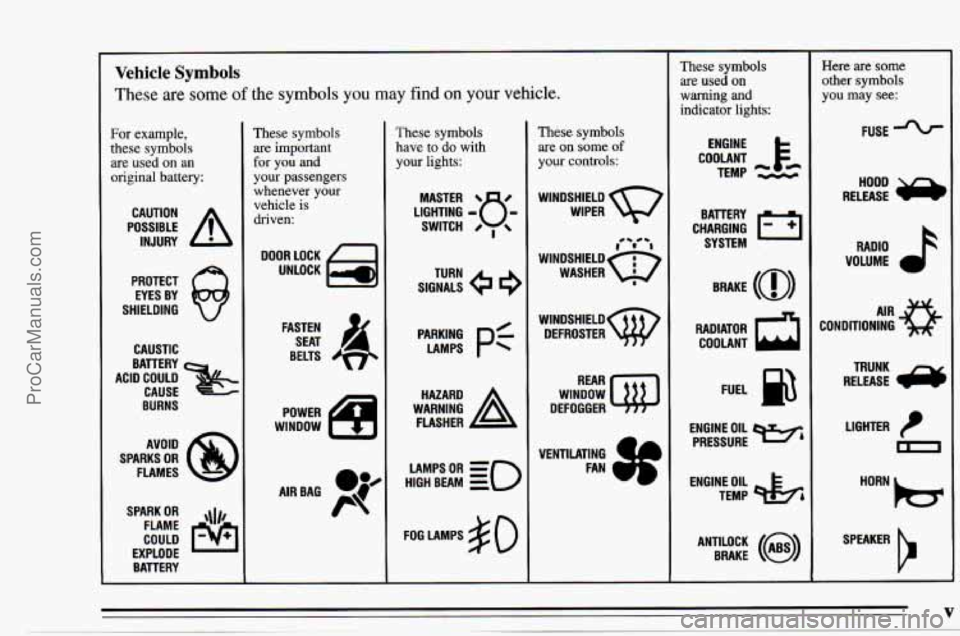
~~ Vehicle Symbols
These are some of the symbols you may find on your vehicle.
For example,
these symbols
are used on an
original battery:
POSSIBLE A
CAUTION
INJURY
PROTECT EYES BY
SHIELDING
CAUSTIC
ACID COULD BATTERY
CAUSE
BURNS
SPARK
OR ,\(I,
COULD FLAME
EXPLODE BAVERY
These symbols are important
for
you and
your passengers
whenever your
vehicle
is
driven:
DOOR LOCK
UNLOCK
FASTEN SEAT
&,
BELTS
POWER
WINDOW
LR
AIRBAG P@K
These symbols
have to
do with
your
lights:
SIGNALS e
TURN
PyN;
pf
WARNING A
HAZARD
FLASHER
HIGH
LAMPSoR BEAM = =o
FOG LAMPS $0
These symbols
are on some of
your controls:
WINDSHIELD
WIPER
,-/ 'I
WINDSHIELDQ
WASHER 8
wlNDSHIELDw DEFROSTER
WINDOW
DEFOGGER
These symbols are used on
warning and
indicator lights:
COOLANT F-
TEMP --
ENGINE
CHARGING
I-1
BATTERY SYSTEM
BRAKE
(a)
RADIATOR a
COOLANT
FUEL
ENGINE OIL
e,
PRESSURE
TEMP
OIL pk;
ANTIU)CK BRAKE (i)
~
Here are some
other symbols
you may see:
FUSE -%-
RADIO h
VOLUME a
CONDITIONING AIR 43
LIGHTER
m
SPEAKER
b
V
. ~ ProCarManuals.com
Page 51 of 354
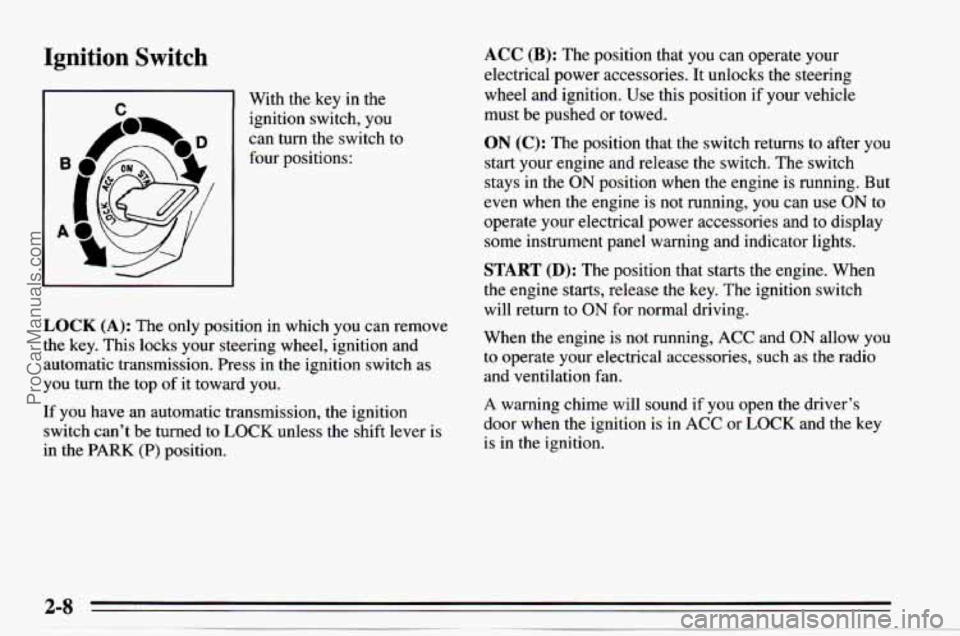
Ignition Switch
I n 1 With the key in the
ignition switch, you
can turn the switch to
four positions:
I I
LOCK (A): The only position in which you can remove
the key. This locks your steering wheel, ignition and
automatic transmission. Press in the ignition switch as
you turn the top
of it toward you.
If you have an automatic transmission, the ignition
switch can't be turned
to LOCK unless the shift lever is
in the
PARK (P) position.
ACC (B): The position that you can operate your
electrical power accessories.
It unlocks the steering
wheel and ignition. Use this position if
your vehicle
must be pushed
or towed.
ON (C): The position that the switch returns to after you
start your engine and release the switch. The switch
stays in the
ON position when the engine is running. But
even when the engine is not running, you can use
ON to
operate your electrical power accessories and to display
some instrument panel warning and indicator lights.
START (D): The position that starts the engine. When
the engine starts, release the key. The ignition switch
will return to
ON for normal driving.
When the engine is not running,
ACC and ON allow you
to operate your electrical accessories, such as the radio
and ventilation fan.
A warning chime will sound if you open the driver's
door when the ignition is in
ACC or LOCK and the key
is in the ignition.
ProCarManuals.com
Page 63 of 354
You can shift from TWO-WHEEL HIGH (2H) to
FOUR-WHEEL HIGH (4H) or from FOUR-WHEEL
HIGH
(4H) to TWO-WHEEL HIGH (2H) at any speed
if your hubs are locked and your wheels are straight
ahead. Your front axle will engage faster if
you take
your foot
off the accelerator pedal for a few seconds as
you shift.
To shift into or out of FOUR-WHEEL LOW (4L):
1. Stop your vehicle and shift your transmission to
2. Shift the
transfer case in one continuous motion.
NEUTRAL (N).
Don’t pause in NEUTRAL (N) as you shift into
FOUR-WHEEL HIGH (4H), or your gears could clash.
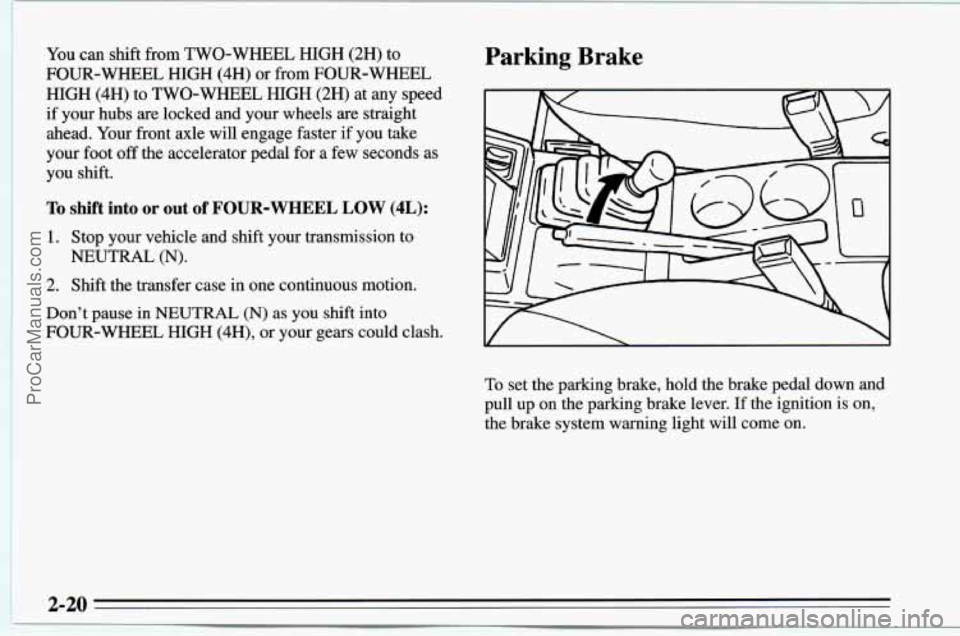
Parking Brake
To set the parking brake, hold the brake pedal down and
pull up on the parking brake lever. If the ignition is on,
the brake system warning light will come
on.
2-20
ProCarManuals.com
Page 82 of 354
1.
2.
3.
4.
5.
6.
7.
8.
9.
10.
11.
12.
Air Vent
Side Defroster Vent
Turn SignalLamps ControlM[eadlamp Beam Lever
Instrument Cluster
Hazard Warning Flasher
Windshield WiperNasher Lever
Rear Window Wiper Switch
Comfort Controls
Audio System
Cigarette Lighter
Assist Grip Glove Box 13. Transmission
Shift Lever
14. Coinholder and Bin
15. Transfer Case Shift Lever
16. Parking Brake Lever
17. Ashtray
18. Rear Window Washer Switch
19. Ignition Switch
20. Horn
2 1. Fuse Block
22. Rear Window Defogger Switch
23. Brightness Control
ProCarManuals.com
Page 86 of 354

Warning Lights, Gages and Indicators
This part describes the warning lights and gages that
may be on your vehicle. The pictures will help you
locate them.
Warning lights and gages can signal that something is
wrong before it becomes serious enough to cause an
expensive repair or replacement. Paying attention to
your warning lights and gages could also save you or
others from injury.
Warning lights come on when there may be or is
a
problem with one of your vehicle’s functions. As you
will see in the details on the next few pages, some
warning lights come on briefly when you start the
engine just to let you know they’re working. If you are
familiar with this
section, you should not be alarmed
when this happens. Gages
can indicate when there may be or is a problem
with one of your vehicle’s functions. Often gages and
warning lights work together to let you
know when
there’s a problem with your vehicle.
When one of the warning lights comes on and stays on
when you are driving, or
when one of the gages shows
there may be a problem, check the section that tells you
what to do about it. Please follow this manual’s advice.
Waiting to do repairs can be costly
-- and even
dangerous.
So please get to know your warning lights
and gages. They’re a big help.
ProCarManuals.com
Page 88 of 354

Brake System Warning Light
BRAKE
United States Canada
Your Geo’s
hydraulic brake system is divided into two
parts. If one part isn’t working, the other part can still
work and stop you. For good braking, though, you need
both
parts working well.
Your vehicle also has rear-wheel anti-lock brakes. If the
warning light comes on, there could be a brake problem
with either your regular or rear-wheel anti-lock brakes,
or both. Have your brake system inspected right away.
This light should come on briefly as you start the
vehicle.
If it doesn’t come on then, have it fixed so it
will be ready to warn you if there’s a problem. If
the light comes on while you are driving, pull
off the
road and stop carefully.
You may notice that the pedal is
harder to push. Or, the pedal may
go closer to the floor.
It may take longer to stop.
If the light is still on, have the
vehicle towed
for service. (See “Towing Your Vehicle”
in the Index.)
The brake system warning light will also come on when
you set your parking brake, and it will stay on if your
parking brake doesn’t release fully. If it stays on after
your parking brake is fully released, it means you have
a
brake problem.
~ ..
2-45
ProCarManuals.com
Page 156 of 354
City Driving One of the biggest problems with city streets is the
amount of traffic
on them. You’ll want to watch out for
what the other drivers are doing and pay attention to
traffic signals.
Here are ways to increase your safety in city driving:
0 Know the best way to get to where you are going.
Get a city map and plan your trip into an unknown
part of the city just as you would for a cross-country
trip.
Try to use the freeways that rim and crisscross most
large cities. You’ll save time and energy. (See the
next part, “Freeway Driving.”)
Treat a green light as a warning signal. A traffic light
is there because the corner is busy enough to need it.
When a light turns green, and just before you start to
move, check both ways for vehicles that have not
cleared the intersection or
may be running the red
light.
ProCarManuals.com
Page 161 of 354
Winter Driving
Here are some tips for winter driving:
Have your Geo in good shape for winter. Be sure
your engine coolant
mix is correct.
You may want to put winter emergency supplies in
your vehicle. Include an
ice scraper, a small brush or broom,
a supply
of windshield washer fluid,
a rag, some winter outer
clothing,
a small shovel, a flashlight, a red cloth, and a
couple of reflective warning triangles. And, if you will
be driving under severe conditions, include
a small bag
of sand, a piece of old carpet or a couple of burlap bags
to help provide traction. Be sure you properly secure
these items
in your vehicle.
Driving on Snow or Ice
Most of the time, those places where your tires meet the
road probably have good traction.
However,
if there is snow or ice between your tires and
the road, you can have a very slippery situation. You’ll
have
a lot less traction or “grip” and will need to be very
careful.
ProCarManuals.com