Page 6 of 354
~~ Vehicle Symbols
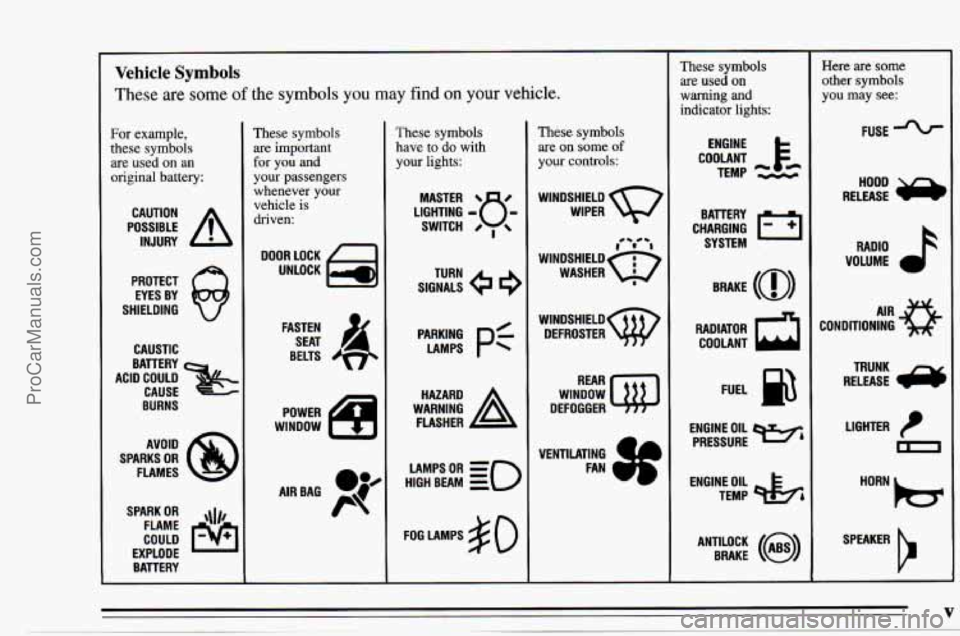
These are some of the symbols you may find on your vehicle.
For example,
these symbols
are used on an
original battery:
POSSIBLE A
CAUTION
INJURY
PROTECT EYES BY
SHIELDING
CAUSTIC
ACID COULD BATTERY
CAUSE
BURNS
SPARK
OR ,\(I,
COULD FLAME
EXPLODE BAVERY
These symbols are important
for
you and
your passengers
whenever your
vehicle
is
driven:
DOOR LOCK
UNLOCK
FASTEN SEAT
&,
BELTS
POWER
WINDOW
LR
AIRBAG P@K
These symbols
have to
do with
your
lights:
SIGNALS e
TURN
PyN;
pf
WARNING A
HAZARD
FLASHER
HIGH
LAMPSoR BEAM = =o
FOG LAMPS $0
These symbols
are on some of
your controls:
WINDSHIELD
WIPER
,-/ 'I
WINDSHIELDQ
WASHER 8
wlNDSHIELDw DEFROSTER
WINDOW
DEFOGGER
These symbols are used on
warning and
indicator lights:
COOLANT F-
TEMP --
ENGINE
CHARGING
I-1
BATTERY SYSTEM
BRAKE
(a)
RADIATOR a
COOLANT
FUEL
ENGINE OIL
e,
PRESSURE
TEMP
OIL pk;
ANTIU)CK BRAKE (i)
~
Here are some
other symbols
you may see:
FUSE -%-
RADIO h
VOLUME a
CONDITIONING AIR 43
LIGHTER
m
SPEAKER
b
V
. ~ ProCarManuals.com
Page 74 of 354

HI: The wipers will run continuously at high speed.
For a single wiping cycle, push the lever to MIST. Hold
it there until the wipers start, then let go. The wipers will
stop after one cycle.
If you want more cycles, hold the
lever on MIST longer.
Washers
Pull the wipedwasher lever toward you to spray washer
fluid on the windshield. The spray will continue until
you release the lever. This will also turn on the low
speed wipers.
Be sure to clear ice and snow from the wiper blades
before using them. If they’re frozen to the windshield,
carefully loosen or thaw them.
If your blades do become
damaged, get new blades or blade inserts.
Heavy snow or ice can overload your wipers.
A circuit
breaker will stop them until the motor cools. Clear away
snow or ice to prevent an overload.
When using concentrated washer fluid,
follow the manufacturer’s instructions for
adding water.
Don’t mix water with ready-to-use washer
fluid. Water can cause the solution to freeze
and damage your washer fluid tank and
other parts
of the washer system. Also,
water doesn’t clean as well as washer fluid.
Fill your washer fluid tank only
3/4 full
when it’s very cold.
This allows for
expansion, which could damage the tank
if
it is completely full.
Don’t
use radiator antifteeze in your
windshield washer.
It can damage your paint.
2-31
ProCarManuals.com
Page 190 of 354
stops. But then, if you still have the warning, turn ofthe
engine
and get everyone out of the vehicle until it cools down.
You may decide not to lift the hood but to get service
help right away.
2. Radiator Pressure Cap
3. Electric Engine Fan
Cooling System
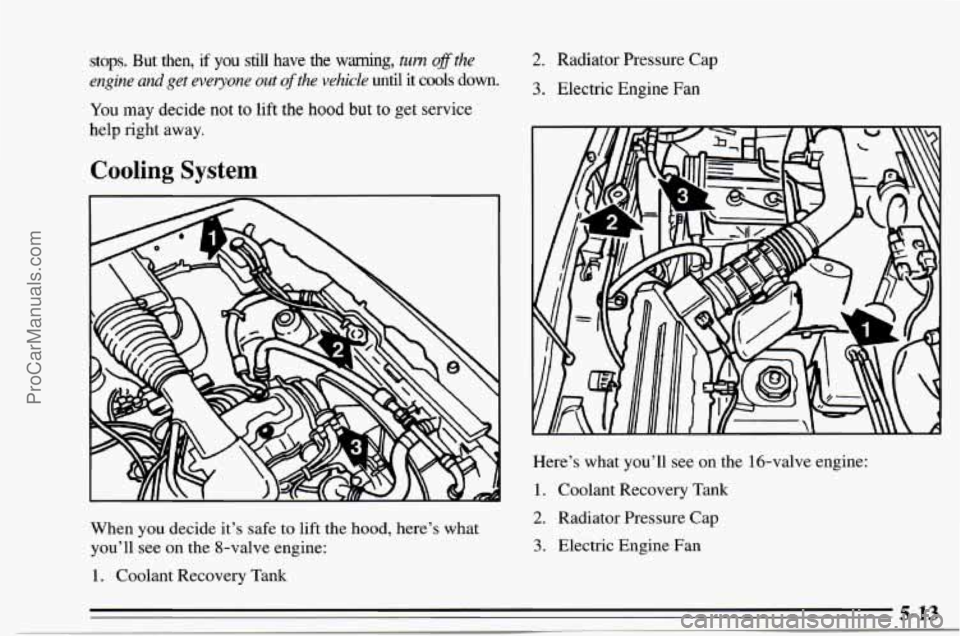
When you decide it’s safe to lift the hood, here’s what
you’ll see on the 8-valve engine:
1. Coolant Recovery Tank Here’s what
you’ll see on the 16-valve engine:
1. Coolant Recovery Tank
2. Radiator Pressure Cap
3. Electric Engine Fan
ProCarManuals.com
Page 191 of 354
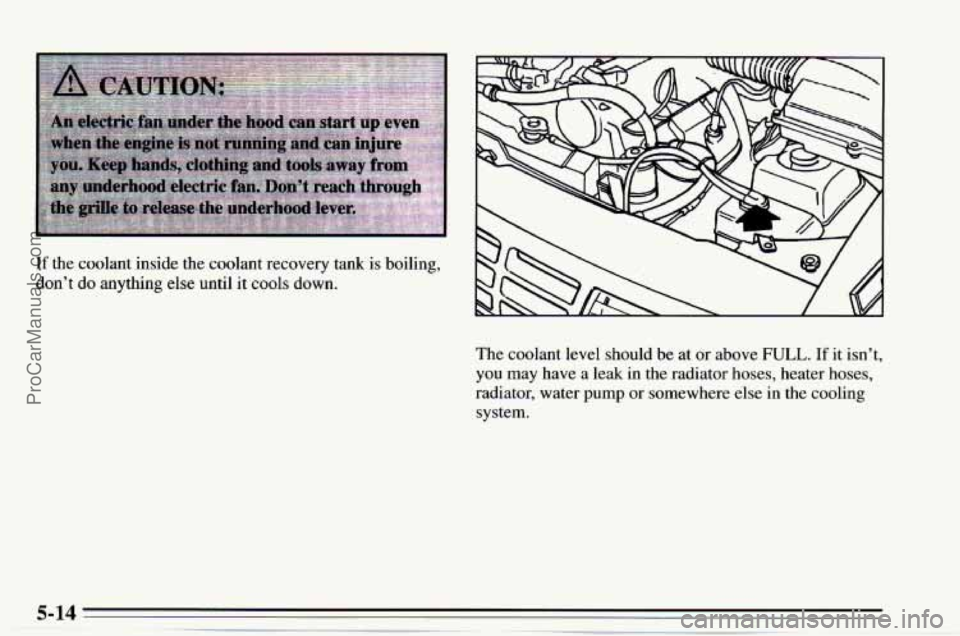
If the coolant inside the coolant recovery tank is boiling,
don’t do anything
else until it cools down.
The coolant level should be at or above
FULL. If it isn’t,
you may have a leak in the radiator hoses, heater hoses,
radiator, water pump or somewhere else in the cooling
system.
ProCarManuals.com
Page 193 of 354
I NOTICE:
In cold weather, water can freeze and crack the
engine, radiator, heater core and other parts. Use
the recommended coolant.
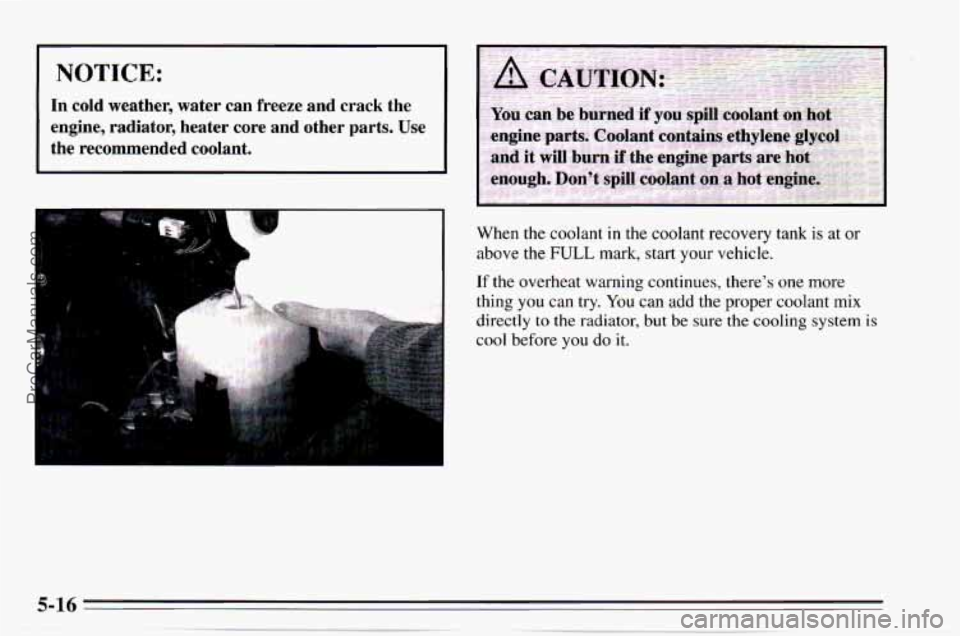
When the coolant in the coolant recovery tank is at or
above the
FULL mark, start your vehicle.
If the overheat warning continues, there's one more
thing
you can try. You can add the proper coolant mix
directly to the radiator, but be sure the cooling system is
cool before you do it.
ProCarManuals.com
Page 195 of 354
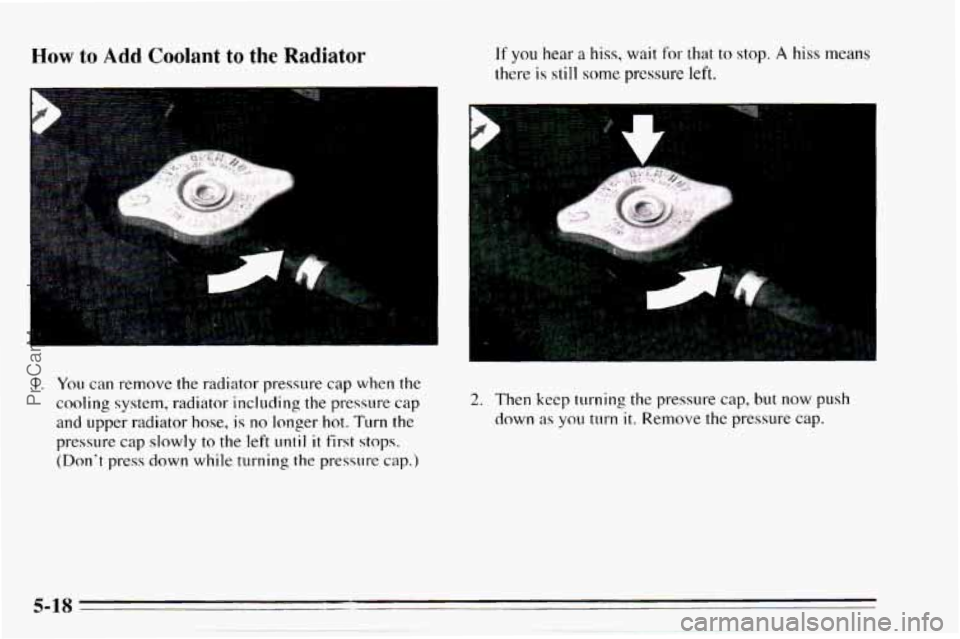
How to Add Coolant to the Radiator If you hear a hiss, wait for that to stop. A hiss means
there
is still some pressure left.
1. You can remove the radiator pressure cap when the
cooling system, radiator including
the pressure cap
and upper radiator hose,
is no longer hot. Turn the
pressure cap slowly to the left until it first stops.
(Don’t press down while turning the pressure cap.)
2. Then keep turning the pressure cap, but now push
down
as you turn it. Remove the pressure cap.
5-18 .
ProCarManuals.com
Page 196 of 354
.. ... ., . ,.
... . .. ..
I I
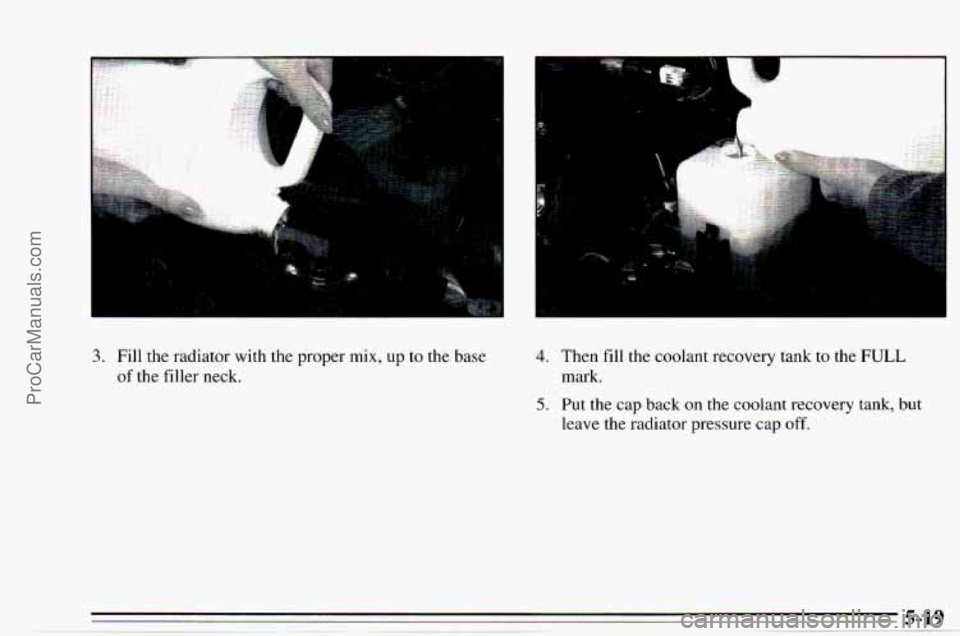
3. Fill the radiator with the proper mix, up to the base
of the filler neck.
1
4. Then fill the coolant recovery tank to the FULL
mark.
5. Put the cap back on the coolant recovery tank, but
leave the radiator pressure
cap off.
ProCarManuals.com
Page 197 of 354
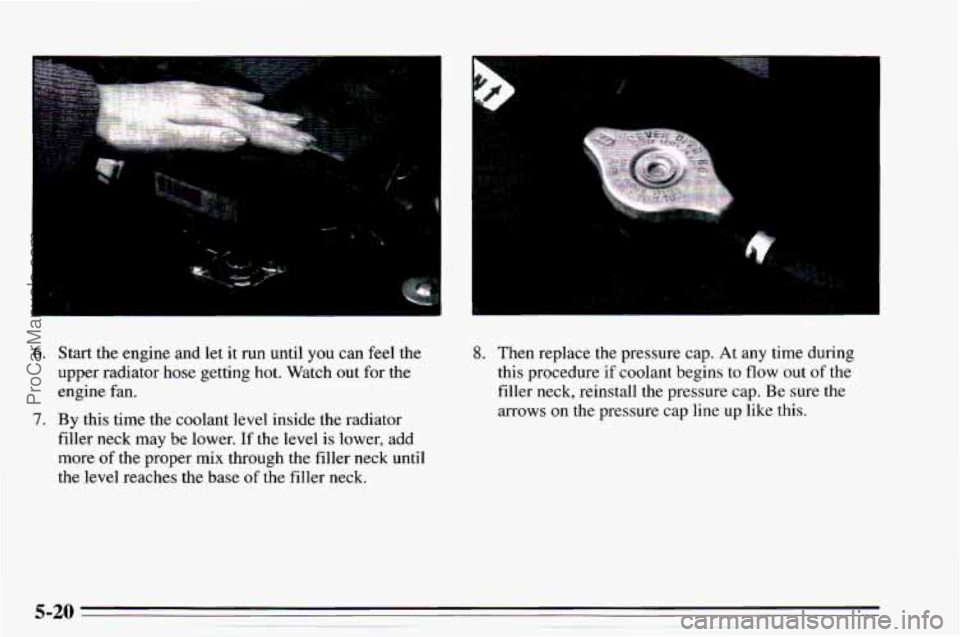
6. Start the engine and let it run until you can feel the
upper radiator hose getting hot. Watch out for the
engine fan.
7. By this time the coolant level inside the radiator
filler neck may be lower.
If the level is lower, add
more
of the proper mix through the filler neck until
the level reaches the base of the filler neck.
8. Then replace the pressure cap. At any time during
this procedure
if coolant begins to flow out of the
filler neck, reinstall the pressure cap. Be sure the
arrows on the pressure cap line up like this.
5-20 ~ - . . I .. - -- . . .,.^. . . .. ProCarManuals.com