Page 220 of 354
When you open the hood, you’ll see the following on
the 8-valve engine:
1. Battery
2. Automatic Transmission Dipstick (if equipped)
3. Oil Fill Cap
4. Brake Fluid Reservoir
5. Air Cleaner
6. Engine Coolant Reservoir
7. Power Steering Reservoir
8. Radiator Pressure Cap
9. Electric Engine Fan
10. Engine Oil Dipstick
1 1. Windshield Washer Reservoir
12. Main Fuse Box Before
closing the hood, be sure all the filler caps are
on.
6-9
ProCarManuals.com
Page 222 of 354
When you open the hood, you’ll see the following on
the 16-valve engine:
1. Battery
2. Automatic Transmission Dipstick (if equipped)
3. Oil Fill Cap
4. Brake muid Reservoir
5. Air Cleaner
6. Engine Coolant Reservoir
7. Power Steering Reservoir
8. Radiator Pressure Cap
9. Electric Engine Fan
10. Windshield Washer Reservoir
11. Main Fuse Box Before
closing the hood, be sure all the filler caps are
on.
Then lift the hood to relieve pressure on the hood prop.
Remove the hood prop from the slot in the hood and
return the prop to its retainer. Then just let the hood
down and close it firmly.
6-11 ProCarManuals.com
Page 237 of 354
I NOTICE:
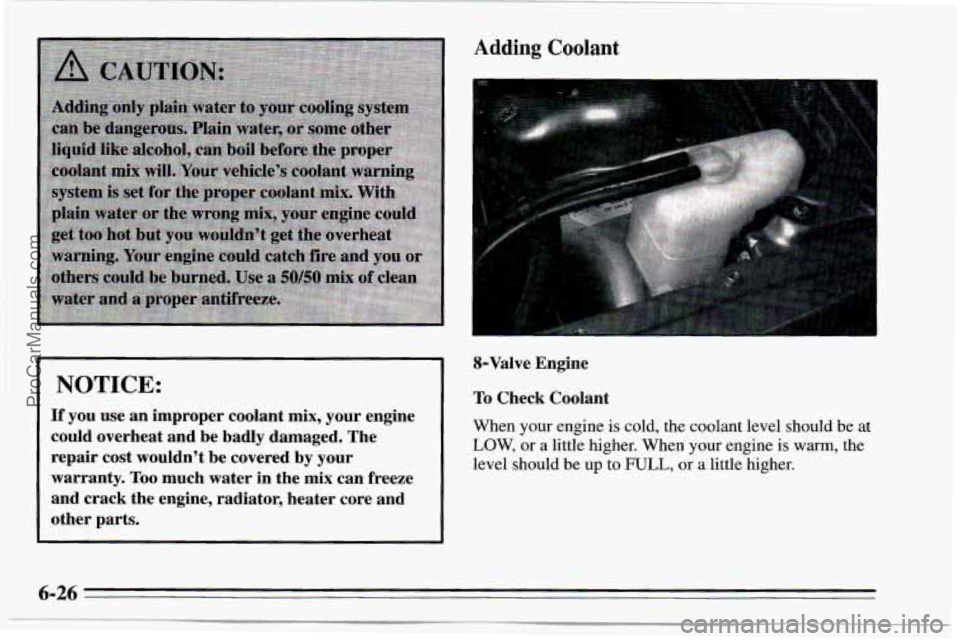
If you use an improper coolant mix, your engine
could overheat and be badly damaged. The
repair cost wouldn’t be covered by your
warranty.
Too much water in the mix can freeze
and crack the engine, radiator, heater core and
other parts.
Adding Coolant
8-Valve Engine
To Check Coolant
When your engine is cold, the coolant level should be at
LOW, or
a little higher. When your engine is warm, the
level should be
up to FULL, or a little higher.
6-26
ProCarManuals.com
Page 239 of 354
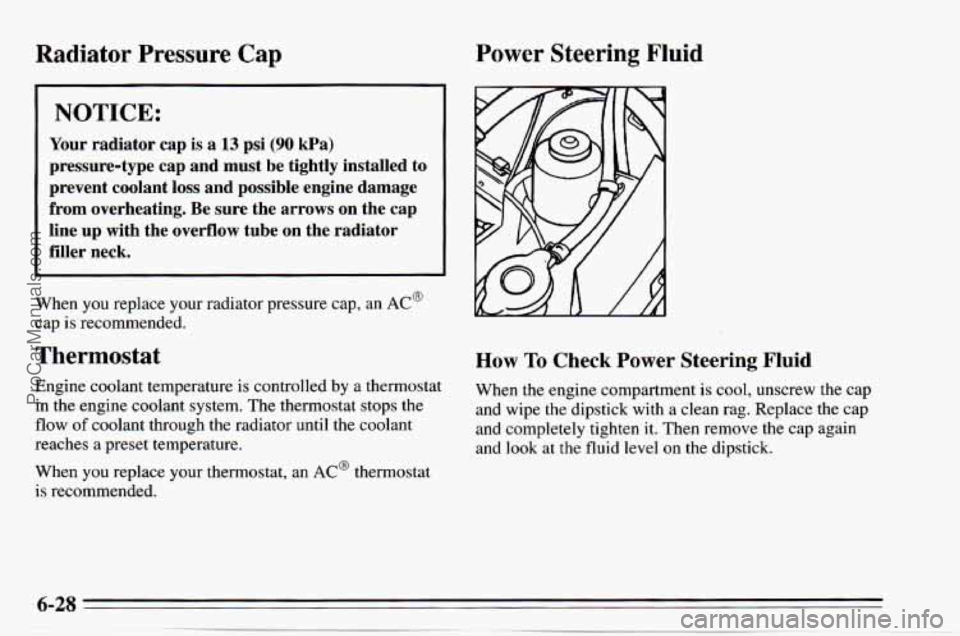
Radiator Pressure Cap Power Steering Fluid
I NOTICE:
Your radiator cap is a 13 psi (90 kPa)
pressure-type cap and must be tightly installed to
prevent coolant
loss and possible engine damage
from overheating. Be sure the arrows on the cap
line up with the overflow tube on the radiator
filler neck.
When you replace your radiator pressure cap, an AC@
cap is recommended.
Thermostat
Engine coolant temperature is controlled by a thermostat
in the engine coolant system. The thermostat stops the
flow of coolant through the radiator until the coolant
reaches
a preset temperature.
When
you replace your thermostat, an AC@ thermostat
is recommended.
How To Check Power Steering Fluid
When the engine compartment is cool, unscrew the cap
and wipe the dipstick with a clean rag. Replace the cap
and completely tighten it. Then remove the cap again
and look at the
fluid level on the dipstick.
ProCarManuals.com
Page 241 of 354
3
Windshield Washer Fluid
What to Use
When you need windshield washer fluid, be sure to read
the manufacturer’s instructions before use.
If you will be
operating your vehicle in an area where the temperature
may fall below freezing, use a fluid that has sufficient
protection against freezing.
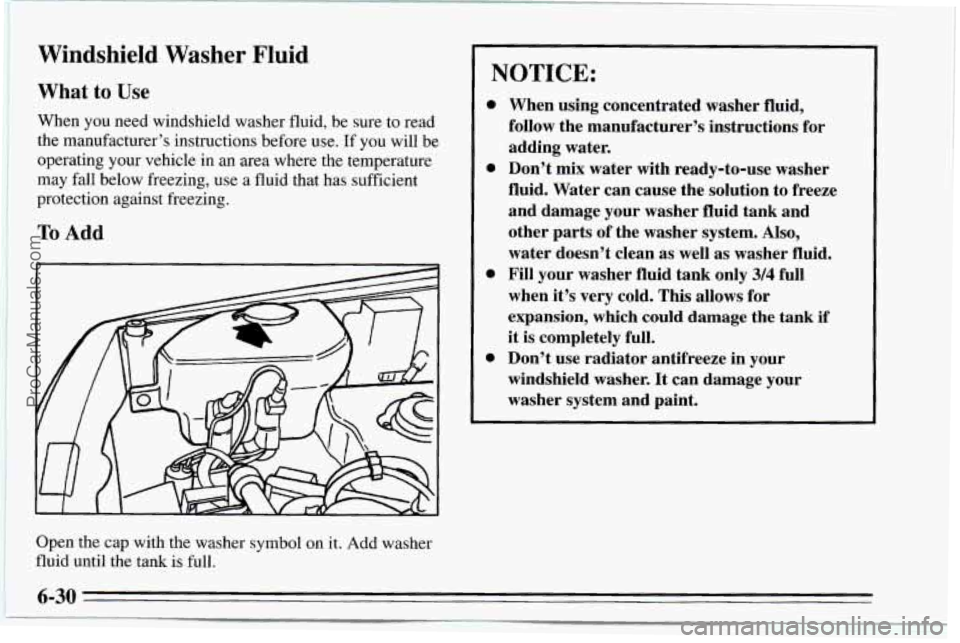
To Add
Open the cap with the washer symbol on it. Add washer
fluid until the tank
is full.
NOTICE:
a
a
a
a
When using concentrated washer fluid,
follow the manufacturer’s instructions for
adding water.
Don’t mix water with ready-to-use washer
fluid. Water can cause the solution to freeze
and damage your washer fluid tank and
other parts of the washer system. Also,
water doesn’t clean as well as washer fluid.
Fill your washer fluid tank only
3/4 full
when it’s very cold. This allows for
expansion, which could damage the tank if
it is completely full.
Don’t use radiator antifreeze in your
windshield washer. It can damage your
washer system and paint.
6-30
ProCarManuals.com
Page 276 of 354
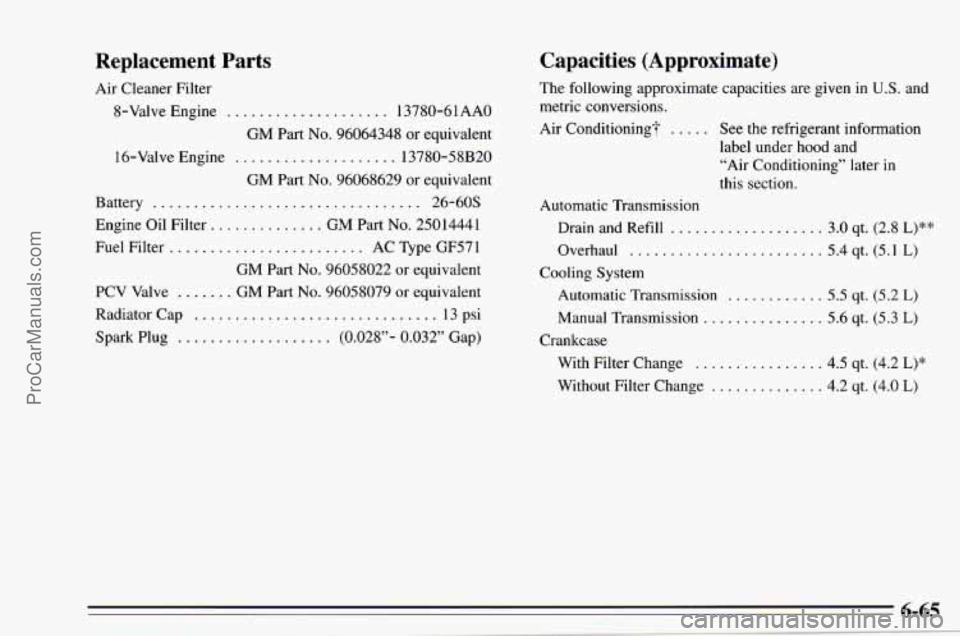
Replacement Parts
Air Cleaner Filter
8-Valve Engine
.................... 13780-61AAO
GM Part
No. 96064348 or equivalent
16-Valve Engine
.................... 13780-58B20
GM Part No. 96068629 or equivalent
Battery
................................. 26-60s
Engine Oil Filter .............. GM Part No. 2501444 1
Fuel Filter ........................ AC Type GF57 1
GM Part No. 96058022 or equivalent
PCV Valve
....... GM Part No. 96058079 or equivalent
Radiator Cap
.............................. 13 psi
Spark Plug
................... (0.028”- 0.032” Gap)
Capacities (Approximate)
The following approximate capacities are given in U.S. and
metric conversions.
Air Conditioning?
..... See the refrigerant information
label under hood and
“Air Conditioning” later in
this section.
Automatic Transmission
Drain and Refill
................... 3.0 qt. (2.8 L)**
Overhaul ........................ 5.4 qt. (5.1 L)
Cooling System
Automatic Transmission
............ 5.5 qt. (5.2 L)
Manual Transmission ............... 5.6 qt. (5.3 L)
Crankcase
With Filter Change
................ 4.5 qt. (4.2 L)*
Without Filter Change .............. 4.2 qt. (4.0 L)
ProCarManuals.com
Page 290 of 354
I Maintenance Schedule I I
27,000 Miles (45 000 km)
0 Change engine oil and filter (or every
3 months, whichever occurs first).
An Emission Control Service.
0 Inspect the locking front hubs (if equipped)
for correct operation (or every
3 months,
whichever occurs first). Repair or replace if
necessary.
30,000 Miles (50 000 km)
0 Change engine oil and filter (or every
3 months, whichever occurs first).
An Emission Control Sewice.
0 Inspect engine accessory drive belts (or
every
24 months, whichever occurs first).
An Emission Control Service
0 Drain, flush and refill cooling system (or
every
30 months, whichever occurs first).
See “Engine Coolant” in the Index for what
to use. Inspect hoses. Clean radiator,
condenser, pressure cap and neck. Pressure
test the cooling system and pressure cap.
An Emission Control Service.
(Continued)
ProCarManuals.com
Page 298 of 354
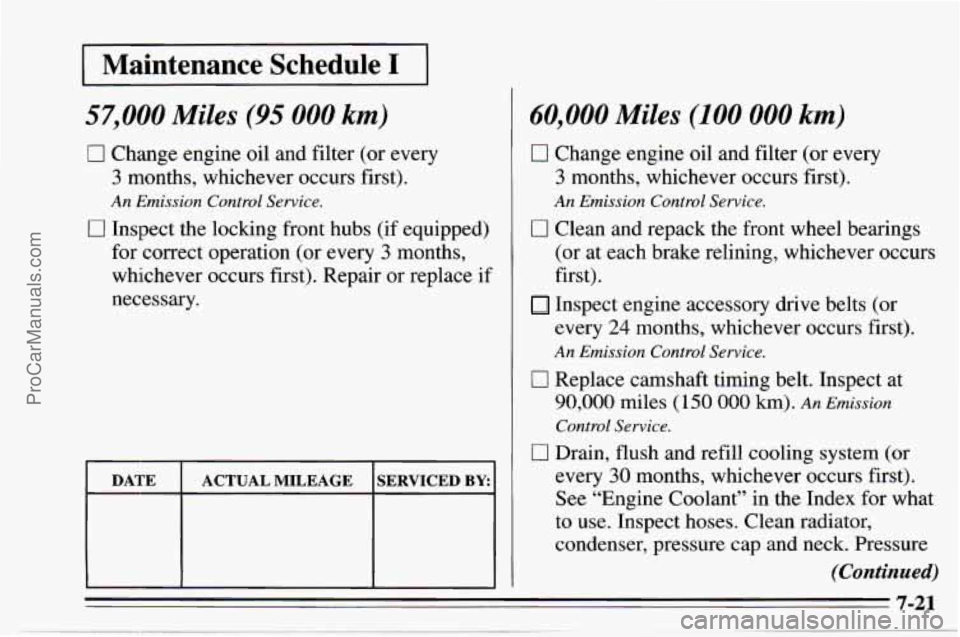
I Maintenance Schedule I I
57,000 Miles (95 000 km)
0 Change engine oil and filter (or every
3 months, whichever occurs first).
An Emission Control Service.
0 Inspect the locking front hubs (if equipped)
for correct operation (or every
3 months,
whichever occurs first). Repair
or replace if
necessary.
DATE ACTUAL MILEAGE SERVICED BY:
I I I I
60,000 Miles. (1 00 000 km)
0 Change engine oil and filter (or every
3 months, whichever occurs first).
An Emission Control Service.
0 Clean and repack the front wheel bearings
(or at each brake relining, whichever occurs
first).
every
24 months, whichever occurs first).
An Emission Control Service.
Inspect engine accessory drive belts (or
0 Replace camshaft timing belt. Inspect at
90,000 miles (150 000 km). An Emission
Control Service.
0 Drain, flush and refill cooling system (or
every
30 months, whichever occurs first).
See "Engine Coolant" in the Index for what
to use. Inspect hoses. Clean radiator,
condenser, pressure cap and neck. Pressure
(Continued)
ProCarManuals.com