1995 CHEVROLET S10 tow
[x] Cancel search: towPage 230 of 354
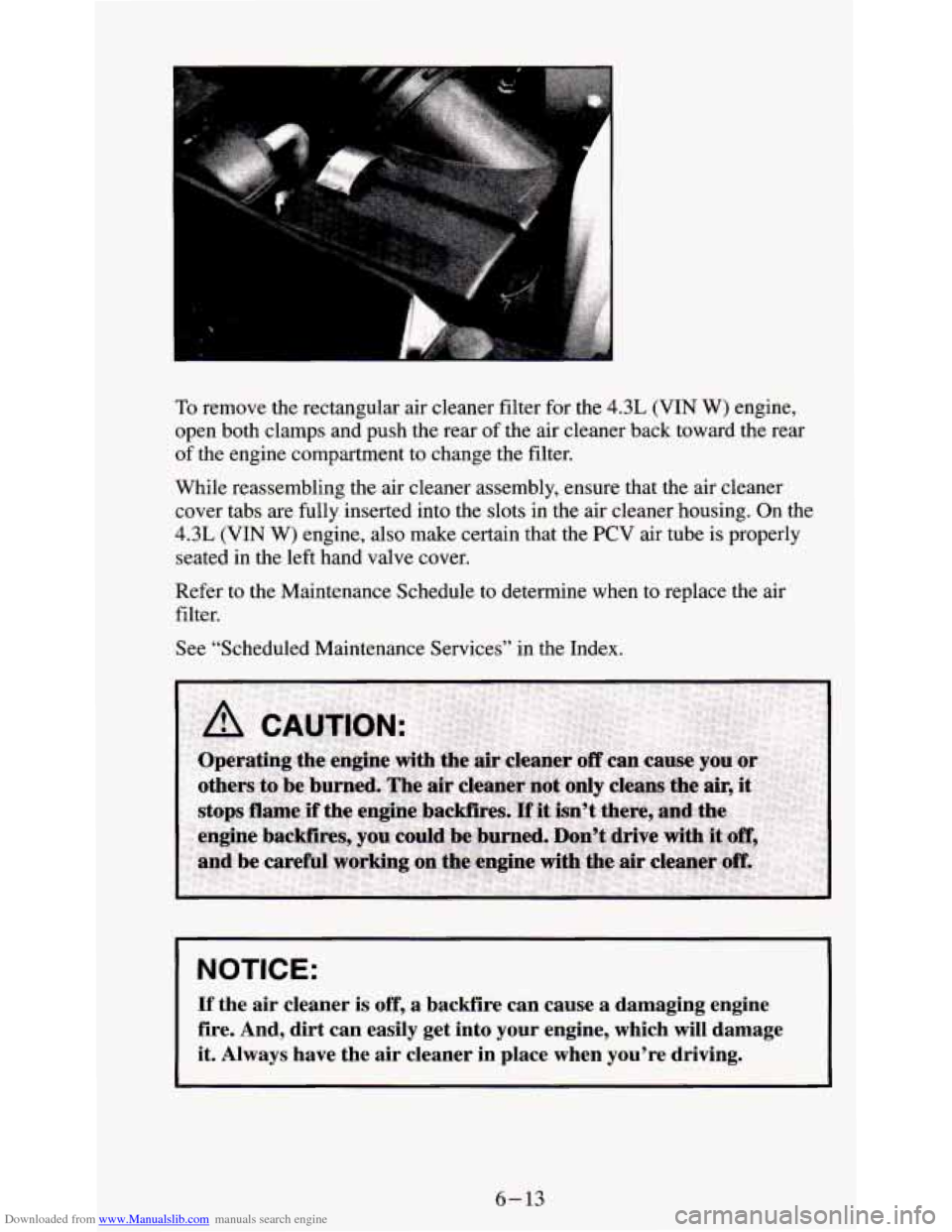
Downloaded from www.Manualslib.com manuals search engine To remove the rectangular air cleaner filter for the 4.3L (VIN W) engine,
open both clamps and push the rear of the air cleaner back toward the rear
of the engine compartment to change the filter.
While reassembling the air cleaner assembly, ensure that the air cleaner
cover tabs are fully inserted into the slots in the air cleaner housing. On the
4.3L (VIN W) engine, also make certain that the PCV air tube is properly
seated in the left hand valve cover.
Refer to the Maintenance Schedule to determine when to replace the air
filter.
See “Scheduled Maintenance Services’’ in the Index.
I NOTICE:
If the air cleaner is off, a backfire can cause a damaging engine
fire. And, dirt can easily get into your engine, which
will damage
it. Always have the air cleaner in place when you’re drivin\
g.
6- 13
Page 232 of 354
Downloaded from www.Manualslib.com manuals search engine To check transmissionfluid cold: A cold check is made after the vehicle has
been sitting for eight hours or more with the engine off and is used only as a
reference. Let the engine run at idle
for five minutes if outside temperatures
are
50°F ( 10°C) or more. If it's colder than 50°F ( lO"C), you may have to
idle the engine longer. Should the fluid level be low during a cold check,
you must perform a hot check before adding fluid. This will give you a more
accurate reading of the fluid level.
To check the fluid hot or cold
Park your vehicle on a level place. Keep the engine running.
With the parking brake applied, place the shift lever in PARK (P).
0 With your foot on the brake pedal, move the shift lever through each
gear range, pausing for about three seconds in each range.
Then,
position the shift lever in PARK (P).
Let the engine run at idle for three minutes or more.
Then, without shutting
off the engine, follow these steps:
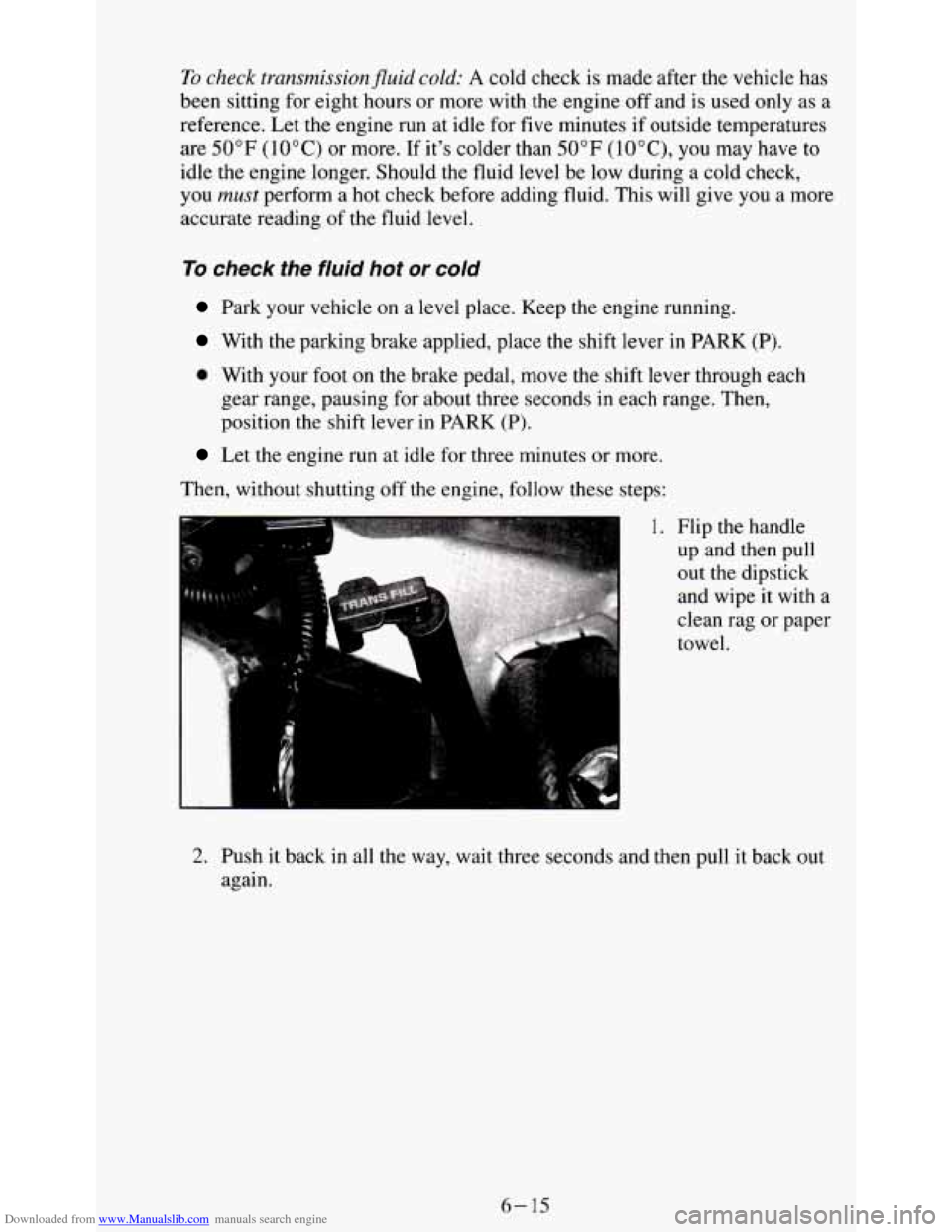
1. Flip the handle up and then pull
out the dipstick
and wipe it with a
clean rag or paper
towel.
2. Push it back in all the way, wait three seconds and then pull it back out
again.
6- 15
Page 266 of 354
Downloaded from www.Manualslib.com manuals search engine Using Foam-Type Cleaner on Fabric
Vacuum and brush the area to remove any loose dirt.
Always clean a whole trim panel or section. Mask surrounding trim
0 Mix Multi-Purpose Powdered Cleaner following the directions on the
along
stitch or welt lines.
container label.
Use suds only and apply with a clean sponge.
Don’t saturate the material.
Don’t rub it roughly.
As soon as you’ve cleaned the section, use a sponge to remove the
suds.
0 Rinse the section with a clean, wet sponge.
0 Wipe off what’s left with a slightly damp paper towel or cloth.
Then dry it immediately with a blow dryer or a heat lamp.
I NOTICE:
Be careful. A blow dryer may scorch the fabric.
0 Wipe with a clean cloth.
Using Solvent-Type Cleaner on Fabric
First, see if you have to use solvent-type cleaner at all. Some spots and
stains will clean off better with just water and mild soap.
If you need to use a solvent:
Gently scrape excess soil from the trim material with a clean, dull knife
or scraper. Use very little cleaner, light pressure and clean cloths
(preferably cheesecloth). Cleaning should start at the outside
of the
stain, “feathering” toward the center. Keep changing to a clean section
of the cloth.
0 When you clean a stain from fabric, immediately dry the area with a
blow dryer to help prevent a cleaning ring. (See the previous NOTICE.)
6-49
Page 269 of 354
Downloaded from www.Manualslib.com manuals search engine Glass
Glass should be cleaned often. GM Glass Cleaner (GM Part No. 1050427)
or a liquid household glass cleaner will remove normal tobacco smoke and
dust films.
Don’t use abrasive cleaners on glass, because they may cause scratches.
Avoid placing decals on the inside rear window, since they may have to be
scraped
off later.
Cleaning the Outside of the Windshield and
Wiper Blades
If the windshield is not clear after using the windshield washer, or if the
wiper blade chatters when running, wax or other material may be on the
blade or windshield.
Clean the outside
of the windshield with GM Windshield Cleaner, Bon-Ami
Powder@
(GM Part No. 105001 1). The windshield is clean if beads do not
form when you rinse it with water.
Clean the blade by wiping vigorously with a cloth soaked
in full strength
windshield washer solvent. Then rinse the blade with water.
Wiper blades should be checked on a regular basis and replaced when worn.
Weatherstrips
Silicone grease on weatherstrips will make them last longer, seal better, and
not stick or squeak. Apply silicone grease with a clean cloth at least every
six months. During very cold, damp weather more frequent application may
be required. (See “Recommended Fluids
& Lubricants” in the Index.)
Cleaning the Outside of Your Vehicle
The paint finish on your vehicle provides beauty, depth of color, gloss
retention and durability.
Washing Your Vehicle
The best way to preserve your vehicle’s finish is to keep it clean by washing
it often with lukewarm or cold water.
Don’t wash your vehicle in the direct rays of the sun. Don’t use strong soaps
or chemical detergents.
Use liquid hand, dish or car washing (mild
detergent) soaps. Don’t use cleaning agents that are petroleum based, or that
contain acid
or abrasives. All cleaning agents should be flushed promptly
and not allowed to dry on the surface, or they could stain. Dry the finish
with a soft, clean chamois or a
100% cotton towel to avoid surface scratches
and water spotting.
High pressure vehicle washes may cause water to enter your vehicle.
6-52
Page 291 of 354
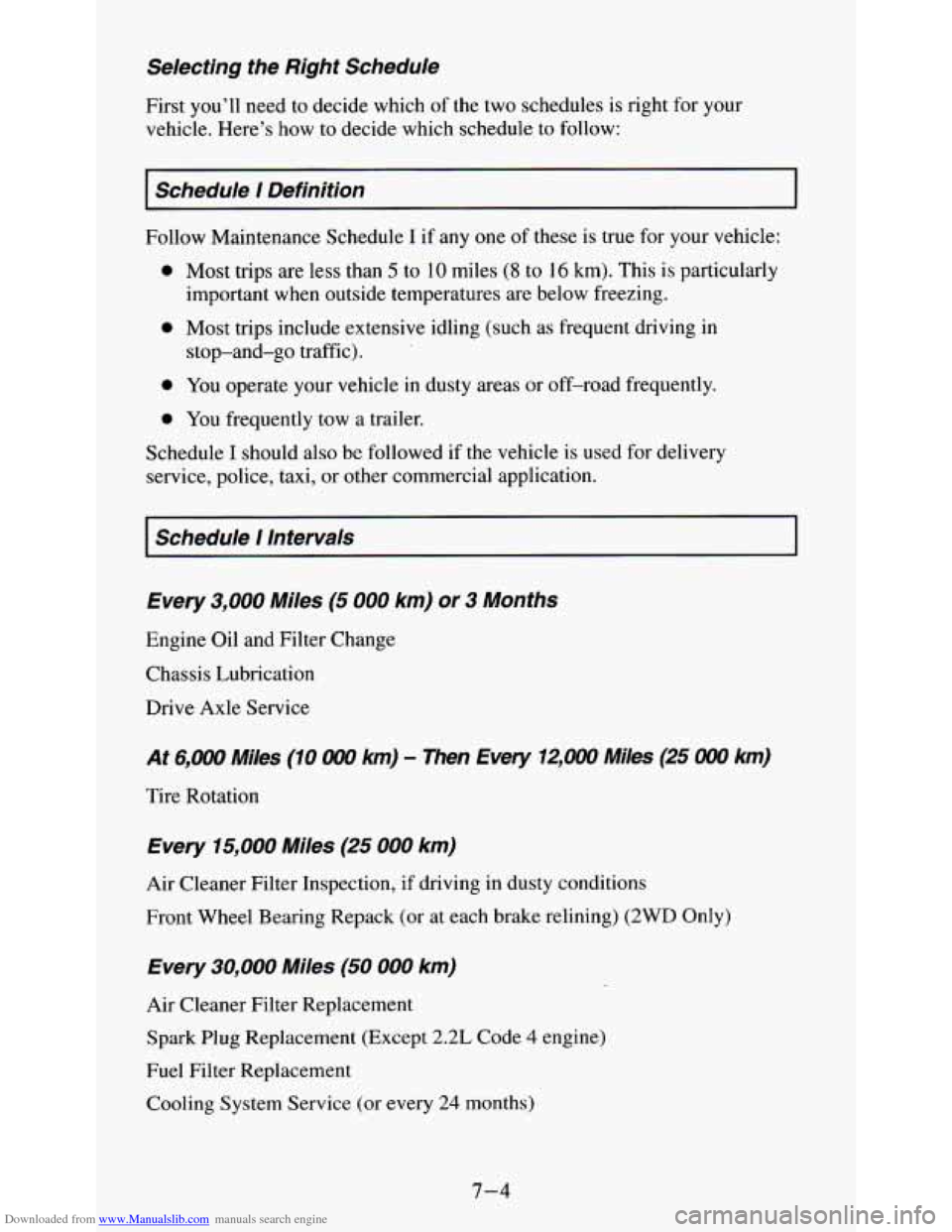
Downloaded from www.Manualslib.com manuals search engine Selecting the Right Schedule
First you’ll need to decide which of the two schedules is right for your
vehicle. Here’s how to decide which schedule to follow:
I Schedule I Definition I
Follow Maintenance Schedule I if any one of these is true for your vehicle:
0 Most trips are less than 5 to 10 miles (8 to 16 km). This is particularly
0 Most trips include extensive idling (such as frequent driving in
0 You operate your vehicle in dusty areas or off-road frequently.
0 You frequently tow a trailer.
important
when outside temperatures are below freezing.
stop-and-go traffic).
Schedule
I should also be followed if the vehicle is used for delivery
service, police, taxi, or other commercial application.
I Schedule I Intervals I
Every 3,000 Miles (5 000 km) or 3 Months
Engine Oil and Filter Change
Chassis Lubrication
Drive Axle Service
At 6,000 Miles (10 OOO km) - Then Every 12,000 Miles (25 OOO km)
Tire Rotation
Every 15,000 Miles (25 000 km)
Air Cleaner Filter Inspection, if driving in dusty conditions
Front Wheel Bearing Repack (or at each brake relining) (2WD Only)
Every 30,000 Miles (50 000 km)
Air Cleaner Filter Replacement
Spark Plug Replacement (Except
2.2L Code 4 engine)
Fuel Filter Replacement
Cooling System Service (or every 24 months)
7-4
Page 293 of 354
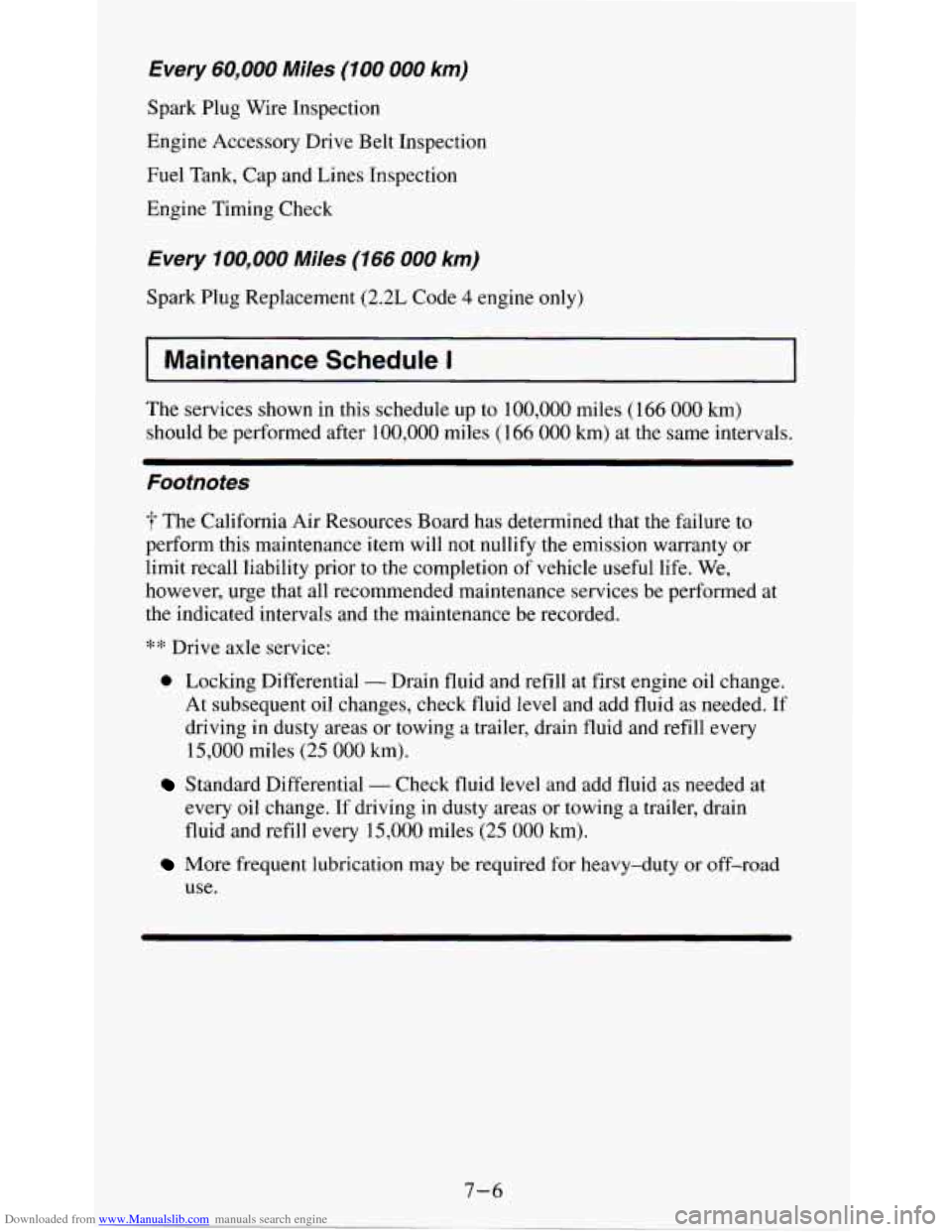
Downloaded from www.Manualslib.com manuals search engine Every 60,000 Miles (100 000 km)
Spark Plug Wire Inspection
Engine Accessory Drive Belt Inspection
Fuel Tank, Cap and Lines Inspection
Engine Timing Check
Every 100,000 Miles (166 000 km)
Spark Plug Replacement (2.2L Code 4 engine only)
I Maintenance Schedule I I
The services shown in this schedule up to 100,000 miles (166 000 km)
should be performed after
100,000 miles ( 166 000 km) at the same intervals.
Footnotes
3- The California Air Resources Board has determined that the failure to
perform this maintenance item will
not nullify the emission warranty or
limit recall liability prior to the completion of vehicle useful life. We,
however, urge that all recommended maintenance services be perfo\
rmed at
the indicated intervals and the maintenance be recorded.
** Drive axle service:
0 Locking Differential - Drain fluid and refill at first engine oil change.
At subsequent oil changes, check fluid level and add fluid as needed. If
driving
in dusty areas or towing a trailer, drain fluid and refill every
15,000 miles
(25 000 km).
Standard Differential - Check fluid level and add fluid as needed at
every oil change. If driving in dusty areas or towing a trailer, drain
fluid and refill every
15,000 miles (25 000 km).
More frequent lubrication may be required for heavy-duty or off-road
use.
7-6
Page 302 of 354
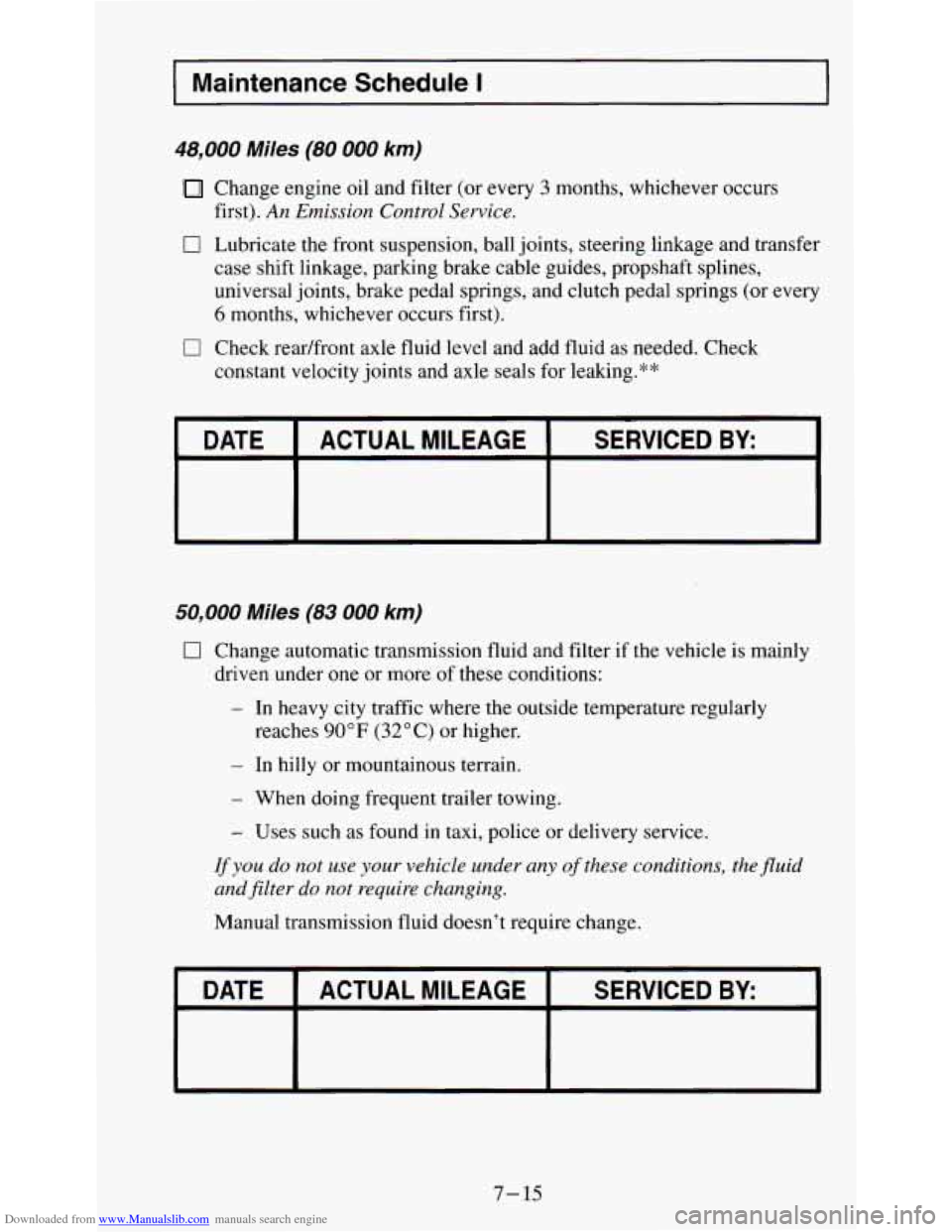
Downloaded from www.Manualslib.com manuals search engine I Maintenance Schedule I
48,000 Miles (80 000 km)
Change engine oil and filter (or every 3 months, whichever occurs
0 Lubricate the front suspension, ball joints, steering linkage and transfer
case shift linkage, parking brake cable guides, propshaft splines,
universal joints, brake pedal springs, and clutch pedal springs (or every
6 months, whichever occurs first).
first).
An Emission
Control Service.
0 Check readfront axle fluid level and add fluid as needed. Check
constant velocity joints and axle seals for leaking.**
DATE ACTUAL MILEAGE SERVICED BY
50,000 Miles (83 000 km)
0 Change automatic transmission fluid and filter if the vehicle is mainly
- In heavy city traffic where the outside temperature regularly
reaches
90°F (32°C) or higher.
- In hilly or mountainous terrain.
- When doing frequent trailer towing.
- Uses such as found in taxi, police or delivery service.
driven under
one or more
of these conditions:
If you do not use your vehicle under any of these conditions, the fluid
andfilter do not require changing.
Manual transmission fluid doesn’t require change.
I DATE I ACTUALMILEAGE SERVICED BY
-.
7-15
Page 312 of 354
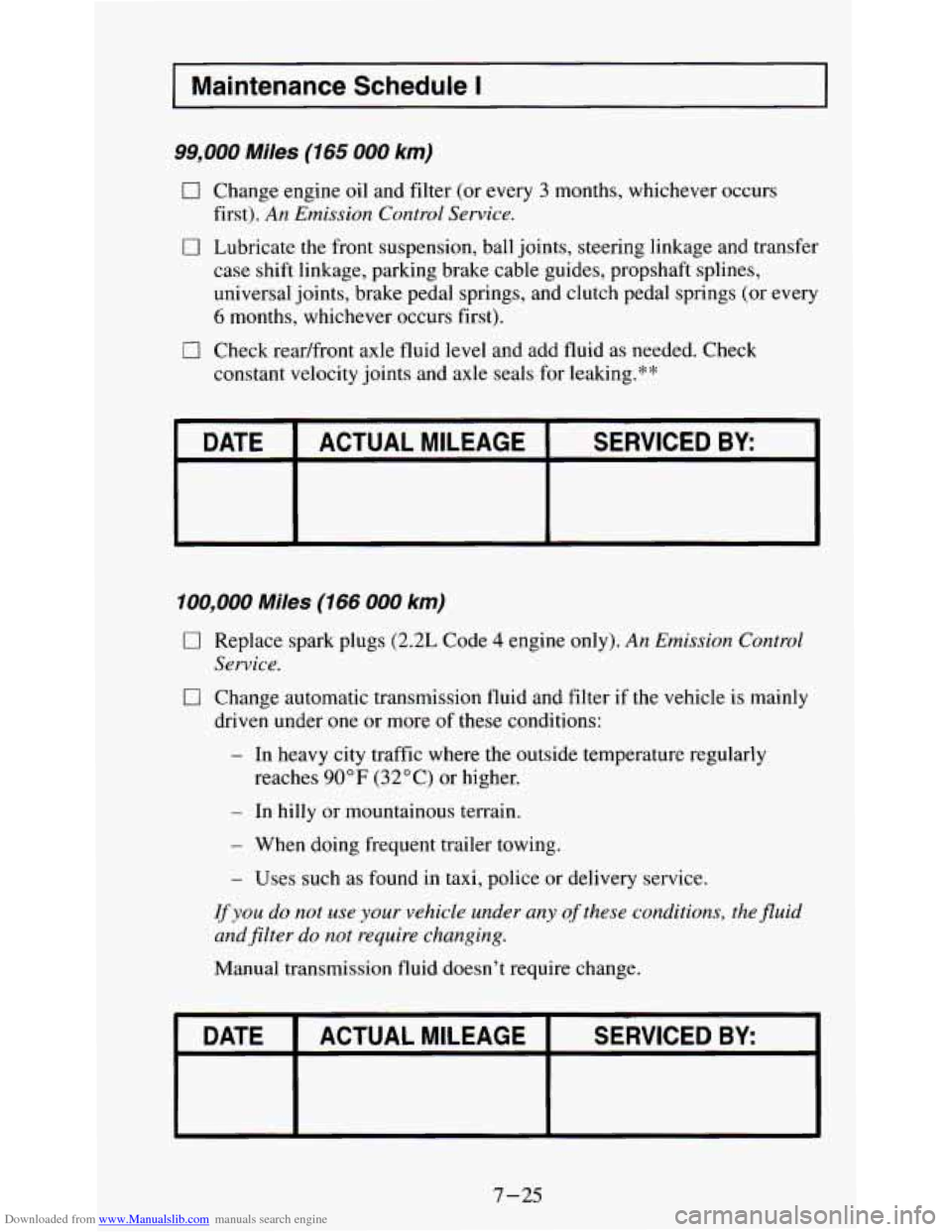
Downloaded from www.Manualslib.com manuals search engine I Maintenance Schedule I
99,000 Miles (165 000 km)
0 Change engine oil and filter (or every 3 months, whichever occurs
first).
An Emission Control Service.
0 Lubricate the front suspension, ball joints, steering linkage and transfer
case shift linkage, parking brake cable guides, propshaft splines,
universal joints, brake pedal springs,
and clutch pedal springs (or every
6 months, whichever occurs first).
0 Check readfront axle fluid level and add fluid as needed. Check
constant velocity joints and axle seals for leaking.**
DATE ACTUAL MILEAGE SERVICED BY:
100,000 Miles (166 000 km)
0 Replace spark plugs (2.2L Code 4 engine only). An Emission Control
0 Change automatic transmission fluid and filter if the vehicle is mainly
- In heavy city traffic where the outside temperature regularly
reaches
90°F (32°C) or higher.
- In hilly or mountainous terrain.
- When doing frequent trailer towing.
- Uses such as found in taxi, police or delivery service.
Service.
driven under one or more of these conditions:
Ifyou do not use your vehicle under any of these conditions, the fluid
and filter do nor require changing.
Manual transmission fluid doesn’t require change.
DATE
ACTUAL MILEAGE SERVICED BY.
7-25