1995 CHEVROLET MONTE CARLO ABS
[x] Cancel search: ABSPage 134 of 324
Downloaded from www.Manualslib.com manuals search engine Avoid needless heavy braking. Some people drive
in spurts
-- heavy acceleration followed by heavy
braking
-- rather than keeping pace with traffic. This
is a mistake. Your brakes may
not have time to cool
between hard stops. Your brakes will wear out much
faster if you do a
lot of heavy braking. If you keep pace
with
the traffic and allow realistic following distances,
you will eliminate a lot of unnecessary braking. That
means better braking and longer brake life.
If your engine ever stops while you’re driving, brake
normally but don’t pump your brakes. If you do, the
pedal may get harder to push down. If your engine
stops, you will still have some power brake assist. But
you will use it when you brake. Once the power assist is
used up,
it may take longer to stop and the brake pedal
will be harder to push.
Anti-Lock Brakes (ABS)
Your Chevrolet has an advanced electronic braking
system that will help prevent a braking skid.
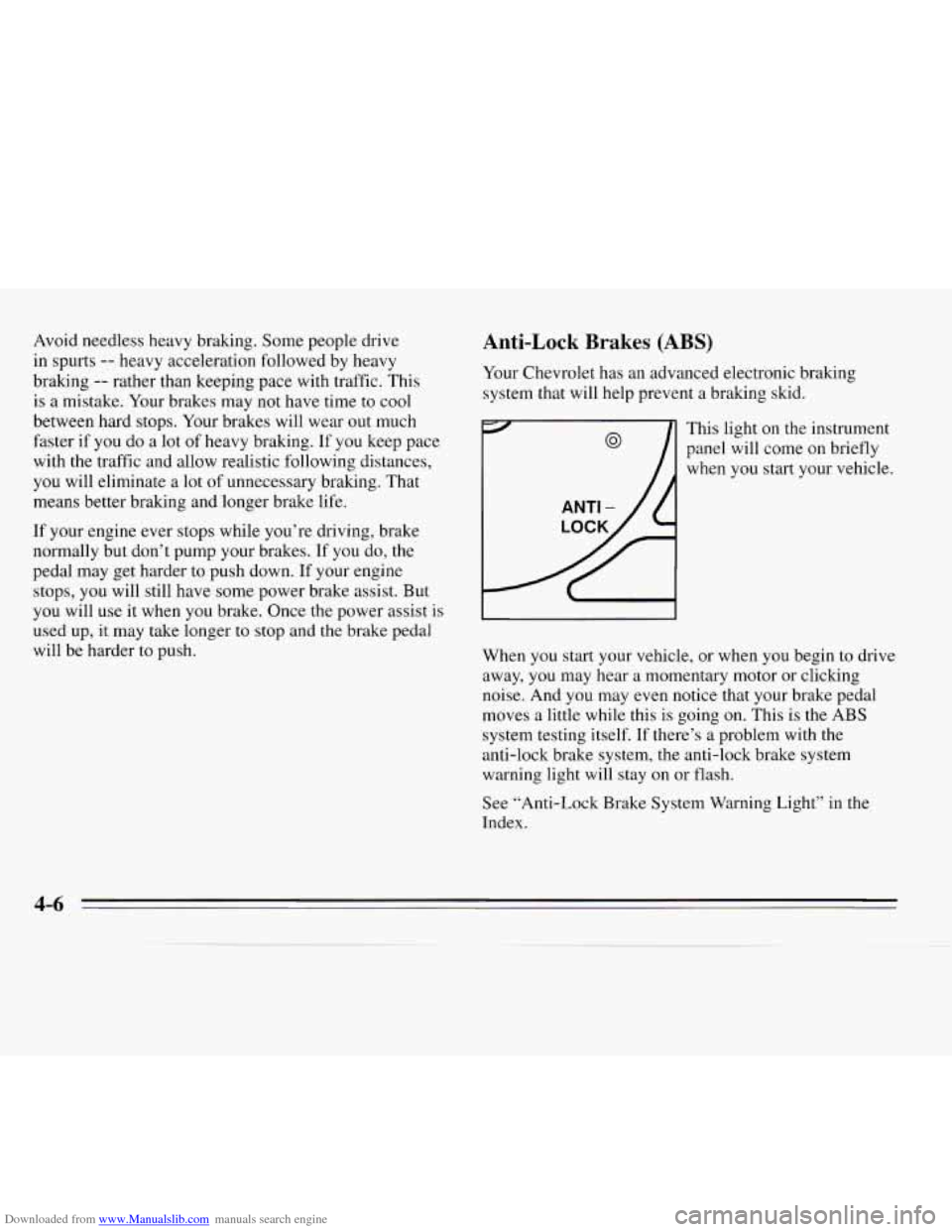
ANTI -
LOCI
This light
panel will
when you on the
instrument
come on briefly
start your vehicle.
When you start your vehicle,
or when you begin to drive
away, you may hear a momentary motor or clicking
noise. And you may even notice that your brake pedal
moves a little while this
is going on. This is the ABS
system testing itself.
If there’s a problem with the
anti-lock brake system, the anti-lock brake system
warning light will stay on or flash.
See “Anti-Lock Brake System Warning Light’’ in the
Index.
4-6
Page 135 of 324
Downloaded from www.Manualslib.com manuals search engine The anti-lock system can change the brake pressure faster
than any driver could. The computer is programmed to
make the
most of available tire and road conditions.
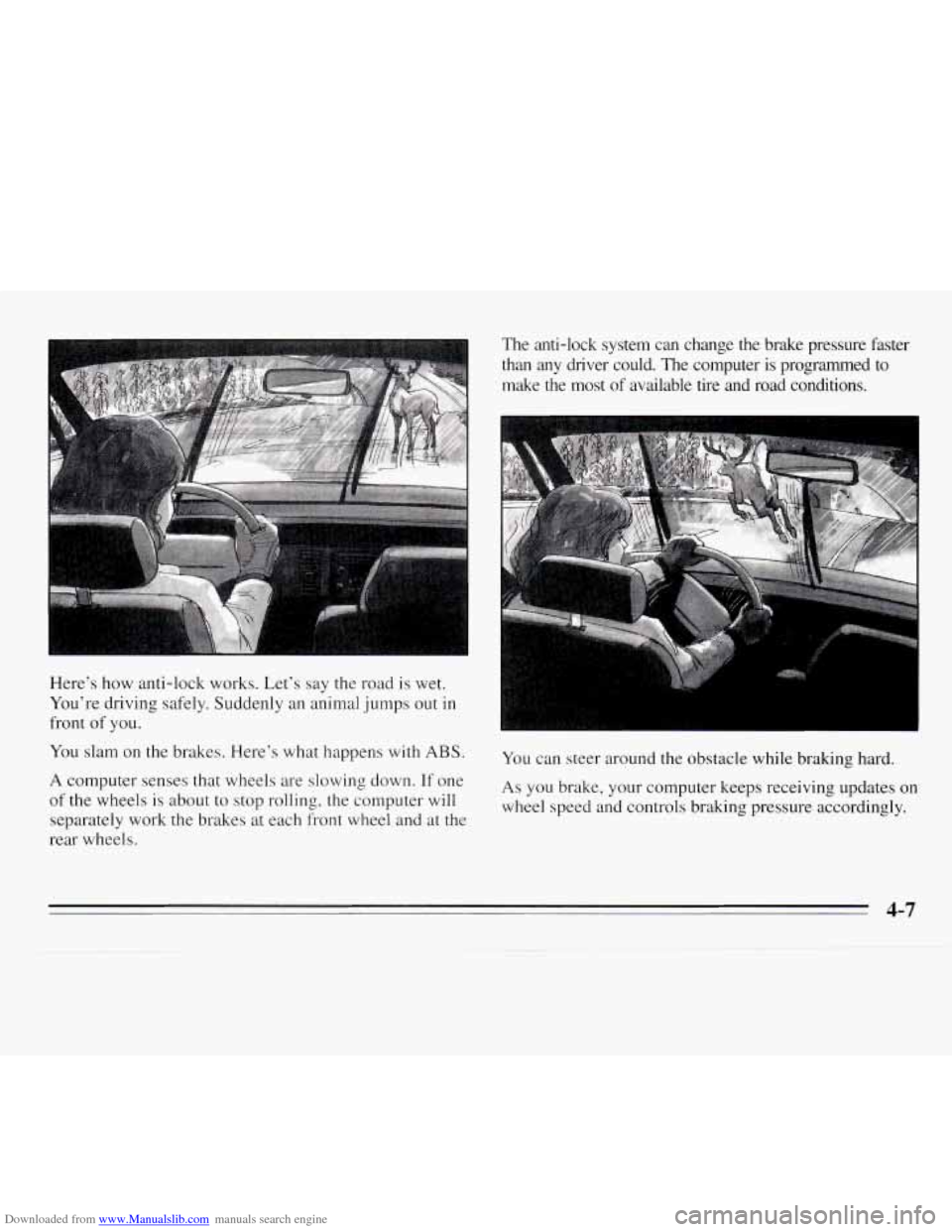
Here’s how anti-lock works. Let’s say the road is wet.
You’re driving safely. Suddenly an animal jumps out
in
front of you.
You slam on the brakes. Here’s what happens with
ABS.
A computer senses that wheels are slowing down. If one
of the wheels
is about to stop rolling, the computer will
separately work the brakes at each front wheel and at the
rear wheels.
You can steer around the obstacle while braking hard.
As you brake, your computer keeps receiving updates on
wheel speed and controls braking pressure accordingly.
4-7
Page 141 of 324
Downloaded from www.Manualslib.com manuals search engine A cornering skid and an acceleration skid are best
handled by easing your foot off the accelerator pedal.
If your vehicle starts to slide, ease your foot off
the
accelerator pedal and quickly steer the way you want the
vehicle to go. If you start steering quickly enough, your
vehicle may straighten out. Always be ready for a
second skid if it occurs.
Of course, traction is reduced when water, snow, ice,
gravel, or other material is on the road. For safety,
you’ll
want to slow down and adjust your driving to these
conditions. It is important to slow down on slippery
surfaces because stopping distance will be longer and
vehicle control more limited.
While driving on
a surface with reduced traction, try your
best to avoid sudden steering, acceleration, or braking
(including engine braking by shifting to a lower gear).
Any sudden changes could cause the tires to slide.
You
may not realize the surface is slippery until your vehicle
is skidding. Learn to recognize warning clues
-- such
as enough water, ice or packed snow on the road to make
a “mirrored surface”
-- and slow down when you
have any doubt.
Remember: Any anti-lock brake system
(ABS) helps
avoid only
the braking skid.
Driving at Night
F _+--
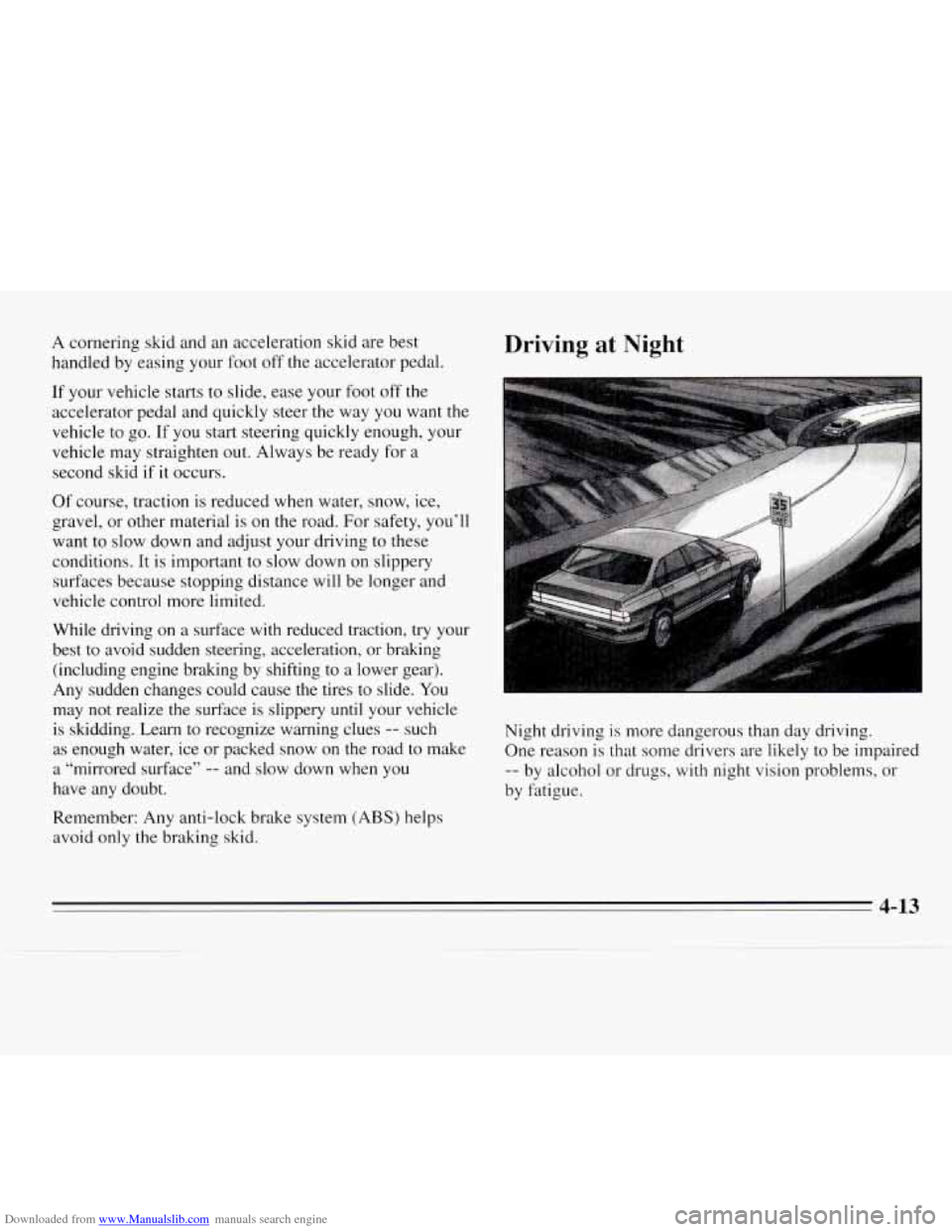
Night driving is more dangerous than day driving.
One reason is that some drivers are likely to be impaired
-- by alcohol or drugs, with night vision problems, or
by fatigue.
4-13
Page 161 of 324
Downloaded from www.Manualslib.com manuals search engine Turn Signals When Towing a Trailer
When you tow a trailer, your vehicle has to have a
different
turn signal flasher and extra wiring. The green
arrows on your instrument panel will flash whenever
you signal a turn or lane change. Properly hooked up,
the trailer lamps will also flash, telling other drivers
you’re about to turn, change lanes or stop.
When towing a trailer, the green arrows
on your
instrument panel will flash for turns even if the bulbs on
the trailer are burned out. Thus, you may think drivers
behind
you are seeing your signal when they are not. It’s
important to check occasionally to be sure the trailer
bulbs are still working.
Driving On Grades
Reduce speed and shift to a lower gear before you start
down a long or steep downgrade. If you don’t shift
down, you might have to use your brakes
so much that
they would get hot and no longer work well.
On a long uphill grade, shift down and reduce your
speed
to around 45 mph (70 km/h) to reduce the
possibility of engine and transaxle overheating. If
you are towing a trailer, you may want to drive in
DRIVE (D) instead
of OVERDRIVE (0) (or, as you
need to, a lower gear).
Parking on Hills
You really should not park your vehicle, with a trailer
attached, on
a hill. If something goes wrong, your rig
could start to move. People can be injured, and both
your vehicle and the trailer can be damaged.
But
if you ever have to park your rig on a hill, here’s
how to do it:
1. Apply your regular brakes, but don’t shift into
PARK (P) yet.
2. Have someone place chocks under the trailer wheels.
3. When the wheel chocks are in place, release the
regular brakes until the chocks absorb the load.
4. Reapply the regular brakes. Then apply your parking
brake, and then shift to PARK (P).
5. Release the regular brakes.
4-33
Page 249 of 324
Downloaded from www.Manualslib.com manuals search engine Fuse
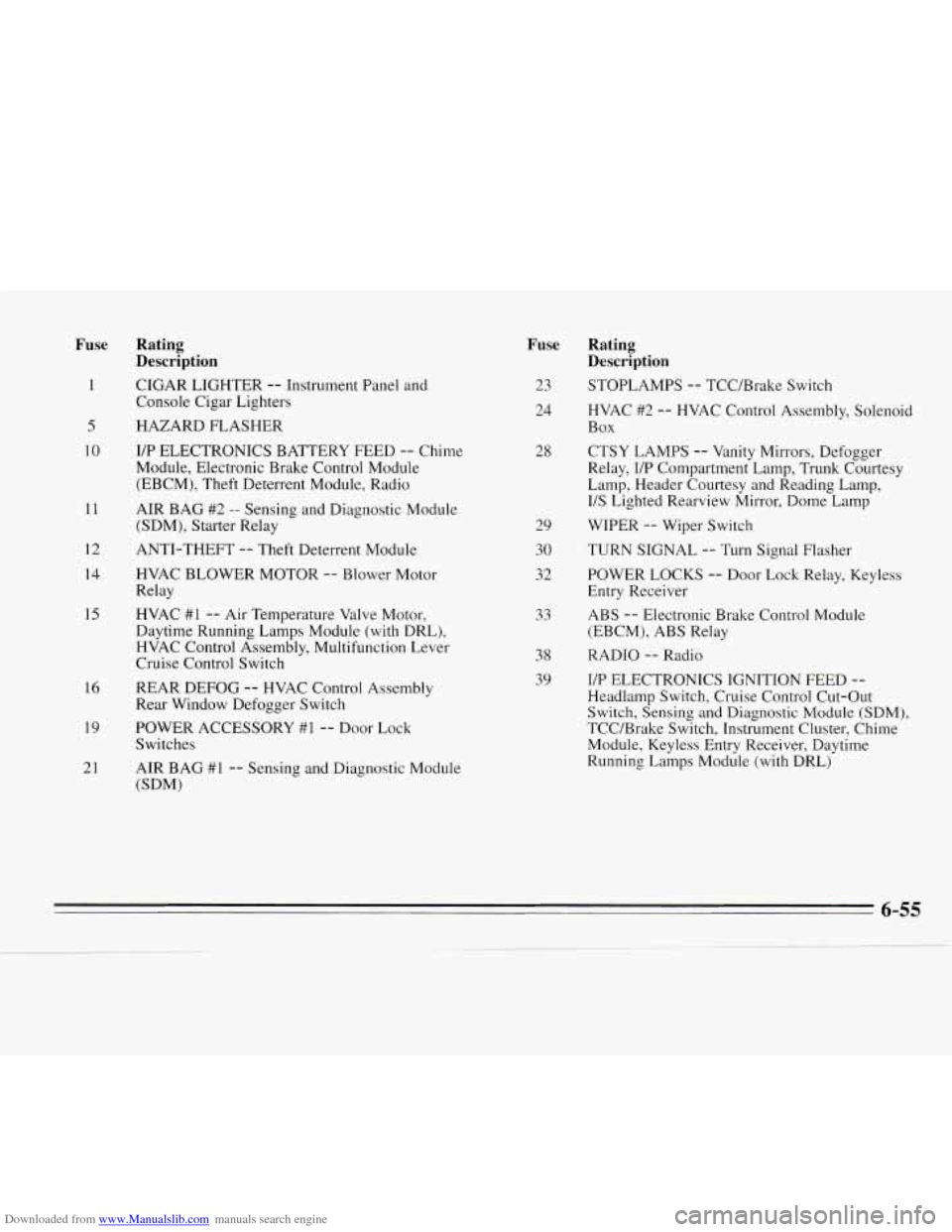
1
5
10
11
12
14
15
16
19
21
Rating
Description
CIGAR LIGHTER -- Instrument Panel and
Console Cigar Lighters
HAZARD FLASHER
I/P ELECTRONICS BATTERY FEED
-- Chime
Module, Electronic Brake Control Module
(EBCM), Theft Deterrent Module, Radio
AIR BAG #2
-- Sensing and Diagnostic Module
(SDM), Starter Relay
ANTI-THEFT
-- Theft Deterrent Module
HVAC BLOWER MOTOR
-- Blower Motor
Relay
HVAC
#1 -- Air Temperature Valve Motor,
Daytime Running Lamps Module (with DRL),
HVAC Control Assembly, Multifunction Lever
Cruise Control Switch
REAR DEFOG
-- WAC Control Assembly
Rear Window Defogger Switch
POWER ACCESSORY
#I -- Door Lock
Switches
AIR BAG
#1 -- Sensing and Diagnostic Module
(SDM)
Fuse Rating
Description
23
24
28
29
30
32
33
38
39 STOPLAMPS
-- TCC/Brake Switch
HVAC #2
-- HVAC Control Assembly, Solenoid
Box
CTSY LAMPS
-- Vanity Mirrors, Defogger
Relay,
UP Compartment Lamp, Trunk Courtesy
Lamp, Header Courtesy and Reading Lamp,
I/S Lighted Rearview Mirror, Dome Lamp
WIPER
-- Wiper Switch
TURN SIGNAL
-- Turn Signal Flasher
POWER LOCKS
-- Door Lock Relay, Keyless
Entry Receiver
ABS
-- Electronic Brake Control Module
(EBCM), ABS Relay
RADIO
-- Radio
I/€' ELECTRONICS IGNITION FEED
--
Headlamp Switch, Cruise Control Cut-Out
Switch, Sensing and Diagnostic Module
(SDM),
TCC/Brake Switch, Instrument Cluster, Chime
Module, Keyless Entry Receiver, Daytime
Running Lamps Module (with DRL)
6-55
Page 252 of 324
Downloaded from www.Manualslib.com manuals search engine Underhood Electrical Center -- Driver Side
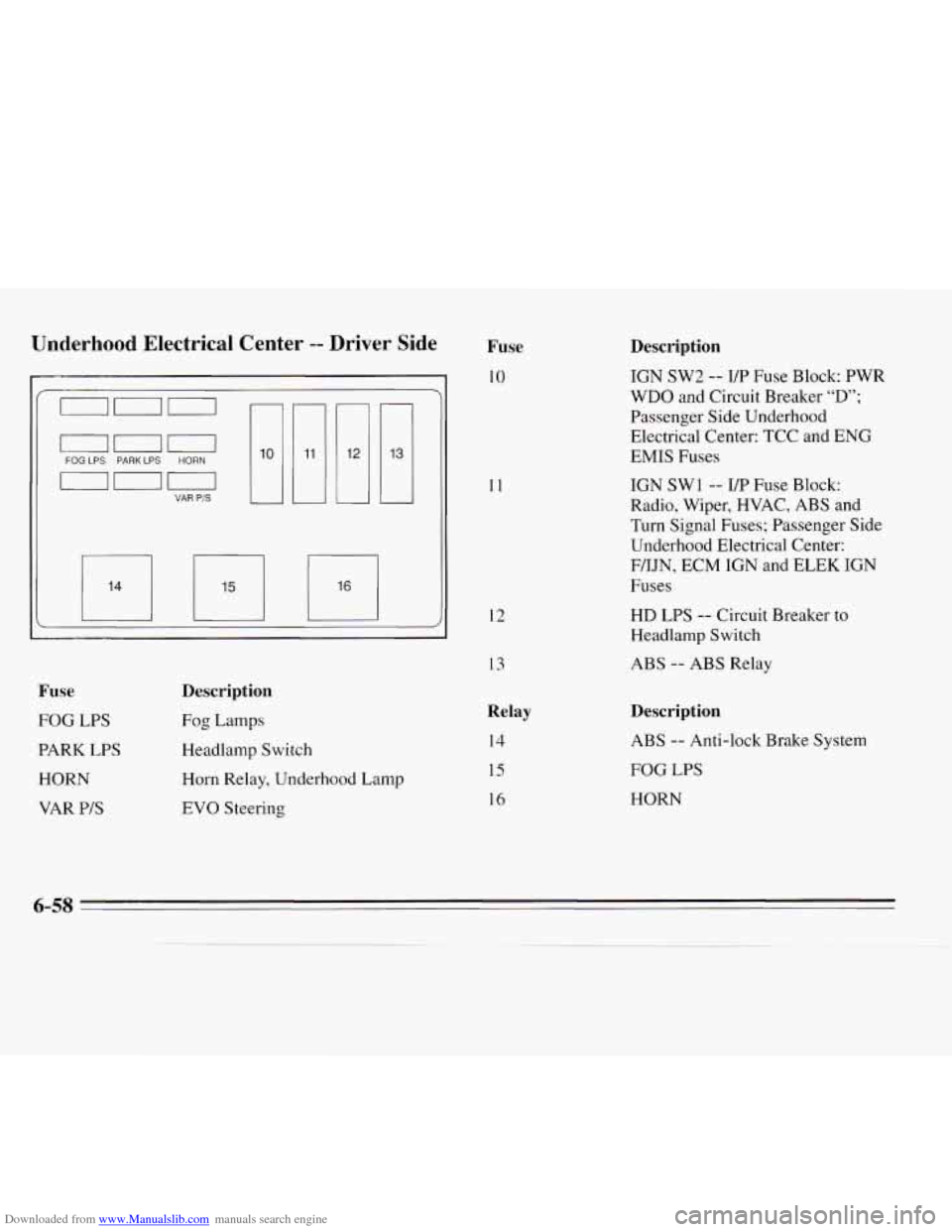
ODD
000
uno
FOG LPS PARKLPS HORN
VAR PIS
Fuse
FOG LPS
PARK LPS
HORN
VAR
P/S
Description
Fog Lamps
Headlamp Switch Horn Relay, Underhood Lamp
EVO Steering
Fuse
10
11
12
13
Relay
14
15
16
Description
IGN SW2 -- I/P Fuse Block: PWR
WDO and Circuit Breaker “D”;
Passenger Side Underhood
Electrical Center: TCC and
ENG
EMIS Fuses
IGN
SWl -- I/P Fuse Block:
Radio, Wiper, HVAC, ABS and
Turn Signal Fuses; Passenger Side
Underhood Electrical Center:
F/IJN, ECM IGN and ELEK IGN
Fuses
HD
LPS -- Circuit Breaker to
Headlamp Switch
ABS -- ABS Relay
Description
ABS -- Anti-lock Brake System
FOG LPS
HORN
6-58
Page 311 of 324
Downloaded from www.Manualslib.com manuals search engine 0 Section 9 Index
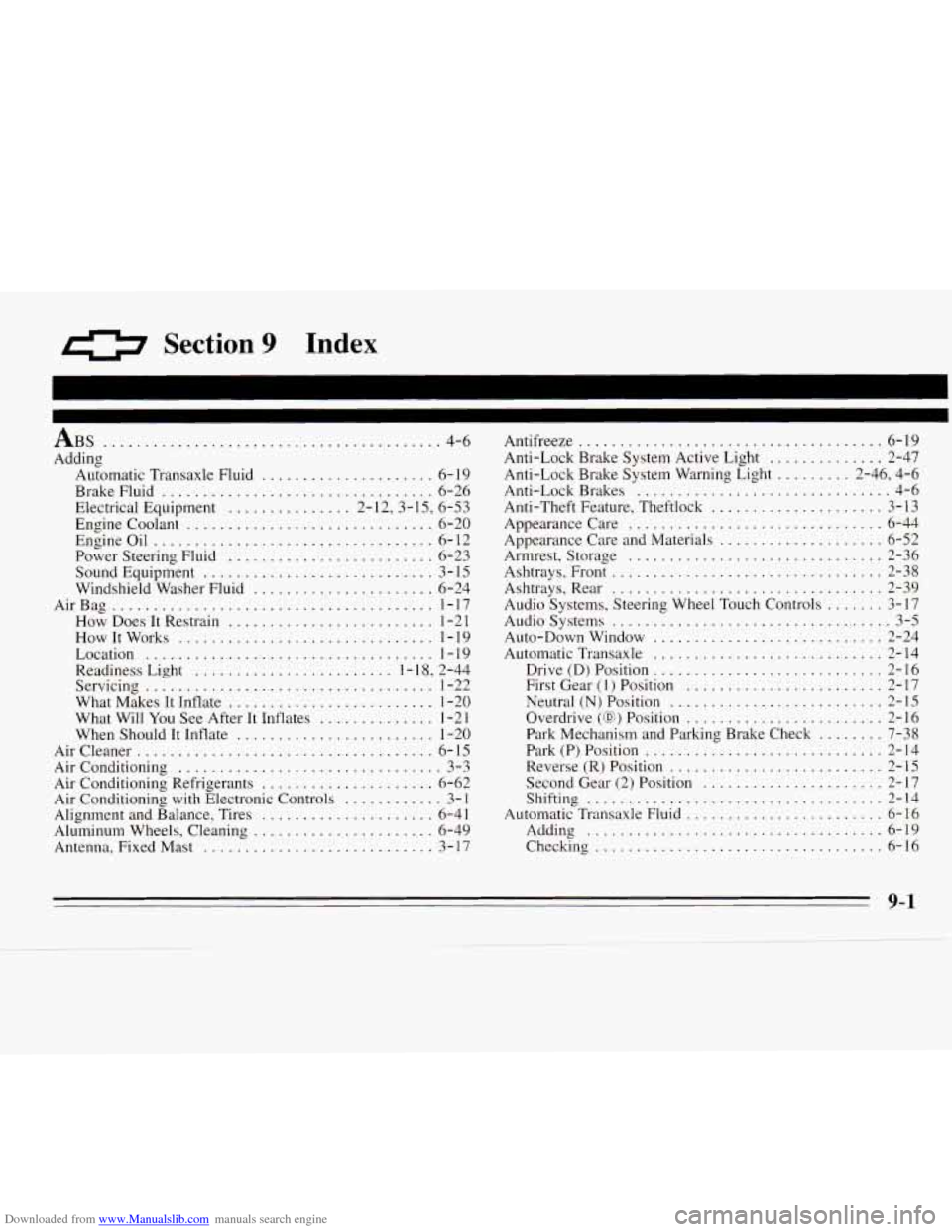
ABS ......................................... 4-6
Adding Automatic Transaxle Fluid
..................... 6- I9
Brake Fluid
................................. 6-26
Electrical Equipment
............... 2- 12 . 3- IS. 6-53
Engine Coolant
.............................. 6-20
Engine Oil
.................................. 6- 12
Power Steering Fluid ......................... 6-23
Sound Equipment
............................ 3- 15
Windshield Washer Fluid ...................... 6-24
AirBag
....................................... 1-17
How Does It Restrain ......................... 1-2 1
How It Works ............................... 1 - 19
Location ................................... 1-19
Readiness Light ........................ I - 18. 2-44
Servlclng 1-22
What Makes
It Inflate ......................... 1-20
What Will You See After It Inflates .............. 1-21
When Should It Inflate ........................ 1-20
Aircleaner
.................................... 6-15
Air Conditioning ................................ 3-3
Air Conditioning Refrigerants ..................... 6-62
Air Conditioning with Electronic Controls ............ 3- 1
Alignment and Balance, Tires ..................... 6-41
Aluminum Wheels
. Cleaning ...................... 6-49
Antenna
. Fixed Mast ............................ 3- 17
.. ...................................
Antifreeze ..................................... 6-19
Anti-Lock Brake System Warning Light
......... 2.46. 4.6
Anti-Lock Brakes
............................... 4-6
Anti-Theft Feature. Theftlock
..................... 3-13
Appearancecare
............................... 6-44
Appearance Care and Materials
.................... 6-52
Armrest. Storage
............................... 2-36
Ashtrays. Front
................................. 2-38
Ashtrays. Rear
................................. 2-39
Audio Systems
.................................. 3-5
Auto-Down Window
............................ 2-24
Automatic Transaxle
............................ 2-14
Drive (D) Position
............................ 2-16
First Gear (1) Position
........................ 2-17
Neutral (N) Position
.......................... 2-15
Overdrive (@I) Position ........................ 2-16
Park Mechanism and Parking Brake Check
........ 7-38
Park
(P) Position ............................. 2-14
Reverse (R) Position
.......................... 2-15
Second Gear (2) Position
...................... 2-17
Shifting
.................................... 2-14
Automatic Transaxle Fluid
........................ 6-16
Adding
.................................... 6-19
Checking
................................... 6-16
Anti-Lock Brake System Active Light
.............. 2-47
Audio Systems. Steering Wheel Touch Controls
....... 3-17
9-1