1995 CHEVROLET CORVETTE service
[x] Cancel search: servicePage 251 of 386
Downloaded from www.Manualslib.com manuals search engine You should look for this on the oil container, and use
only those oils that are identified as meeting GM
Standard
4718M and have the “Starburst” symbol on the
front of the oil container.
Your Corvette engine is filled at the factory with a
Mobil
1 @ synthetic oil, which meets all requirements for
your vehicle.
Substitute Oil (LTl Only): When adding oil to
maintain engine oil level, oil meeting GM Standard
GM47
18M may not be available. You can add substitute
oil designated
SAE 5W-30 with the “Starburst” symbol
or API Service SH at all temperatures. If temperatures
are above
0” F (- 18 O C), you may substitute SAE
1OW-30 with the “Starburst” symbol or API Service
SH
oil. This oil should not be used for an oil change.
Substitute Oil (LT5 Only): When adding oil to
maintain engine oil level,
if an oil meeting GM Standard
GM47
18M is not available, you can use oil designated
SAE 1OW-30 with the “Starburst” symbol or API
~ Service SH at all temperatures. This oil should not be
used for
an oil change.
Engine Oil Additives
Don’t add anything to your oil. Your Chevrolet dealer is
ready to advise if you think something should be added.
When to Change Engine Oil
See if any one of these is true for you:
0 Most trips are less than 5 to 10 miles (8 to 16 km).
This is particularly important when outside
temperatures are below freezing.
Most trips include extensive idling (such as frequent
driving in stop and
go traffic).
Most trips are through dusty areas.
If any one of these is true for your vehicle, you need to
change your oil and filter every 3,000 miles
(5 000 km)
or 3 months -- whichever comes first. (See “Engine Oil
Life Monitor” in the Index.)
If none of them is true, change the oil and filter every
7,500 miles (12 500 km) or 12 months -- whichever
comes first. (See “Engine Oil Life Monitor” in the
Index.)
Engine Coolant Heater
An engine coolant heater can be a big help if you have
to
park outside in very cold weather, 0” F (- 1 8 O C) or
colder. If your vehicle has this feature, see “Engine
Coolant Heater” in the Index.
6-16
Page 252 of 386
Downloaded from www.Manualslib.com manuals search engine What to Do with Used Oil
Did you know that used engine oil contains certain
elements that
may be unhealthy for your skin and could
even cause cancer? Don’t let used oil stay on your skin
for very long. Clean your skin and nails with soap and
water, or a good hand cleaner. Wash or throw away
clothing or rags containing used engine oil. (See the
manufacturer’s warnings about the use and disposal of
oil products.)
Used oil can be a real threat to the environment. If you
change your own oil, be sure to drain all free-flowing oil
from the filter before disposal. Don’t ever dispose
of oil
by putting it in the trash, pouring it on the ground, into
sewers, or into streams or bodies of water. Instead,
recycle it
by taking it to a place that collects used oil. If
you have a problem properly disposing of your used oil,
ask your dealer, a service station or a local recycling
center for help.
Air Cleaner
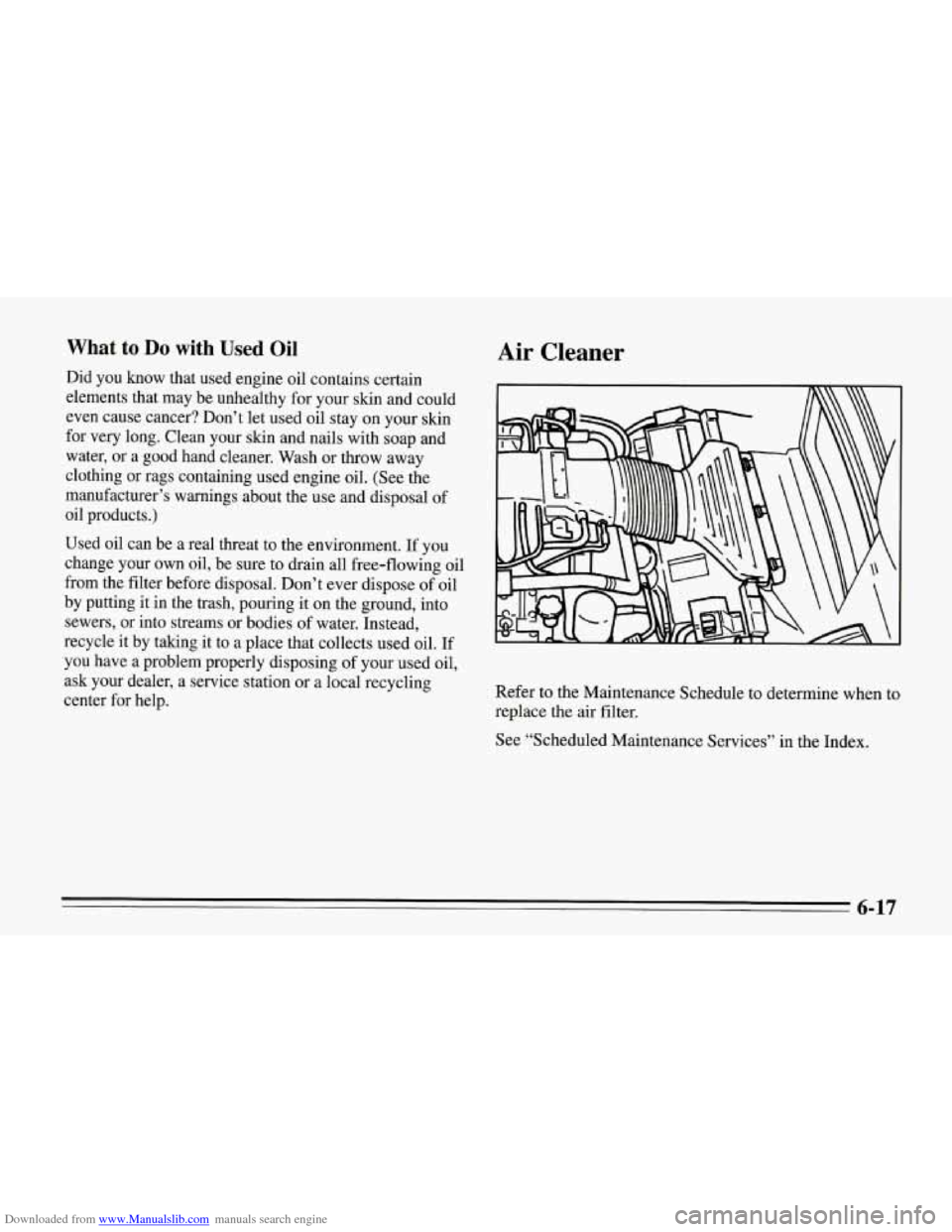
Refer to the Maintenance Schedule to determine when to
replace the air filter.
See “Scheduled Maintenance Services” in the Index.
6-17
Page 255 of 386
Downloaded from www.Manualslib.com manuals search engine Automatic Transmission Fluid
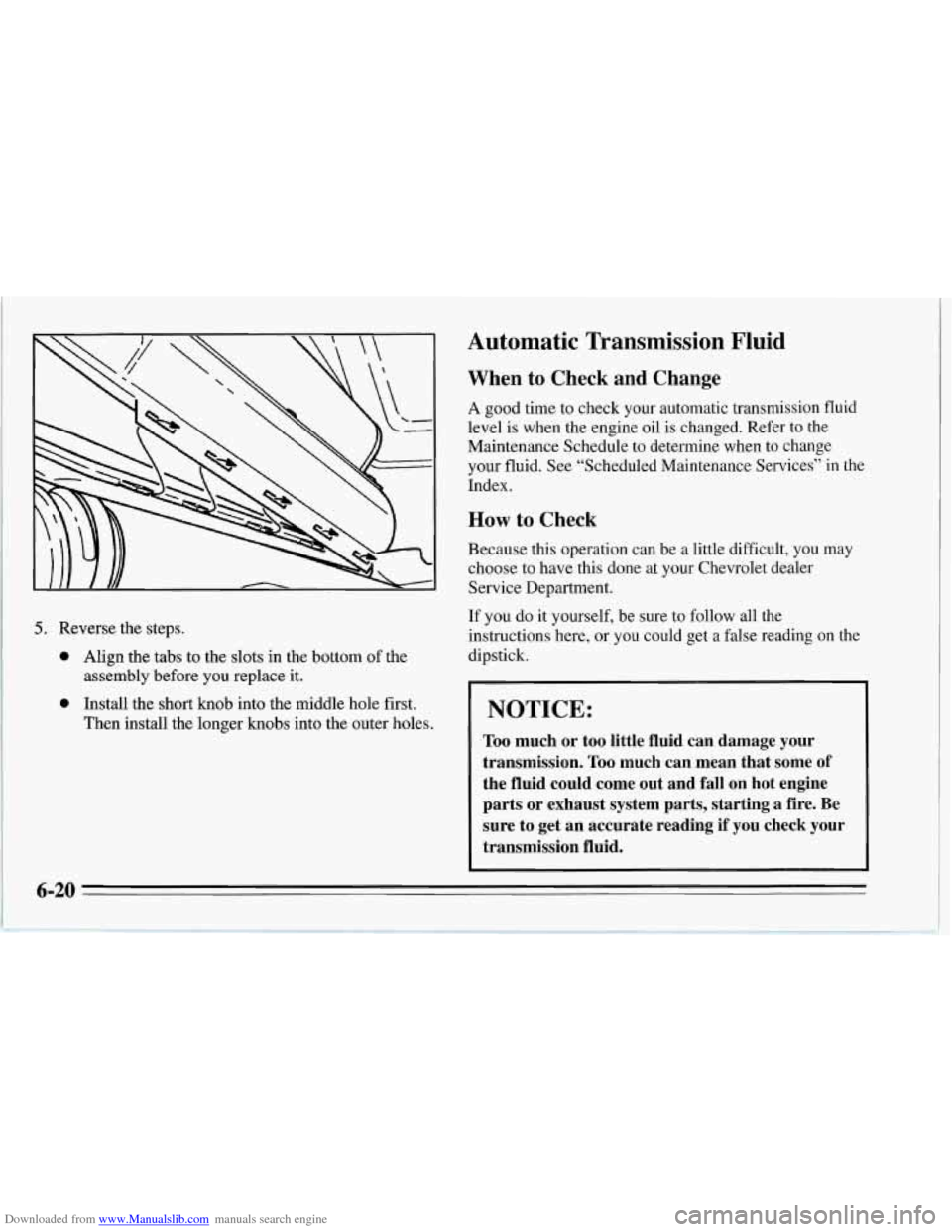
5. Reverse the steps.
0 Align the tabs to the slots in the bottom of the
0 Install the short knob into the middle hole first.
assembly before you
replace it.
Then install the longer knobs into the outer holes.
When to Check and Change
A good time to check your automatic transmission fluid
level is when the engine oil is changed. Refer to the
Maintenance Schedule to determine when to change
your fluid. See “Scheduled Maintenance Services” in the
Index.
How to Check
Because this operation can be a little difficult, you may
choose to have this done at your Chevrolet dealer
Service Department.
If you do it yourself, be sure to follow all the
instructions here, or you could get a false reading on the
dipstick.
I
I NOTICE:
Too much or too little fluid can damage your
transmission.
Too much can mean that some of
the fluid could come out and fall on hot engine
parts or exhaust system parts, starting a fire. Be sure to get an accurate reading if you check your
transmission fluid.
6-20
Page 258 of 386
Downloaded from www.Manualslib.com manuals search engine Manual Transmission Fluid
How to Check
Because this operation can be difficult, you may choose
to have this done at your Chevrolet dealer Service
Department.
If you do it yourself, be sure to follow all the
instructions here, or you could get a false reading.
NOTICE:
Too much or too little fluid can damage your
transmission.
Too much can mean that some of
the fluid could come out and
fall on hot engine
parts or exhaust system parts, starting
a fire. Be
sure to get an accurate reading
if you check your
transmission fluid.
Check the fluid level only when your engine is off, the
vehicle is parked on a level place and the transmission is
cool enough for
you to rest your fingers on the
transmission case. Then,
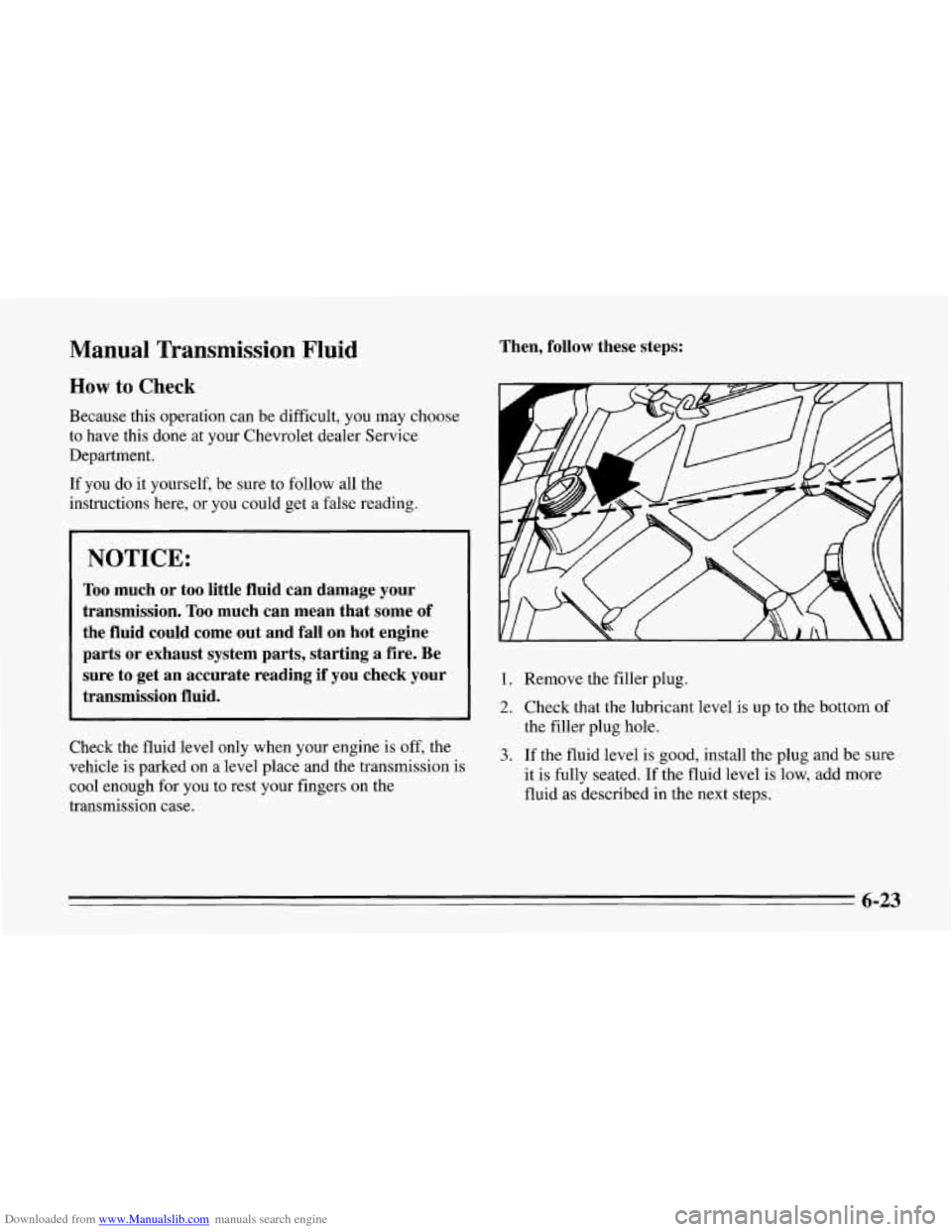
follow these steps:
n
1. Remove the filler plug.
2. Check that the lubricant level is up to the bottom of
the filler plug hole.
3. If the fluid level is good, install the plug and be sure
it is fully seated.
If the fluid level is low, add more
fluid as described in the next steps.
6-23
Page 259 of 386
Downloaded from www.Manualslib.com manuals search engine How to Add Fluid
Here’s how to add fluid. Refer to the Maintenance
Schedule to determine what kind of fluid to use. See
“Recommended Fluids and Lubricants” in the Index.
1. Remove the filler plug.
2. Add fluid at the filler plug hole. Add only enough
fluid to bring the fluid level up to the bottom
of the
filler plug hole.
3. Install the filler plug. Be sure the plug is fully seated.
Hydraulic Clutch
The clutch linkage in your vehicle is self-adjusting. The
clutch master cylinder reservoir is filled with hydraulic
clutch fluid.
It isn’t a good idea to “top
off’ your clutch fluid. Adding
fluid won’t correct a leak.
A fluid
loss in this system could indicate a problem.
Have
the system inspected and repaired.
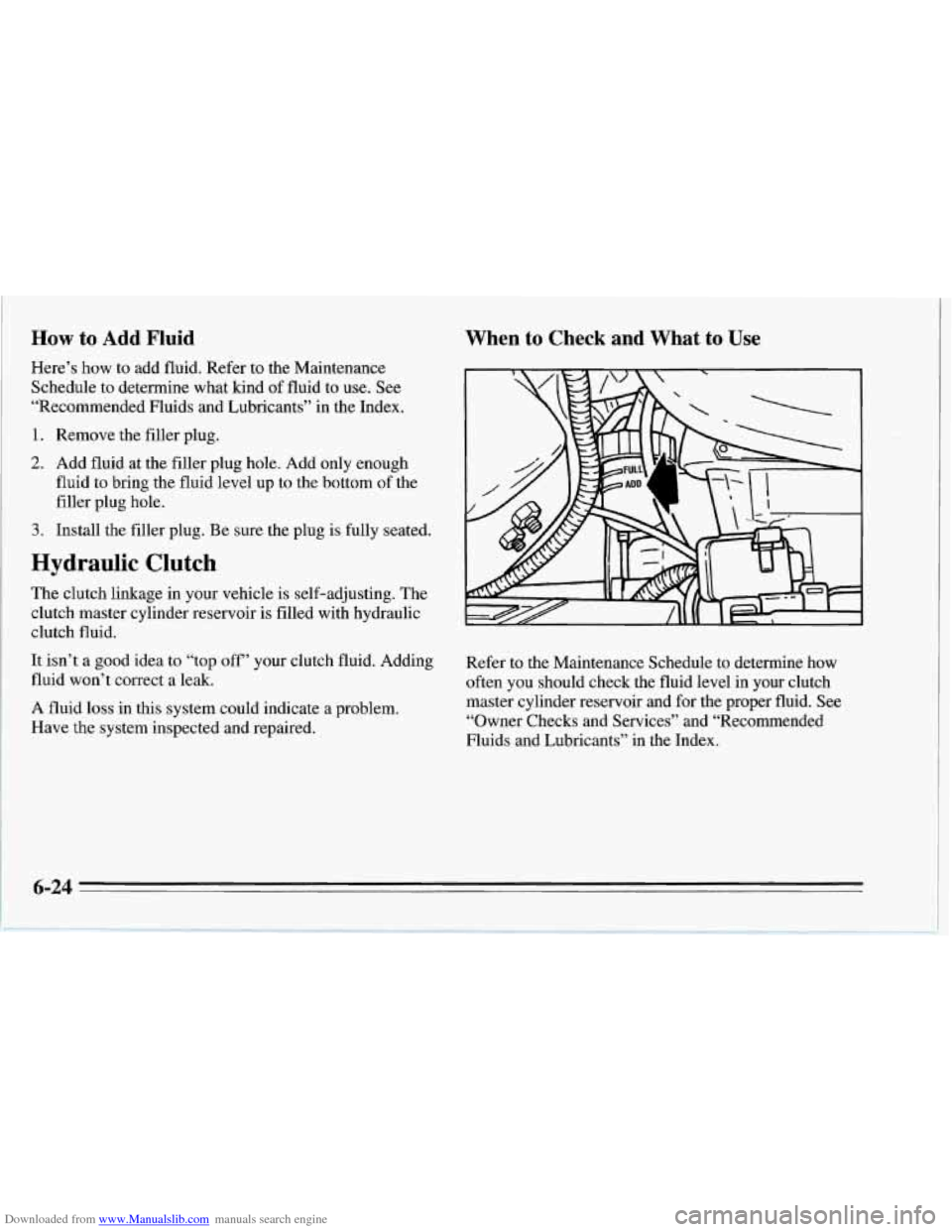
When to Check and What to Use
Refer to the Maintenance Schedule to determine how
often you should check the fluid level in
your clutch
master cylinder reservoir and for the proper fluid. See
“Owner Checks and Services” and “Recommended
Fluids and Lubricants” in the Index.
6-24
Page 270 of 386
Downloaded from www.Manualslib.com manuals search engine NOTICE:
Replacing Brake System Parts
The braking system on a modem vehicle is complex. Its
I
Continuing to drive with worn-out brake pads
could result in costly brake repair.
I
Some driving conditions or climates may cause a brake
squeal when the brakes are first applied or lightly
applied. This does not mean something is wrong with
your brakes.
Brake linings should always be replaced as complete
axle sets.
Brake Pedal Travel
See your dealer if the brake pedal does not return to
normal height, or if there is a rapid increase in pedal
travel. This could be
a sign of brake trouble.
Brake Adjustment
As you make brake stops, your disc brakes
automatically adjust for wear. many
parts have to be
of top quality and work well
together if the vehicle is to have really good braking.
Vehicles we design and test have top-quality
GM brake
parts in them, as your Corvette does when
it is new.
When you replace parts of your braking system
-- for
example, when your brake linings wear down and you
have to have new ones put in
-- be sure you get new
genuine
GM replacement parts. If you don’t, your
brakes may no longer work properly. For example, if
someone puts in brake linings that are wrong for your
vehicle, the balance between your front and rear brakes
can change
-- for the worse. The braking performance
you’ve come to expect can change
in many other ways if
someone puts
in the wrong replacement brake parts.
Battery
Every new Corvette has a Delco Freedom@ battery. You
never have to add water to one of these. When it’s time
for a new battery, we recommend a Delco Freedom@
battery. Get one that has the replacement number shown
on the original battery’s label. For battery replacement,
see your dealer or the Corvette Service Manual.
To
purchase a service manual, see “Service Publications” in
the Index.
6-35
Page 284 of 386
Downloaded from www.Manualslib.com manuals search engine Extended Mobility Tires (Option)
If your Corvette has optional Goodyear Extended
Mobility Tires (EMT’s), the tires will have “EMT”
molded on the sidewalls. Your vehicle may also have a
spare tire delete option. With the spare tire delete option,
there’s no spare tire, no tire changing equipment and no
place to store a tire in the vehicle. Extended Mobility
Tires perform
so well without any air that a Low Tire
Pressure Warning System (LTPWS) is used to alert you if
a tire has lost pressure.
A LOWELAT TIRE light will
appear on your Driver Information Center
if a tire’s
inflation pressure is less than
25 psi (170 kPa). If the
LOW/FLAT
TIRE light comes on, check your tire
pressures as soon as you can. See “Low Tire Pressure
Warning System” in the Index for additional information. If a
tire goes flat,
you won’t need to stop on the side of
the road to change the tire. You can just keep on driving.
The shorter the distance
you drive and the slower the
speed, the greater the chance that the tire will not have
to be replaced. If
you drive on a deflated EMT for
distances
of 50 miles (80 km) or less and at speeds of
55 mph (90 km/h) or less, there is a good chance that the
tire can be repaired. The tire can operate effectively with
no air pressure for up to 200 miles (320 km) at speeds
up to
55 mph (90 kmk), but the tire would then have to
be replaced. Also remember: When a tire is filled with
air, it provides a cushion between the road and the
wheel. Because you do not have this cushion when
driving on a deflated tire, try to avoid potholes that
could damage your wheel and require replacement of it.
Some road hazards can damage a tire beyond repair. This
damage could occur before you’ve driven on the tire
in a
deflated condition. Whenever a tire has been damaged, or
if you’ve driven any distance on a deflated EMT, check
with a Goodyear EMT Service Center to determine
whether
the tire can be repaired or should be replaced.
To maintain your vehicle’s extended mobility feature,
all replacement tires must be Extended Mobility Tires.
See the Goodyear Extended Mobility Tire Owner’s
Manual and Limited Warranty supplied with your
Corvette for additional information.
6-49
Page 287 of 386
Downloaded from www.Manualslib.com manuals search engine Buying New Tires
To find out what kind and size of tires you need, look at
the Tire-Loading Information label.
The tires installed on your vehicle when it was new had
a Tire Performance Criteria Specification (TPC Spec)
number on each tire’s sidewall. When you get new tires,
get ones with that same TPC Spec number. That way,
your vehicle will continue to have tires that are designed
to give proper endurance, handling, speed rating,
traction, ride and other things during normal service on
your vehicle. If your tires have an all-season tread
design, the TPC number will be followed by an
“MS”
(for mud and snow).
If you ever replace your tires with those not having a
TPC Spec number, make sure they are the same size,
load range, speed rating and construction type (bias,
bias-belted or radial) as your original tires.
Uniform Tire Quality Grading
The following information relates to the system
developed
by the United States National Highway
Traffic Safety Administration which grades tires by
treadwear, traction and temperature performance. (This
applies only to vehicles sold in the United States.)
Treadwear
The treadwear grade is a comparative rating based on
the wear rate of the tire when tested under controlled
conditions on
a specified government test course. For
6-52