Page 154 of 340
Downloaded from www.Manualslib.com manuals search engine sunshine you are wise to wear sunglasses. Your eyes will
have less trouble adjusting to night. But if you’re
driving, don’t wear sunglasses
at night. They may cut
down on glare from headlamps, but they also make a lot
of things invisible.
You can be temporarily blinded by approaching
headlamps.
It can take a second or two, or even several
seconds, for your eyes
to readjust to the dark. When you
are faced with severe glare
(as from a driver who
doesn’t lower the high beams, or a vehicle with
misaimed headlamps), slow down a little. Avoid staring
directly into the approaching headlamps.
Keep your windshield and all the glass on your vehicle
clean
-- inside and out. Glare at night is made much
worse by dirt on the glass. Even the inside of the glass
can build up
a film caused by dust. Dirty glass makes
lights dazzle and flash more than clean glass would,
making
the pupils of your eyes contract repeatedly.
Remember that
your headlamps light up far less of a
roadway when
you are in a turn or curve. Keep your
eyes moving; that way, it’s easier
to pick out dimly
lighted objects. Just as your headlamps should be
checked regularly for proper aim,
so should your eyes
be examined regularly. Some drivers suffer from night
blindness
-- the inability to see in dim light -- and aren’t
even aware of it.
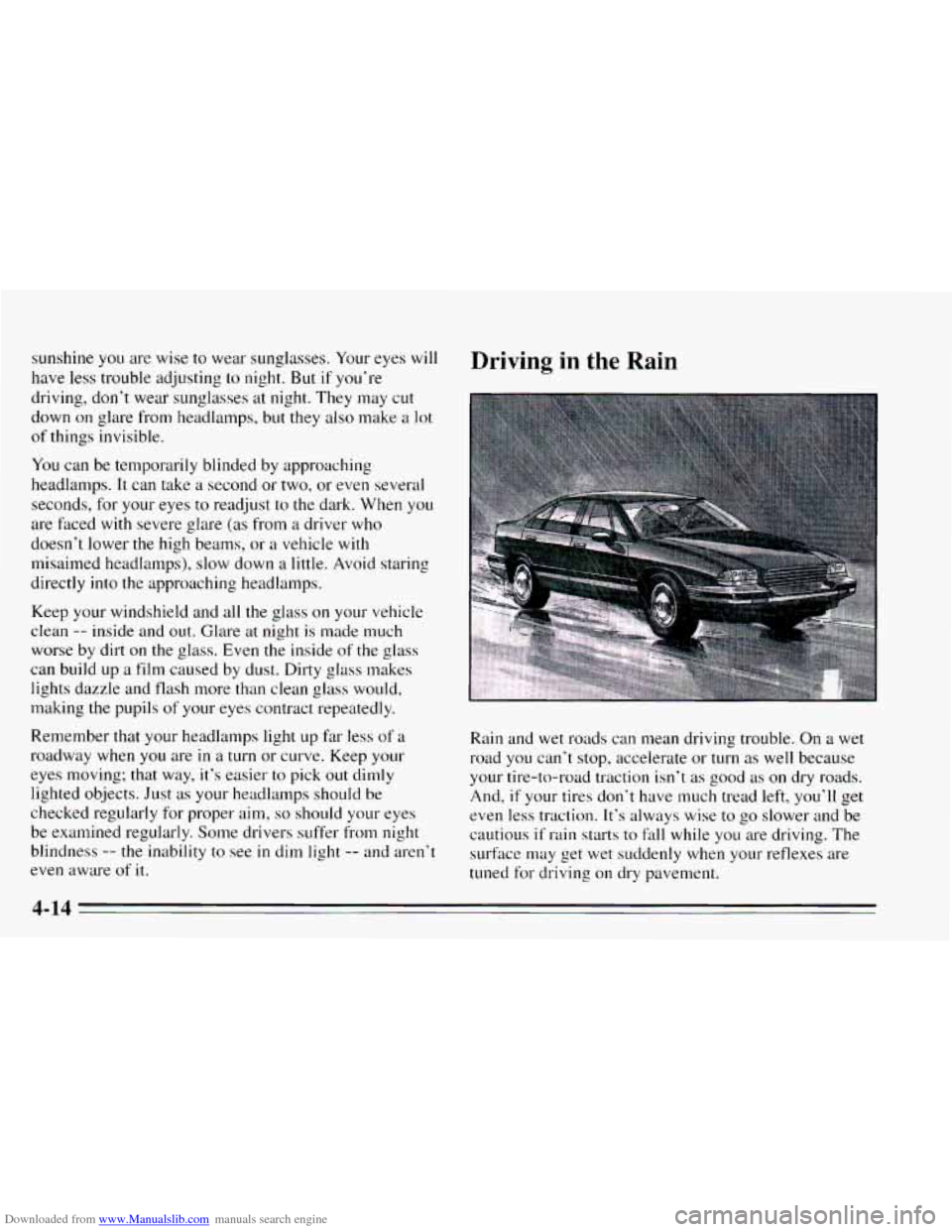
Driving in the Rain
Rain and wet roads can mean driving trouble. On a wet
road you can’t stop, accelerate or turn as well because
your tire-to-road traction
isn’t as good as on dry roads.
And,
if your tires don‘t have much tread left, you’ll get
even less traction. It‘s always wise to
go slower and be
cautious
if rain starts to fall while you are driving. The
surfxe may get wet suddenly when your reflexes are
tuned for driving
on dry pavement.
4-14
Page 156 of 340
Downloaded from www.Manualslib.com manuals search engine Hydroplaning
Hydroplaning is dangerous. So much water can build up
under your tires that they can actually ride on the water.
This can happen
if the road is wet enough and you’re
going fast enough. When your vehicle is hydroplaning,
it has little or no contact with the road.
Hydroplaning doesn’t happen often. But it can if your
tires haven’t much tread or
if the pressure in one or
more is low. It can happen
if a lot of water is standing on
the road. If you can see reflections from trees, telephone
poles, or other vehicles, and raindrops “dimple” the
water’s surface, there
could be hydroplaning.
Hydroplaning usually happens at higher speeds. There
just isn’t a hard and fast rule about hydroplaning. The
best advice
is to slow down when it is raining.
Some Other Rainy Weather Tips
0
0
0 Turn on your low-beam headlamps -- not just your
parking lamps
-- to help make you more visible to
others.
Besides slowing down, allow
some extra following
distance. And be especially careful when
you pass
another vehicle. Allow yourself more clear room
ahead, and be prepared
to have your view restricted
by road spray.
Have good tires with proper tread depth. (See
“Tires”
in the Index.)
4-16
Page 165 of 340
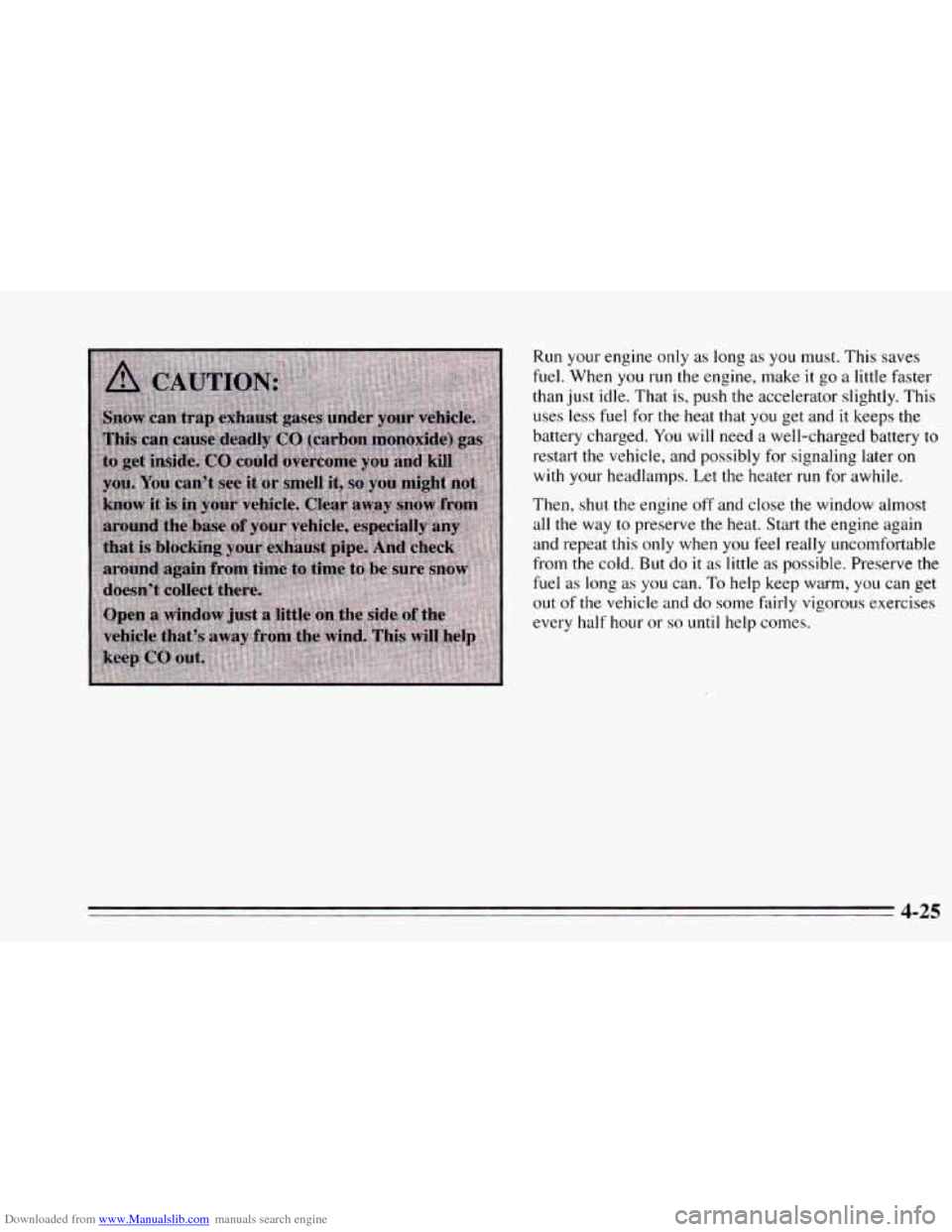
Downloaded from www.Manualslib.com manuals search engine Run your engine only as long as you must. This saves
fuel. When you run the engine, make it go a little faster
than just idle. That
is, push the accelerator slightly. This
uses less fuel for the heat that you get and it keeps the
battery charged.
You will need a well-charged battery to
restart the vehicle, and possibly for signaling later on
with your headlamps. Let the heater run for awhile.
Then, shut the engine off and close the window almost
all the way to preserve the heat. Start the engine again
and repeat
this only when you feel really uncomfortable
from the cold. But do
it as little as possible. Preserve the
fuel as long
as you can. To help keep warm, you can get
out of the vehicle and do some fairly vigorous exercises
every half hour or
so until help comes.
4-25
Page 233 of 340
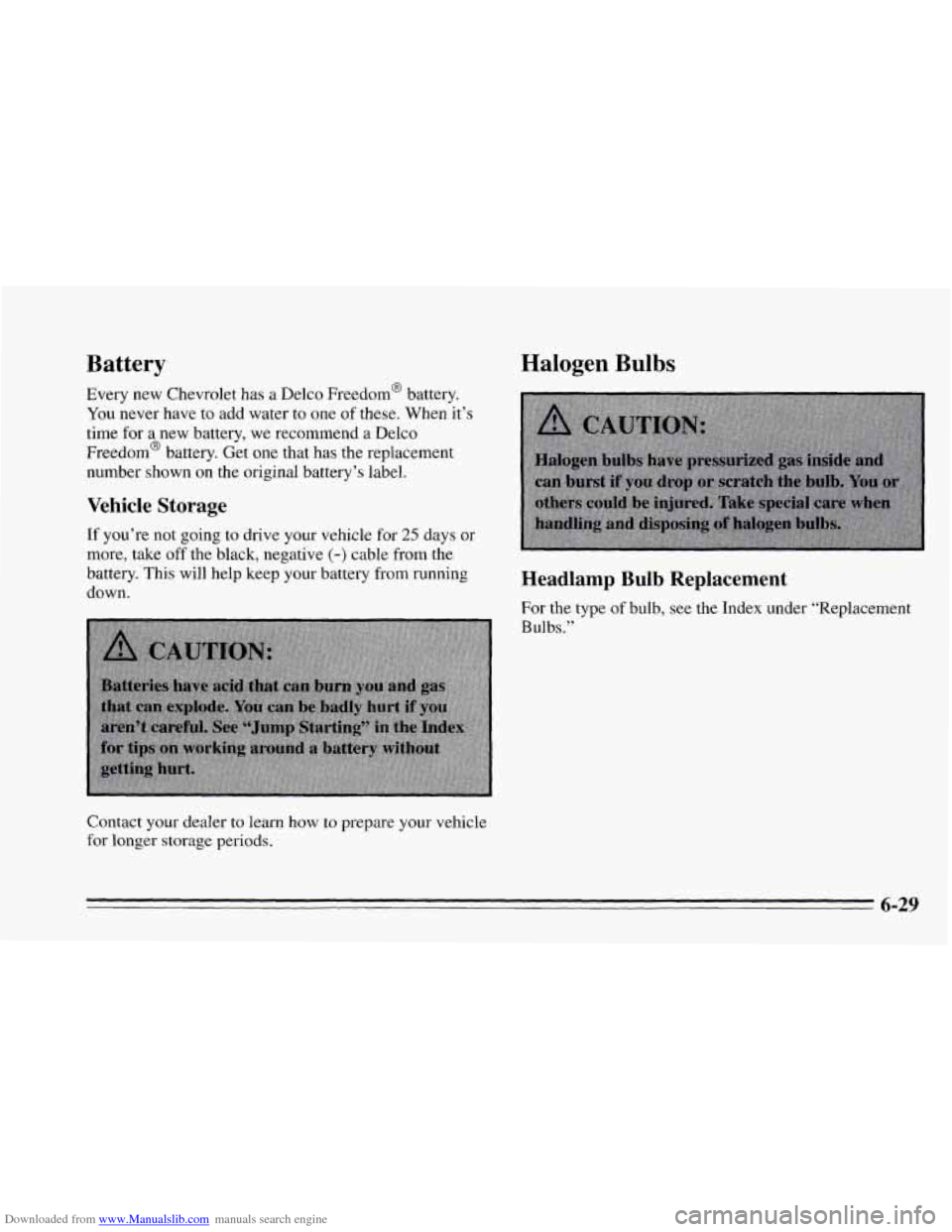
Downloaded from www.Manualslib.com manuals search engine Battery
Every new Chevrolet has a Delco Freedom@ battery.
You never have to add water to one of these. When it’s
time for
a new battery, we recommend a Delco
Freedom@ battery. Get one that has the replacement
number shown
on the original battery’s label.
Vehicle Storage
If you’re not going to drive your vehicle for 25 days or
more, take
off the black, negative (-) cable from the
battery. This will help keep your battery from running
down.
Contact your dealer to learn
how to prepare your vehicle
for longer storage periods.
Halogen Bulbs
Headlamp Bulb Replacement
For the type of bulb, see the Index under “Replacement
Bulbs.”
6-29
Page 234 of 340
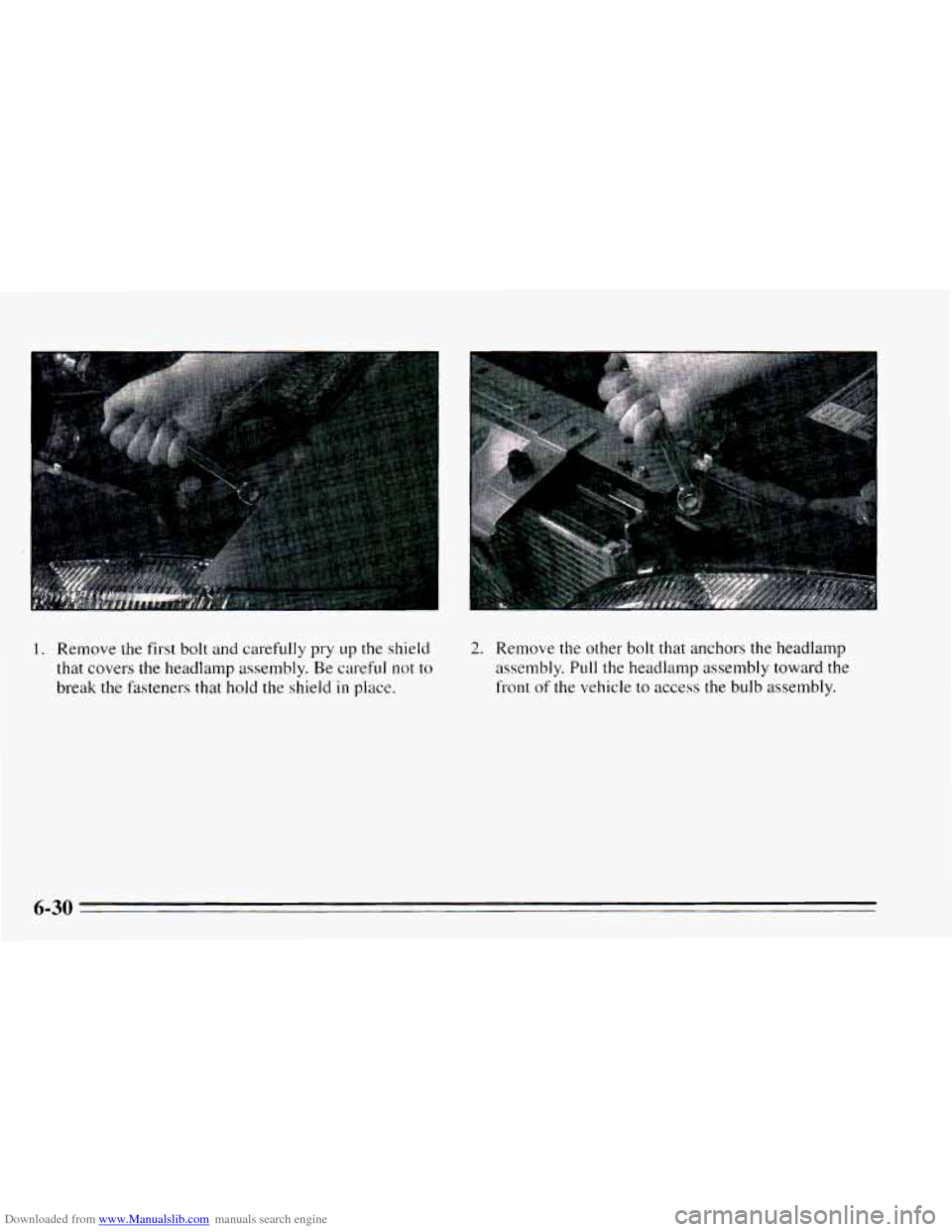
Downloaded from www.Manualslib.com manuals search engine 1. Remove the first bolt and carefully pry up the shield
that covers
the headlamp assembly. Be careful not to
break the fasteners that hold the shield in place.
2. Remove the other bolt that anchors the headlamp
assembly. Pull the headlamp assembly toward the
front of the vehicle to access the bulb assembly.
6-30
Page 244 of 340
Downloaded from www.Manualslib.com manuals search engine Wheel Replacement
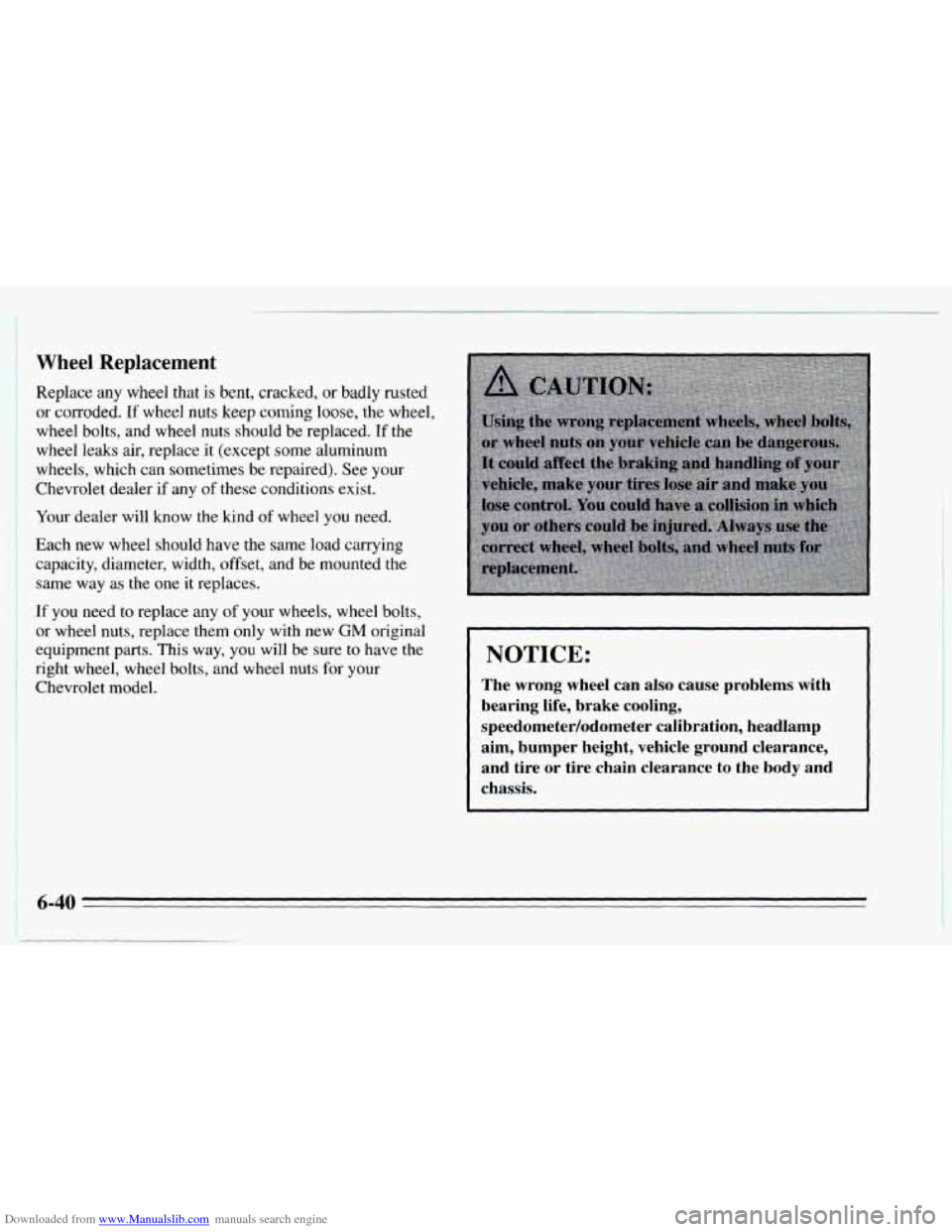
Replace any wheel that is bent, cracked, or badly rusted
i or corroded. If wheel nuts keep coming loose, the wheel,
' wheel bolts, and wheel nuts should be replaced. If the
wheel leaks air, replace
it (except some aluminum
I wheels, which can sometimes be repaired). See your
Chevrolet dealer if any
of these conditions exist.
Your dealer will know the kind
of wheel you need.
Each new wheel should have the same load carrying
~ capacity, diameter, width, offset, and be mounted the
same way as the
one it replaces.
~ If you need to replace any of your wheels, wheel bolts,
' or wheel nuts, replace them only with new GM original
i equipment parts. This way, you will be sure to have the
~ right wheel, wheel bolts, and wheel nuts for your
Chevrolet model. NOTICE:
The wrong wheel can also cause problems with
bearing life, brake cooling,
speedometer/odometer calibration, headlamp
aim, bumper height, vehicle ground clearance,
and tire or tire chain clearance to the body and
chassis.
Page 257 of 340
Downloaded from www.Manualslib.com manuals search engine Fuse Usage
S ALARM PCM/IGN IGN
Fuse
AIR BG 1
AIR BG 2
ALARM
CIG
CLSPCM
CLUSTER
CRUISE DRL
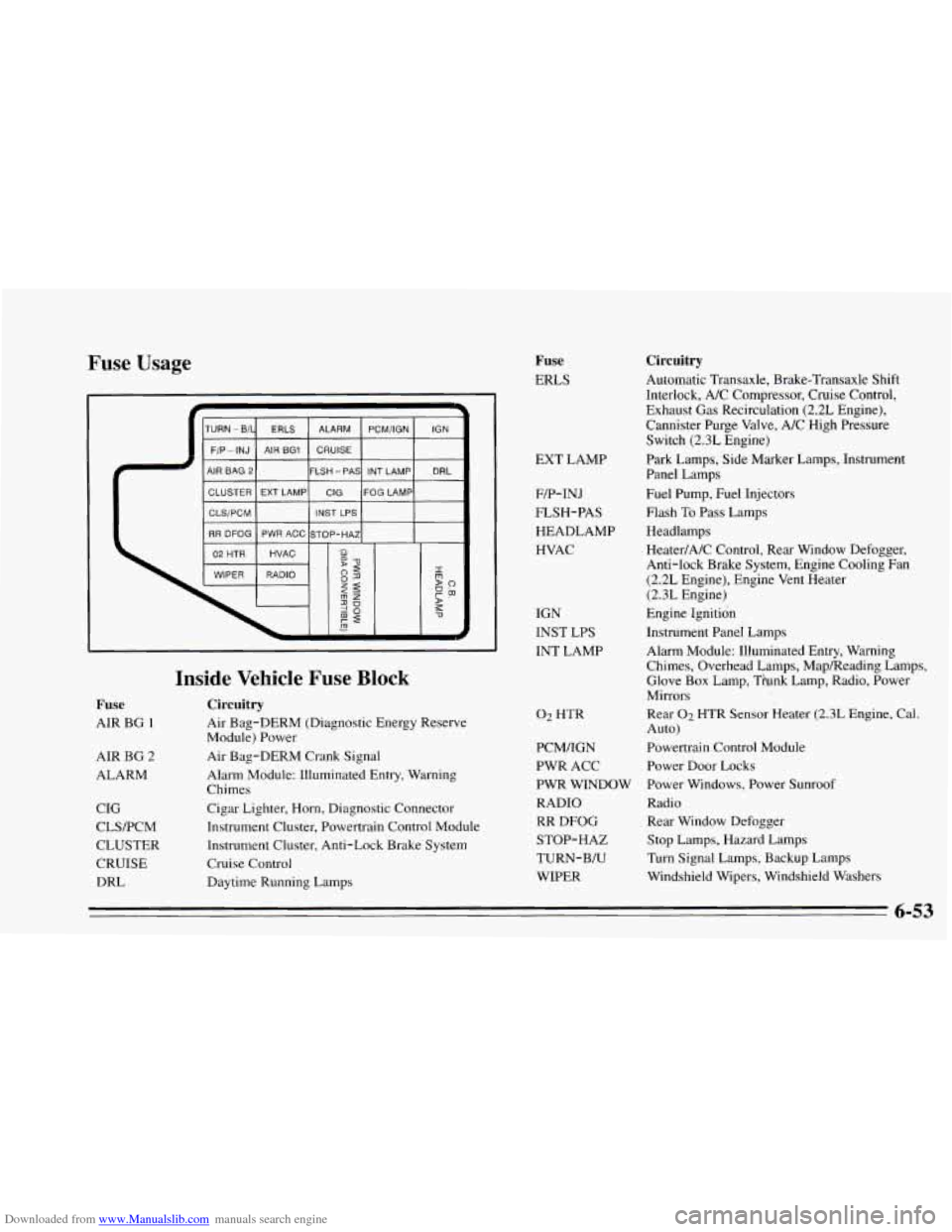
Inside Vehicle Fuse Block
Circuitry
Air Bag-DERM (Diagnostic Energy Reserve
Module) Power
Air Bag-DERM Crank Signal
Alarm Module: Illuminated Entry, Warning
Chimes
Cigar Lighter, Horn, Diagnostic Connector
Instrument Cluster, Powertrain Control Module
Instrument Cluster, Anti-Lock Brake System Cruise Control
Daytime Running Lamps IGN
INST
LPS
INT LAMP
Fuse
ERLS
EXT LAMP
F/P-INJ
FLSH-PAS
HEADLAMP
HVAC
Circuitry
Automatic Transaxle, Brake-Transaxle Shift
Interlock, A/C Compressor, Cruise Control,
Exhaust Gas Recirculation (2.2L Engine),
Cannister Purge Valve, A/C High Pressure
Switch (2.3L Engine)
Park Lamps, Side Marker Lamps, Instrument
Panel Lamps
Fuel Pump, Fuel Injectors
Flash To Pass Lamps
Headlamps
Heater/A/C Control, Rear Window Defogger,
Anti-lock Brake System, Engine Cooling Fan
(2.2L Engine), Engine Vent Heater
(2.3L Engine)
Engine Ignition
Instrument PaneiLamps
Alarm Module: 11,luminated Entry, Warning
Chimes, Overhead Lamps, MapReading Lamps,
Glove Box Lamp, Thnk Lamp, Radio, Power
Mirrors
Auto)
02 HTR Rear 02 HTR Sensor keater (2.3L Engine, Cal.
PCM/IGN Powertrain Control Module
PWR ACC Power
Door Locks
PWR WINDOW Power Windows, Power Sunroof
RADIO Radio
RR DFOG Rear Window Defogger
STOP-HAZ Stop Lamps, Hazard Lamps
TURN-B/U Turn
Signal Lamps, Backup Lamps
WIPER Windshield
Wipers, Windshield Washers
6-53
Page 258 of 340
Downloaded from www.Manualslib.com manuals search engine I 1
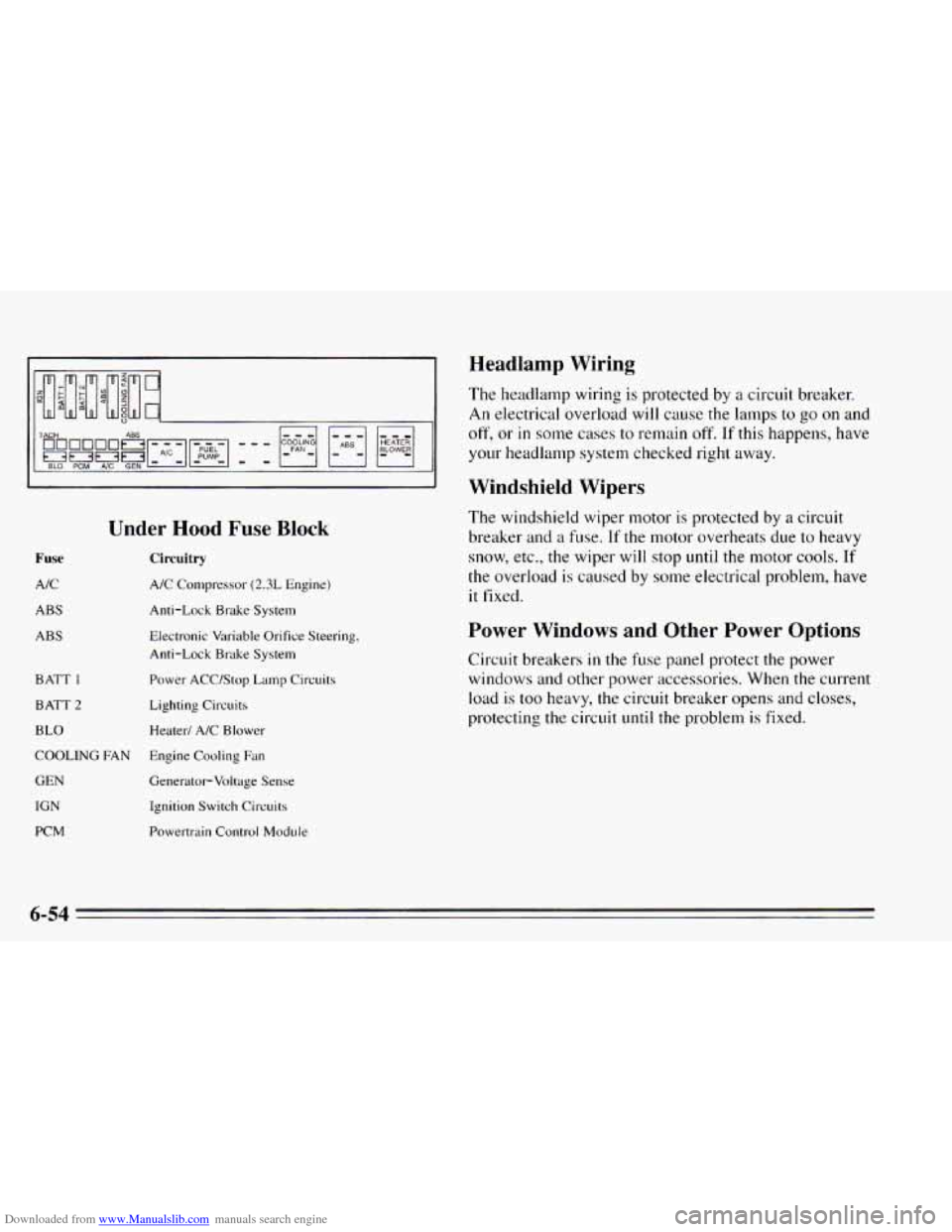
Under Hood Fuse Block
Fuse
AIC
ABS
ABS
BATT 1
BATT 2
BLO
COOLING FAN
GEN
IGN
PCM
Circuitry
A/C Compressor (2.3L Engine)
Anti-Lock Brake System
Electronic Variable Orifice Steering,
Anti-Lock Brake System
Power ACC/Stop
Lamp Circuits
Lighting Circuits
Heater/ A/C Blower
Engine Cooling Fan
Generator-Voltage Sense
Ignition Switch Circuits
Powertrain Control Module
Headlamp Wiring
The headlamp wiring is protected by a circuit breaker.
An electrical overload will cause the lamps to go on and
off, or
in some cases to remain off. If this happens, have
your headlamp system checked right away.
Windshield Wipers
The windshield wiper motor is protected by a circuit
breaker and a fuse.
If the motor overheats due to heavy
snow, etc., the wiper will stop until the motor cools. If
the overload is caused by some electrical problem, have
it fixed.
Power Windows and Other Power Options
Circuit breakers in the fuse panel protect the power
windows and other power accessories. When the current
load is too heavy, the circuit breaker
opens and closes,
protecting the circuit
until the problem is fixed.