Page 178 of 340
Downloaded from www.Manualslib.com manuals search engine ' ' To turn off the flashers, move the switch to the left.
When the hazard warning flashers are on, your turn
signals won't work.
1 Other Warning Devices
~ If you carry reflective triangles, you can set one up at
~ the side of the road about 300 feet (100 m) behind your
vehicle.
: Jump Starting
I
1 If your battery has run down, you may want to use
' another vehicle and some jumper cables to start your
i Chevrolet. But please follow the steps below to do it
safely.
NOTICE:
Ignoring these steps could result in costly damage
to your vehicle that wouldn't be covered by your
warranty.
Trying to start your Chevrolet by pushing or
pulling
it could damage your vehicle, even if you
have a manual transaxle. And if you have an
automatic transaxle,
it won't start that way.
5-2
Page 179 of 340
Downloaded from www.Manualslib.com manuals search engine To Jump Start Your Chevrolet
1. Check the other vehicle. It must have a 12-volt
battery with
a negative ground system.
3. Turn off the ignition on both vehicles. Turn off all
lights that aren’t needed, and radios. This will avoid
sparks and help save both batteries. And it could
save your radio!
NOTICE:
If the other system isn’t a 12-volt system with a
negative ground, both vehicles can be damaged.
2. Get the vehicles close enough so the jumper cables
can reach, but be sure the vehicles aren’t touching
each other.
If they are, it could cause a ground
connection you don’t want. You wouldn’t be able to
start your Chevrolet, and the bad grounding could
damage the electrical systems.
You could be injured if the vehicles roll. Set the
parking
brake firmly on each vehicle. Put an
automatic transaxle in PARK (P) or a manual
transaxle
in NEUTRAL (N).
NOTICE:
If you leave your radio on, it could be badly
damaged. The repairs wouldn’t be covered by
your warranty.
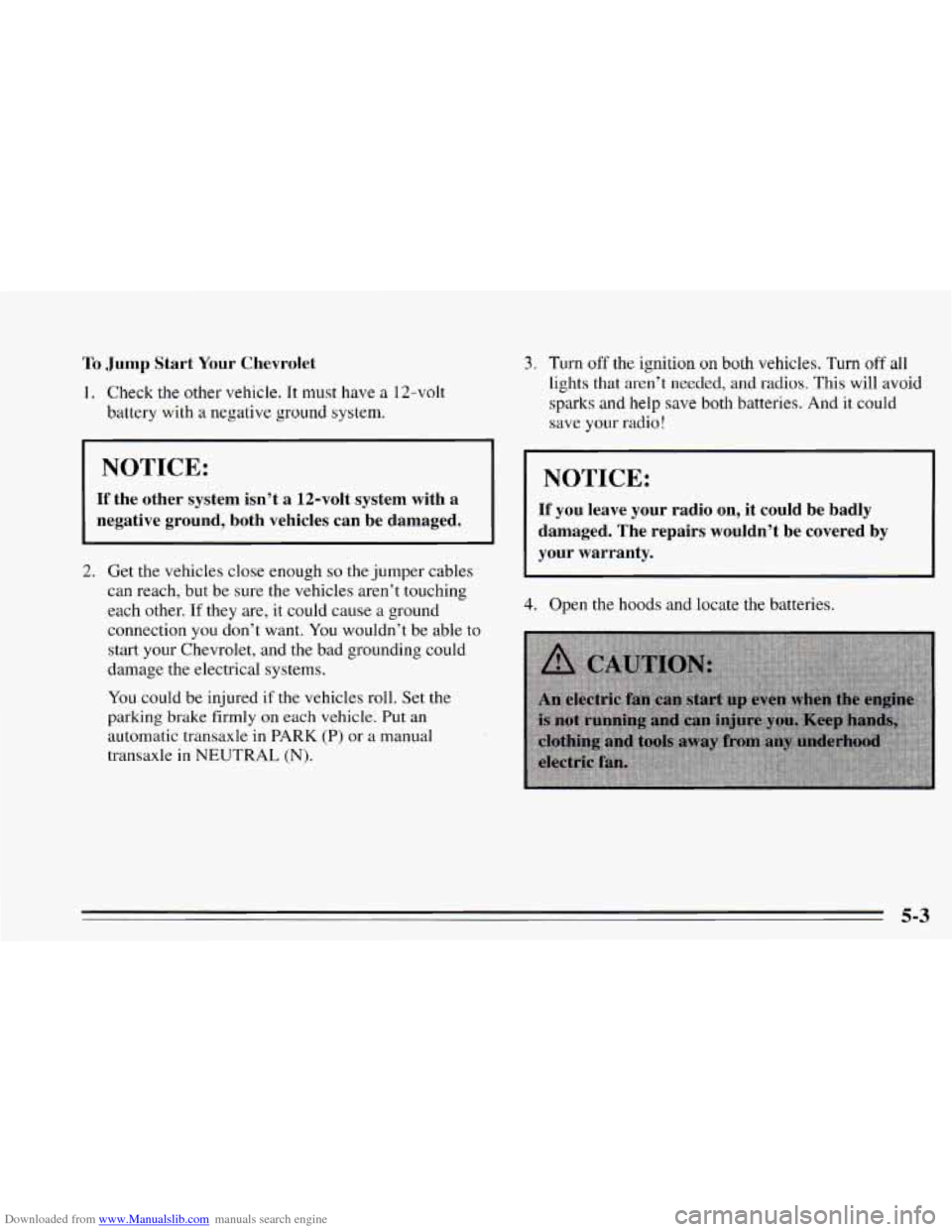
4. Open the hoods and locate the batteries.
5-3
Page 180 of 340
Downloaded from www.Manualslib.com manuals search engine 5. Find the positive (+) and negative (-) terminals on
each battery.
6. Check that the jumper cables don’t have loose or
missing insulation. If they do, you could get a shock.
The vehicles could be damaged, too.
Before you connect the cables, here are some basic
things
you should know. Positive (+) will go to
positive
(+) and negative (-) will go to negative (-)
or a metal engine part. Don’t connect (+) to (-) or
you’ll get a short that would damage the battery and
maybe other parts, too.
5-4
Page 181 of 340
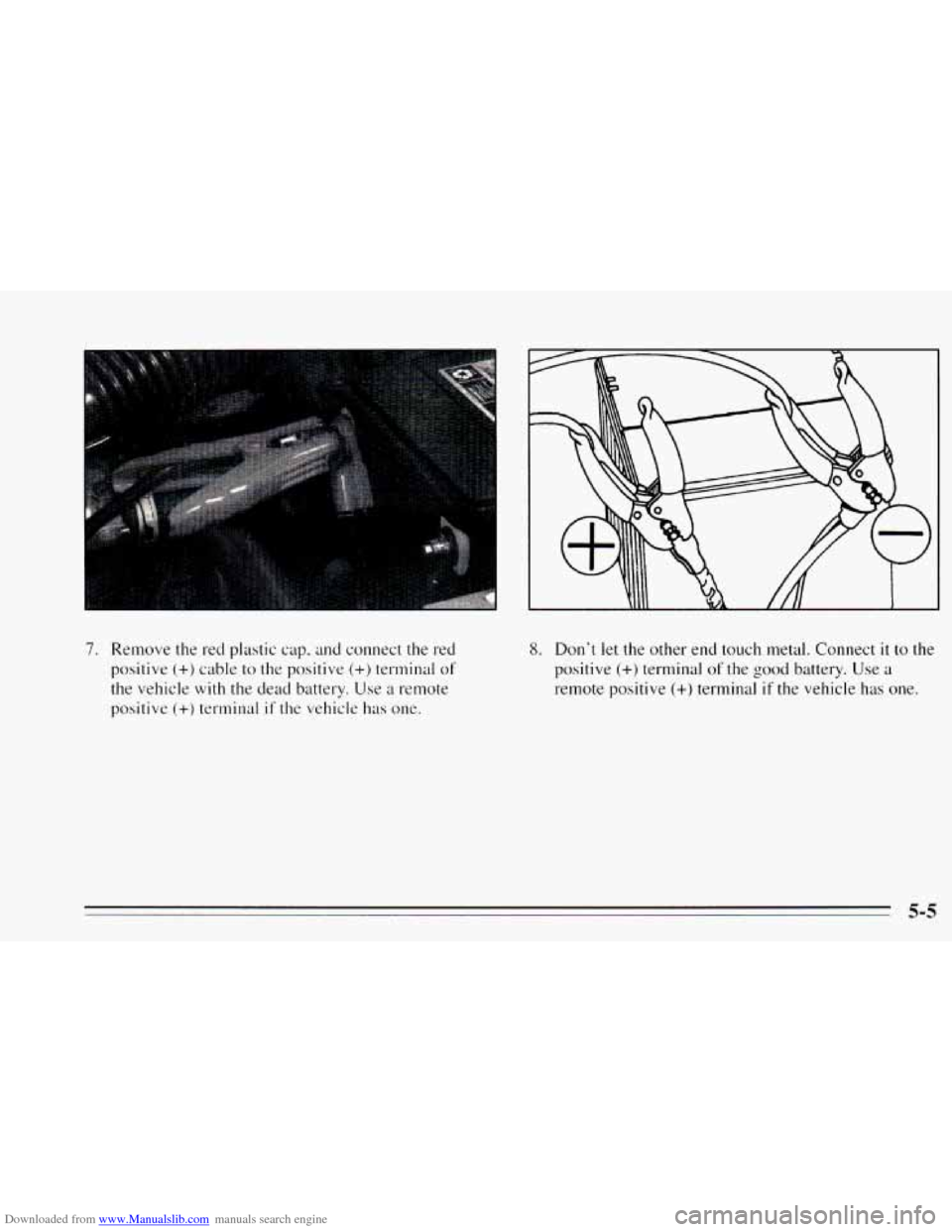
Downloaded from www.Manualslib.com manuals search engine 7. Remove the red plastic cap, and connect the red
positive
(+) cable to the positive (+) terminal of
the vehicle with the dead battery. Use a remote
positive
(+) terminal if the vehicle has one.
8. Don't let the other end touch metal. Connect It to the
positive
(+) terminal of the good battery. Use a
remote positive (+) terminal if the vehicle has one.
5-5
Page 182 of 340
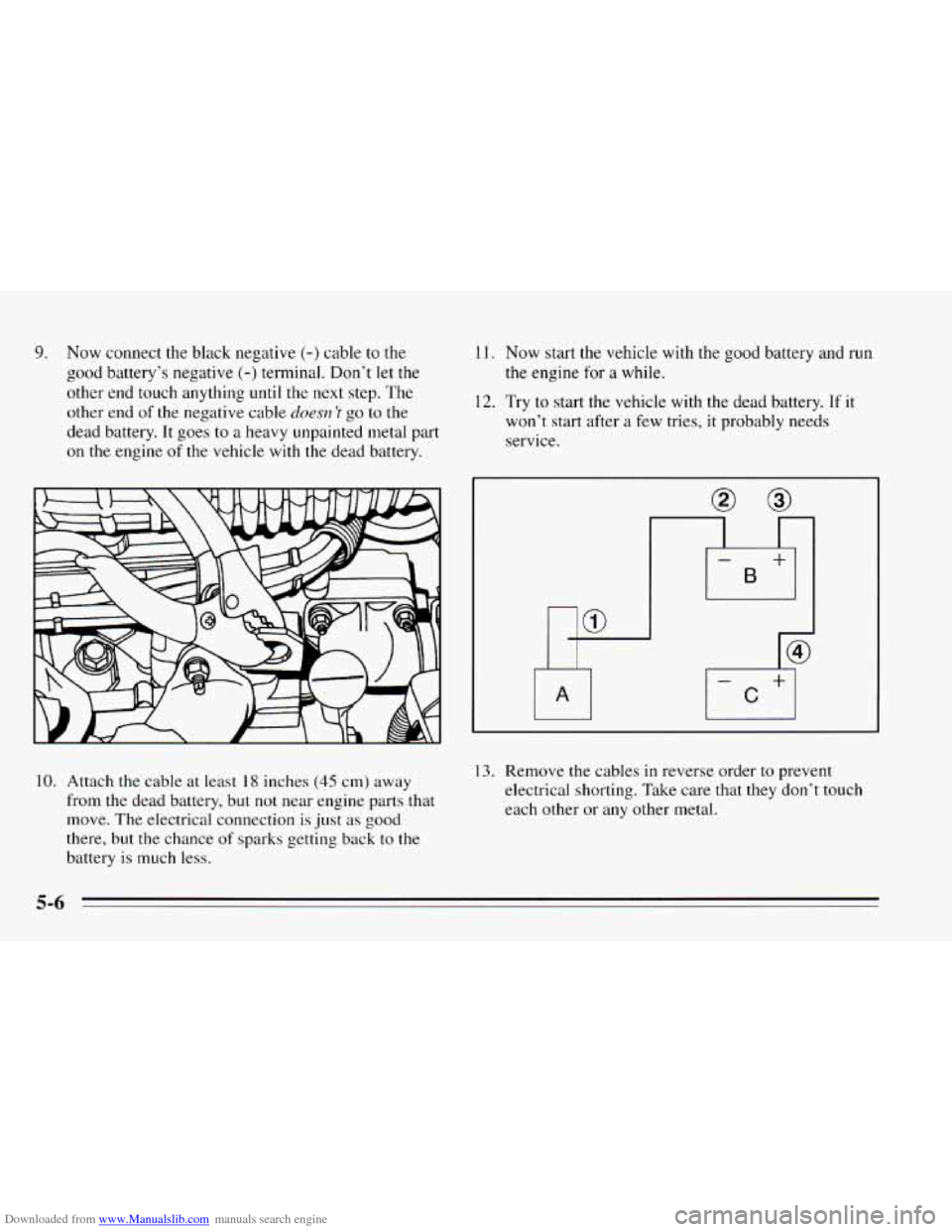
Downloaded from www.Manualslib.com manuals search engine 9. Now connect the black negative (-} cable to the
good battery’s negative (-) terminal. Don’t let the
other end touch anything until the next step. The
other end
of the negative cable doesrz ’t go to the
dead battery. It goes to
a heavy unpainted metal part
on the engine
of the vehicle with the dead battery.
11. Now start the vehicle with the good battery and run
the engine
for a while.
12. Try to start the vehicle with the dead battery. If it
won’t start after a few tries, it probably needs
service.
10. Attach the cable at least 18 inches (45 cm) away
from the dead battery, but not near engine parts that
move. The electrical connection is just
as good
there, but the chance of sparks getting back to the
battery
is much less.
13. Remove the cables in reverse order to prevent
electrical shorting. Take care that they don’t touch
each other or any other metal.
5-6
Page 212 of 340
Downloaded from www.Manualslib.com manuals search engine Before closing the hood, be sure all the filler caps are on
properly. Then lift the hood to relieve pressure
on the
hood prop. Remove the hood prop from the slot in the
hood and return
the prop to its retainer. Then just let the
hood down and close it firmly.
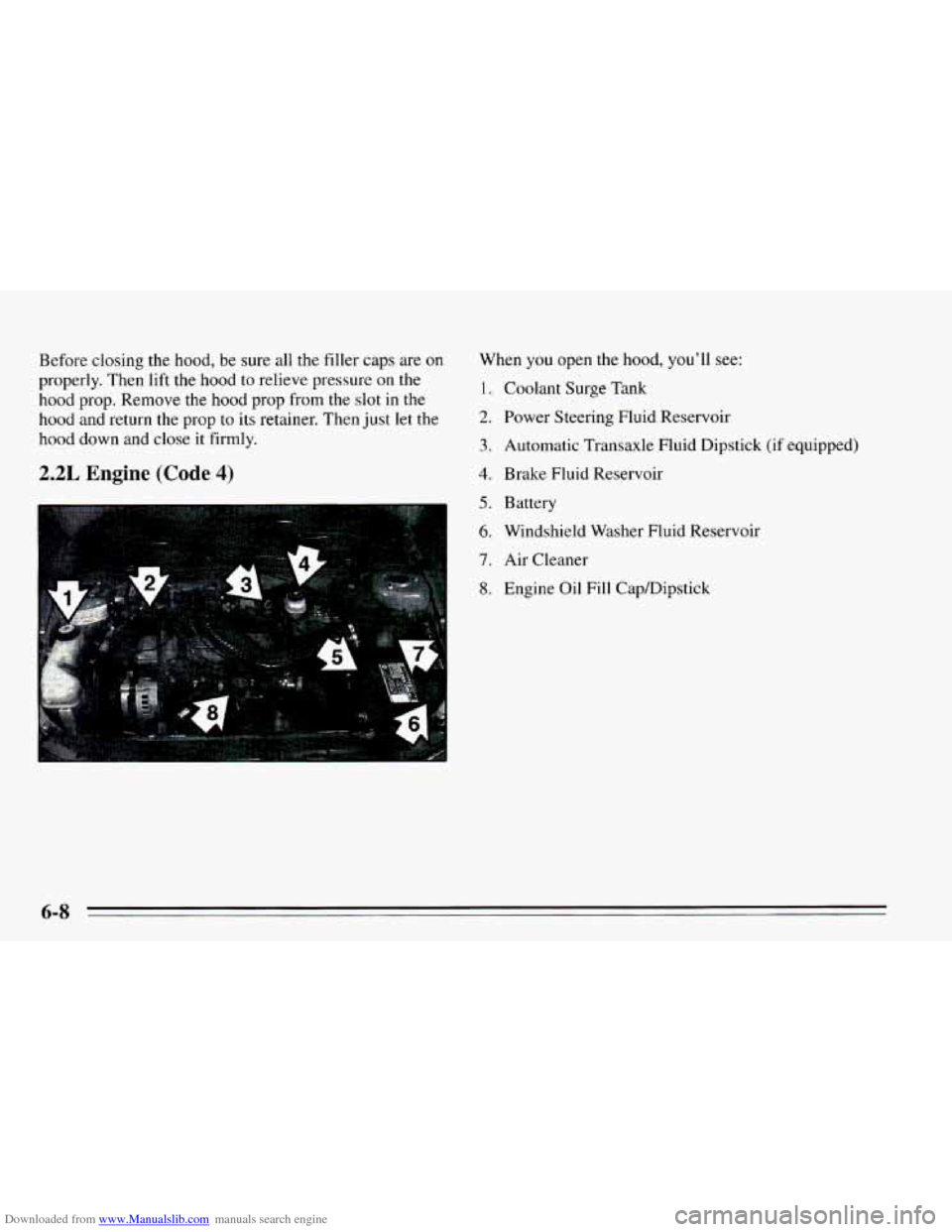
2.2L Engine (Code 4)
When you open the hood, you’ll see:
1. Coolant Surge Tank
2. Power Steering Fluid Reservoir
3. Automatic Transaxle Fluid Dipstick (if equipped)
4. Brake Fluid Reservoir
5. Battery
6. Windshield Washer Fluid Reservoir
7. Air Cleaner
8. Engine Oil Fill Capmipstick
Page 213 of 340
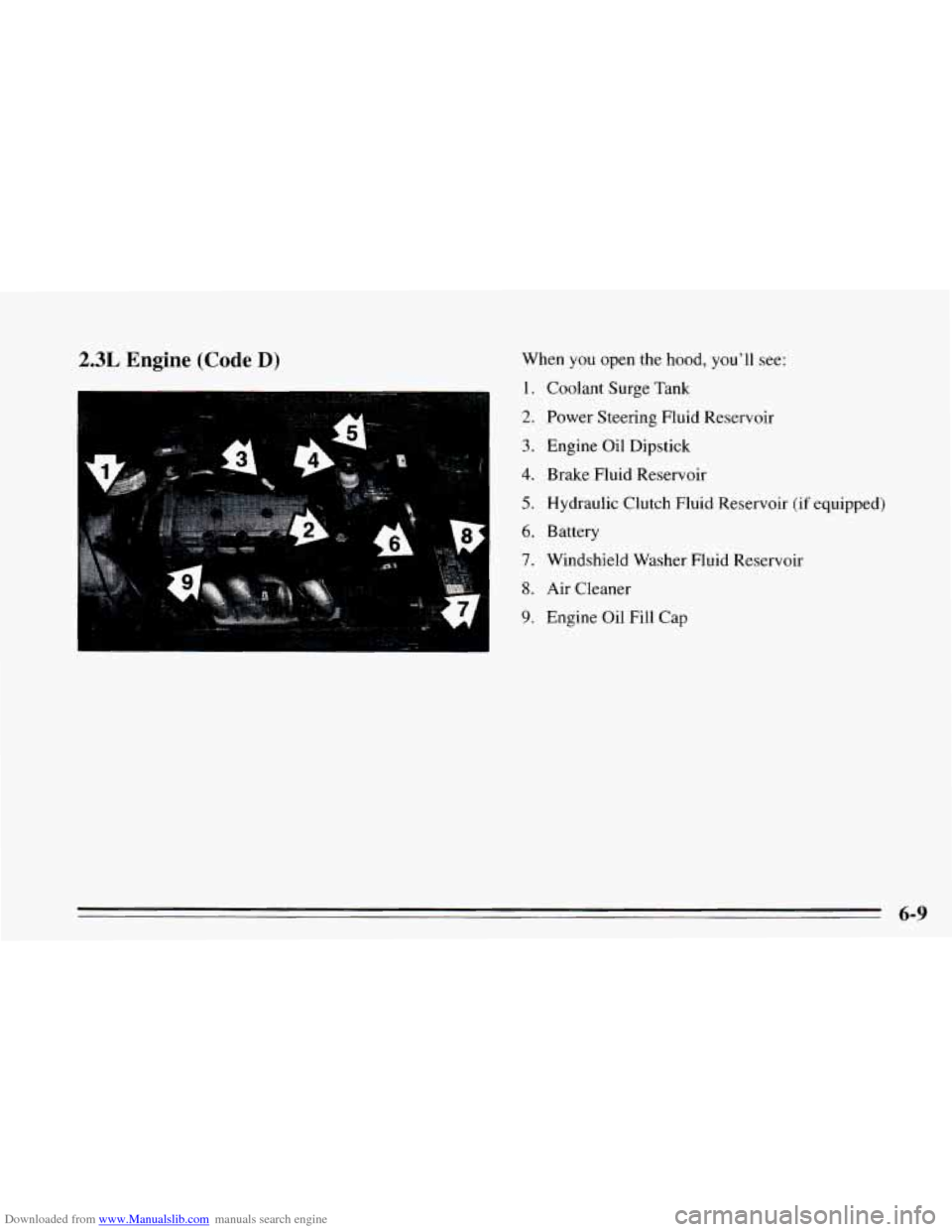
Downloaded from www.Manualslib.com manuals search engine 2.3L Engine (Code D) When you open the hood, you’ll see:
1.
2.
3.
4.
5.
6.
7.
8.
9.
Coolant Surge Tank
Power Steering Fluid Reservoir
Engine
Oil Dipstick
Brake Fluid Reservoir
Hydraulic Clutch Fluid Reservoir
(if equipped)
Battery
Windshield Washer Fluid Reservoir
Air Cleaner
Engine Oil Fill Cap
6-9
Page 233 of 340
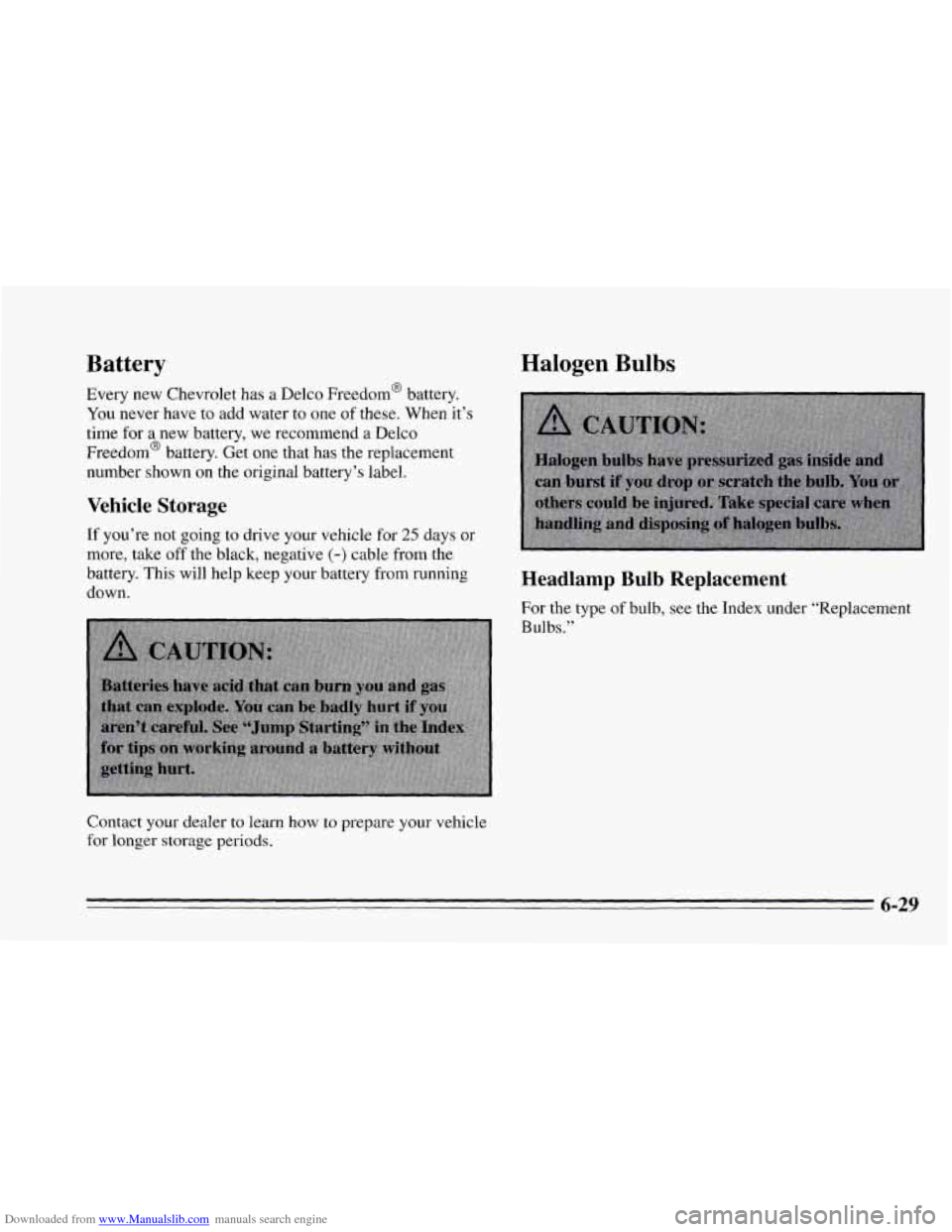
Downloaded from www.Manualslib.com manuals search engine Battery
Every new Chevrolet has a Delco Freedom@ battery.
You never have to add water to one of these. When it’s
time for
a new battery, we recommend a Delco
Freedom@ battery. Get one that has the replacement
number shown
on the original battery’s label.
Vehicle Storage
If you’re not going to drive your vehicle for 25 days or
more, take
off the black, negative (-) cable from the
battery. This will help keep your battery from running
down.
Contact your dealer to learn
how to prepare your vehicle
for longer storage periods.
Halogen Bulbs
Headlamp Bulb Replacement
For the type of bulb, see the Index under “Replacement
Bulbs.”
6-29