1995 CHEVROLET CAMARO wheel
[x] Cancel search: wheelPage 268 of 388
Downloaded from www.Manualslib.com manuals search engine What to Add
When you do need brake fluid, use only DOT-3 brake
fluid
-- such as Delco Supreme II@ (GM Part
No. 1052535). Use new brake fluid from a sealed
container only, and always clean the brake fluid
reservoir cap before removing it.
I NOTICE:
Don’t let someone put in the wrong kind of
fluid. For example, just a few drops of
mineral-based oil, such
as engine oil, in
your brake system can damage brake
system parts
so badly that they’ll have to be
replaced.
Brake fluid can damage paint, so be careful
not
to spill brake fluid on your vehicle. If
you do, wash it off immediately. See
“Appearance Care” in the Index.
Brake Wear
Unless you have the four-wheel disc brake option, your
Chevrolet has front disc brakes and rear
drum brakes.
Disc brake pads have built-in wear indicators that make
a
high-pitched warning sound when the brake pads are
worn and new pads are needed. The sound may come and
go or be heard all the time your vehicle is moving (except
when
you are pushing on the brake pedal firmly).
NOTICE:
Continuing to drive with worn-out brake pads
could result in costly brake repair.
6-36
Page 283 of 388
Downloaded from www.Manualslib.com manuals search engine When to Check
Check your tires once a month or more.
Don’t forget your compact spare tire. It should be at
60 psi (420 kPa).
DW to Check
use a good quality pocket-type gage to check tire
pressure. Simply looking at the tires will not tell you the
pressure, especially if you have radial tires
-- which
may look properly inflated even if they’re underinflated.
If your tires have valve caps, be sure to put them back
on. They help prevent leaks by keeping out dirt and
moisture.
Tire Inspection and Rotation
Tires should be inspected every 6,000 to 8,000 miles
(1 0 000 to 13 000 km) for any signs of unusual wear.
If unusual wear is present, rotate your tires as soon as
possible and check wheel alignment. Also check for
damaged tires or wheels. See “When it’s Time
for New Tires”
and “Wheel Replacement” later
in this section for
more information.
The purpose
of regular rotation is to achieve more
uniform wear for all tires on the vehicle. The first
rotation
is the most important. See “Scheduled
Maintenance Services”
in the Index for scheduled
rotation intervals.
-7 [*
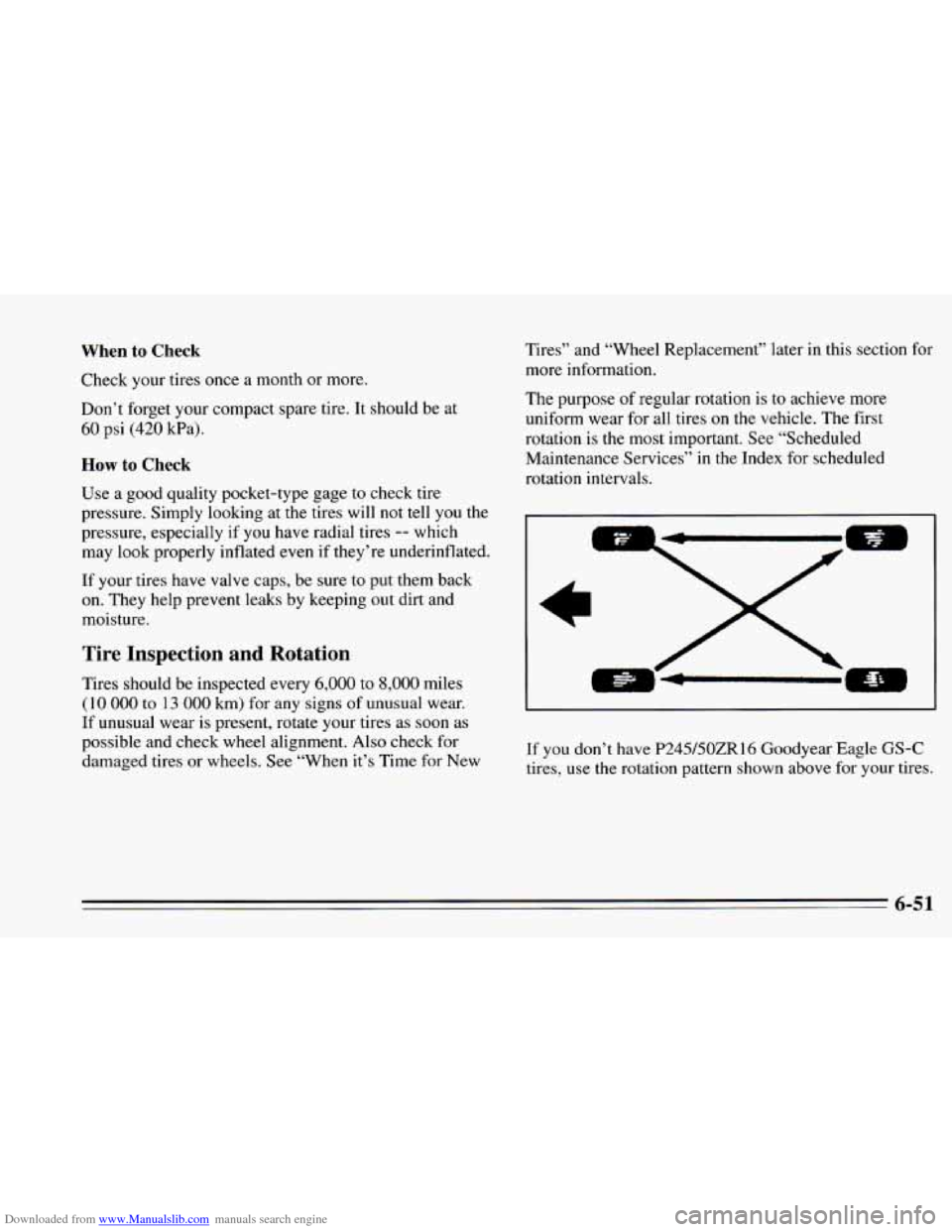
If you don’t have P245/5OZR16 Goodyear Eagle GS-C
ires, use the rotation pattern shown above for your tires.
6-51
Page 284 of 388
Downloaded from www.Manualslib.com manuals search engine LIJ
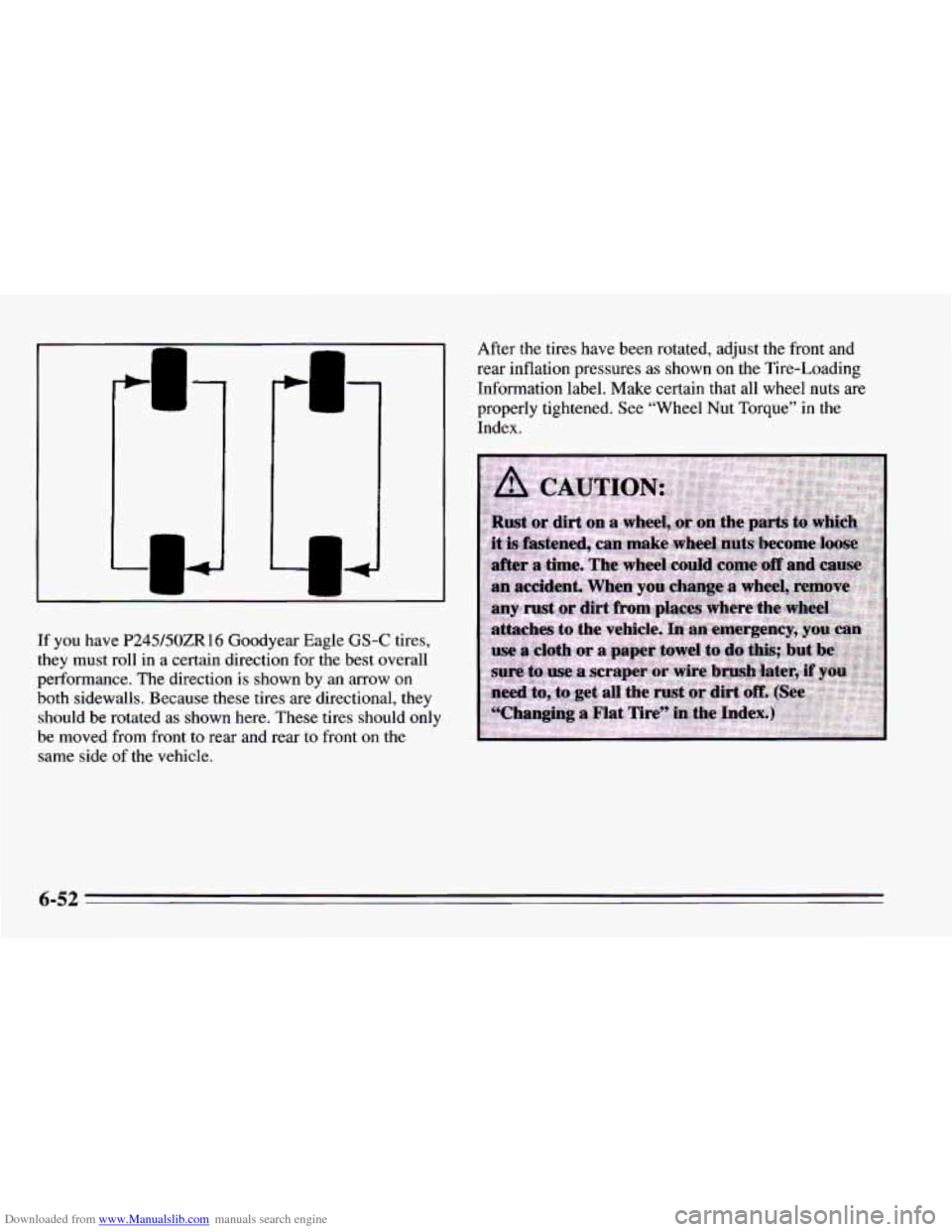
If you have P245/50ZR 16 Goodyear Eagle GS-C tires,
they must roll
in a certain direction for the best overall
performance. The direction
is shown by an arrow on
both sidewalls. Because these tires are directional, they
should be rotated as shown here. These tires should only
be moved from front to rear and rear to front on the
same side
of the vehicle. After the
tires
have been rotated, adjust the front and
rear inflation pressures as shown
on the Tire-Loading
Information label.
Make certain that all wheel nuts are
properly tightened. See “Wheel Nut Torque” in the
Index.
Page 287 of 388
Downloaded from www.Manualslib.com manuals search engine Temperature - A, B, C
The temperature grades are A (the highest), B, and C,
representing the tire’s resistance to the generation of
heat and its ability to dissipate heat when tested under
controlled conditions on a specified indoor laboratory
test wheel. Sustained high temperature can cause the
material of the tire to degenerate and reduce tire
life, and
excessive temperature can lead to sudden tire failure.
The grade
C corresponds to a level of performance
which all passenger car tires must meet under the
Federal Motor Vehicle Safety Standard
No. 109. Grades
B and A represent higher levels of performance on the
laboratory test wheel than the minimum required by law.
Warning: The temperature grade for this tire
is
established for a tire that is properly inflated and not
overloaded. Excessive speed, underinflation, or
excessive loading, either separately or in combination,
can cause heat buildup and possible tire failure.
These grades are molded
on the sidewalls of passenger
car tires. While
the tires available as standard or optional
equipment on General Motors vehicles may vary with
respect to these grades, all such tires meet General
Motors performance standards and have been approved
for use
on General Motors vehicles. All passenger type
(P Metric) tires must conform to Federal safety
requirements in addition to these grades.
Wheel Alignment and Tire Balance
The wheels on your vehicle were aligned and balanced
carefully at the factory to give you the longest tire life
and best overall performance.
In most cases, you will not
need to have your wheels
aligned again. However,
if you notice unusual tire wear
or your vehicle pulling one way or the other, the
alignment may need to be reset. If you notice your
vehicle vibrating when driving
on a smooth road, your
wheels may need to be rebalanced.
6-55
Page 288 of 388
Downloaded from www.Manualslib.com manuals search engine Wheel Replacement
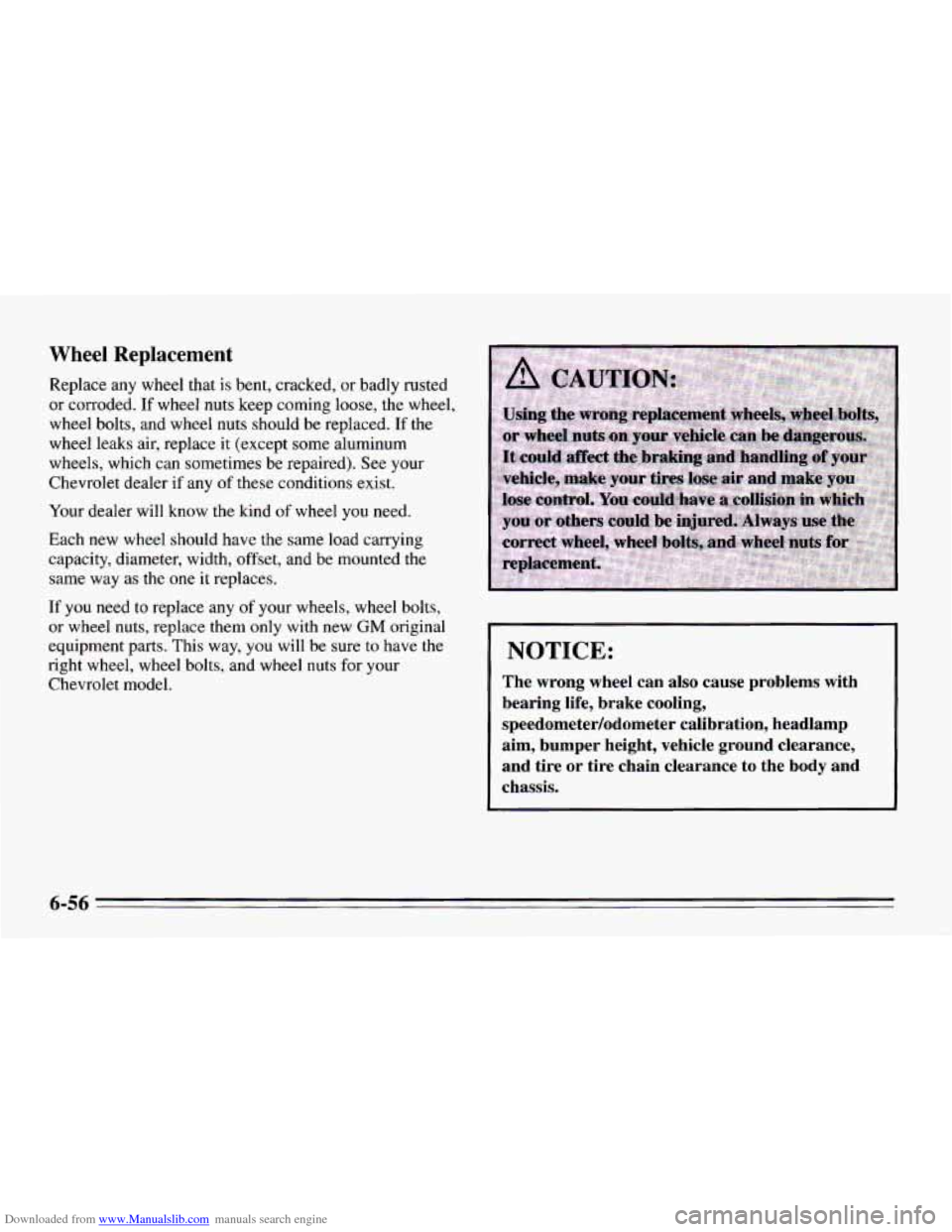
Replace any wheel that is bent, cracked, or badly rusted
or corroded. If wheel nuts keep coming loose, the wheel,
wheel bolts, and wheel nuts should be replaced. If the
wheel leaks air, replace it (except some aluminum
wheels, which can sometimes be repaired). See your
Chevrolet dealer if any
of these conditions exist.
Your dealer will know the kind
of wheel you need.
Each new wheel should have the same load carrying
capacity, diameter, width, offset, and be mounted the
same way as the one it replaces.
If you need
to replace any of your wheels, wheel bolts,
or wheel
nuts, replace them only with new GM original
equipment parts. This way,
you will be sure to have the
right wheel, wheel bolts, and wheel nuts
for your
Chevrolet model. I NOTICE:
The wrong wheel can also cause problems with
bearing life, brake cooling,
speedometerlodometer calibration, headlamp
aim, bumper height, vehicle ground clearance,
I and tire or tire chain clearance to the body and
chassis.
6-56
Page 289 of 388
Downloaded from www.Manualslib.com manuals search engine Used Replacement Wheels Tire Chains
NOTICE:
If your Chevrolet has P235/55R16 or
P245150ZRl6 size tires, don’t use tire chains;
they can damage your vehicle.
If you have other tires, use tire chains only where
legal and only when you must. Use only
SAE
Class “S” type chains that are the proper size for
your tires. Install them on the rear tires and
tighten them
as tightly as possible with the ends
securely fastened. Drive slowly and follow the
chain manufacturer’s instructions.
If you can
hear the chains contacting your vehicle, stop and
retighten them.
If the contact continues, slow
down until
it stops. Driving too fast or spinning
the wheels with chains on will damage your
vehicle.
6-57
Page 296 of 388
Downloaded from www.Manualslib.com manuals search engine Cleaning Your Convertible Top
Your convertible top should be cleaned often. If you use
an automatic car wash, use one with water jets and
hanging cloths.
When
you hand wash the top, do it in partial shade.
Vacuum away any dust and other material. Use a mild
soap, lukewarm water and a soft sponge.
A chamois or
cloth may leave
lint on the top, and a brush can chafe
the threads in the top fabric. Don’t use detergents, harsh
cleaners, solvents or bleaching agents.
When you clean the top, put
one hand under it to
support it. Wet the entire vehicle and wash the top
evenly to avoid spots or rings. Let
the soap remain on
the fabric for a few minutes. When the top is really dirty,
use a mild foam-type cleaner. Thoroughly rinse the
entire vehicle,
then let the top dry in direct sunlight.
To protect the convertible top:
After you wash the vehicle, make sure the top is
Don’t get any cleaner on the vehicle’s painted finish;
completely dry
before
you lower it.
it could leave streaks.
If you decide to go through an automatic car wash,
ask
the manager if the equipment could damage your
top.
Aluminum Wheels (If So Equipped)
Your aluminum wheels have a protective coating similar
to the painted surface
of your car. Don’t use strong
soaps, chemicals, chrome polish, abrasive cleaners or
abrasive cleaning brushes
on them because you could
damage this coating. After rinsing thoroughly,
a wax
may be applied.
I
I NOTICE:
If you have aluminum wheels, don’t use an
automatic car wash that has hard silicon carbide
cleaning brushes. These brushes can take the
protective coating
off your aluminum wheels.
Tires
To clean your tires, use a stiff brush with a tire cleaner.
When applying a tire dressing always take care
to wipe
off any overspray or splash from painted surfaces.
Petroleum-based products may damage
the paint finish.
6-64
Page 306 of 388

Downloaded from www.Manualslib.com manuals search engine Capacities and Specifications
Engine
Type VIN Engine Code
S and K ................... V6
VIN Engine Code
P ........................ V8
Fuel Delivery
...................... Fuel Injection
Valve Arrangement
...................... In-Head
Piston Displacement
VIN Engine Code
S .............. 207 CID (3.4L)
VIN Engine Code
K .............. 23 1 CID (3.8L)
VIN Engine Code
P .............. 350 CID (5.7L)
VIN Engine Code
S and K ................. 9.0: I
VIN Engine Code P ..................... 10.5: 1
VIN Engine Code S and K ........... 1-6-5-4-3-2
VIN Engine Code
P ............ 1-8-4-3-6-5-7-2
Compression Ratio
Firing Order
Wheel Nuts
Wheel Nut Torque ... 100
Ib. ft. (I 40 N-m)
Capacities (Approximate)
The following approximate capacities are given in U.S.
and metric conversions.
Air Conditioning?
..... See the refrigerant information
label under the hood.
Automatic Transmission
Drain and Refill
.................. IO pt. (4.7 L)*
VIN Engine Code S and K . . , . . , . . 17.6 pt. (8.3 L)*
VIN Engine Code P ............ 2 1.6 pt. (1 0.2 L)*
VIN Engine Code S
Overhaul
Cooling System
With Manual Transmission
...... 12.5 qt. (1 1.8 L)
With Automatic Transmission
, . . , 12.3 qt. (1 1.6 L)
With Manual Transmission
...... 12.5 qt. (1 1.8 L)
With Automatic Transmission .... 12.3 qt. (1 I .6 L)
With Manual Transmission ...... 15.3 qt. (14.5 L)
With Automatic Transmission
.... 15.1 qt. (14.3 L)
VIN
Engine Code
K
VIN Engine Code P
6-74