Page 100 of 388

Downloaded from www.Manualslib.com manuals search engine Brightness Control
This switch controls the brightness of your
instrument panel lights. Turn the switch to brighten or
dim the lamps.
If you turn the switch all the way up,
your courtesy lamps will come on.
Daytime Running Lamps (Canada)
Daytime Running Lamps (DRL) make it easier to see
the front
of your vehicle during the day. DRL can be
helpful when it’s raining and in the short periods after
dawn and before sunset.
A light sensor on top of the instrument panel makes the
DRL work,
so be sure it isn’t covered.
The DRL system will make your front turn signal lamps
come on
when:
0 The ignition is on
The headlamp switch is off, and
0 The parking brake is released.
When the DRL are on,
only your front turn signal lamps
will be on. The taillamps, sidemarker
and other lamps
won’t be
on. Your instrument panel won’t be lit up either.
When
it’s dark enough outside, your front turn signal
lamps will go
out and your headlamps will come on.
The other lamps that come on with your headlamps will
also come
on.
When it’s bright enough outside, the regular lamps will
go off, and your front turn signal lamps come on.
As with any vehicle, you should turn on the regular
headlamp system any time you need
it.
2-48
Page 101 of 388
Downloaded from www.Manualslib.com manuals search engine Fog Lamps (Option)
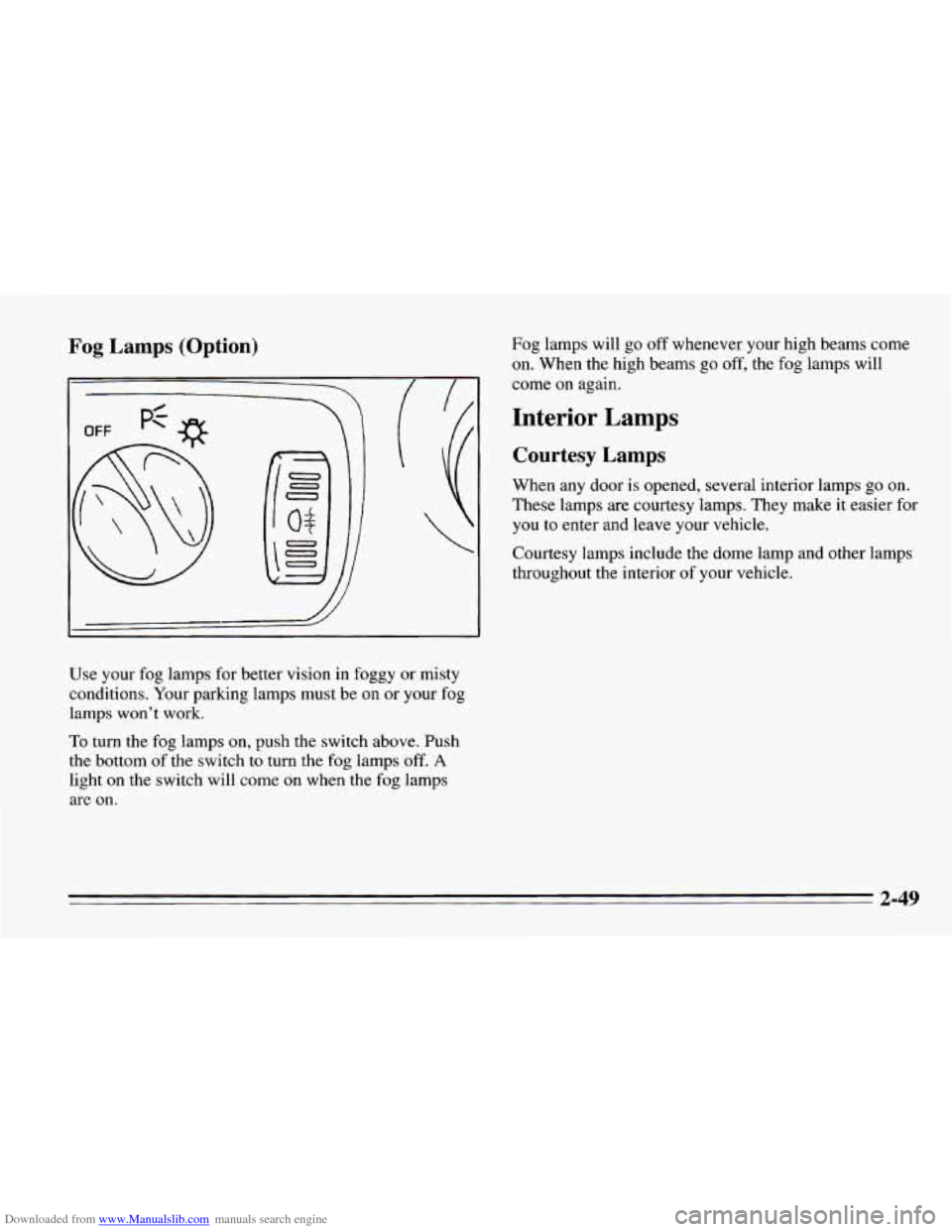
Use your fog lamps for better vision in foggy or misty
conditions. Your parking lamps must be on or your fog
lamps won’t
work.
To turn the fog lamps on, push the switch above. Push
the bottom of the switch
to turn the fog lamps off. A
light on the switch will come on when the fog lamps
are
on.
Fog lamps will go off whenever your high beams come
on. When the high beams go off, the
fog lamps will
come
on again.
Interior Lamps
Courtesy Lamps
When any door is opened, several interior lamps go on.
These lamps are courtesy lamps. They make it easier for
you
to enter and leave your vehicle.
Courtesy lamps include the dome lamp and other lamps
throughout the interior
of your vehicle.
2-49
Page 109 of 388
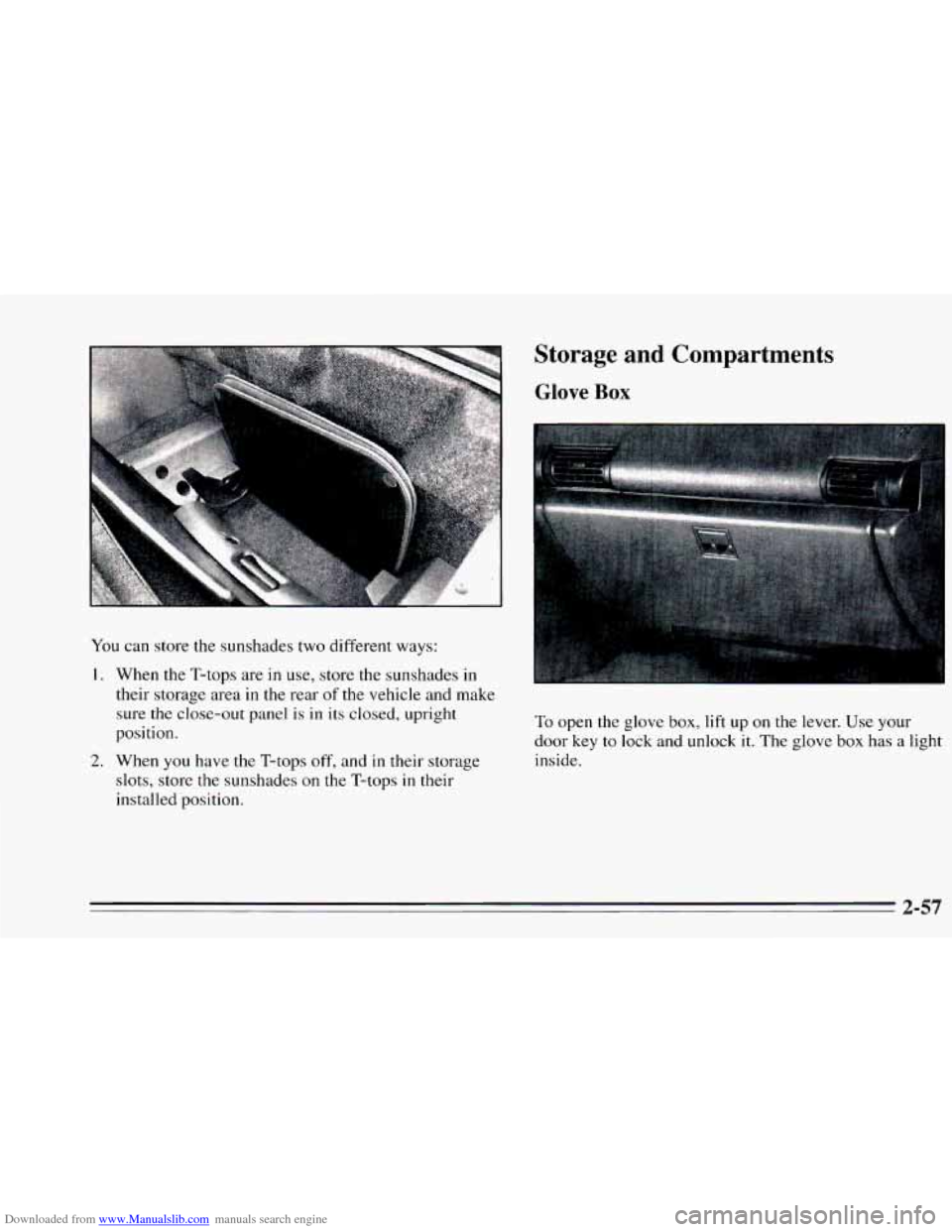
Downloaded from www.Manualslib.com manuals search engine You can store the sunshades two different ways:
1. When the T-tops are in use, store the sunshades in
their storage area in the rear
of the vehicle and make
sure
the close-out panel is in its closed, upright
position.
2. When you have the T-tops off, and in their storage
slots, store the sunshades
on the T-tops in their
installed position.
Storage and Compartments
Glove Box
To open the glove box, lift up on the lever. Use your
door
key to lock and unlock it. The glove box has a light
inside.
2-57
Page 114 of 388
Downloaded from www.Manualslib.com manuals search engine Sun Visors
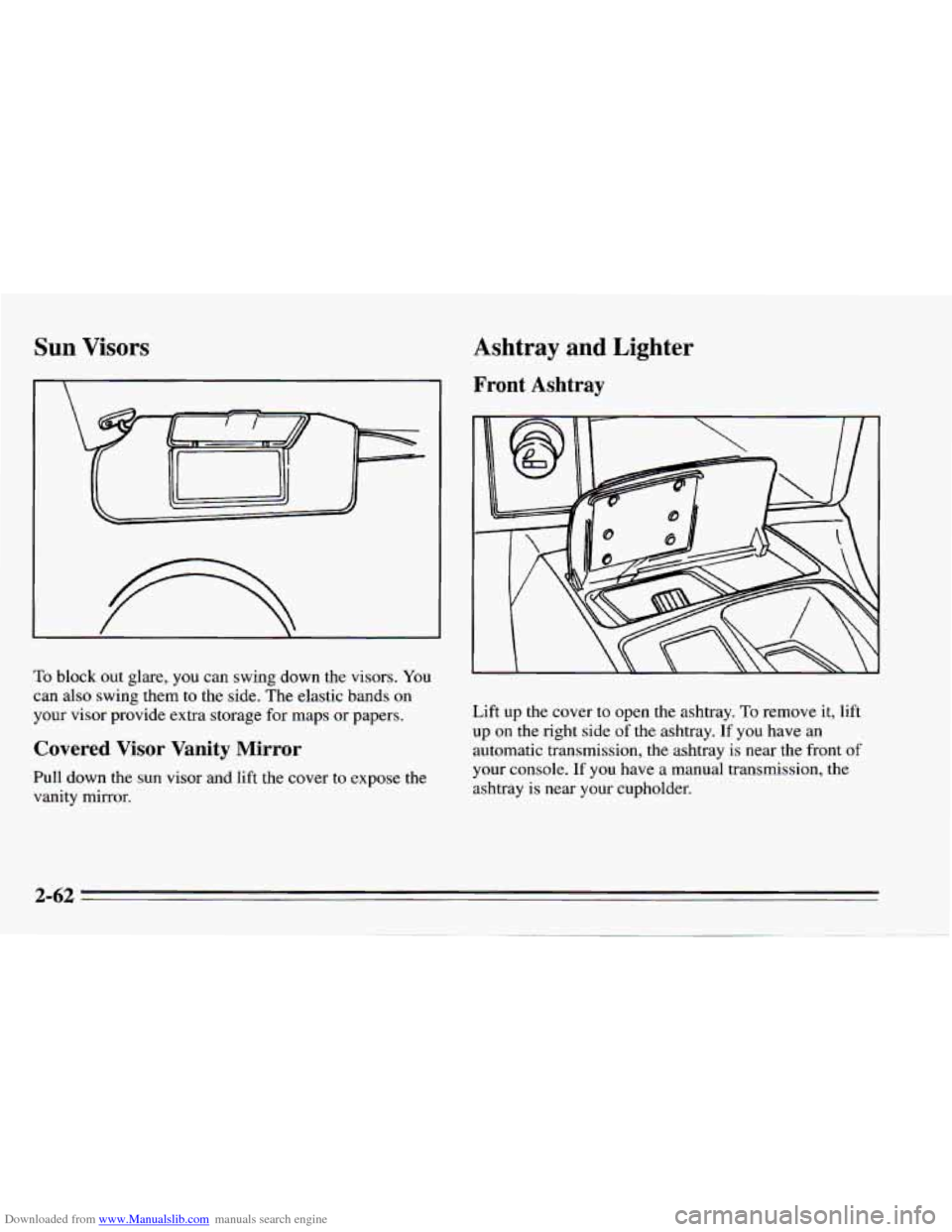
To block out glare, you can swing down the visors. You
can also swing them
to the side. The elastic bands on
your visor provide extra storage for maps or papers.
Covered Visor Vanity Mirror
Pull down the sun visor and lift the cover to expose the
vanity mirror.
Ashtray and Lighter
Front Ashtray
Lift up the cover to open the ashtray. To remove it, lift
up
on the right side of the ashtray. If you have an
automatic transmission, the ashtray is near the front
of
your console. If you have a manual transmission, the
ashtray is near your cupholder.
2-62
Page 115 of 388
Downloaded from www.Manualslib.com manuals search engine NOTICE:
Don’t put papers and other things that burn into
your ashtrays.
If you do, cigarettes or other
smoking materials could set them on fire, causing
damage.
Cigarette Lighter
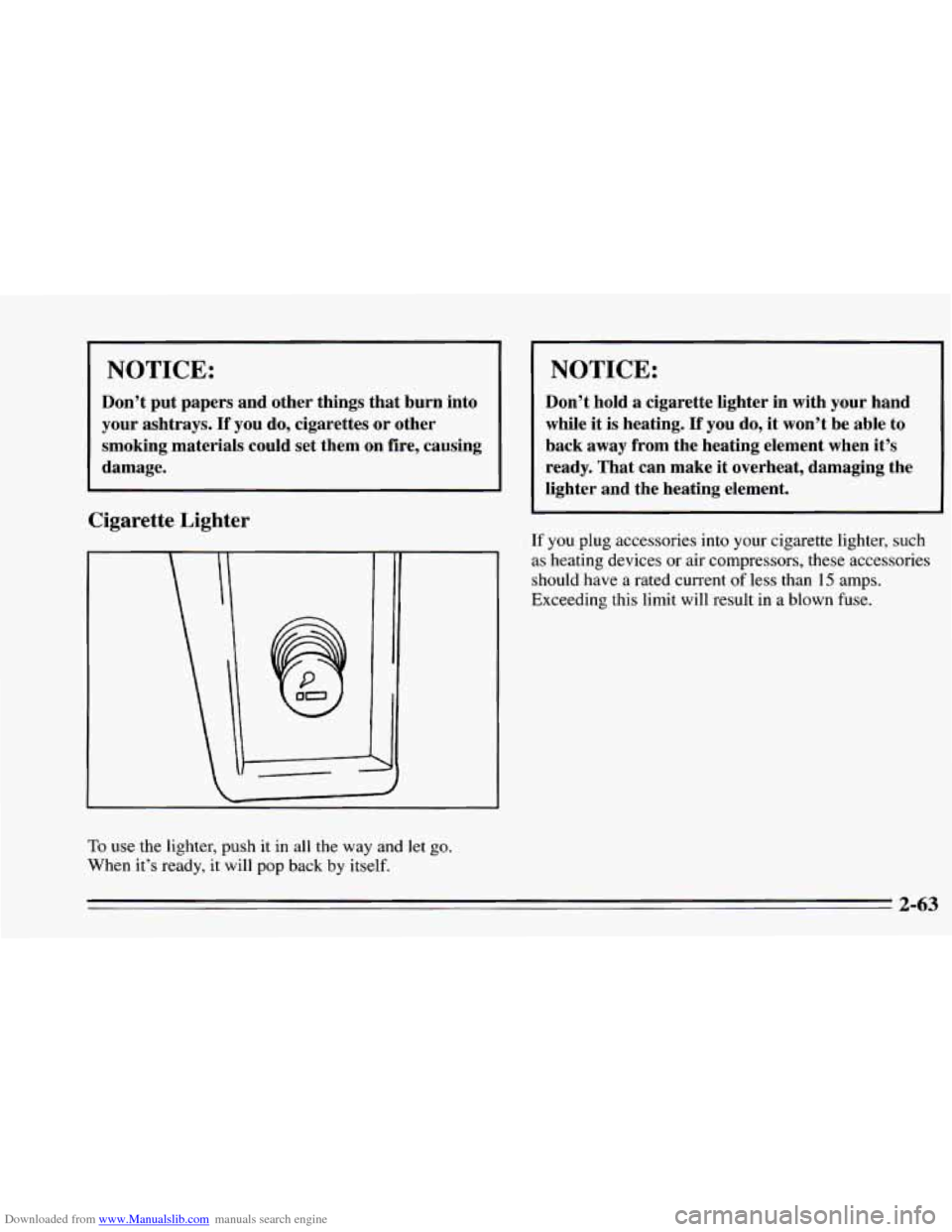
To use the lighter, push it in all the way and let go.
When it’s ready, it will pop back by itself.
I NOTICE:
Don’t hold a cigarette lighter in with your hand
while it
is heating. If you do, it won’t be able to
back away from the heating element when it’s
ready. That can make it overheat, damaging the
lighter and the heating element.
If you plug accessories into your cigarette lighter, such
as heating devices or air compressors, these accessories
should have a rated current
of less than 15 amps.
Exceeding this limit will result
in a blown fuse.
2-63
Page 117 of 388
Downloaded from www.Manualslib.com manuals search engine 1. Upper Air Vent
2. Main Light Control
3. Side Upper Air Vent
4. Instrument Cluster
5. Comfort Controls
6. Audio System
7. Side Window Defogger Vent
8. Glove
Box
9. Remote Hatch Release
10. Cassette Tape Storage
11. Shift Lever
12. Parking Brake Lever 13.
Cupholder
14. Storage Console and Compact Disc Storage (if
equipped)
15. Acceleration Slip Regulation Switch (if equipped)
16. Ashtray (Automatic Transmission)
17. Cigarette Lighter
18.
Horn
19. Rear Window Defogger Switch
20. Fog Lamp Switch (if equipped)
2 1. Convertible Top Switch (if equipped)
22. Ashtray (Manual Transmission)
2-65
Page 119 of 388
Downloaded from www.Manualslib.com manuals search engine Speedometer and Odometer
Your speedometer lets you see your speed in both miles
per hour (mph) and kilometers per hour
(km/h). Your
odometer shows how far your vehicle has been driven,
in either miles (used in the
US.) or kilometers (used in
Canada).
Your Chevrolet’s odometer is tamper-resistant, If you
can see silver lines between
the numbers, probably
someone has tried to turn it back. The numbers may not
be true.
You may wonder what happens if your Chevrolet needs
a new odometer installed. If possible, the new one has to
be set to the same reading the old one had.
If it can’t be,
then it’s set at zero, but a label on the driver’s door must
show the old reading and when
the new one was
installed.
Trip Odometer
The trip odometer can tell you how far your car has been
driven since you last set the trip odometer to zero.
To set the trip odometer to zero, press the knob.
Tachometer
The tachometer displays the engine speed in thousands
of revolutions per minute (rpm).
I NOTICE:
I
Do not operate the engine with the tachometer in
the red area, or engine damage may occur.
I
Warning Lights, Gages and Indicators
Warning lights and gages can signal that something is
wrong before
it becomes serious enough to cause an
expensive repair or replacement. Paying attention to
your warning lights and gages could also save you or
others from injury.
2-67
Page 120 of 388

Downloaded from www.Manualslib.com manuals search engine Warning lights come on when there may be or is a
problem with
one of your vehicle’s functions. As you
will see in the details on the next few pages, some
warning lights come on briefly when you start the
engine just to let you know they’re working. If
you are
familiar with this section, you should not be alarmed
when this happens.
Gages can indicate when there may be
or is a problem
with one of your vehicle’s functions. Often gages and
warning lights work together to let you know when
there’s a problem with your vehicle.
When
one of the warning lights comes on and stays on
when
you are driving, or when one of the gages shows
there may be
a problem, check the section that tells you
what to do about it. Please follow this manual’s advice.
Waiting to do repairs can be costly
-- and even
dangerous.
So please get to know your warning lights
and gages. They’re a
big help.
Safety Belt Reminder Light
When the key is turned to RUN or START, a tone will
come
on for about eight seconds to remind people to
fasten their safety belts, unless the driver’s safety belt is
already buckled. The safety belt light will also come
on
and stay on until the driver’s belt is buckled.
2-68