Page 67 of 388
Downloaded from www.Manualslib.com manuals search engine If you have an automatic transmission, the ignition
switch can’t be turned to
LOCK unless the shift lever is
in the PARK (P) position.
OFF (C): Unlocks the steering wheel, ignition and
automatic transmission, but does not send electrical
power to any accessories. Use this position if your
vehicle must be pushed or towed. A warning tone will
sound if you open the driver’s door when the ignition is
in
OFF and the key is in the ignition.
RUN (D): Position to which the switch returns after you
start your engine and release the switch. The switch
stays in the
RUN position when the engine is running.
But even when the engine is not running, you can use
RUN to operate your electrical power accessories and to
display some instrument panel warning and indicator
lights.
START (E): Starts the engine. When the engine starts,
release the key. The ignition switch
will return to RUN
for normal driving.
Note that even if the engine is not running, ACC and
RUN allow you to operate your electrical accessories,
such as the radio and ventilation fan.
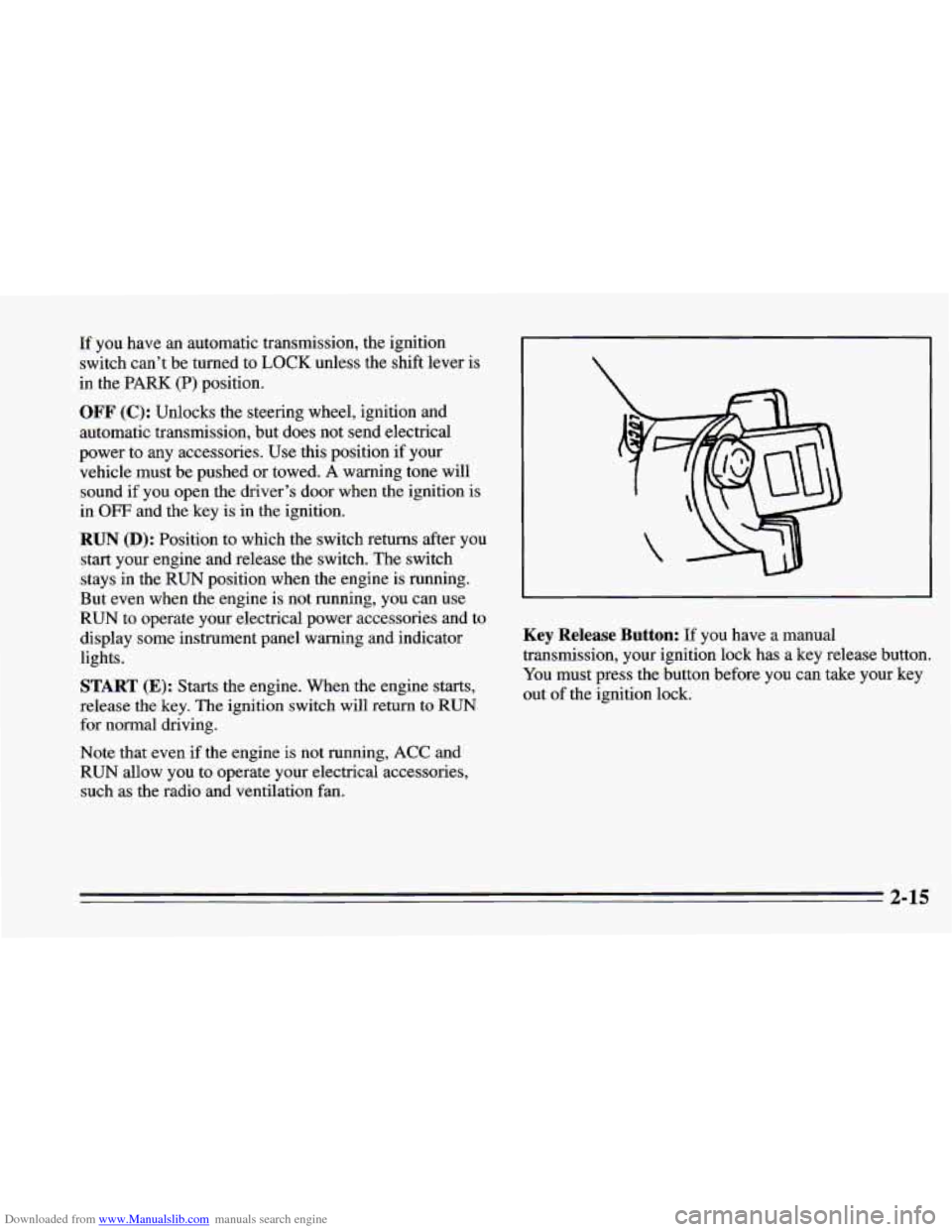
Key Release Button: If you have a manual
transmission, your ignition lock has a key release button.
You must press the button before you can take your key
out
of the ignition lock.
2-15
Page 71 of 388

Downloaded from www.Manualslib.com manuals search engine 2. If your engine still won’t start (or starts but then
stops), it could be flooded with too much gasoline.
Try pushing your accelerator pedal all the way to the
floor and holding it there as
you hold the key in
START
for about three seconds. If the car starts
briefly but then stops again,
do the same thing, but
this time keep the pedal down
for five or six seconds.
This clears the extra gasoline from the engine.
NOTICE:
Your engine is designed to work with the
electronics in your vehicle. If you add electrical
parts or accessories, you could change the
way
the fuel injection system operates. Before adding
electrical equipment, check with your dealer.
If
you don’t, your engine might not perform
properly.
If you ever have to have your vehicle towed, see
the part of this manual that tells how to do it
without damaging your vehicle. See “Towing
Your Car” in the Index.
Driving Through Deep Standing
Water
NOTICE:
If you drive too quickly through deep puddles or
standing water, water can come in through your
engine’s
air intake and badly damage your
engine. Never drive through water that
is slightly
lower than the underbody of your vehicle.
If you
can’t avoid deep puddles or standing water, drive
through them very slowly.
2-19
Page 79 of 388
Downloaded from www.Manualslib.com manuals search engine REVERSE (R): To back up, press down the clutch
pedal and shift into REVERSE
(R). Let up on the clutch
pedal slowly while pressing the accelerator pedal. If you
shift from SIXTH
(6) into REVERSE (R) the shift lever
must be first placed in the NEUTRAL
(N) position
centered between SECOND
(2) and THIRD (3) prior to
shifting into REVERSE (R).
Your 6-speed manual transmission has a feature that
allows you to safely shift into
REVERSE (R) while the
vehicle
is rolling (at less than 5 mph). You will be
“locked-out” if you try to shift into REVERSE
(R)
while your vehicle is moving faster than 5 mph.
If you have turned your ignition off and wish to park
your car in REVERSE
(R), you will have to move the
shift lever quickly to the right, “crashing” through the
high load spring and then into gear.
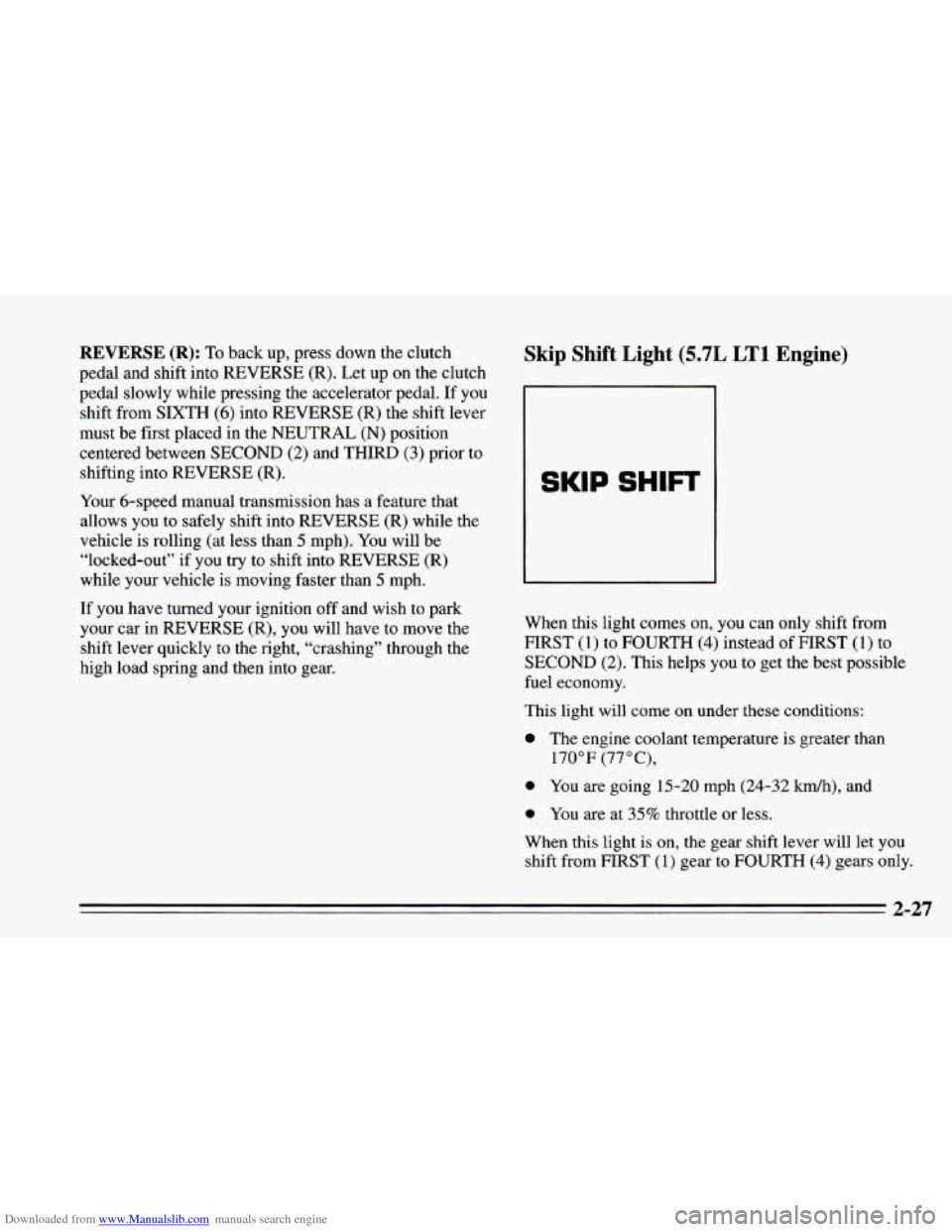
Skip Shift Light (5.7L LTl Engine)
When this light comes on, you can only shift from
FIRST
(1) to FOURTH (4) instead of F’IRST (1) to
SECOND (2). This helps you to get the best possible
fuel economy.
This light will
come on under these conditions:
The engine coolant temperature is greater than
0 You are going 15-20 mph (24-32 kmh), and
0 You are at 35% throttle or less.
170°F (77”C),
When this light
is on, the gear shift lever will let you
shift from FIRST
(1) gear to FOURTH (4) gears only.
2-27
Page 80 of 388
Downloaded from www.Manualslib.com manuals search engine Once you are in FOURTH (4), you can press the clutch
again
and shift into another gear.
Follow the shift speeds on
this chart when the ‘‘SKIP
SHIFT” light is on.
Computer Aided Manual Transmission Shift Speeds:
1st to 4th. . . . . . . 15 mph (24 km/h)
4th to 5th . . . . . . 25 mph (40 km/h)*
5th to 6th . . . . . . 40 mph (64 km/h)**
Each time you come to a stop, the engine’s Electronic
Control Module (ECM) determines when to activate the
“SKIP SHIFT” upshift system. Use SECOND (2) gear
only when you accelerate very quickly from a stop. You
can then follow the full gear shift pattern.
*30 mph (48 km/h) when accelerating to highway
speeds.
**45 mph (72km/h) when accelerating to highway
speeds.
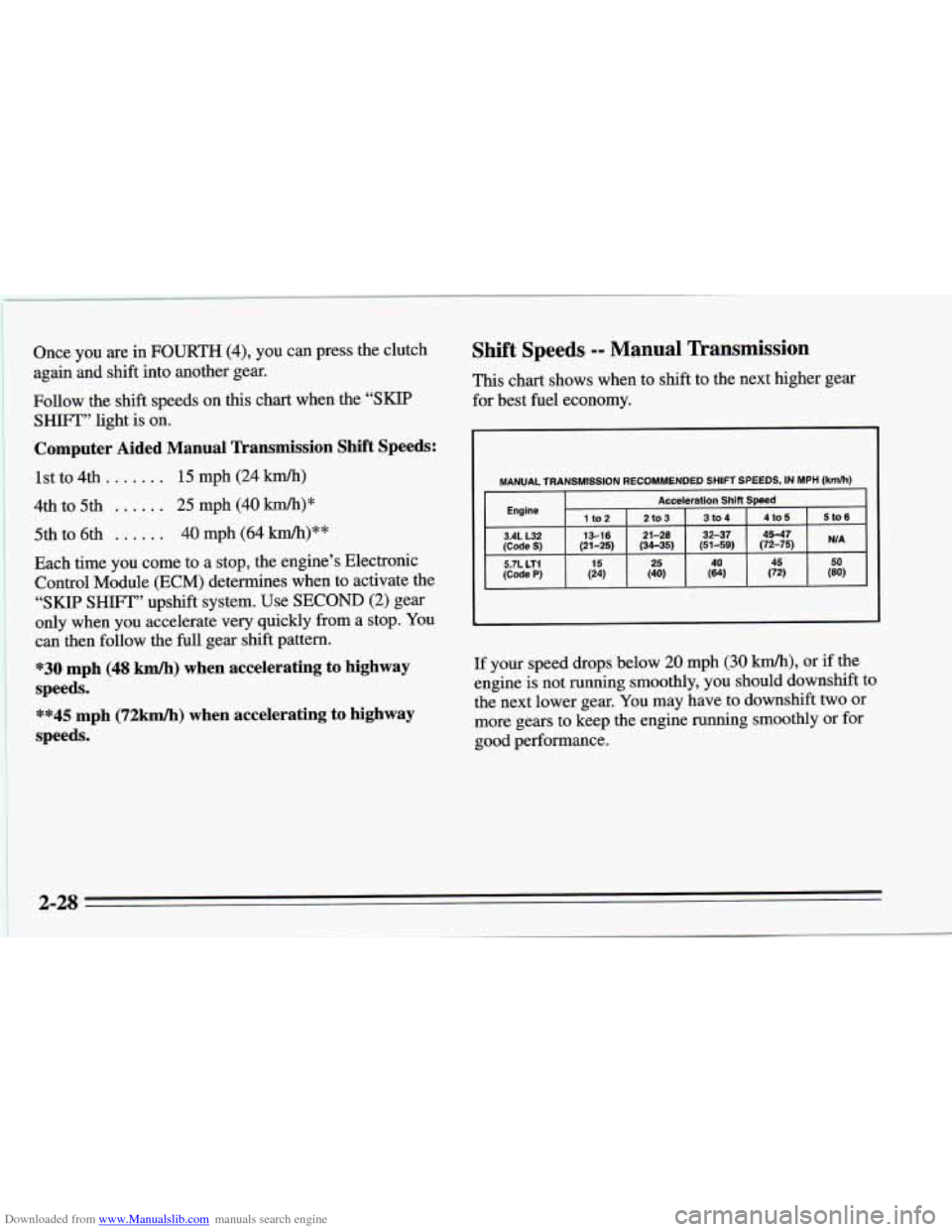
Shift Speeds -- Manual Transmission
This chart shows when to shift to the next higher gear
for best fuel economy.
MANUAL TRANSMISSION RECOMMENDED SHIFT SPEEDS, IN MPH (kmlh)
Acceleration Shift Speed Engine 1 to 2 2t03 3 to 4 4tO 5 5 to 6
3.4L L32 13-1 6 21-28 32-37 45-47 (Code S) (21-25) (34-35) (51-59) (72-75) NIA
If your speed drops below 20 mph (30 km/h), or if the
engine is not running smoothly, you should downshift to
the next lower gear. You may have to downshift two
or
more gears to keep the engine running smoothly or for
good performance.
2-28
~-
Page 81 of 388
Downloaded from www.Manualslib.com manuals search engine NOTICE:
If you skip more than one gear when you
downshift, or if you race the engine when you
downshift, you can damage the clutch or
transmission.
Limited-Slip Rear Axle
If you have this feature, your rear axle can give you
additional traction on snow, mud, ice, sand or gravel. It
works like a standard axle most
of the time, but when
one of the rear wheels has no traction and the other does,
the limited-slip feature will allow
the wheel with
traction to move the vehicle.
Parking
Parking Brake
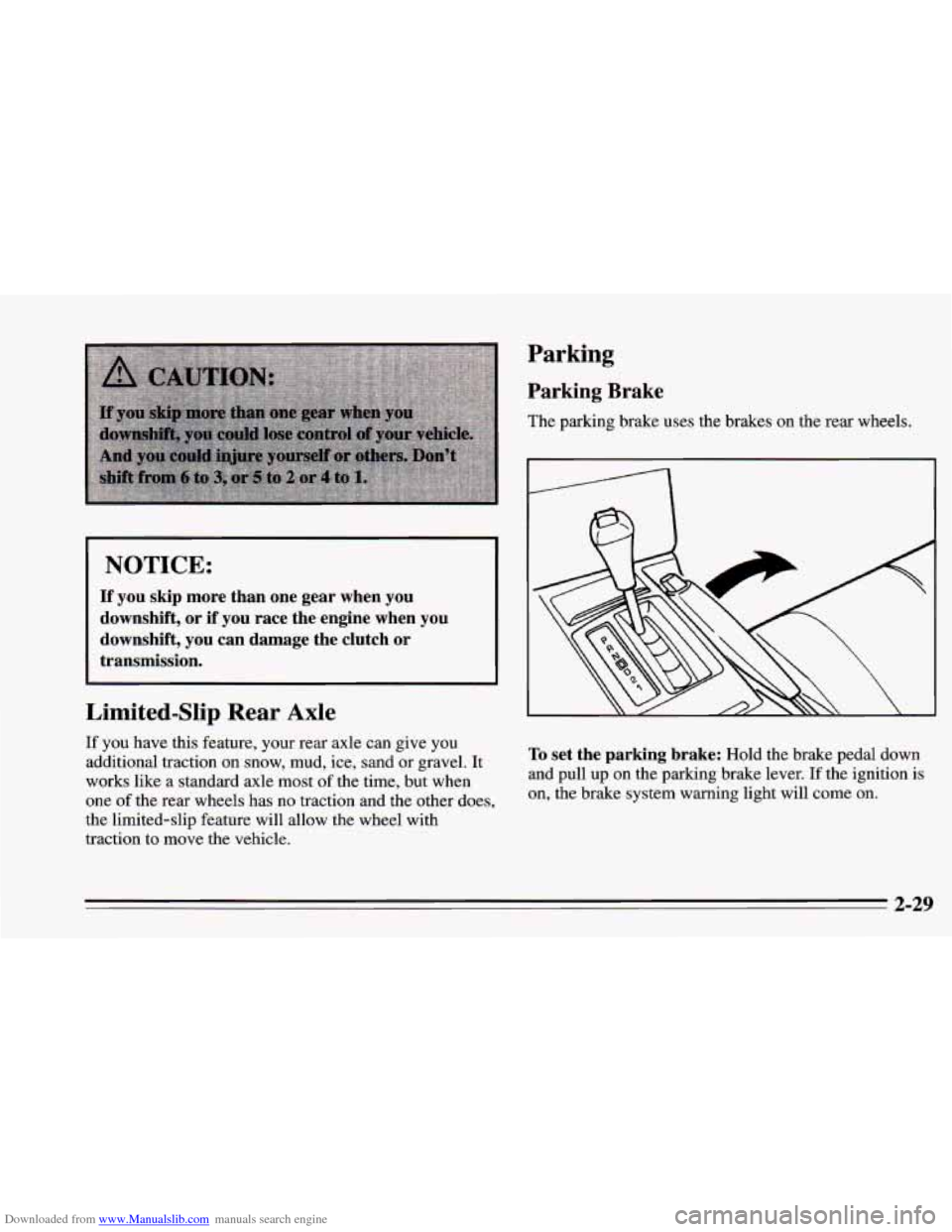
The parking brake uses the brakes on the rear wheels.
To set the parking brake: Hold the brake pedal down
and
pull up on the parking brake lever. If the ignition is
on, the brake system warning light will come on.
2-29
Page 91 of 388
Downloaded from www.Manualslib.com manuals search engine A green arrow on the
instrument panel will flash
in the direction of the turn
or lane change.
To signal a lane change, just raise or lower the lever
until the green arrow starts to flash. Hold it there until
you complete your lane change. The lever will return by
itself when you release it.
As you signal a turn or a lane change, if the arrows don’t
flash but just stay
on, a signal bulb may be burned out
and other drivers won’t see your turn signal.
If a bulb is burned out, replace it to help avoid an
accident.
If the green arrows don’t go on at all when you
signal a turn, check the fuse (see “Fuses” in the Index).
Headlamp High-Low Beam
To change the headlamps
from low beam to high or
high to low, pull the turn
signal lever all the way
toward
you. Then release it.
When the high beams are
on, this blue light on the
instrument panel also will
be
on.
2-39
Page 92 of 388
Downloaded from www.Manualslib.com manuals search engine Windshield Wipers
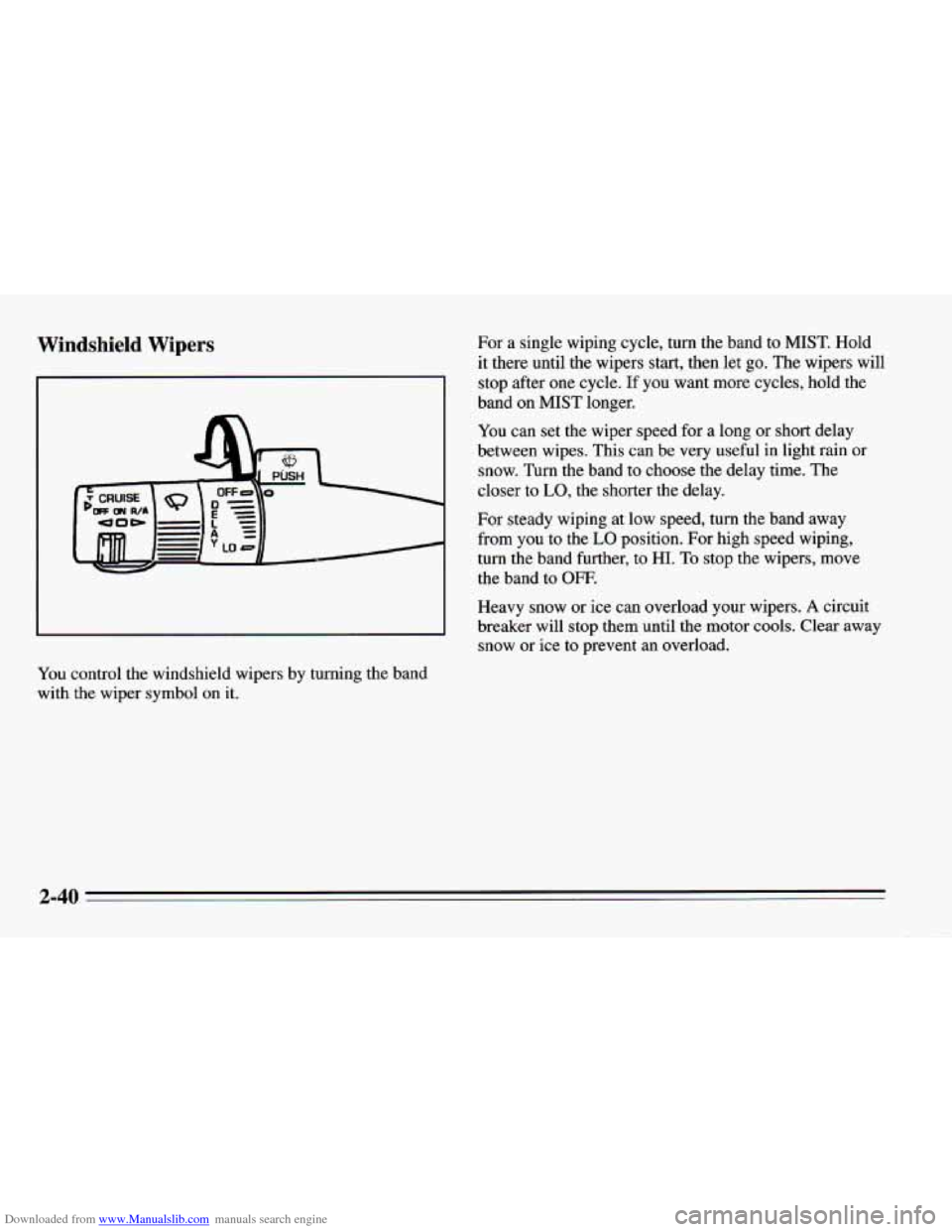
You control the windshield wipers by turning the band
with the wiper symbol on
it.
For a single wiping cycle, turn the band to MIST. Hold
it there until the wipers start, then let
go. The wipers will
stop after one cycle.
If you want more cycles, hold the
band on
MIST longer.
You can set the wiper speed for a long or short delay
between wipes. This can be very useful in light rain or
snow. Turn the band to choose the delay time. The
closer to
LO, the shorter the delay.
For steady wiping at low speed, turn the band away
from you to the
LO position. For high speed wiping,
turn the band further, to HI. To stop the wipers, move
the band to
OFF.
Heavy snow or ice can overload your wipers. A circuit
breaker will stop them until the motor cools. Clear away
snow or ice to prevent an overload.
2-40
Page 98 of 388
Downloaded from www.Manualslib.com manuals search engine To Get Out of Cruise Control
There are several ways to turn off the cruise control:
1. Step lightly on the brake pedal or push the clutch
pedal, if
you have a manual transmission; OR
2. Move the Cruise switch to OFF.
To Erase Speed Memory
When you turn off the cruise control or the ignition,
your cruise control
set speed memory is erased.
2-46