Page 176 of 388
Downloaded from www.Manualslib.com manuals search engine City Driving
One of the biggest problems with city streets is the
amount of traffic
on them. You’ll want to watch out for
what the other drivers are doing and pay attention
to
traffic signals. Here
are ways
to increase your safety in city driving:
Know the best way to get to where you are going.
Get
a city map and plan your trip into an unknown
part of the city just as you would for a cross-country
trip,
Try to use the freeways that rim and crisscross most
large cities. You’ll save time and energy. (See the
next part, “Freeway Driving.”)
Treat a green light as a warning signal. A traffic light
is there because the corner is busy enough
to need it.
When a light turns green, and just before you start to
move, check both ways for vehicles that have not
cleared the intersection or may be running the red
light.
4-20
Page 178 of 388
Downloaded from www.Manualslib.com manuals search engine Once you are moving on the freeway, make certain you
allow a reasonable following distance. Expect to move
slightly slower at night.
When you want to leave the freeway, move
to the proper
lane well in advance.
If you miss your exit do not, under
any circumstances, stop and back up. Drive
on to the
next exit.
The exit ramp can be curved, sometimes quite sharply.
The exit speed is usually posted.
Reduce your speed according to your speedometer,
not
to your sense of motion. After driving for any distance
at higher speeds, you may tend to think you are going
slower than you actually are.
Before Leaving on a Long Trip
Make sure you’re ready. Try to be well rested. If you
must start when you’re not fresh -- such as after a day’s
work
-- don’t plan to make too many miles that first part
of the journey. Wear comfortable clothing and shoes
you
can easily drive in.
Is your vehicle ready for a long trip? If you keep it
serviced and maintained, it’s ready to
go. If it needs
service, have it done before starting out.
Of course,
you’ll find experienced and able service experts
in
Chevrolet dealers all across North America. They’ll be
ready and willing to help if you need it.
Here are some things you can check before
a trip:
0
0
0
0
0
0
0
Windshield Washer Fluid: Is the reservoir full? Are
all windows clean inside and outside?
Wiper Blades: Are they in good shape?
Fuel, Engine Oil, Other Fluids: Have you checked
all levels?
Lumps: Are they all working? Are the lenses clean?
Tires: They are vitally important to a safe,
trouble-free trip.
Is the tread good enough for
long-distance driving? Are
the tires all inflated to the
recommended pressure?
Weather Forecasts: What’s the weather outlook
along your route? Should
you delay your trip a short
time to avoid a major storm system?
Maps: Do you have up-to-date maps?
4-22
Page 197 of 388
Downloaded from www.Manualslib.com manuals search engine To Jump Start Your Chevrolet:
1. Check the other vehicle. It must have a 12-volt
battery with a negative ground system.
NOTICE:
If the other system isn’t a 12-volt system with a
negative ground, both vehicles can be damaged.
I
2. Get the vehicles close enough so the jumper cables
can reach, but be sure the vehicles aren’t touching
each other.
If they are, it could cause a ground
connection you don’t want. You wouldn’t be able to
start your Chevrolet, and the bad grounding could
damage the electrical systems.
3. Turn off the ignition on both vehicles. Turn off all
lights that aren’t needed, and radios. This will avoid
sparks and help save both batteries. And it could
save your radio!
I NOTICE:
If you leave your radio on, it could be badly
damaged. Thk repairs wouldn’t be covered
by
your warranty. I
4. Open the hoods and locate the batteries.
Find the positive
(+) and negative (-) terminals on
each battery.
5-3
Page 243 of 388
Downloaded from www.Manualslib.com manuals search engine Then just pull the hood down and close it firmly.
Before closing
the hood, be sure
all the filler caps are
on.
Engine Oil
LOW blL
If the “LOW OIL” light on the instrument panel comes
on, it means you need to check your engine oil level
right away. For more information, see “Low Oil”
in the
Index. You should check your engine oil level regularly;
this is an added reminder.
It’s
a good idea to check your engine oil every time you
get
fuel. In order to get an accurate reading, the oil must
be warm and the vehicle must be on level ground.
6-11
Page 261 of 388
Downloaded from www.Manualslib.com manuals search engine Adding Coolant
To Check Coolant
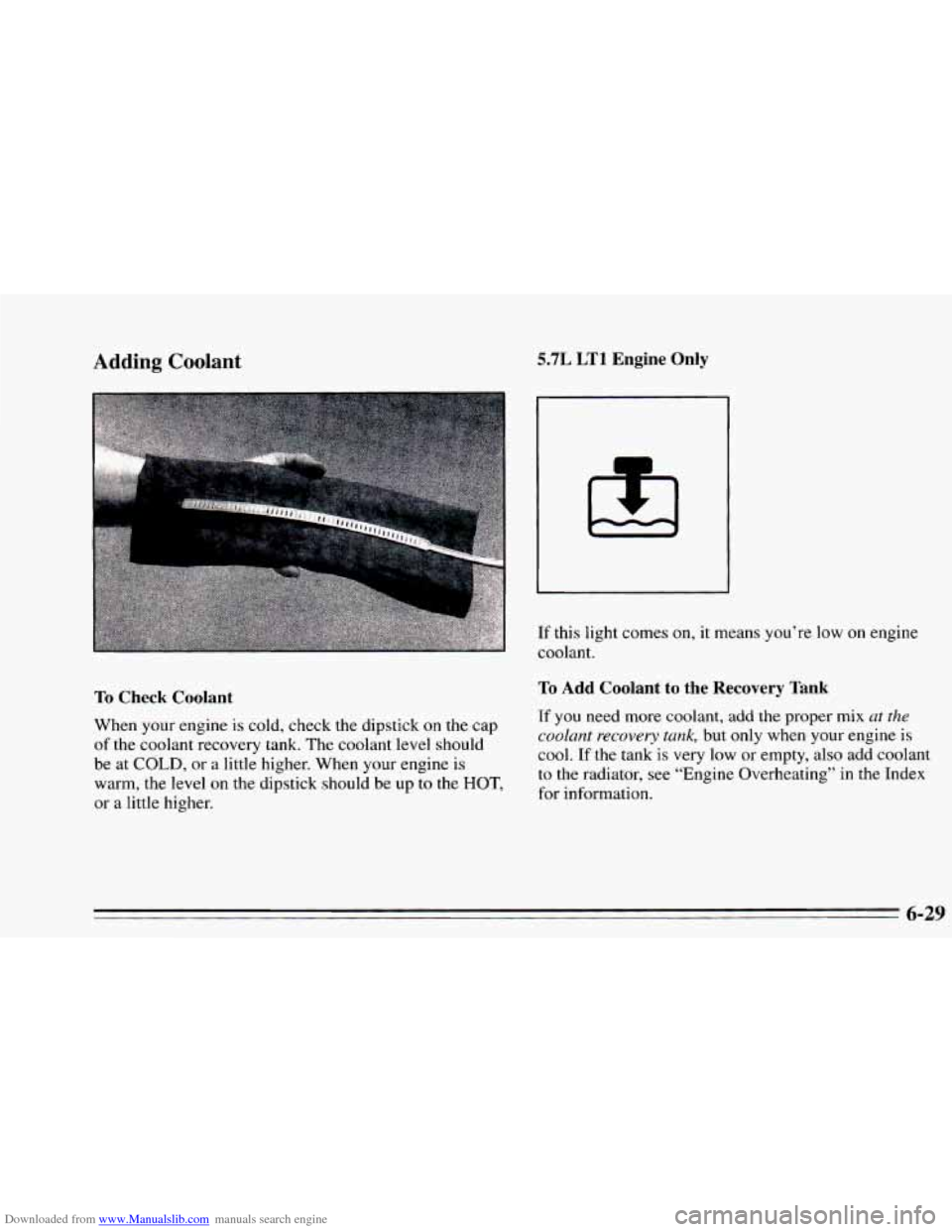
When your engine is cold, check the dipstick on the cap
of the coolant recovery tank. The coolant level should
be at
COLD, or a little higher. When your engine is
warm, the level on the dipstick should be up to the HOT,
or a little higher.
5.7L LT1 Engine Only
If this light comes on, it means you’re low on engine
coolant.
To Add Coolant to the Recovery Tank
If you need more coolant, add the proper mix ut the
coolant
recovery tank, but only when your engine is
cool. If the tank is very low or empty, also add coolant
to the radiator, see “Engine Overheating” in the Index
for information.
6-29
Page 271 of 388
Downloaded from www.Manualslib.com manuals search engine To check the aim, the vehicle should be properly
prepared as follows:
The vehicle must have all four tires on a perfectly
level surface.
0 The vehicle should not have any snow, ice, or mud
There should not be any cargo or loading of vehicle,
except it should have a full tank of gas and one
person or
160 pounds (75 kg) on the driver’s seat.
attached to
it.
0 Tires
should be properly inflated.
0 The horizontal indicator should read “0.”
I NOTICE:
To make sure your headlamps are aimed
properly, read all the instructions before
beginning. Failure to
follow these instructions
could cause damage to headlamp parts.
State inspection stations will allow a vertical reading of
plus
0.76 degrees or minus 0.76 degrees for the center of
the bubble. It
is recommended that the upper limit not exceed plus
0.4 degrees for the center of the bubble. Other drivers
may flash their bright lights at you if your adjustment is
much above plus
0.4 degrees.
If you find that the headlamp aiming needs adjustment,
follow these steps:
To adjust the aim of your headlamps:
1. Move your vehicle to a level surface. Use a spirit
level to be sure. Be sure to remove any items that are
not part of your original equipment from the trunk
and passenger areas.
No one should be seated in the
vehicle and your fuel tank should be about half full.
Check to be sure your tires are at the correct
pressure.
6-39
Page 273 of 388
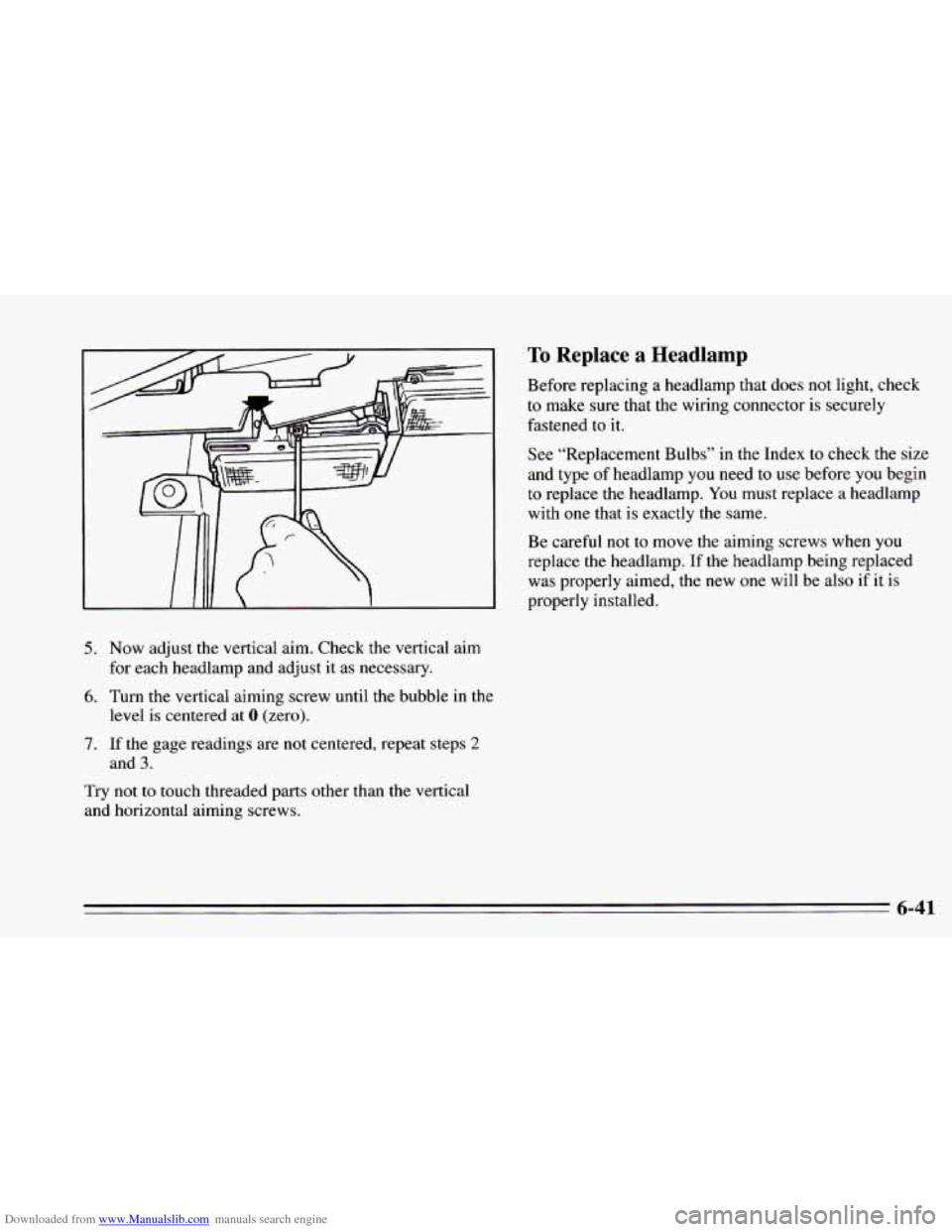
Downloaded from www.Manualslib.com manuals search engine 5. Now adjust the vertical aim. Check the vertical aim
for each headlamp and adjust it as necessary.
6. Turn the vertical aiming screw until the bubble in the
7. If the gage readings are not centered, repeat steps 2
Try not to touch threaded parts other than the vertical
and horizontal aiming screws.
level
is centered at 0 (zero).
and
3.
To Replace a Headlamp
Before replacing a headlamp that does not light, check
to make sure that the wiring connector is securely
fastened to it.
See “Replacement Bulbs”
in the Index to check the size
and type of headlamp you need to
use before you begin
to replace the headlamp.
You must replace a headlamp
with one that
is exactly the same.
Be careful
not to move the aiming screws when you
replace the headlamp. If the headlamp being replaced
was properly aimed, the
new one will be also if it is
properly installed.
6-41
Page 301 of 388
Downloaded from www.Manualslib.com manuals search engine Headlamps
The headlamp wiring is protected by a circuit breaker.
An electrical overload will cause the lamps to go on
and
off, or in some cases to remain off. If this happens, have
your headlamp wiring checked right
away.
Windshield Wipers
The windshield wiper motor is protected by a circuit
breaker and a fuse. If the motor overheats due to heavy
snow, etc., the wiper
will stop until the motor cools. If
the overload is caused by some electrical problem and
not snow, etc., be sure to get it fixed.
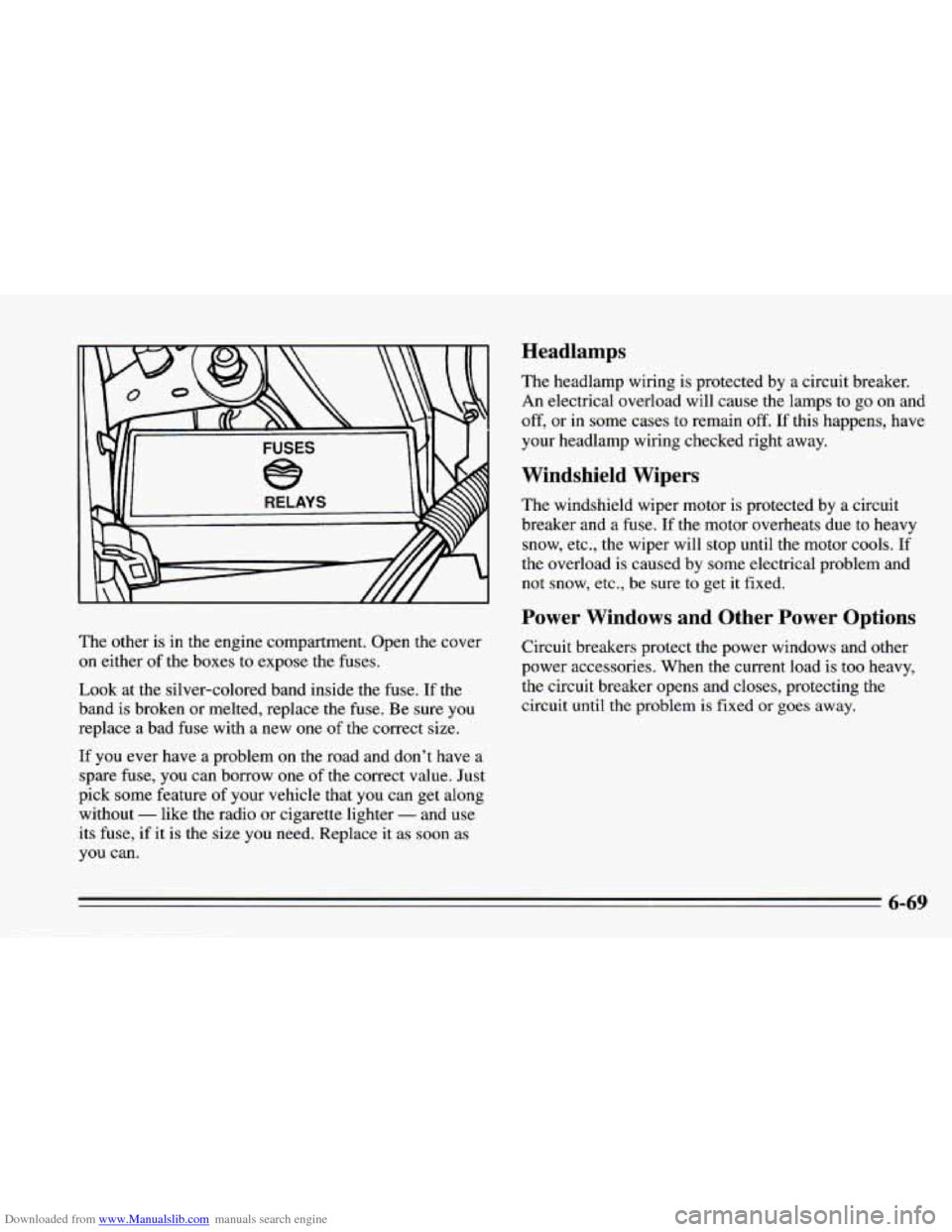
The other is in the engine compartment. Open
the cover
on either of the boxes to expose the fuses.
Look at the silver-colored band inside the fuse. If the
band
is broken or melted, replace the fuse. Be sure you
replace a bad fuse with a new one of the correct size.
If you ever have a problem on the road and don’t have a
spare fuse, you can borrow one of the correct value. Just
pick some feature
of your vehicle that you can get along
without
- like the radio or cigarette lighter - and use
its fuse,
if it is the size you need. Replace it as soon as
you can.
Power Windows and Other Power Options
Circuit breakers protect the power windows and other
power accessories. When the current load is too heavy,
the circuit breaker opens and closes, protecting the
circuit until the problem
is fixed or goes away.