Page 211 of 380
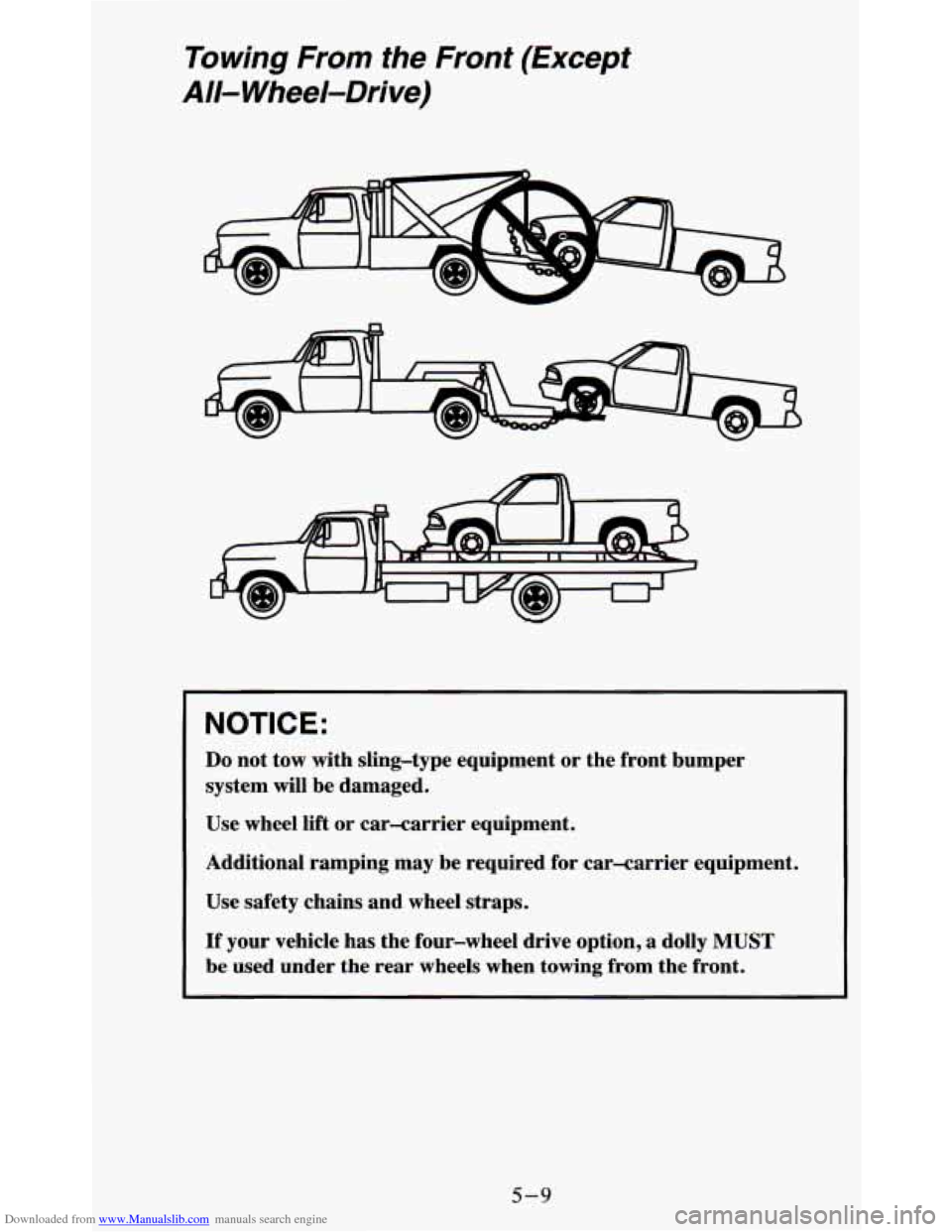
Downloaded from www.Manualslib.com manuals search engine Towing From the Front (Except
All- Wheel-Drive)
NOTICE:
Do not tow with sling-type equipment or the front bumper
system will be damaged.
Use wheel lift or car-carrier equipment.
Additional ramping may be required for car-carrier equipment.
Use safety chains and wheel straps.
If your vehicle has the four-wheel drive option, a dolly MUST
be used under the rear wheels when towing from the front.
5-9
Page 212 of 380
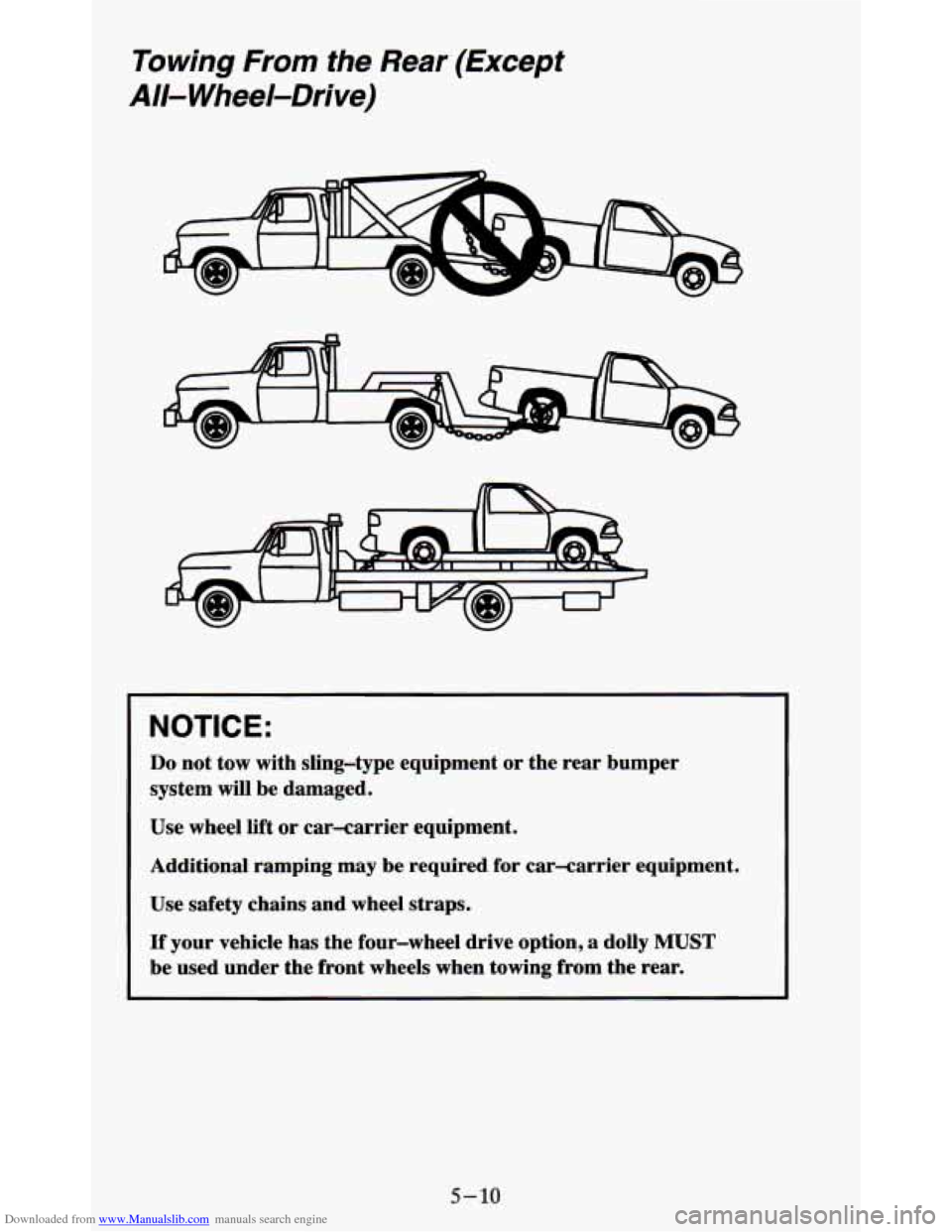
Downloaded from www.Manualslib.com manuals search engine Towing From the Rear (Except
A//' Wheel-Drive)
NOTICE:
Do not tow with sling-type equipment or the rear bumper
system will be damaged.
Use wheel
lift or car-carrier equipment.
Additional ramping may
be required for car-carrier equipment.
Use safety chains and wheel straps.
If your vehicle has the four-wheel drive option, a dolly MUST
be used under the front wheels when towing from the rear.
5-10
Page 213 of 380
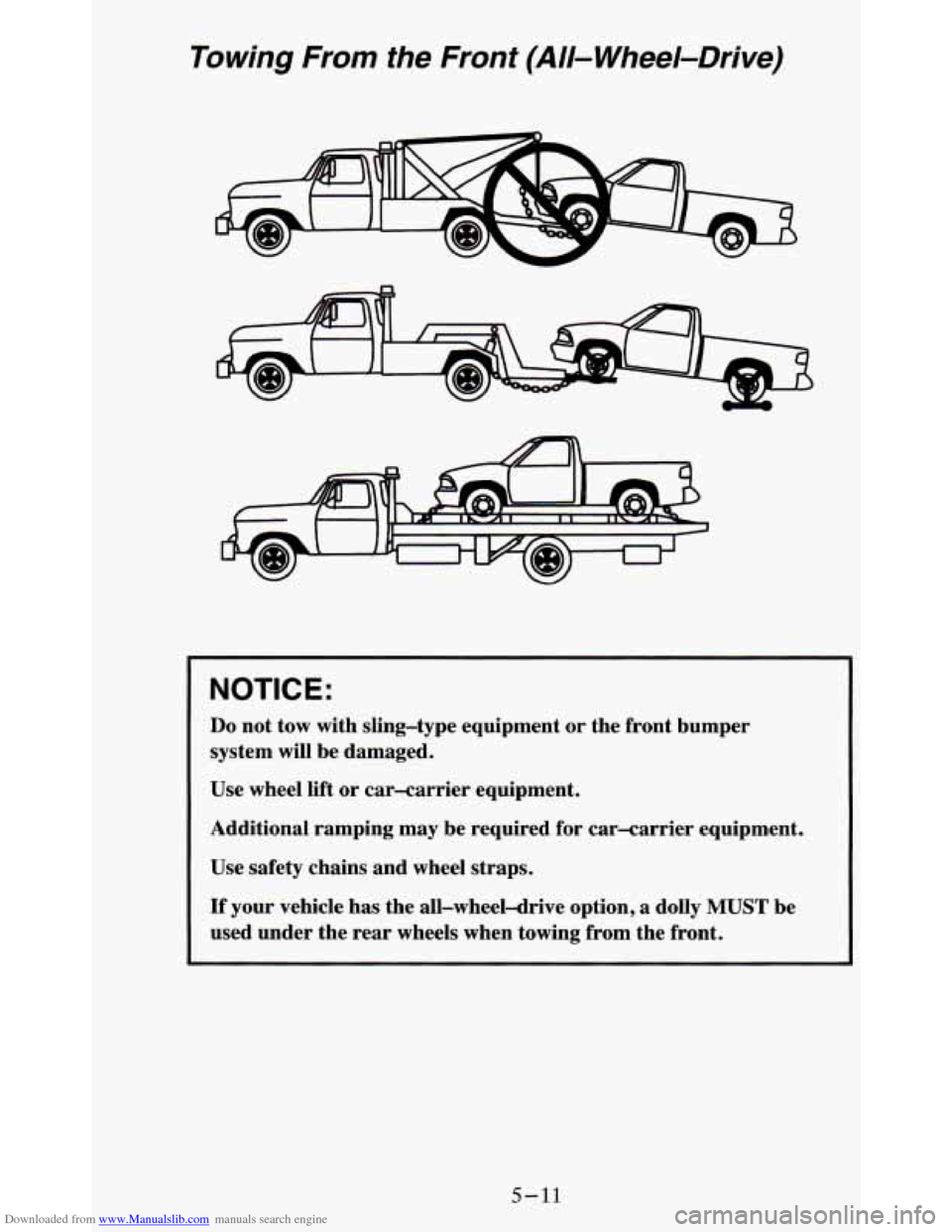
Downloaded from www.Manualslib.com manuals search engine Towing From the Front (All- Wheel-Drive)
NOTICE:
Do not tow with sling-type equipment or the front bumper
system will be damaged.
Use wheel lift or car-carrier equipment.
Additional ramping may be required for car-carrier equipment.
Use safety chains and wheel straps.
If your vehicle has the all-wheel-drive option, a dolly MUST be
used under the rear wheels when towing from the front.
5-11
Page 214 of 380
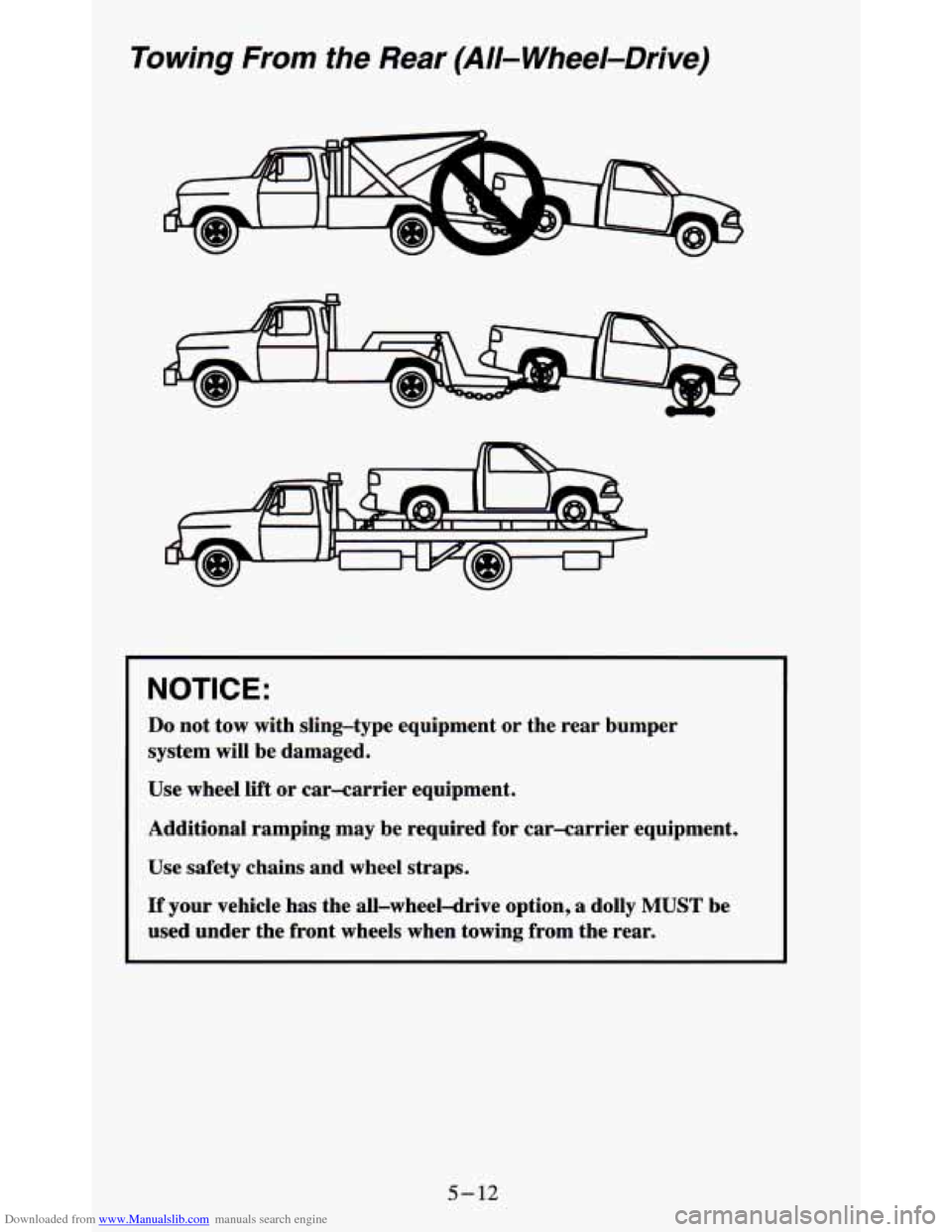
Downloaded from www.Manualslib.com manuals search engine Towing From the Rear (All- Wheel-Drive)
NOTICE:
Do not tow with sling-type equipment or the rear bumper
system will be damaged.
Use wheel lift or car-carrier equipment.
Additional ramping may be required for car-carrier equipment.
Use safety chains and wheel straps.
If your vehicle has the all-wheel-drive option, a dolly MUST be
used under the front wheels when towing from the rear.
5-12
Page 216 of 380
Downloaded from www.Manualslib.com manuals search engine If No Steam IS Coming From Your Engine
If you get the overheat warning but see or hear no steam, the problem may
not be too serious. Sometimes the engine can get a little too hot when you:
0 Climb a long hill on a hot day.
0 Stop after high speed driving.
0 Idle for long periods in traffic.
e Tow a trailer. See "Driving on Grades" in the Index.
If
YOU get the overheat warning with no sign of steam, try this for a minute
or
so:
1. Turn off your air conditioner.
2. Turn on your heater to full hot at the highest fan speed and open the
window as necessary.
3. If you're in a traffic jam, shift to NEUTRAL (N); otherwise, shift to the
highest gear while driving
- AUTOMATIC OVERDRIVE (@) or
DRIVE (D) for automatic transmissions.
If you no longer have the overheat warning, you can drive. Just \
to be safe,
drive slower for about ten minutes.
If the warning doesn't come back on,
you
can drive normally.
If the warning continues, pull over, stop, and park your vehicle \
right away.
If there's still no sign of steam, push the accelerator until the engine speed is
about twice as fast
as normal idle speed. Bring the engine speed back to
normal idle speed after two or three minutes. Now
see if the warning stops.
But then, if you still have the warning,
turn oflthe engine and get everyone
out
of the vehicle until it cools down.
You may decide not to lift the hood but to get service help right away.
ici
5-14
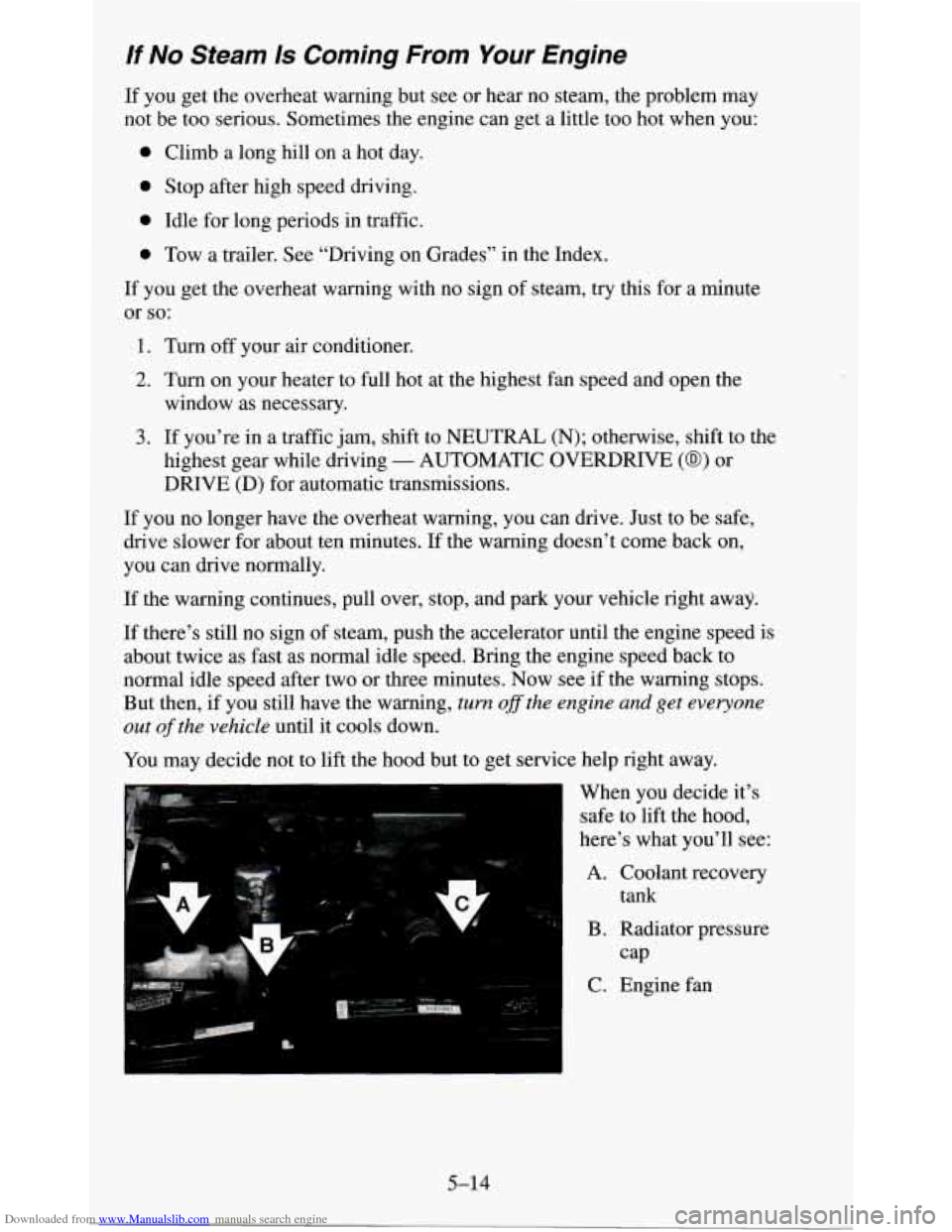
When you decide it's
safe to lift the hood,
here's what you'll
see:
A. Coolant recovery
B. Radiator pressure C. Engine fan tank
cap
Page 222 of 380
Downloaded from www.Manualslib.com manuals search engine 1
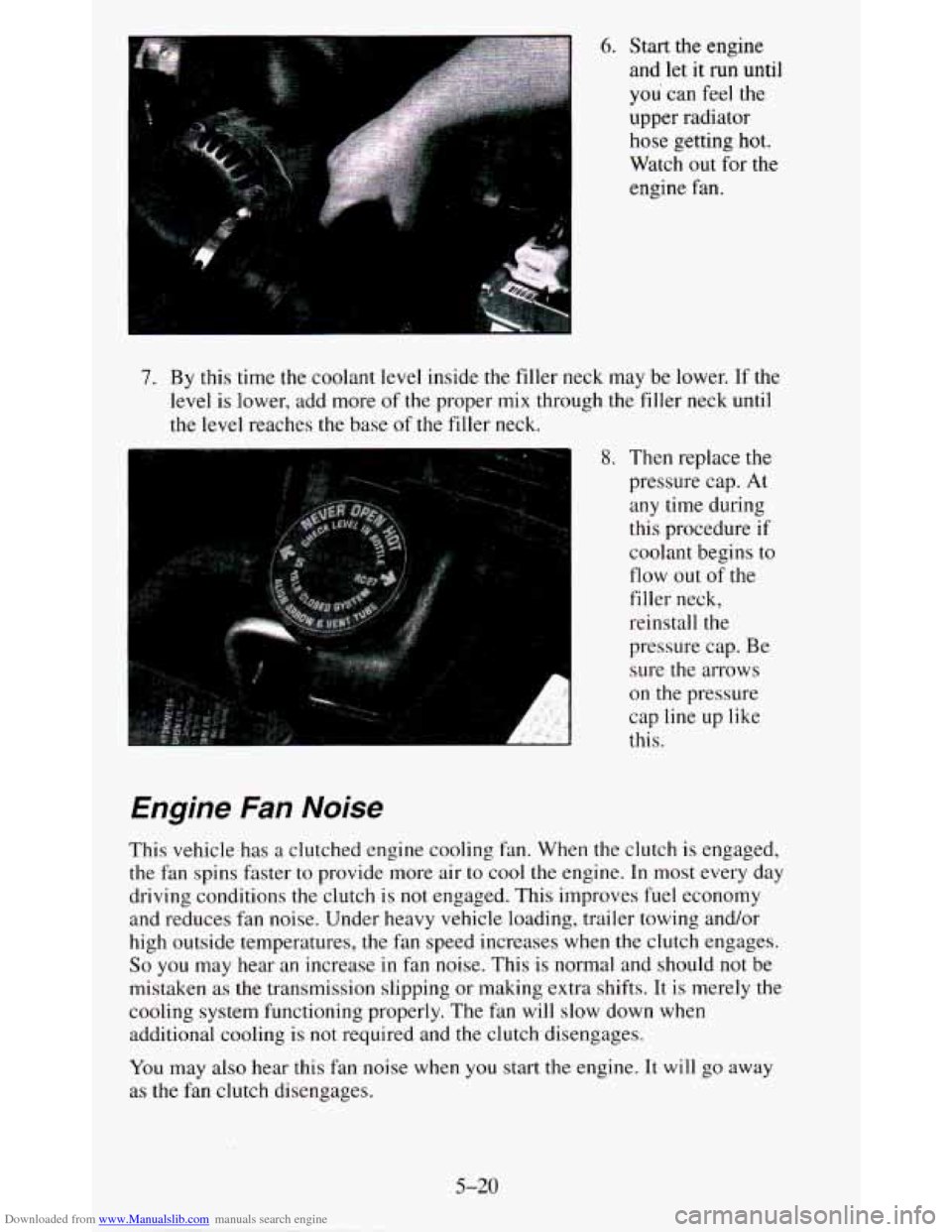
6. Start the engine
and let it
run until
you can feel'the
upper radiator hose getting hot.
Watch out for the
engine fan.
7. By this time the coolant level inside the filler neck may be lower. If the
level is lower, add more of the proper mix through the filler neck unt\
il
the level reaches the base of the filler neck.
8. Then replace the
pressure cap. At
any time during
this procedure if
coolant begins to
flow out of the
filler neck,
reinstall the
pressure cap. Be
sure the arrows
on the pressure
cap line
up like
this.
Engine Fan Noise
This vehicle has a clutched engine cooling fan. When the clutc\
h is engaged, the fan spins faster to provide more air to cool the engine. \
In most every day
driving conditions the clutch
is not engaged. This improves fuel economy
and reduces fan noise. Under heavy vehicle loading, trailer tow\
ing and/or
high outside temperatures, the fan speed increases when
the clutch engages.
So you may hear an increase in fan noise. This is normal and should not be
mistaken
as the transmission slipping or making extra shifts. It is merely \
the
cooling system functioning properly. The fan will slow down when
additional cooling is not required and
the clutch disengages.
You may also hear this fan noise when you start the engine. It will go away
as the fan clutch disengages.
5-20
Page 223 of 380
Downloaded from www.Manualslib.com manuals search engine If a Tire Goes Flat
It’s unusual for a tire to “blow out” while you’re driving, especially if you
maintain your tires properly. If air goes out
of a tire, it’s much more likely to
leak out slowly. But
if you should ever have a “blowout,” here are a few tips
about what to expect and what
to do:
If a front tire fails, the flat tire will create a drag that pulls the vehicle
toward that side. Take your foot
off the accelerator pedal and grip the
steering wheel firmly. Steer to maintain lane position, then ge\
ntly brake to a
stop well out of the traffic lane.
A rear blowout, particularly on a curve, acts much like a skid and may
require the same correction you’d use in a skid. In any rear blowout, remove
your foot from
the accelerator pedal. Get the vehicle under control by
steering the way you want the vehicle to go. It may be very bumpy and
noisy, but you can still steer. Gently brake to a stop, well
off the road if
possible.
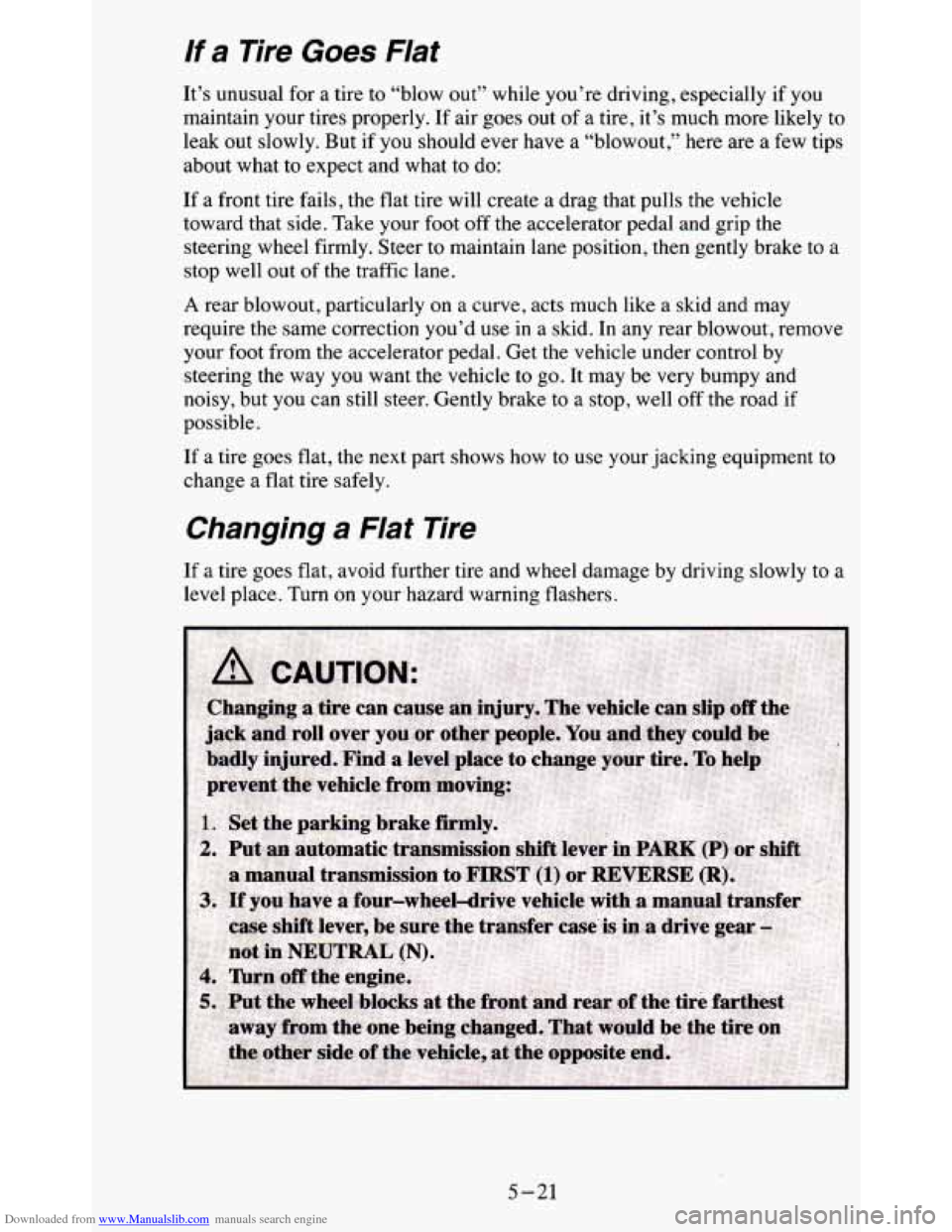
If a tire goes flat,
the next part shows how to use your jacking equipment to
change
a flat tire safely.
Changing a Flat Tire
If a tire goes flat, avoid further tire and wheel damage by driving slowly to a
level place.
Turn on your hazard warning flashers.
5-21
Page 225 of 380
Downloaded from www.Manualslib.com manuals search engine Jacking Equipment
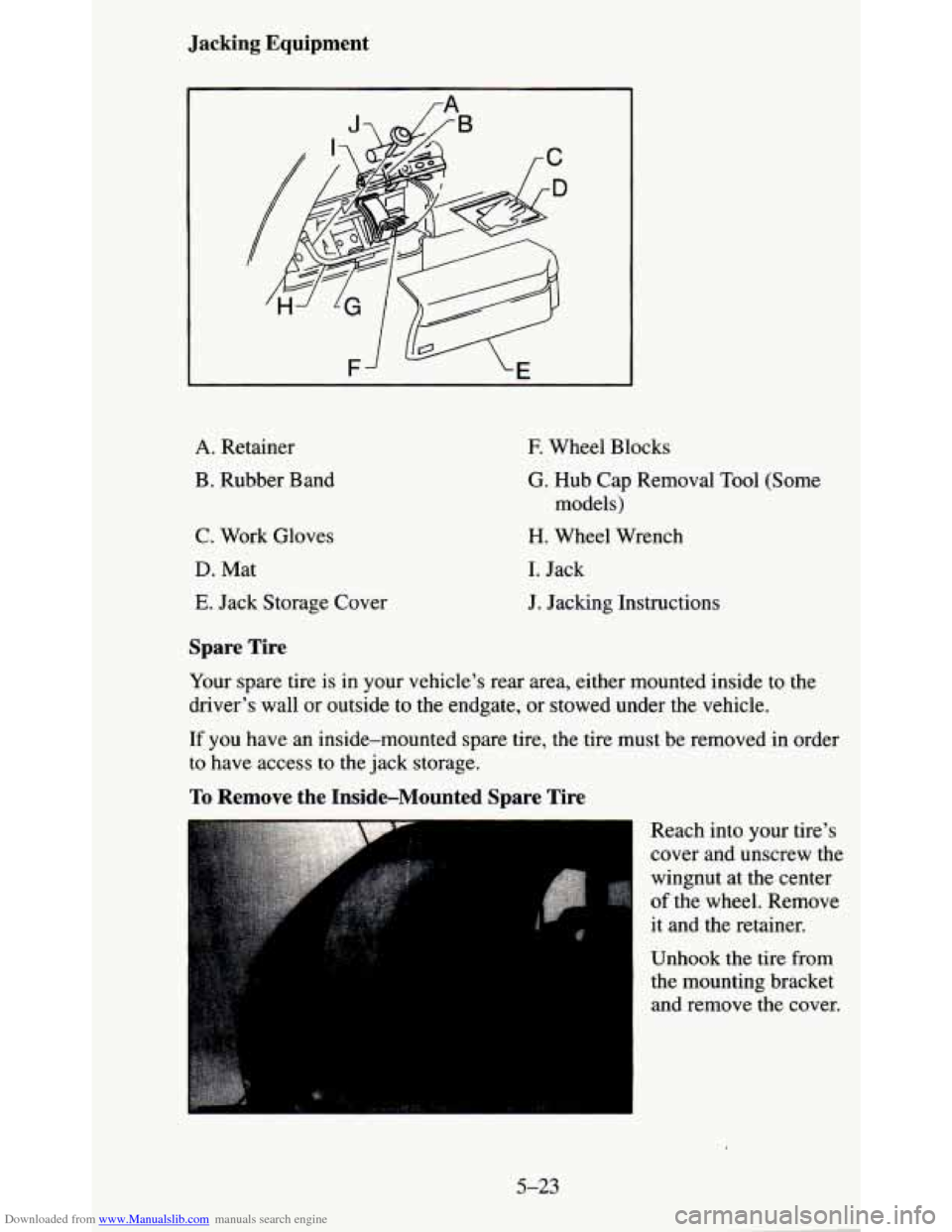
rA
A. Retainer
B. Rubber Band
C. Work Gloves
D. Mat
E. Jack Storage Cover
E Wheel Blocks
G. Hub Cap Removal Tool (Some
H. Wheel Wrench
I. Jack models)
J. Jacking Instructions
Spare Tire
Your spare tire is in your vehicle's rear area, either mounted inside to the
driver's wall or outside to the endgate, or stowed under the vehicle.
If you have an inside-mounted spare tire, the tire must be removed in order
to have access to the jack storage.
To Remove the Inside-Mounted Spare Tire
Reach into your tire's
cover and unscrew the
wingnut at the center
of the wheel. Remove
it and the retainer.
Unhook the tire from
the mounting bracket and remove the cover.
5-23