1995 CHEVROLET BLAZER wheel
[x] Cancel search: wheelPage 5 of 380
Downloaded from www.Manualslib.com manuals search engine Important Notes to Owners and Drivers
About This Manual
Please keep this manual in your vehicle so it will be there if you ever need it
when you’re on the road. If you sell the vehicle, please leave this manual in
it
so the new owner can use it.
This manual includes the latest information at the time it
was printed. We
reserve the right to make changes in
the product after that time without
further notice. For vehicles first
sold in Canada, substitute the name
“General Motors of Canada Limited” for Chevrolet Motor Division
whenever it appears in this manual.
About Driving Your Blazer
As with other vehicles of this type, failure to operate this vehicle correctly
may result in loss of control or
an accident. Be sure to read the
“on-pavement” and “off-road” driving guidelines in this manual. (See
“Driving Guidelines” and “Off-Road Driving With your Four-wheel Drive
Vehicle” in the Index.)
WE SUPPORT
VOLUNTARY TECHNICIAN
CERTIFICATION
THROUGH
National Institute for
AUTOMOTIVE
SERVICE
EXCELLENCE
iii
Page 18 of 380
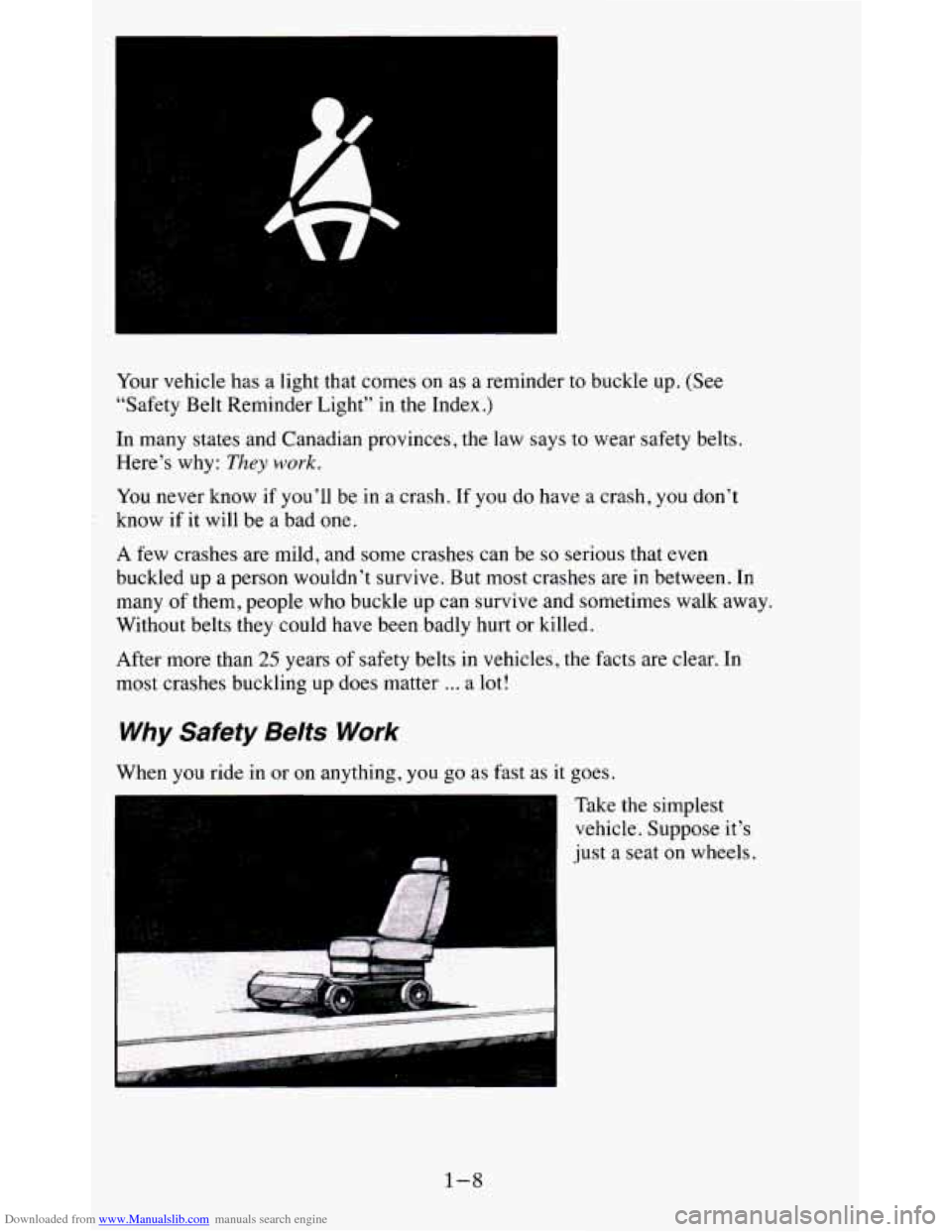
Downloaded from www.Manualslib.com manuals search engine Your vehicle has a light that comes on as a reminder to buckle up. (See
“Safety Belt Reminder Light’’ in the Index.)
In many states and Canadian provinces, the law says
to wear safety belts.
Here’s why:
They work.
You never know if you’ll be in a crash. If you do have a crash, you don’t
know if it will be a bad one.
A few crashes are mild, and some crashes can be
so serious that even
buckled up a person wouldn’t survive. But most crashes are in between. In
many of them, people who buckle up can survive and sometimes walk away.
Without belts they could have been badly hurt or killed.
After more than
25 years of safety belts in vehicles, the facts are clear. In
most crashes buckling up does matter ... a lot!
Why Safety Belts Work
I
When you ride in or on anything, you go as fast as it goes.
Take the simplest vehicle. Suppose it’s
just a seat on wheels.
--I
A
I
1-8
Page 28 of 380
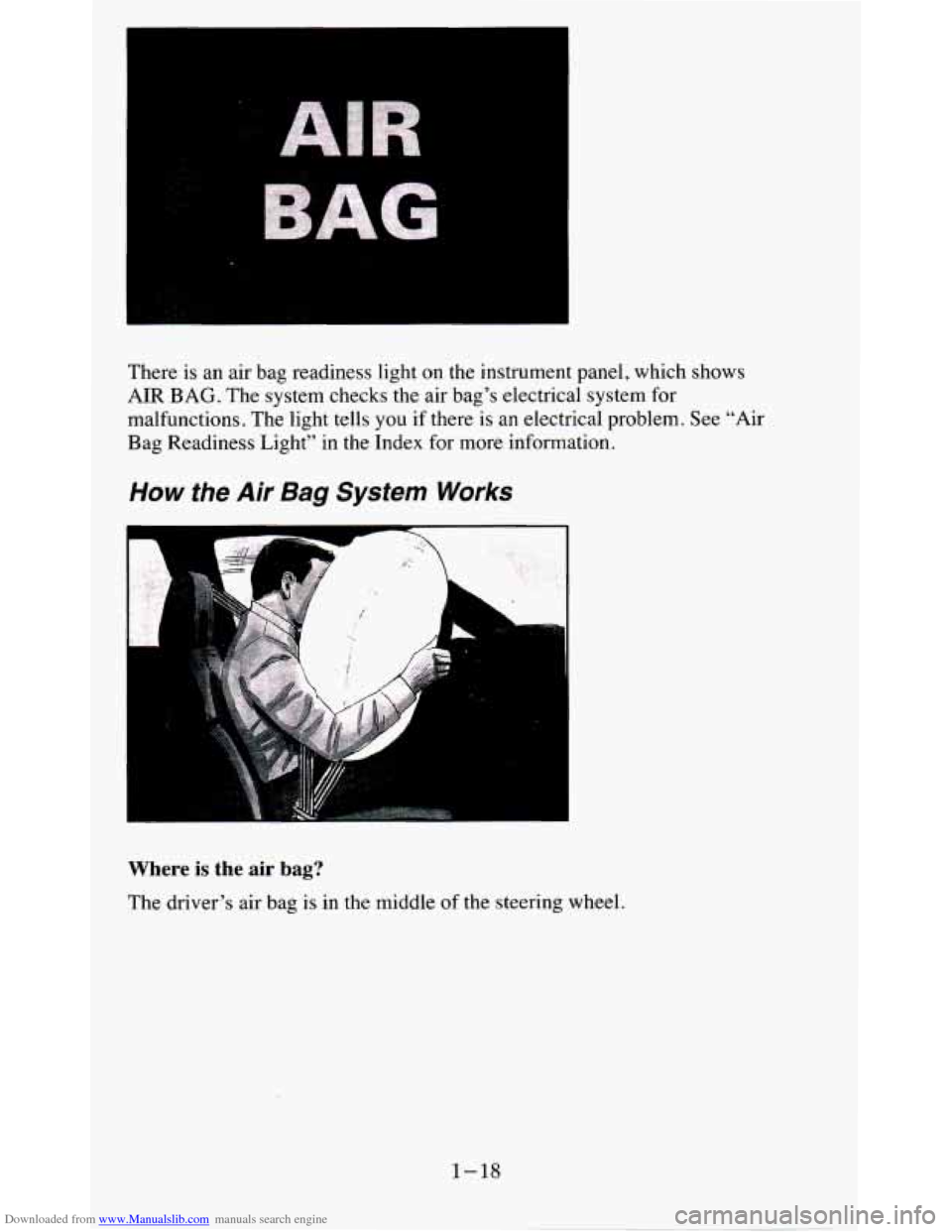
Downloaded from www.Manualslib.com manuals search engine There is an air bag readiness light on the instrument panel, which shows
AIR BAG. The system checks the air bag’s electrical system for
malfunctions. The light tells
you if there is an electrical problem. See “Air
Bag Readiness Light’’ in the Index for more information.
How the Air Bag System Works
1 .. ..
Where is the air bag?
The driver’s air bag is in the middle of the steering wheel.
1-18
Page 29 of 380
Downloaded from www.Manualslib.com manuals search engine When should an air bag inflate?
The air bag is designed to inflate in moderate to severe frontal or
near-frontal crashes. The air bag will inflate only if the impact speed
is
above the system’s designed “threshold level.” If your vehicle goes straight
into
a wall that doesn’t move or deform, the threshold level is about 14 to 18
mph (23 to 29 kdh). The threshold level can vary, however, with specific
vehicle design,
so that it can be somewhat above or below this range. If your
vehicle strikes something that will move or deform, such
as a parked car, the
threshold level will be higher. The air bag is
not designed to inflate in
rollovers, side impacts, or rear impacts, because inflation woul\
d not help the
occupant.
In any particular crash, no one can say whether an air bag should have
inflated simply because of the damage to
a vehicle or because of what the
repair costs were. Inflation is determined by
the angle of the impact and the
vehicle’s deceleration. Vehicle damage is
only one indication of this.
The air bag system is designed to work properly under a wide range
of
conditions, including off-road usage. Observe safe driving speeds,
especially
on rough terrain. As always, wear your safety belt. See
“Off-Road Driving” in the Index for more tips on off-road\
driving.
What makes an air bag inflate?
In a frontal or near-frontal impact of sufficient severity, the air bag sensing \
system detects that
the vehicle is suddenly stopping as a result of a crash.
The sensing system triggers a chemical reaction
of the sodium azide sealed
in the inflator. The reaction produces nitrogen gas, which inflates the air
bag. The inflator, air bag, and related hardware are all part
of the air bag
module packed inside the steering wheel.
How does an air bag restrain?
In moderate to severe frontal or near-frontal collisions, even belted
occupants can contact
the steering wheel. The air bag supplements the
protection provided by safety belts. Air bags distribute the fo\
rce of
the
impact more evenly over the occupant’s upper body, stopping \
the occupant
more gradually. But air bags would not help you
in many types of collisions,
including rollovers and rear and side impacts, primarily because\
an
occupant’s motion is not toward the air bag. Air bags should never be
1-19
Page 30 of 380

Downloaded from www.Manualslib.com manuals search engine regarded as anything more than a supplement to safety belts, and then only\
in moderate to severe frontal or near-frontal collisions.
What will you see after an air bag inflates?
After the air bag inflates, it quickly deflates. This occurs so quickly that
some people may not even realize the air bag inflated. Some compone\
nts of
the air bag module in the steering wheel hub will be hot for a short\
time, but
the part
of the bag that comes into contact with you will not be hot to the
touch. There will be some smoke and dust coming from vents in the deflated
air bag. Air bag inflation will not prevent the driver from seeing\
or from
being able to steer the vehicle, nor will it stop people from leaving
the
vehicle.
The air bag is designed to inflate only once. After it inflates, you’ll
need some new parts for your air bag system. If you don’t get them, the
air bag system won’t be there to help protect
you in another crash. A
new system will include the air bag module and possibly other parts.
The service manual for your vehicle covers the need
to replace other
parts.
information about the air bag system. The module records information
about the readiness of the system, when the sensors are activated and
driver’s safety belt usage at deployment.
Your vehicle is equipped with a diagnostic module, which records
Let only qualified technicians work on your air bag system. Improper
service can mean that your air bag system won’t work properly.
See
your dealer for service.
NOTICE:
If you damage the cover for the driver’s air bag, it may not work
properly. You may have to replace the air bag module. Do not
open or break the air bag cover.
1-20
Page 65 of 380
Downloaded from www.Manualslib.com manuals search engine Theft
Vehicle theft is big business, especially in some cities. Although your
vehicle has a number of theft deterrent features,
we know that nothing we
put on it can make it impossible to steal. However, there are ways you can
help.
Key in the lgnition
If you walk away from your vehicle with the keys inside, it’s an easy target
for joy riders or professional thieves
- so don’t do it.
When you park your vehicle and open the driver’s door, you’ll hear a tone
reminding you to remove your key from the ignition and take it with you.
Always do this. Your steering wheel will be locked, and
so will your
ignition.
If you have an automatic transmission, taking your key out also
locks your transmission. And remember to lock the doors.
Parking at Night
Park in a lighted spot, close all windows and lock your vehicle. Remember
to keep your valuables out of sight. Put them in a storage
area, or take them
with you.
Parking Lots
If you park in a lot where someone will be watching your vehicle, it’s best
to lock it up and take your keys. But what if you have to leave your ignition
key? What if you have to leave something valuable in your vehicle?
0 Put your valuables in a storage area, like your glove box.
0 Lock all the doors except the driver’s.
2-13
Page 66 of 380
Downloaded from www.Manualslib.com manuals search engine New Vehicle “Break-In”
NOTICE:
Your modern vehicle doesn’t need an elaborate “break-in.” But
it will perform better in the long run
if you follow these
guidelines:
Keep your speed at 55 mph (88 km/h) or less for the first 500
miles (804 km).
Don’t drive at any one speed - fast or slow - for the first
500 miles (804 km). Don’t make full-throttle starts.
Avoid making hard stops for the first 200 miles (322 km) or
so. During this time your new brake linings aren’t yet broken
in. Hard stops with new linings can mean premature wear and
earlier replacement. Follow this “breaking-in” guideline
every time
you get new brake linings.
Don’t tow a trailer during ‘(break-in.” See “Towing a Trailer’’
in the Index for more information.
Ignition Switch
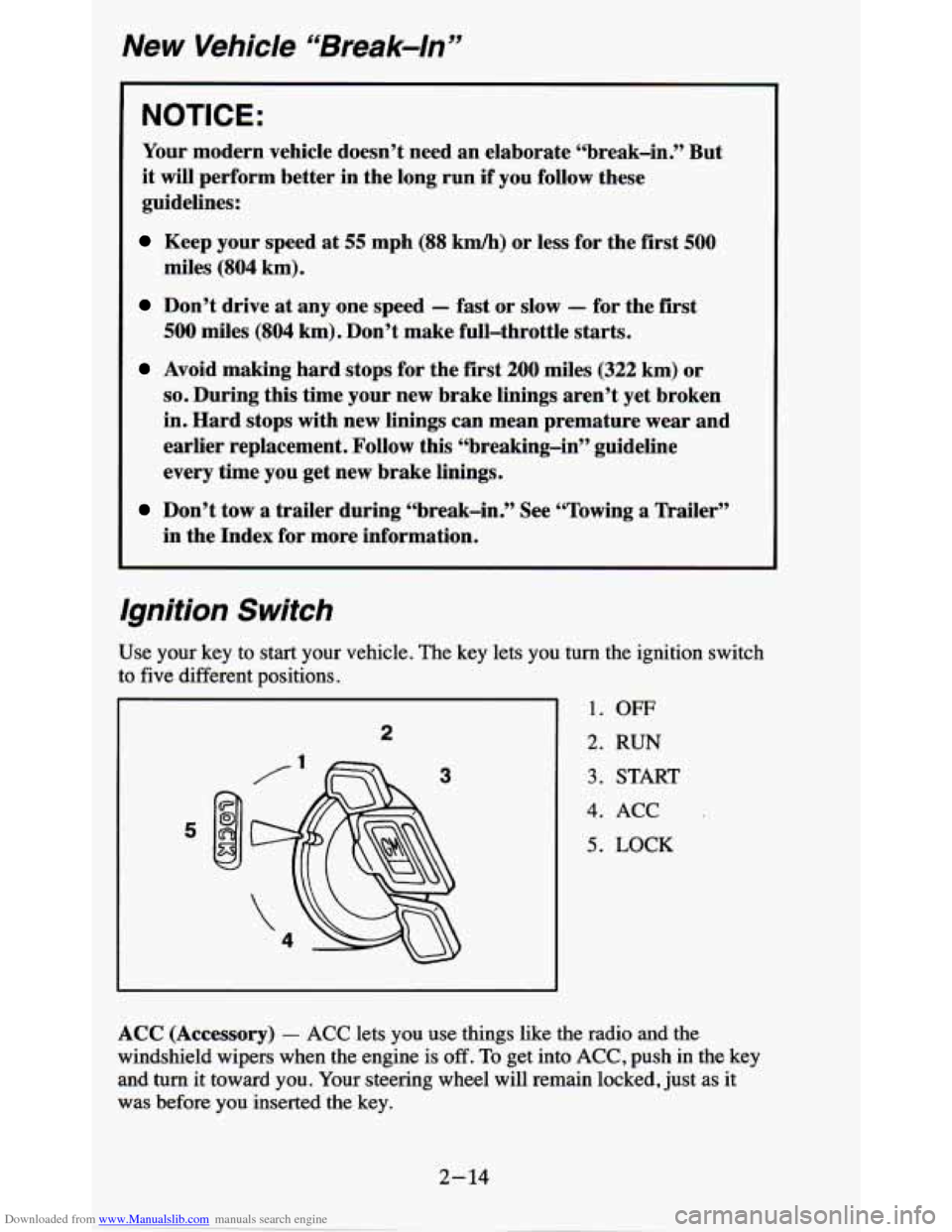
Use your key to start your vehicle. The key lets you turn the ignition switch
to
five different positions.
2
1. OFF
2. RUN
3. START
4. ACC
5. LOCK
ACC (Accessory) - ACC lets you use things like the radio and the
windshield wipers when the engine is
off. To get into ACC, push in the key
and
turn it toward you. Your steering wheel will remain locked, just as it
was before you inserted the key.
Page 67 of 380
Downloaded from www.Manualslib.com manuals search engine I NOTICE:
Don’t operate accessories in the ACC position for long periods
of time. Prolonged operation
of accessories in the ACC position
could drain your battery and prevent you from startiing your
vehicle.
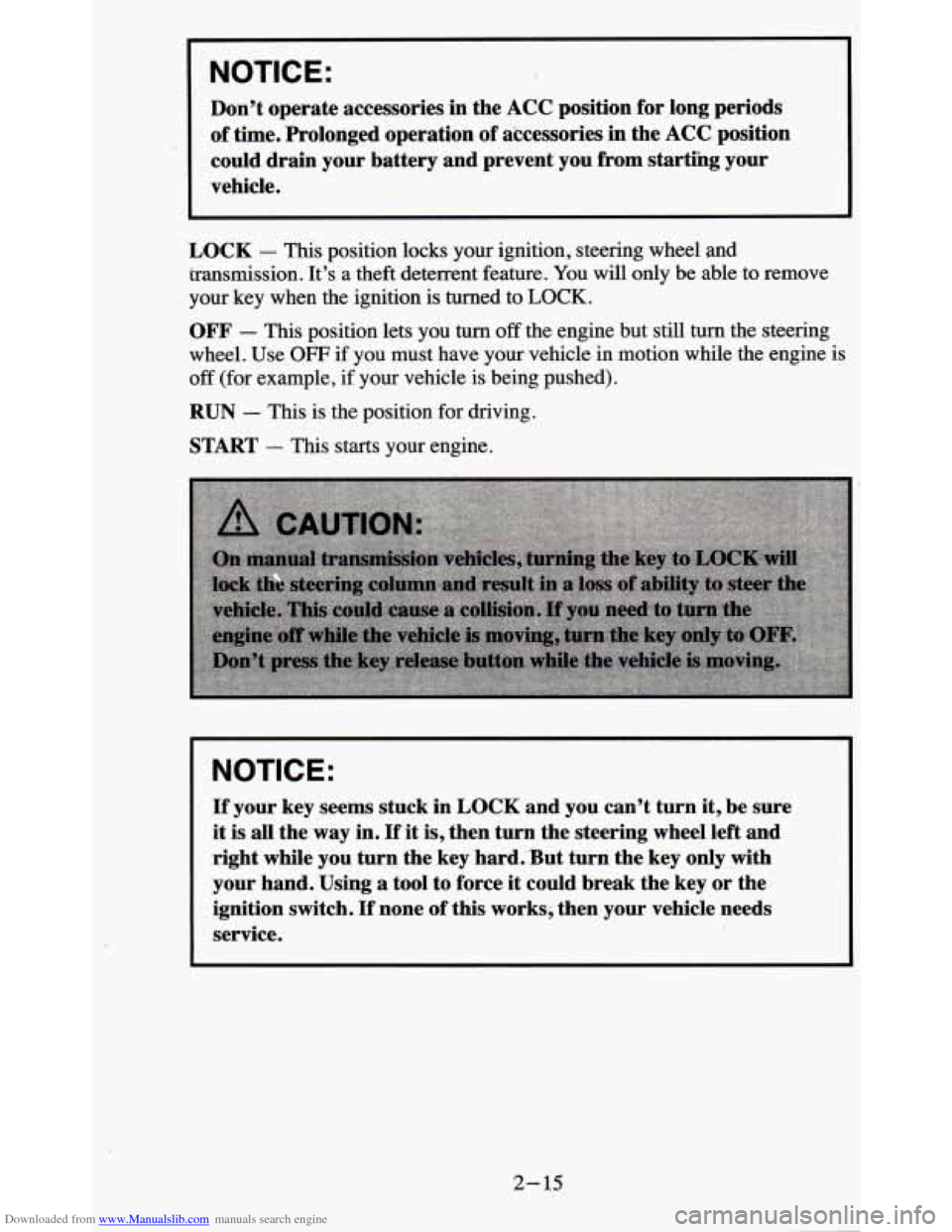
LOCK
- This position locks your ignition, steering wheel and
transmission. It’s a theft deterrent feature.
You will only be able to remove
your key when the ignition
is turned to LOCK.
OFF - This position lets you turn off the engine but still turn the steering
wheel. Use
OFF if you must have your vehicle in motion while the engine is
off (for example, if your vehicle is being pushed).
RUN - This is the position for driving.
START - This starts your engine.
NOTICE:
If your key seems stuck in LOCK and you can’t turn it, be sure
it is all the way in.
If it is, then turn the steering wheel left and
right while you turn the key hard.’But turn the key only with
your hand. Using a tool to force it could break the key or the
ignition switch.
If none of this works, then your vehicle needs
service.
2- I5