Downloaded from www.Manualslib.com manuals search engine NOTICE:
Damage to your engine from neglected oil problems can be
costly and is not covered by your warranty.
Fuel Gage
I
1 /2
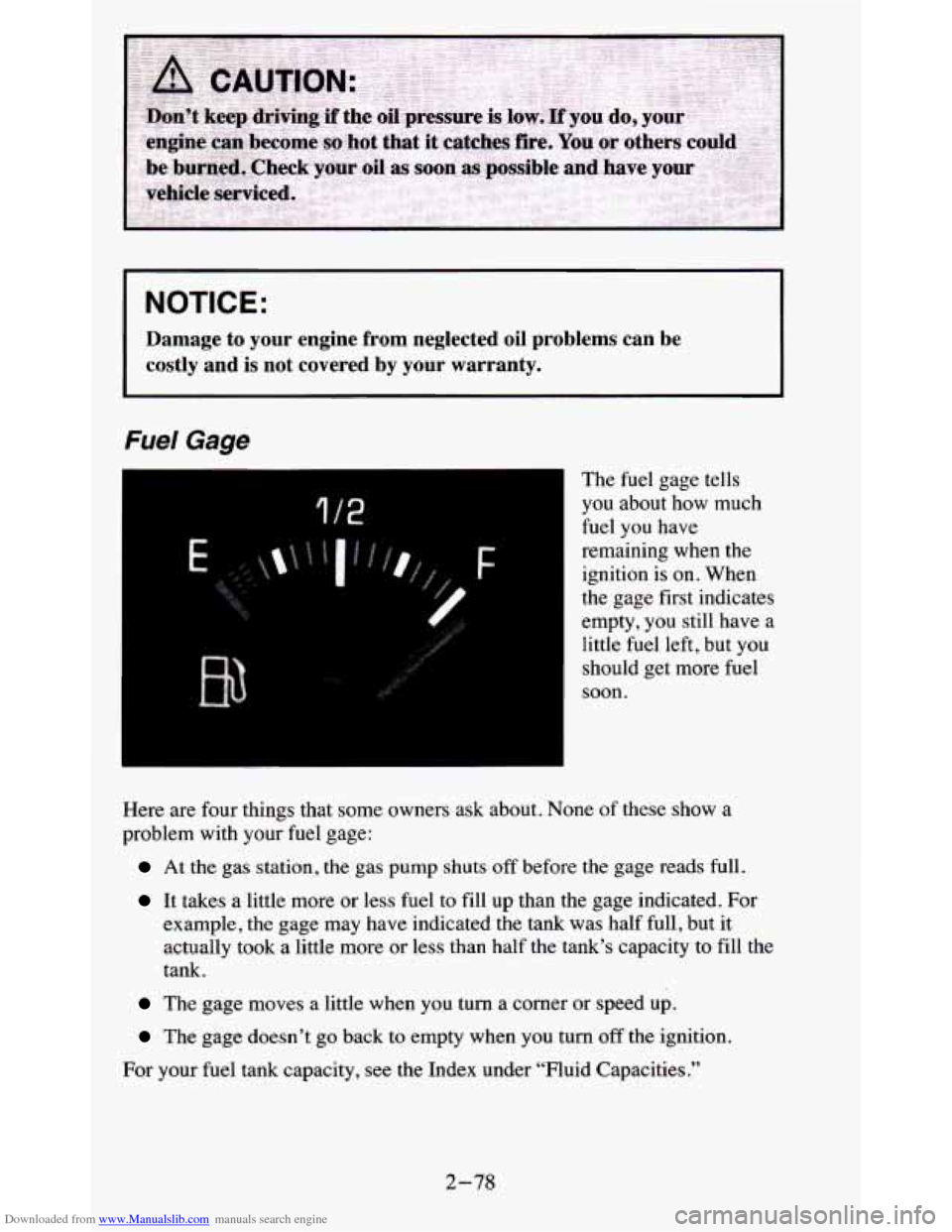
The fuel gage tells
you about how much
fuel you have
remaining when the
ignition
is on. When
the gage first indicates
empty, you still have a
little fuel left, but you
should get more fuel
soon.
3
Here are four things that some owners ask about. None of these show a
problem with
your fuel gage:
At the gas station, the gas pump shuts off before the gage reads full.
It takes a little more or less fuel to fill up than the gage indicated. For
example, the gage may have indicated the tank was half full, but it
actually took a little more
or less than half the tank’s capacity to fill the
tank.
The gage moves a little when you turn a corner or speed up.
The gage doesn’t go back to empty when you turn off the ignition.
For your fuel tank capacity, see the Index under “Fluid Capacities.”
2-78
Downloaded from www.Manualslib.com manuals search engine The gasoline you use should meet specifications ASTM D4814 in the
United States and
CGSB 3.5-92 in Canada. These fuels should have the
proper additives,
so you should not have to add anything to the fuel.
In the United States and Canada, it’s easy to be sure you get the right kind
of gasoline (unleaded). You’ll see
UNLEADED right on the pump. And
only unleaded nozzles will fit into your vehicle’s filler neck.
Be sure the posted octane is at least
91 for premium, 89 for middle grade
and 87-for regular.
If the octane is less than 87, you may get a heavy
knocking noise when you drive. If it’s bad enough,
it can damage your
engine.
If you’re using fuel rated at 91 octane or higher and you still hear heavy
knocking, your engine needs service. But don’t
worry if you hear a little
pinging noise when you’re accelerating
or driving up a hill. That’s normal,
and you don’t have to buy a higher octane fuel to get rid of it. It’s the heavy,
constant knock that means you have a problem.
What about gasoline with blending materials that contain oxygen
(oxygenates), such as
MTBE or alcohol?
MTBE is “methyl tertiary-butyl ether.” Fuel that is no more than 15%
MTBE is fine for your vehicle.
Ethanol is ethyl or grain alcohol. Properly-blended fuel that is no more than
10% ethanol is fine for your vehicle.
Methanol is methyl or wood alcohol.
~ NOTICE:
1 Fuel that is more than 5% methanol is bad for your vehicle.
I Don’t use it. It can corrode metal parts’in your fuel system and
1 also damage plastic and rubber parts. That damage wouldn’t b\
e
1 covered under your warranty. And even at 5% or less, there
~ must be “cosolvents” and corrosion preventers in this fuel\
to
~ help avoid these problems.
6-3
Downloaded from www.Manualslib.com manuals search engine NAME
GAUGES
ENG I HTR NC
PWR AUX
RR DEFOG
ECM BATT
ECM IGN
CIRCUITS PROTECTED
Alternator Field, VTC, A/C Compressor Relay, Cluster
Chime Module, DRL Relay Coil, Four-wheel Drive
Indictor Lamp, DRL Module, Rear Defog Timer, TCCM
Ignition,
SIR Redundant Ignition, RKE Ignition
02 Sensor Heat Dr, EGR, Cam Sensor, CANN, Purge
Heater-A/C Blower Motor, Temperature Door Motor,
A/C Compressor Clutch, HI Blower Relay Coil, Timer
Relay Coil
Power Auxiliary Outlets, ALDL
Rear Window Defogger
PCMNCM Battery, ABS Battery (LN2), Fuel Pump
PCMNCM Ignition, Injectors, Crank Sensor, Coil
Driver Module
6-68