Page 9 of 380
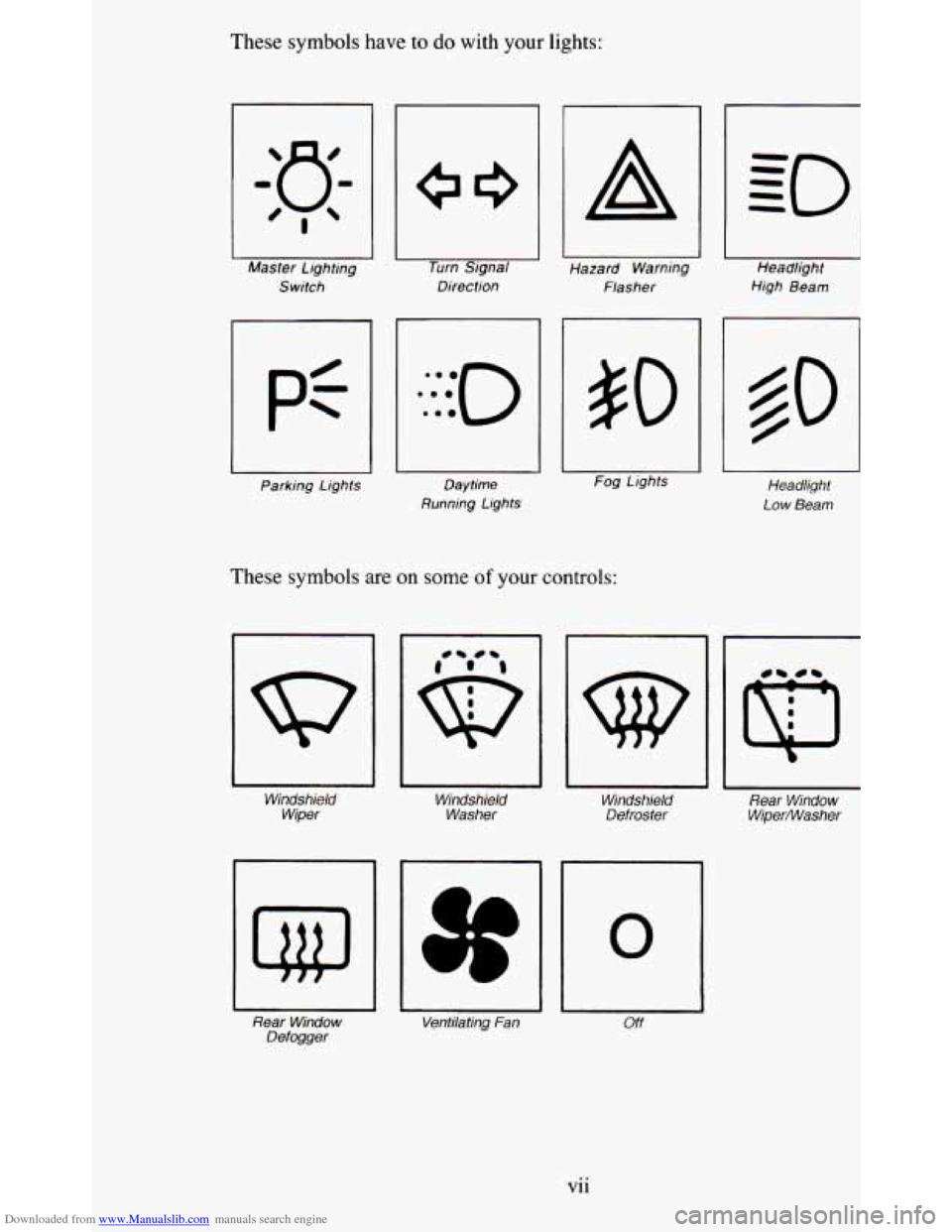
Downloaded from www.Manualslib.com manuals search engine These symbols have to do with your lights:
Master Lighting
Switch
I
Parking Lights
- Turn Signal Direction
Daytime
Running Lights
A
Hazard Warning
Rasher
I Fog Lights
These symbols are on some of your controls:
Windshield
Wiper
Rear Window Defogger
Q
0* ew
Windshield Washer
Ventilating Fan
I
Windshield Defroster
0
c Off
Heaulight
High
Beam
Headlight
Low Beam
0% 0%
Rear Window
WiperMasher
vii
Page 10 of 380
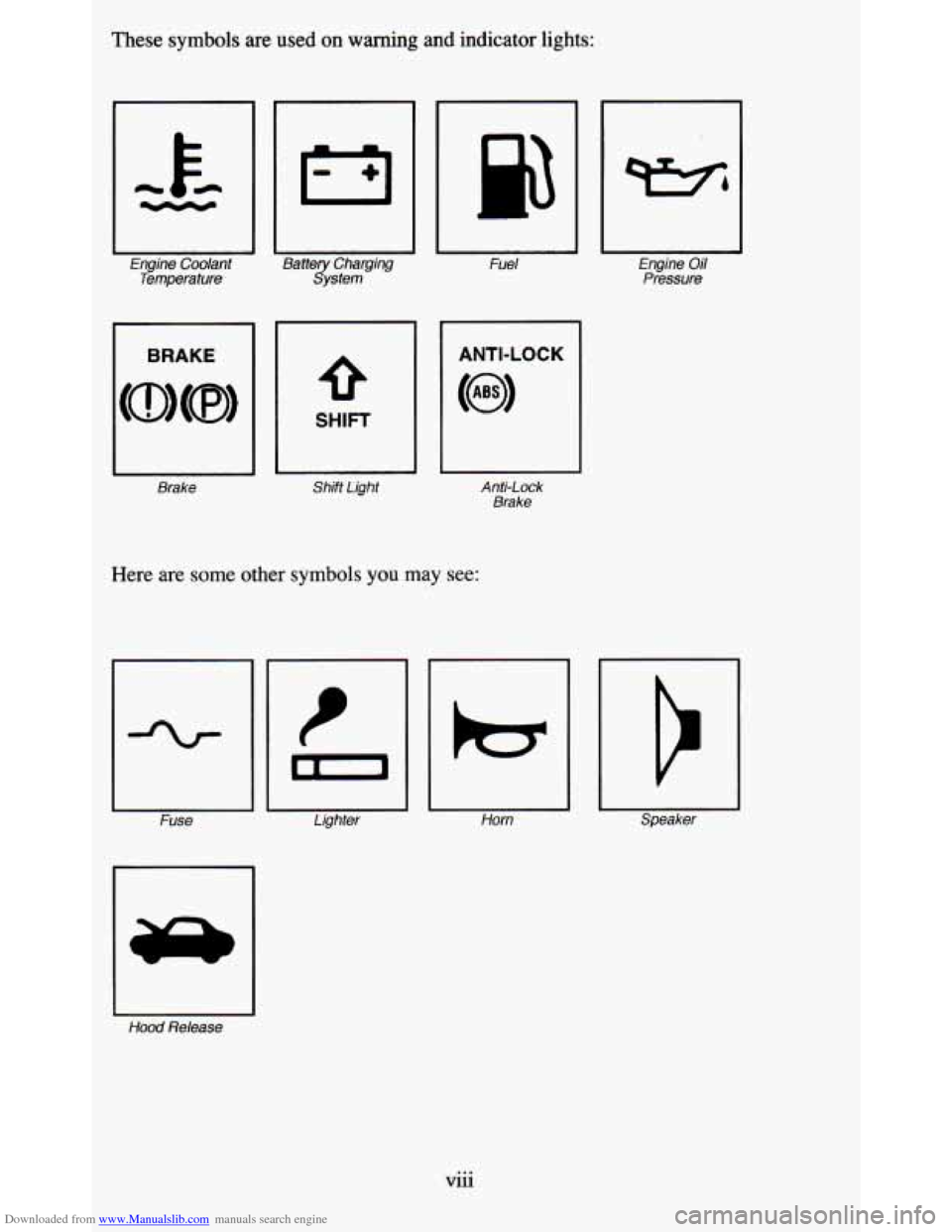
Downloaded from www.Manualslib.com manuals search engine These symbols are used on warning and indicator lights:
Engine Coolant
Temperature
I BRAKE
Brake
Battery Charging
System
1
Fuel
SHIFT
Shift Light
1 ANTI-LOCK
I
Anti-Lock Brake
Here are some other symbols you may see:
Fuse Lighter
I-
I-
Horn
L
Engine Oil Pressure
Hood
Release
Vlll ...
Page 18 of 380
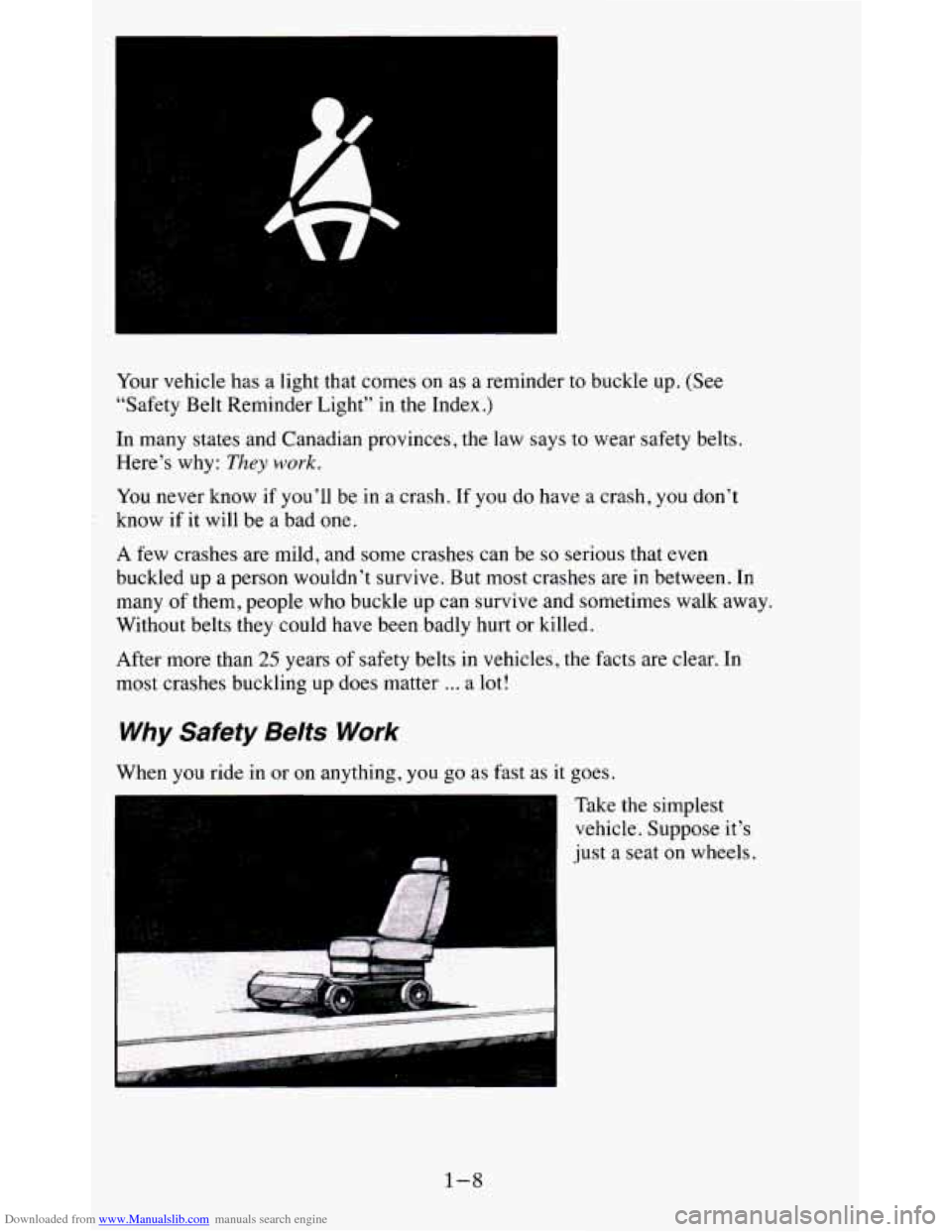
Downloaded from www.Manualslib.com manuals search engine Your vehicle has a light that comes on as a reminder to buckle up. (See
“Safety Belt Reminder Light’’ in the Index.)
In many states and Canadian provinces, the law says
to wear safety belts.
Here’s why:
They work.
You never know if you’ll be in a crash. If you do have a crash, you don’t
know if it will be a bad one.
A few crashes are mild, and some crashes can be
so serious that even
buckled up a person wouldn’t survive. But most crashes are in between. In
many of them, people who buckle up can survive and sometimes walk away.
Without belts they could have been badly hurt or killed.
After more than
25 years of safety belts in vehicles, the facts are clear. In
most crashes buckling up does matter ... a lot!
Why Safety Belts Work
I
When you ride in or on anything, you go as fast as it goes.
Take the simplest vehicle. Suppose it’s
just a seat on wheels.
--I
A
I
1-8
Page 28 of 380
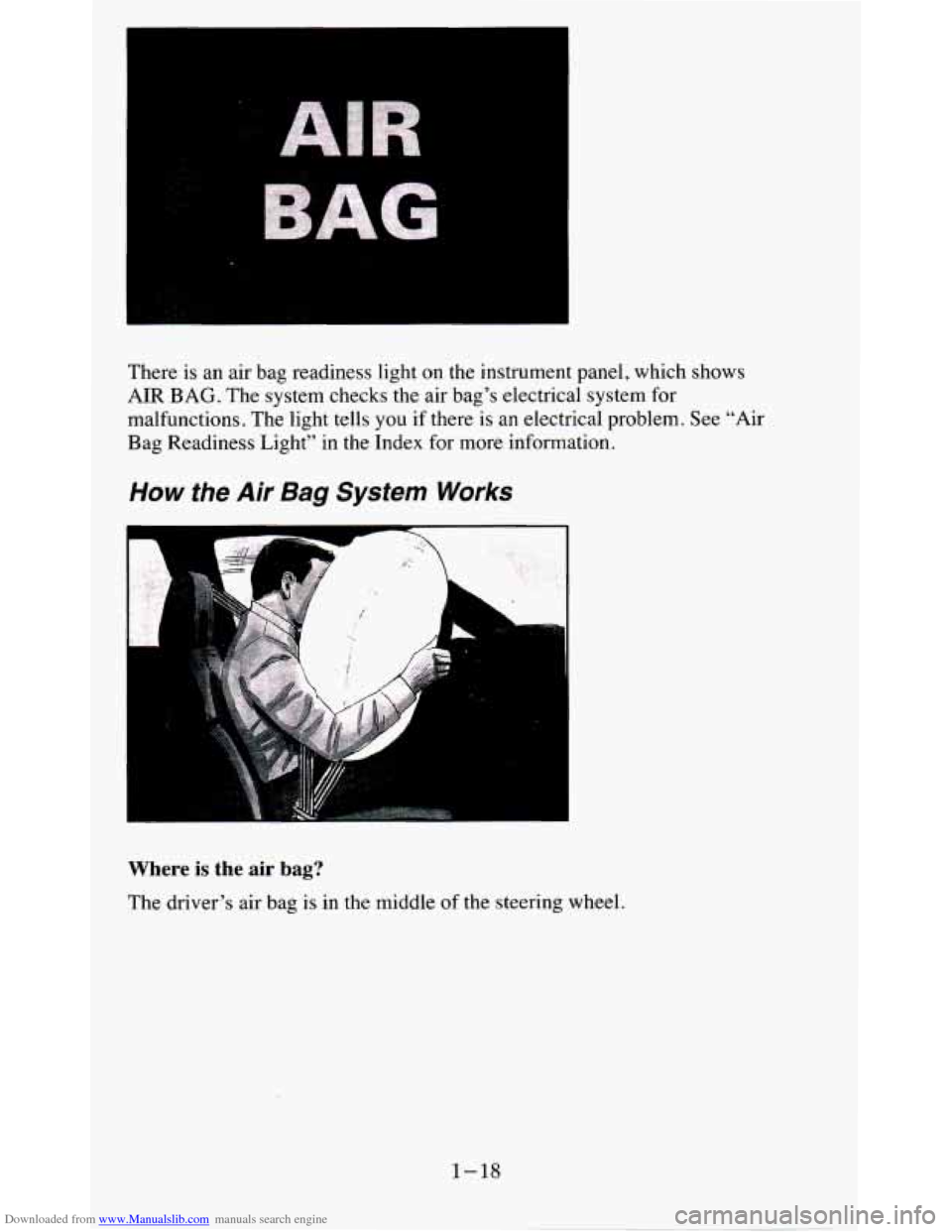
Downloaded from www.Manualslib.com manuals search engine There is an air bag readiness light on the instrument panel, which shows
AIR BAG. The system checks the air bag’s electrical system for
malfunctions. The light tells
you if there is an electrical problem. See “Air
Bag Readiness Light’’ in the Index for more information.
How the Air Bag System Works
1 .. ..
Where is the air bag?
The driver’s air bag is in the middle of the steering wheel.
1-18
Page 35 of 380
Downloaded from www.Manualslib.com manuals search engine Lapshoulder Belt
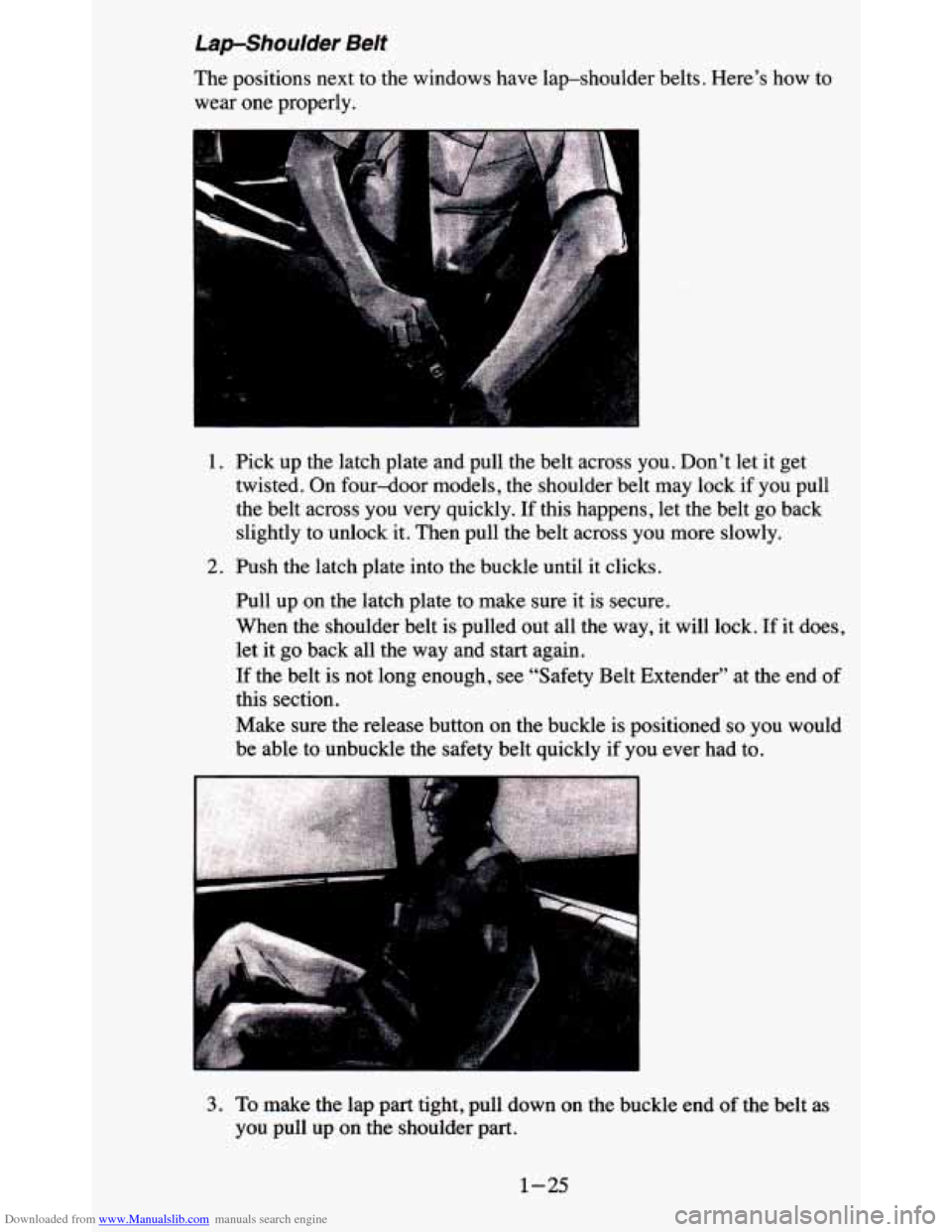
The positions next to the windows have lap-shoulder belts. Here’s how to
wear one properly.
1. Pick up the latch plate and pull the belt across you. Don’\
t let it get
twisted. On four-door models, the shoulder belt may lock if you pull
the belt across you very quickly. If this happens, let the belt go back
slightly to unlock it. Then pull the belt across you more slowly.
2. Push the latch plate into the buckle until it clicks.
Pull up on the latch plate to make sure it is secure.
When the shoulder belt
is pulled out all the way, it will lock. If it doesr
let it go back all the way and start again.
If the belt
is not long enough, see “Safety Belt Extender’’ at the end of
this section.
Make sure the release button on the buckle is positioned
so you would
be able
to unbuckle the safety belt quickly if you ever had to.
3. To make the lap part tight, pull down on the buckle end of the belt as
you pull up on the shoulder part.
1-25
Page 63 of 380
Downloaded from www.Manualslib.com manuals search engine If you have a manual transmission, either with or without the Keyless Entr!
option, you must apply your parking brake before you can open the endgatc
glass.
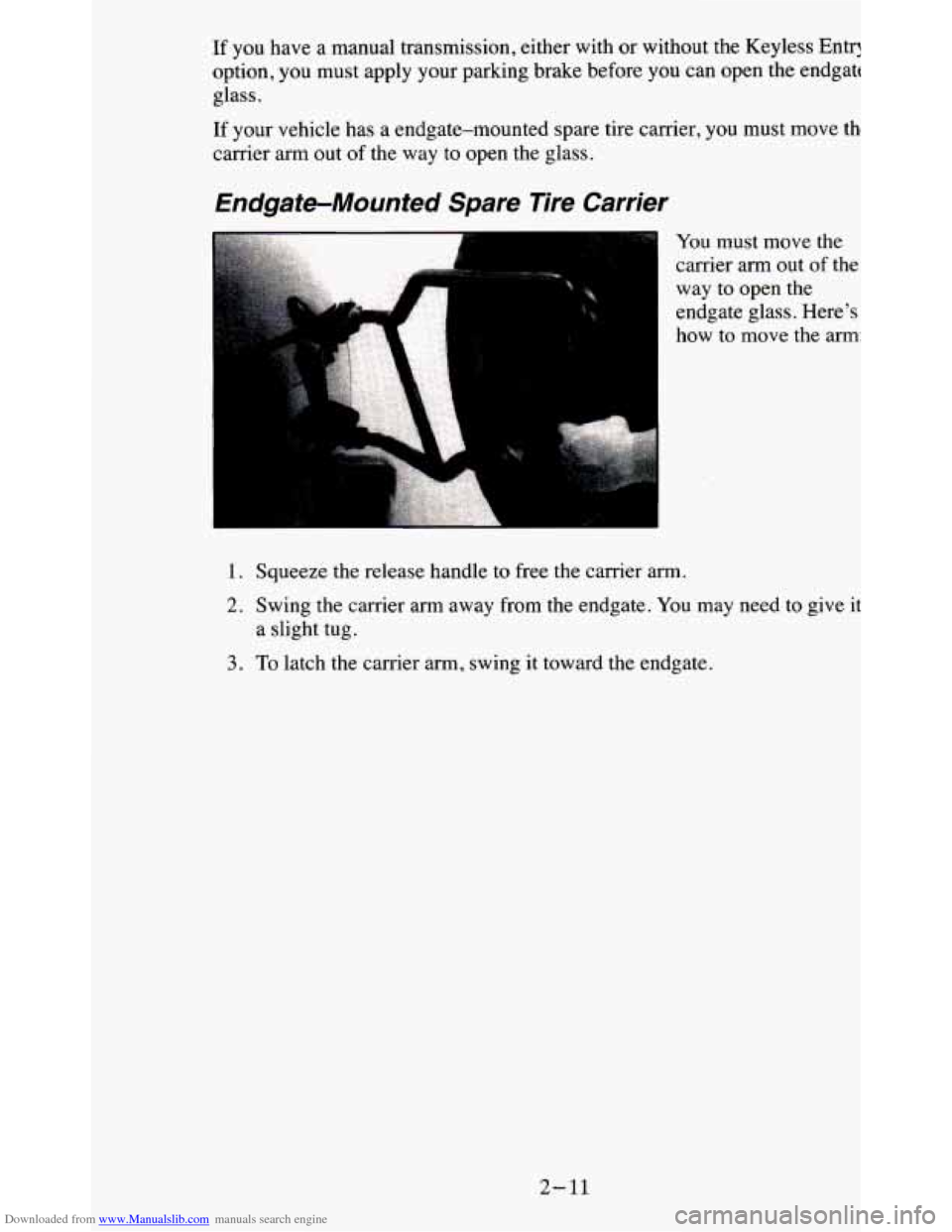
If your vehicle has a endgate-mounted spare tire carrier, you must move th
carrier arm out of the way to open the glass.
Endgate-Mounted Spare lire Carrier
You must move the
carrier arm
out of the
way to open the
endgate glass. Here's
how to move the arm
1. Squeeze the release handle to free the carrier arm.
2. Swing the carrier arm away from the endgate. You may need to give it
a slight tug.
3. To latch the carrier arm, swing it toward the endgate.
2-11
Page 65 of 380
Downloaded from www.Manualslib.com manuals search engine Theft
Vehicle theft is big business, especially in some cities. Although your
vehicle has a number of theft deterrent features,
we know that nothing we
put on it can make it impossible to steal. However, there are ways you can
help.
Key in the lgnition
If you walk away from your vehicle with the keys inside, it’s an easy target
for joy riders or professional thieves
- so don’t do it.
When you park your vehicle and open the driver’s door, you’ll hear a tone
reminding you to remove your key from the ignition and take it with you.
Always do this. Your steering wheel will be locked, and
so will your
ignition.
If you have an automatic transmission, taking your key out also
locks your transmission. And remember to lock the doors.
Parking at Night
Park in a lighted spot, close all windows and lock your vehicle. Remember
to keep your valuables out of sight. Put them in a storage
area, or take them
with you.
Parking Lots
If you park in a lot where someone will be watching your vehicle, it’s best
to lock it up and take your keys. But what if you have to leave your ignition
key? What if you have to leave something valuable in your vehicle?
0 Put your valuables in a storage area, like your glove box.
0 Lock all the doors except the driver’s.
2-13
Page 70 of 380
Downloaded from www.Manualslib.com manuals search engine Driving Through Deep Standing Water
I NOTICE:
If you drive too quickly through deep puddles or standing water,
water can come in through your engine's air intake and badly
damage your engine. Never drive through water that is slightly
lower than the underbody
of your vehicle. If you can't avoid
deep puddles
or standing water, drive through them very slowly.
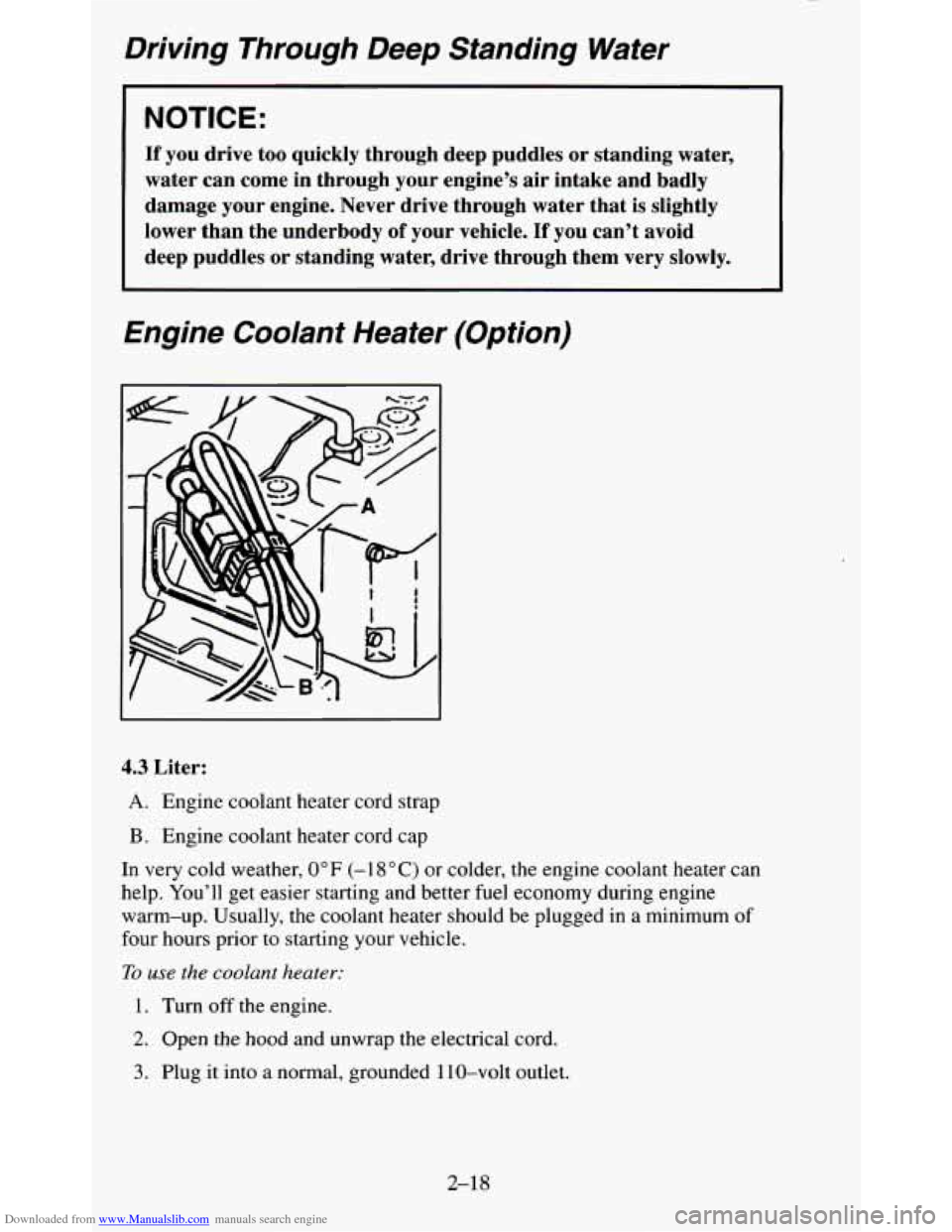
Engine Coolant Heater (Option)
4.3 Liter:
A. Engine coolant heater cord strap
B. Engine coolant heater cord cap
In very cold weather, 0°F (-1 8 "C) or colder, the engine coolant heater can
help. You'll get easier starting and better fuel economy during engine
warm-up. Usually, the coolant heater should be plugged in a mi\
nimum
of
four hours prior to starting your vehicle.
To
use the coolant heater:
1. Turn off the engine.
2. Open the hood and unwrap the electrical cord.
3. Plug it into a normal, grounded 1 10-volt outlet.
2-18