Page 8 of 380
Downloaded from www.Manualslib.com manuals search engine Vehicle Symbols
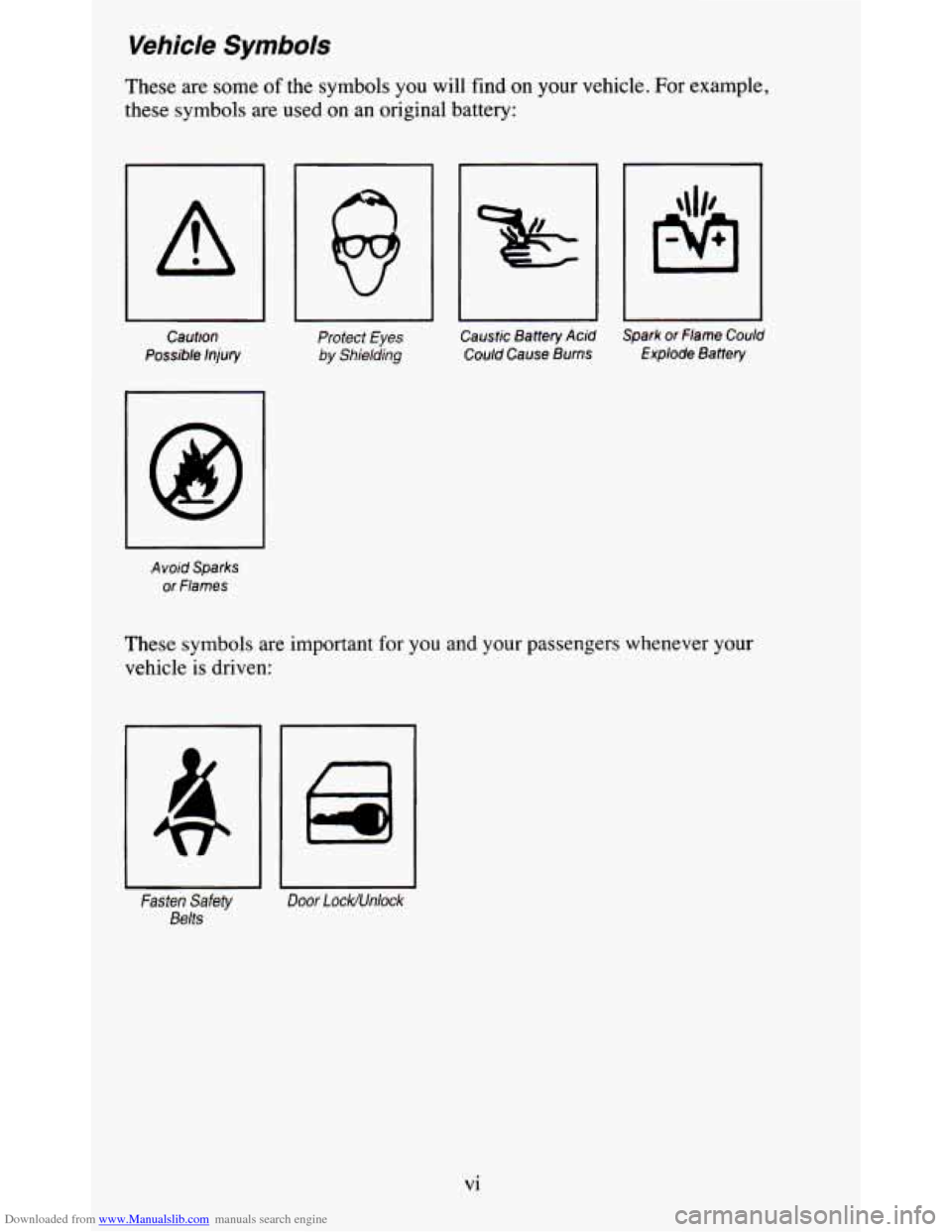
These are some of the symbols you will find on your vehicle. For example,
these symbols are used on an original battery:
Caution
Possible
Injury
Protect Eyes
by Shielding
Avoid Sparks
or Flames
Caustic Battery Acid
Could Cause Burns Spark or
flame Could Explode Battery
These symbols are important for you and your passengers whenever your
vehicle is driven:
uu
Fasten Safety Door Lock/Unlock
Belts
vi
Page 206 of 380
Downloaded from www.Manualslib.com manuals search engine You could be injured if the vehicles roll. Set the parking brake firmly
on each vehicle. Put an automatic transmission in PARK (P) or a
manual transmission in NEUTRAL
(N). If you have a
four-wheel-drive vehicle with a manual transfer case shift lever, be
sure the transfer case
is not in NEUTRAL (N).
3. Turn off the ignition on both vehicles. Turn off all lights that aren’t
needed, and radios. This will avoid sparks and help save both batteries
And it could save your radio!
NOTICE:
If you leave your radio on, it could be badly damaged. The
repair wouldn’t be covered by your warranty.
~~
4. Open both hoods and locate the batteries. Find the positive (+) and
negative
(-) terminals on each battery.
5. Check that the jumper cables don’t have loose or missing insulation. If
they do, you could get a shock. The vehicles could be damaged too.
Before you connect the cables, here are some basic things you should
know. Positive (+) will go to positive (+) and negative (-) will go to
negative
(-) or a metal engine part. Don’t connect (+) to (-) or you’ll
get a
short that would damage the battery and maybe other parts too.
5-4
Page 208 of 380
Downloaded from www.Manualslib.com manuals search engine Good Battery (-) Heavy Metal Engine Part
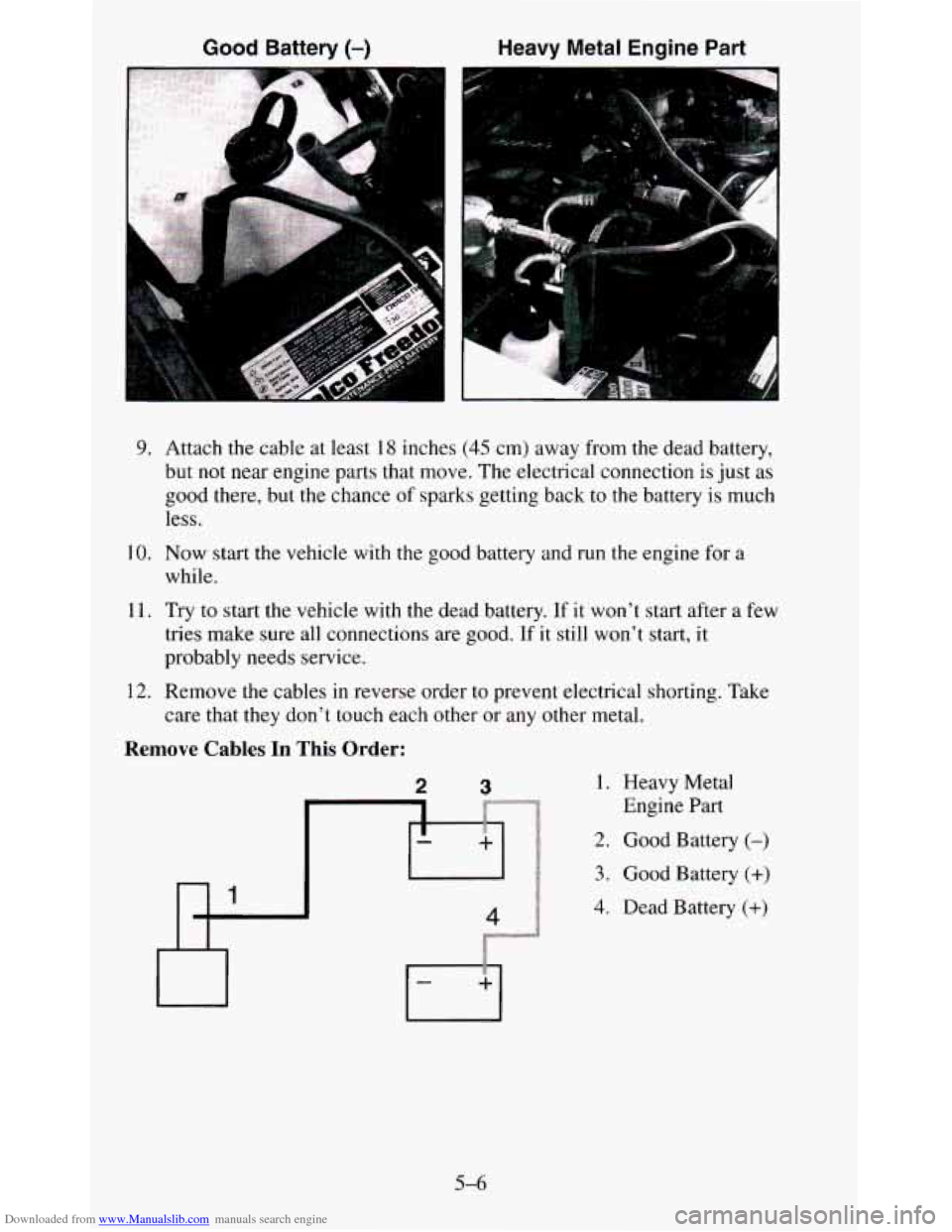
9. Attach the cable at least 18 inches (45 cm) away from the dead battery,
but
not near engine parts that move. The electrical connection is just as
good there, but the chance of sparks getting back to the batt\
ery
is much
less.
10. Now start the vehicle with the good battery and run the engin\
e for a
11. Try to start the vehicle with the dead battery. If it won’t start after a few
while.
tries make sure all connections are good.
If it still won’t start, it
probably needs service.
12. Remove the cables in reverse order to prevent electrical shorti\
ng. Take
care that they don’t touch each other or any other metal.
Remove Cables In This Order:
3 2
2 1. Heavy Metal
Engine Part
2. Good Battery (-)
3. Good Battery (+)
4. Dead Battery (+)
5-6
Page 244 of 380

Downloaded from www.Manualslib.com manuals search engine Gasolines for Cleaner Air
Your use of gasoline with deposit control additives will help preven\
t
deposits from forming in your engine and fuel system. That hel\
ps keep your
engine
in tune and your emission control system working properly. It’s \
good
for your vehicle, and you’ll be doing your part for cleaner air.
Many gasolines are now blended with oxygenates. General Motors
recommends that you use gasolines with these blending materials, such as
MTBE and ethanol. By doing so, you can help clean the air, especially in
those parts of the country that have high carbon monoxide levels.
In addition, some gasoline suppliers are now producing reformulated
gasolines. These gasolines are specially designed to reduce vehicle
emissions. General Motors recommends that you use reformulated gasoline.
By doing
so, you can help clean the air, especially in those parts of the
country that have high ozone levels.
You should ask your service station operators if their gasolines contain
deposit control additives and oxygenates, and
if they have been
reformulated
to reduce vehicle emissions.
Fuels in Foreign Countries
If you plan on driving in another country outside the U.S. or Canada,
unleaded fuel may be hard to find.
Do not use leaded gasoline. If you use
even one tankful, your emission controls won’t work well or at all. With
continuous use, spark plugs can get fouled, the exhaust system can corrode,
and your engine oil can deteriorate quickly. Your vehicle’s oxygen sensor
will be damaged. All of that means costly repairs that wouldn’t be covered
by your warranty.
To check on fuel availability, ask an auto club, or contact a major oil
company that does business in the country where you’ll be driving.
You can also write us at the following address for advice. Just tell us where
you’re going and give your Vehicle Identification Number (VI\
N).
General Motors Overseas Distribution Corporation
North American Export Sales (NAES)
1908 Colonel Sam Drive
Oshawa, Ontario
L1H 8P7
6-4
Page 310 of 380
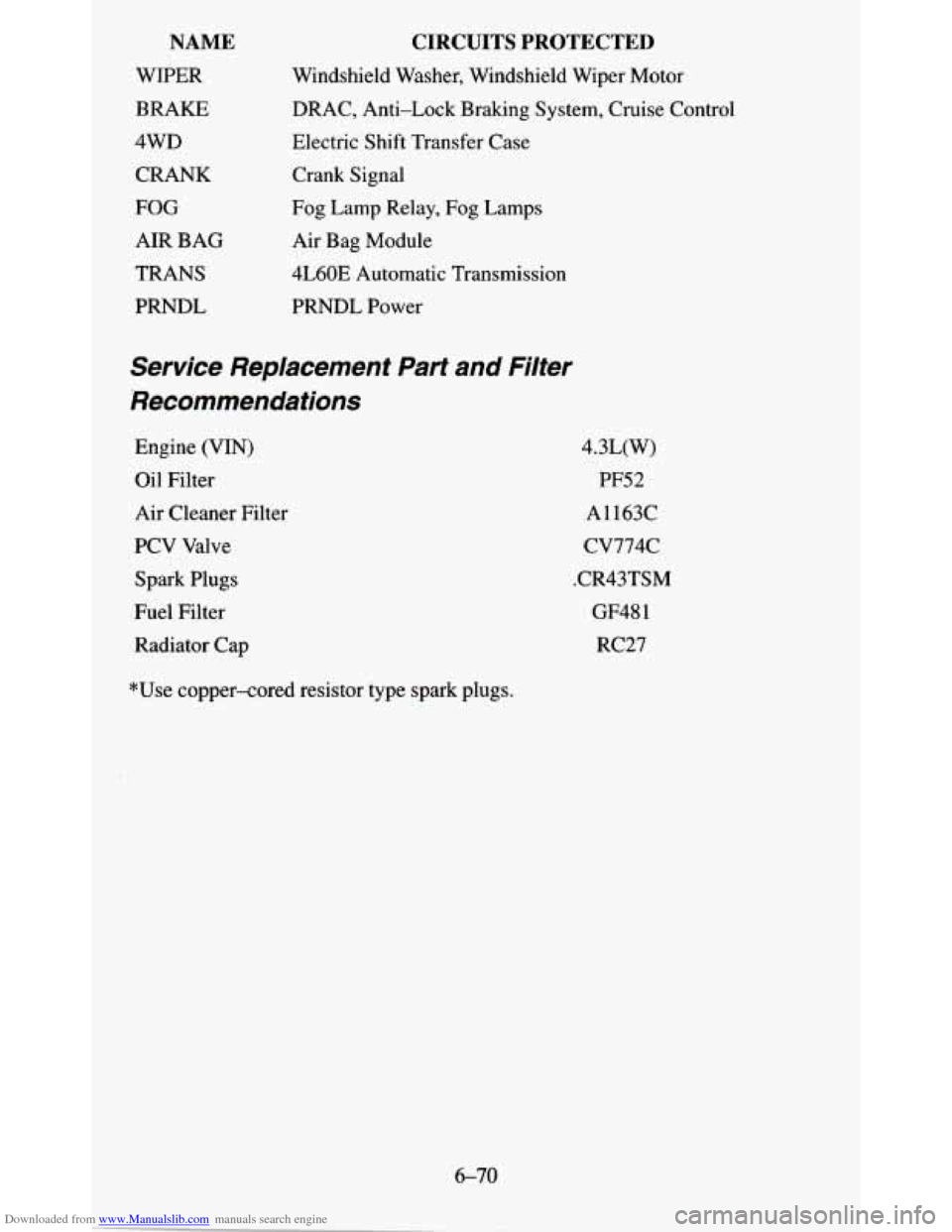
Downloaded from www.Manualslib.com manuals search engine NAME
WIPER
BRAKE
4WD
CRANK
FOG
AIR BAG
TRANS PRNDL
CIRCUITS PROTECTED
Windshield Washer, Windshield Wiper Motor
DRAC, Anti-Lock Braking
System, Cruise Control
Electric Shift Transfer Case
Crank Signal
Fog Lamp Relay, Fog Lamps
Air Bag Module
4L60E Automatic Transmission
PRNDL Power
Service Replacement Part and Filter
Recommendations
Engine (VIN)
Oil Filter
Air Cleaner Filter
PCV Valve Spark Plugs
Fuel Filter
Radiator Cap 4.3L(W)
PF52
A1163C
cv774c
.CR43TSM GF48 1
RC27
*Use copper-cored resistor type spark plugs.
6-70
Page 316 of 380
Downloaded from www.Manualslib.com manuals search engine I Schedule I Definition I
Follow Maintenance Schedule I if any one of these is true for your vehicle:
Most trips are less than 5 to 10 miles (8 to 16 km). This is particularly
important when outside temperatures are below freezing.
Most trips include extensive idling (such as frequent driving \
in stop and
go traffic).
0 You operate your vehicle in dusty areas or off-road frequently.
0 You frequently two a trailer or use a carrier on top of your vehicle.
Schedule
I should also be followed if the vehicle is used for delivery
service, police, taxi, or other commercial application.
I Schedule / Intervals I
Every 3,000 Miles (5 000 km) or 3 Months
Engine Oil and Filter Change
Chassis Lubrication
Drive Axle Service
At 6,000 Miles (10 000 km) - Then Every 12,000 Miles (25 000
km)
Tire Rotation
Every 15,000 Miles (25 000 km)
Air Cleaner Filter Inspection, if driving in dusty conditions
Front Wheel Bearing Repack
(2WD Only)
Every 30,000 Miles (50 000 km)
Air Cleaner Filter Replacement
Spark Plug Replacement
Fuel Filter Replacement
Cooling System Service (or every
24 months)
Every 50,000 Miles (83 000 km)
Automatic Transmission Service (severe conditions)
7-4
Page 317 of 380
Downloaded from www.Manualslib.com manuals search engine Every 60,000 Miles (100 000 km)
Engine Accessory Drive Belt Inspection
Spark Plug Wire Inspection
Engine Timing Check
Fuel Tank, Cap and Lines Inspection
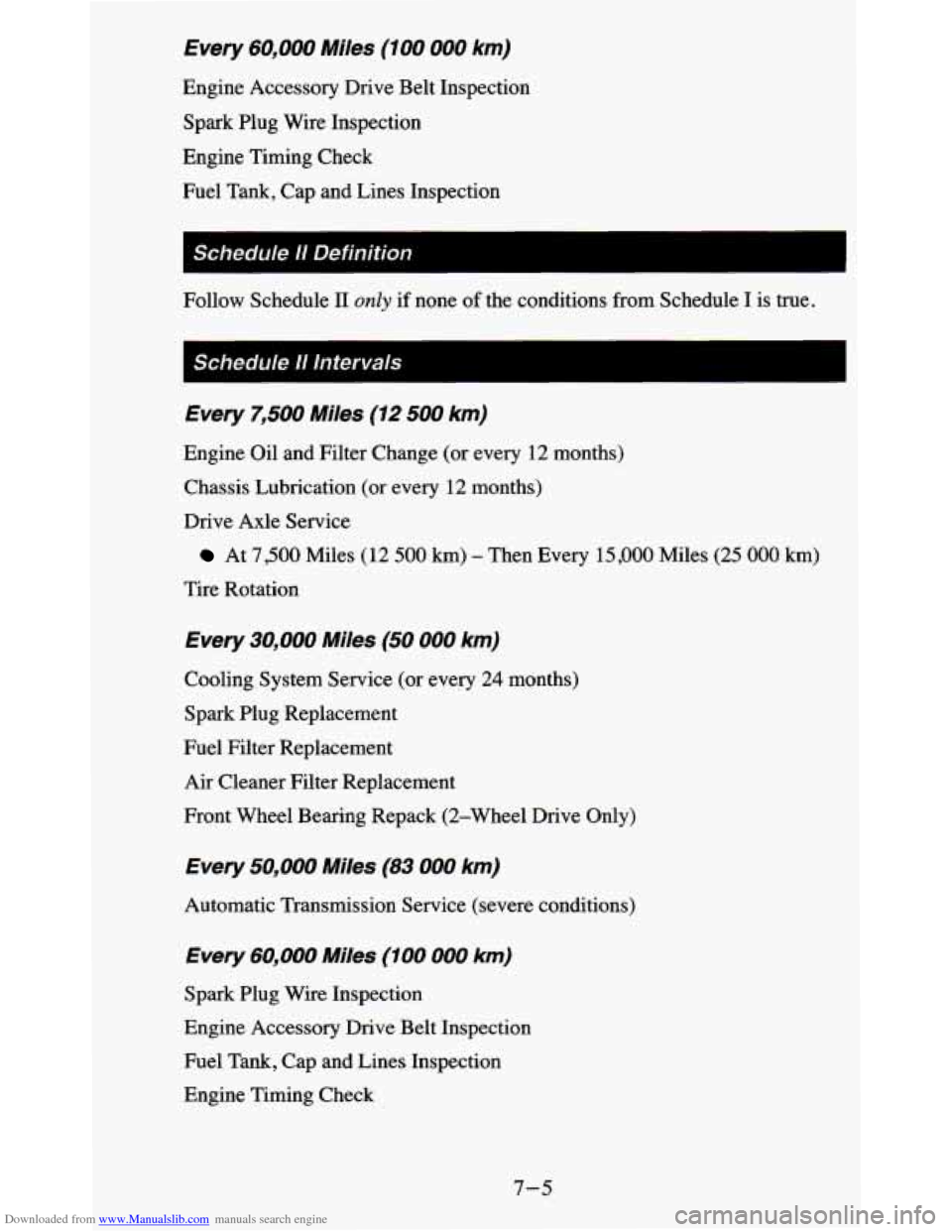
Follow Schedule I1
only if none of the conditions from Schedule I is true.
I Schedule // /nterva/s
Every 7,500 Miles (12 500 km)
Engine Oil and Filter Change (or every 12 months)
Chassis Lubrication (or every 12 months)
Drive Axle Service
At 7,500 Miles ( 12 500 km) - Then Every 15,000 Miles (25 000 km)
Tire Rotation
Every 30,000 Miles (50 000 km)
Cooling System Service (or every 24 months)
Spark Plug Replacement
Fuel Filter Replacement
Air Cleaner Filter Replacement
Front Wheel Bearing Repack (2-Wheel Drive Only)
Every 50,000 Miles (83 000 km)
Automatic Transmission Service (severe conditions)
Every 60,000 Miles (100 000 km)
Spark Plug Wire Inspection
Engine Accessory Drive Belt Inspection
Fuel Tank, Cap and Lines Inspection
Engine Timing Check
7-5
Page 324 of 380
Downloaded from www.Manualslib.com manuals search engine I Maintenance Schedule I I
(Continued)
0 For 2-Wheel Drive vehicles only: Clean and repack the front wheel
bearings (or at each brake relining, whichever occurs first).
0 Replace spark plugs. An Emission Control Service.
0 Replace air cleaner filter. Replace filter more often under dusty
0 Rotate tires. See “Tire Inspection and Rotation” in the Index for proper
conditions.
An Emission Control
Service.
rotation pattern and additional information.
DATE
SERVICED BY ACTUAL MILEAGE
33,000 Miles (55 000 km)
0
Change engine oil and filter (or every 3 months, whichever occurs
first).
An Emission Control Service.
Lubricate the front suspension, ball joints (ball joints should not be
lubricated unless their temperature is
10 OF (-1 2 O C) or higher. When
the weather is cold, let them warm up before lubricating them or they
could be damaged.), steering linkage and transfer case shift linkage,
parking brake cable guides, propshaft splines, universal joints, brake
pedal springs, and clutch pedal springs at every oil change (or every
6
months, whichever occurs first).
Check readfront axle fluid level and add fluid as needed. Check
constant velocity
joints and axle seals for leaking.**
DATE
SERVICED BY ACTUAL MILEAGE
L
7- 12