Page 216 of 380
Downloaded from www.Manualslib.com manuals search engine If No Steam IS Coming From Your Engine
If you get the overheat warning but see or hear no steam, the problem may
not be too serious. Sometimes the engine can get a little too hot when you:
0 Climb a long hill on a hot day.
0 Stop after high speed driving.
0 Idle for long periods in traffic.
e Tow a trailer. See "Driving on Grades" in the Index.
If
YOU get the overheat warning with no sign of steam, try this for a minute
or
so:
1. Turn off your air conditioner.
2. Turn on your heater to full hot at the highest fan speed and open the
window as necessary.
3. If you're in a traffic jam, shift to NEUTRAL (N); otherwise, shift to the
highest gear while driving
- AUTOMATIC OVERDRIVE (@) or
DRIVE (D) for automatic transmissions.
If you no longer have the overheat warning, you can drive. Just \
to be safe,
drive slower for about ten minutes.
If the warning doesn't come back on,
you
can drive normally.
If the warning continues, pull over, stop, and park your vehicle \
right away.
If there's still no sign of steam, push the accelerator until the engine speed is
about twice as fast
as normal idle speed. Bring the engine speed back to
normal idle speed after two or three minutes. Now
see if the warning stops.
But then, if you still have the warning,
turn oflthe engine and get everyone
out
of the vehicle until it cools down.
You may decide not to lift the hood but to get service help right away.
ici
5-14
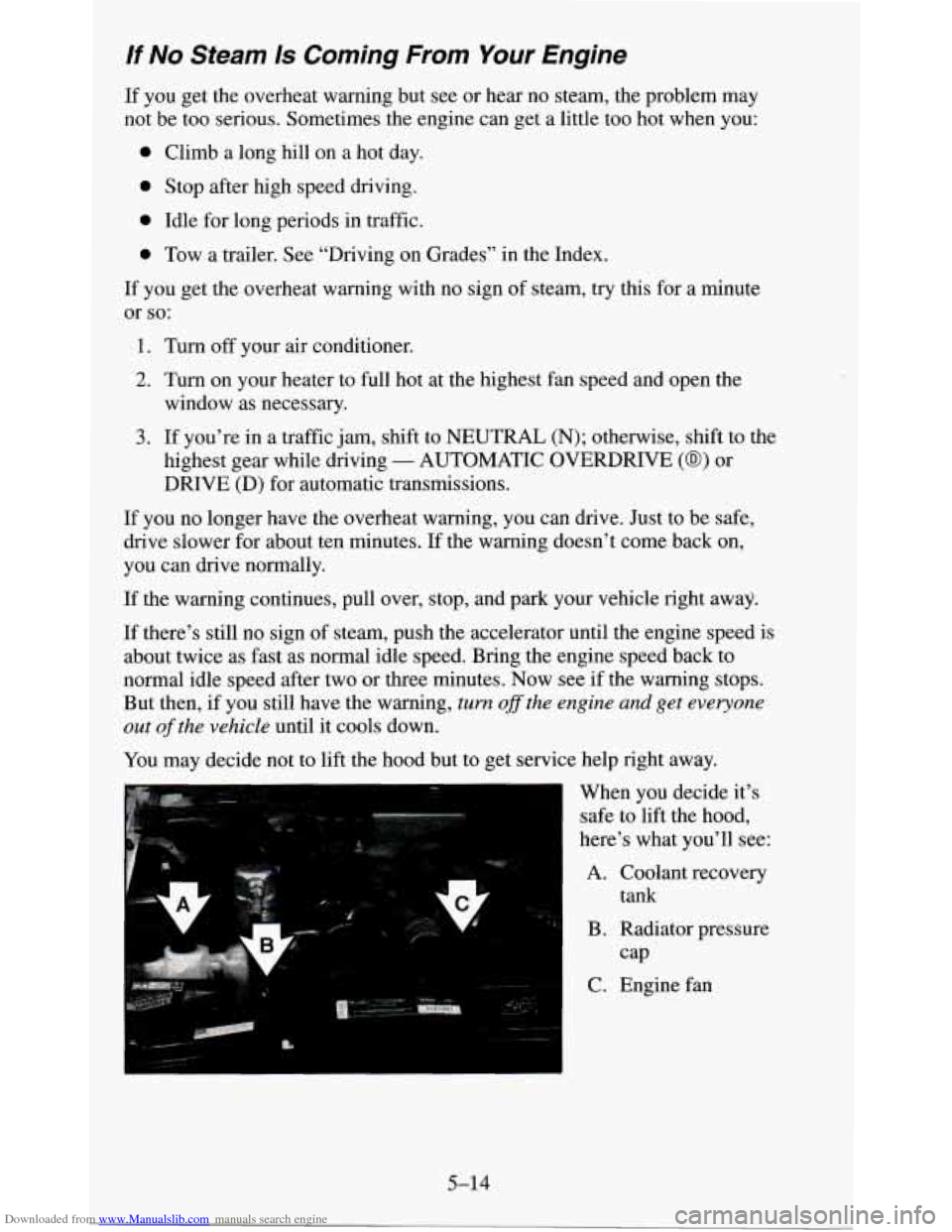
When you decide it's
safe to lift the hood,
here's what you'll
see:
A. Coolant recovery
B. Radiator pressure C. Engine fan tank
cap
Page 220 of 380
Downloaded from www.Manualslib.com manuals search engine How to Add Coolant to the Radiator
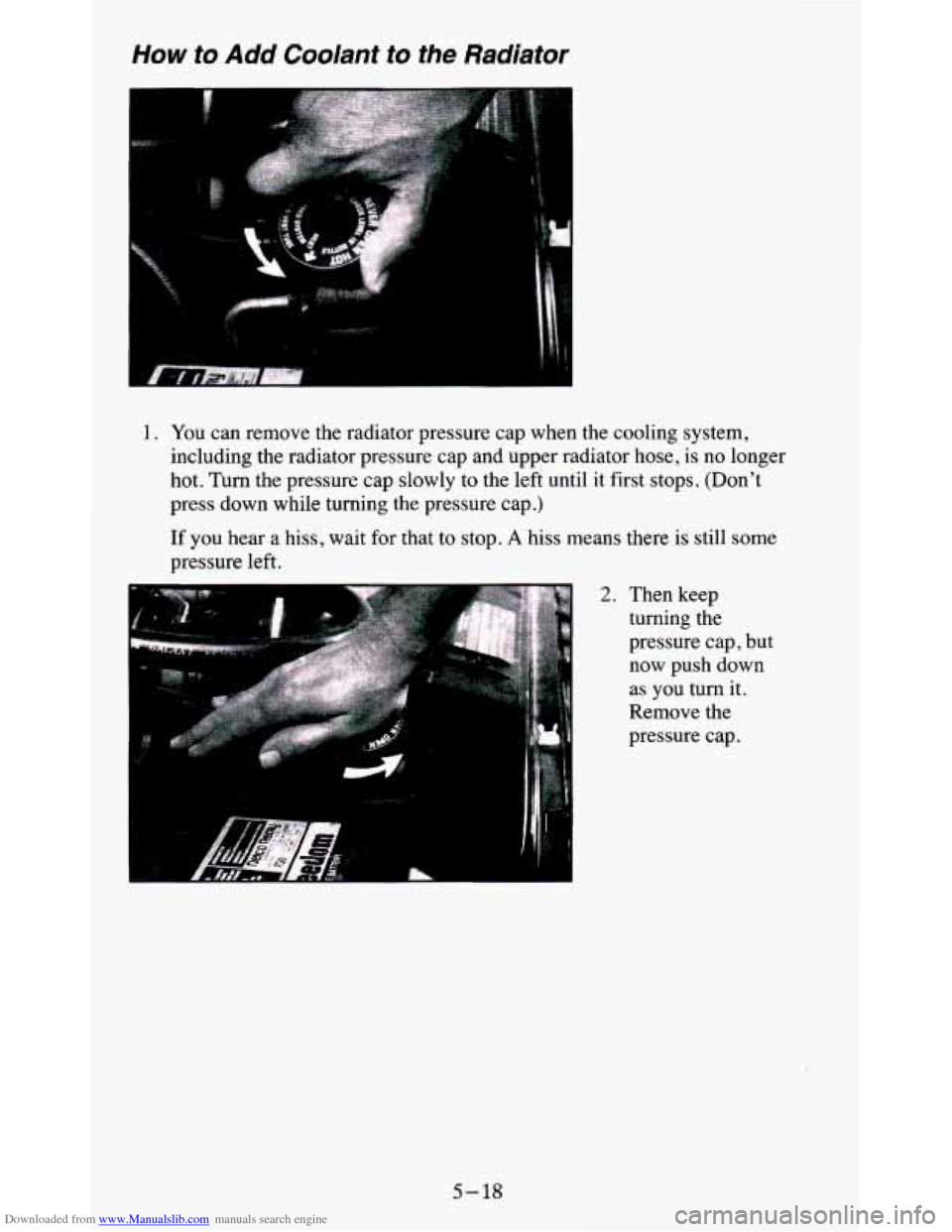
1. You can remove the radiator pressure cap when the cooling system,
including the radiator pressure cap and upper radiator hose, is
no longer
hot. Turn the pressure cap slowly
to the left until it first stops. (Don't
press down while turning the pressure cap.)
If you hear a hiss, wait for that to stop. A hiss means there is still some
pressure left.
.. "
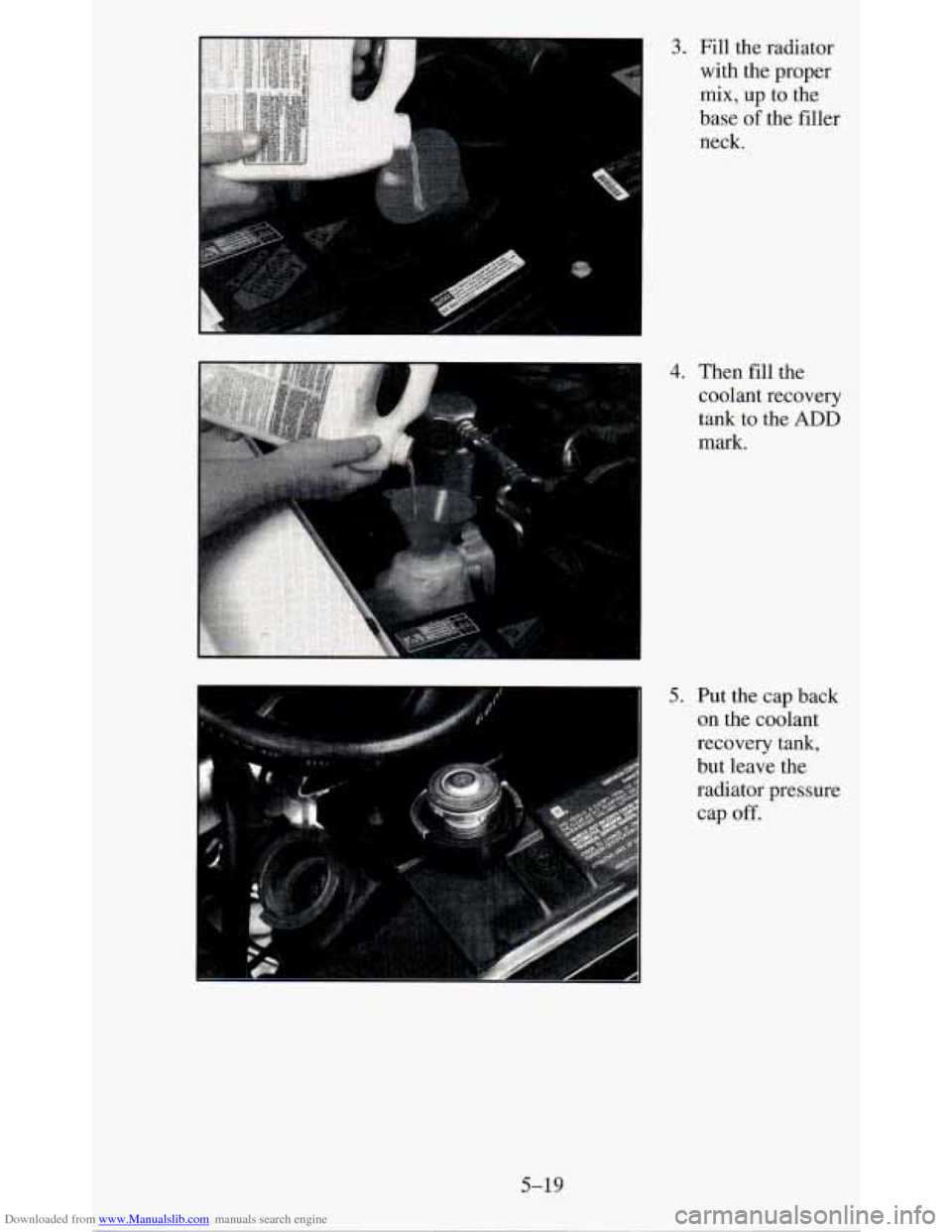
as you turn it.
Remove the
pressure cap.
5-18
Page 221 of 380
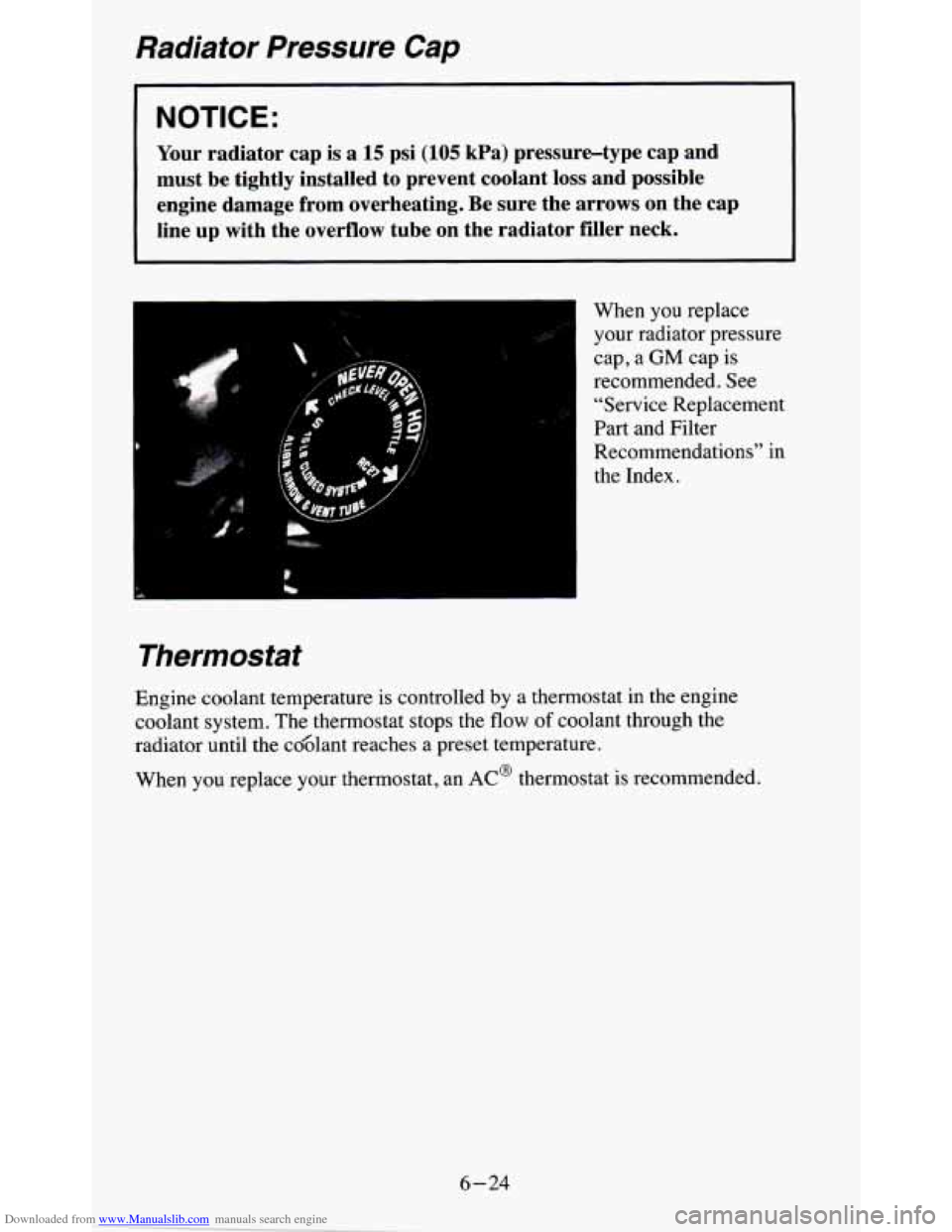
Downloaded from www.Manualslib.com manuals search engine 3. Fill the radiator
with the proper
mix, up to the
base
of the filler
1
neck.
4. Then fill the coolant recovery
tank
to the ADD
mark.
5. Put the cap back
on the coolant
recovery tank,
but leave the
radiator pressure cap off.
5-19
Page 222 of 380
Downloaded from www.Manualslib.com manuals search engine 1
6. Start the engine
and let it
run until
you can feel'the
upper radiator hose getting hot.
Watch out for the
engine fan.
7. By this time the coolant level inside the filler neck may be lower. If the
level is lower, add more of the proper mix through the filler neck unt\
il
the level reaches the base of the filler neck.
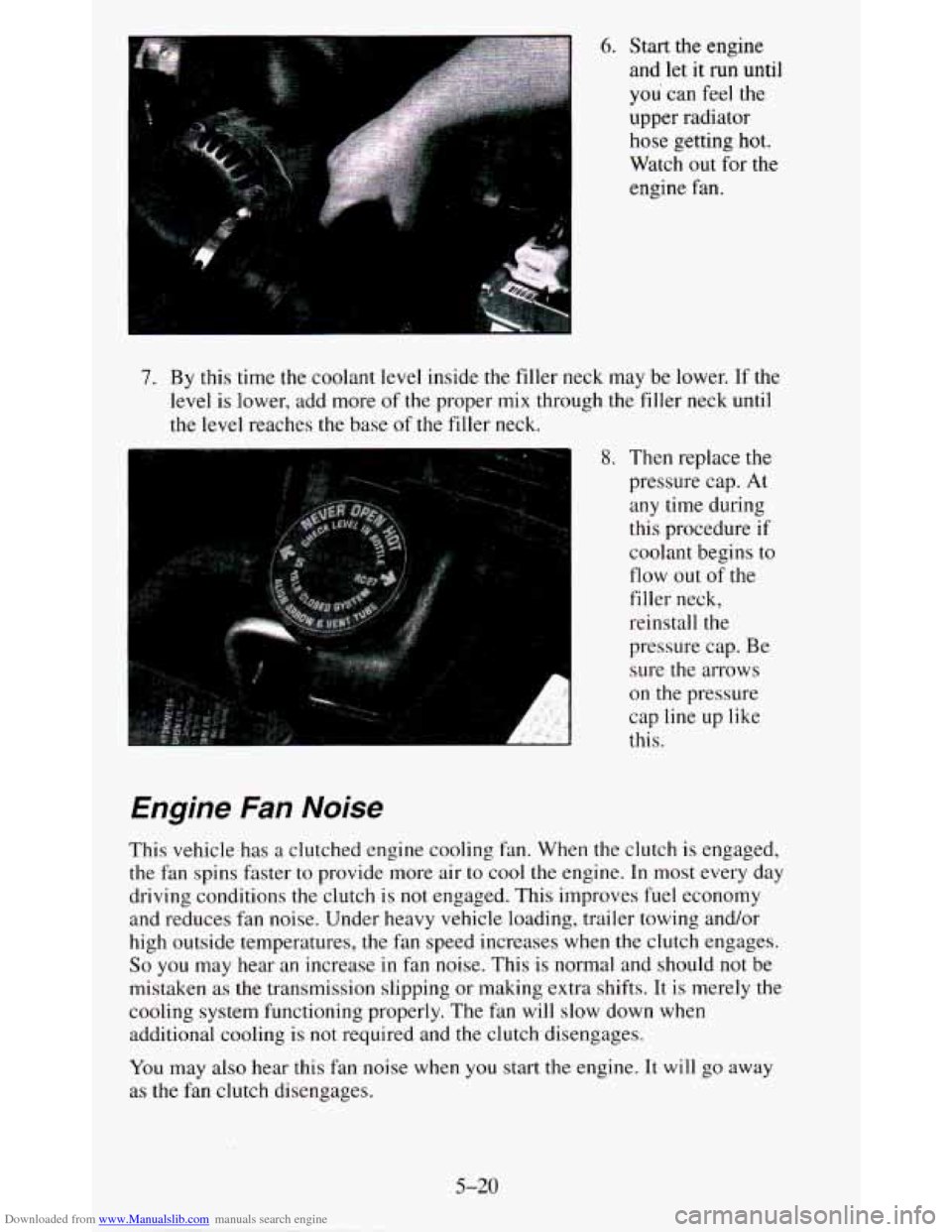
8. Then replace the
pressure cap. At
any time during
this procedure if
coolant begins to
flow out of the
filler neck,
reinstall the
pressure cap. Be
sure the arrows
on the pressure
cap line
up like
this.
Engine Fan Noise
This vehicle has a clutched engine cooling fan. When the clutc\
h is engaged, the fan spins faster to provide more air to cool the engine. \
In most every day
driving conditions the clutch
is not engaged. This improves fuel economy
and reduces fan noise. Under heavy vehicle loading, trailer tow\
ing and/or
high outside temperatures, the fan speed increases when
the clutch engages.
So you may hear an increase in fan noise. This is normal and should not be
mistaken
as the transmission slipping or making extra shifts. It is merely \
the
cooling system functioning properly. The fan will slow down when
additional cooling is not required and
the clutch disengages.
You may also hear this fan noise when you start the engine. It will go away
as the fan clutch disengages.
5-20
Page 264 of 380
Downloaded from www.Manualslib.com manuals search engine Radiator Pressure Cap
NOTICE:
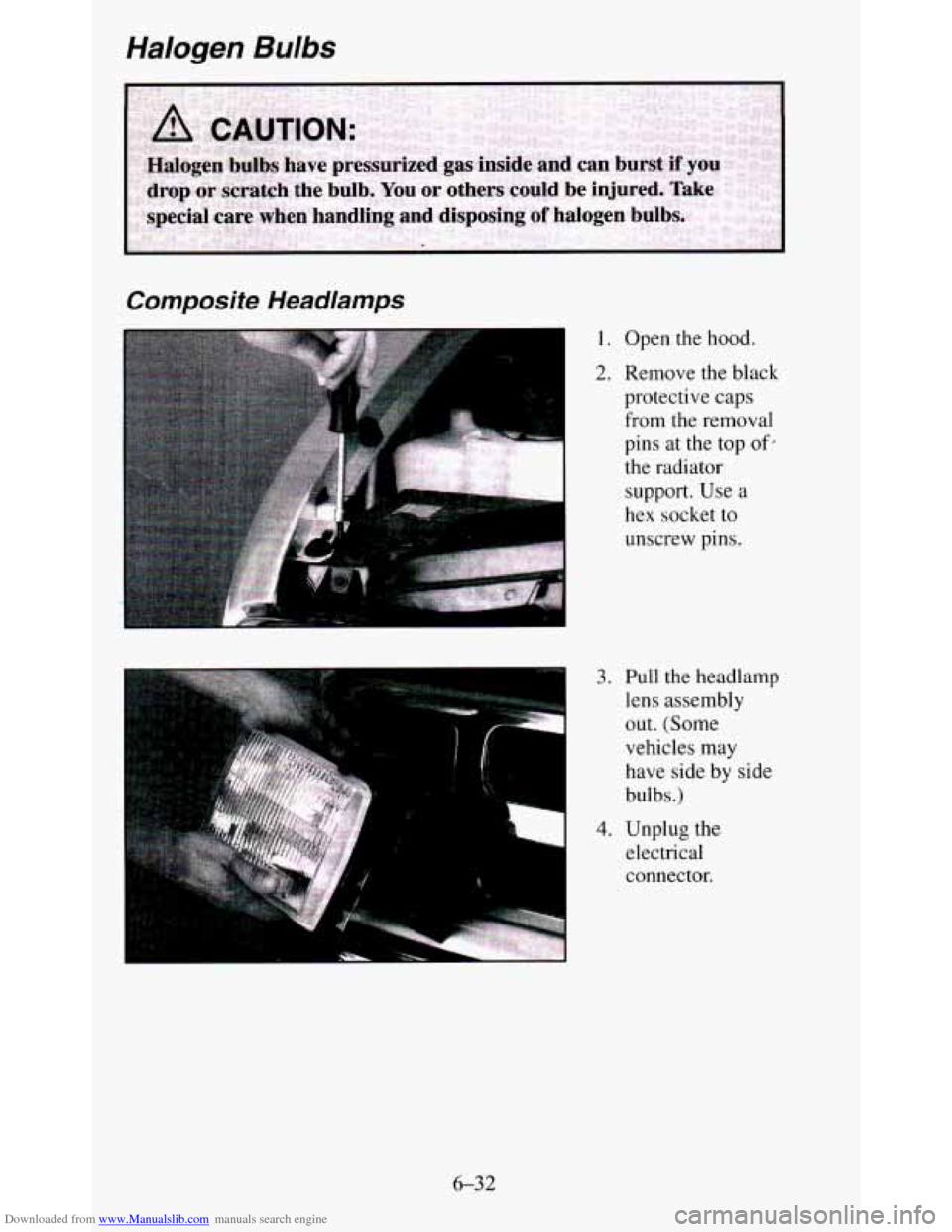
Your radiator cap is a 15 psi (105 kPa) pressure-type cap and
must be tightly installed to prevent coolant loss and possible \
engine damage from overheating. Be sure the arrows on the cap \
line up with the overflow tube on the radiator filler neck.
When you replace your radiator pressure
cap, a
GM cap is
recommended. See
“Service Replacement
Part and Filter
Recommendations” in
the Index.
Thermostat
Engine coolant temperature is controlled by a thermostat in the engine
coolant system. The thermostat stops the
flow of coolant through the
radiator until the co6lant reaches a preset temperature.
When you replace your thermostat, an
AC@ thermostat is recommended.
6-24
Page 266 of 380
Downloaded from www.Manualslib.com manuals search engine Windshield Washer Fluid
What To Use
When you need windshield washer fluid, be sure to read the manufacturer’s
instructions before use. If you will be operating your vehicle in
an area
where the temperature may fall below freezing, use a fluid that has
sufficient protection against freezing.
To Add
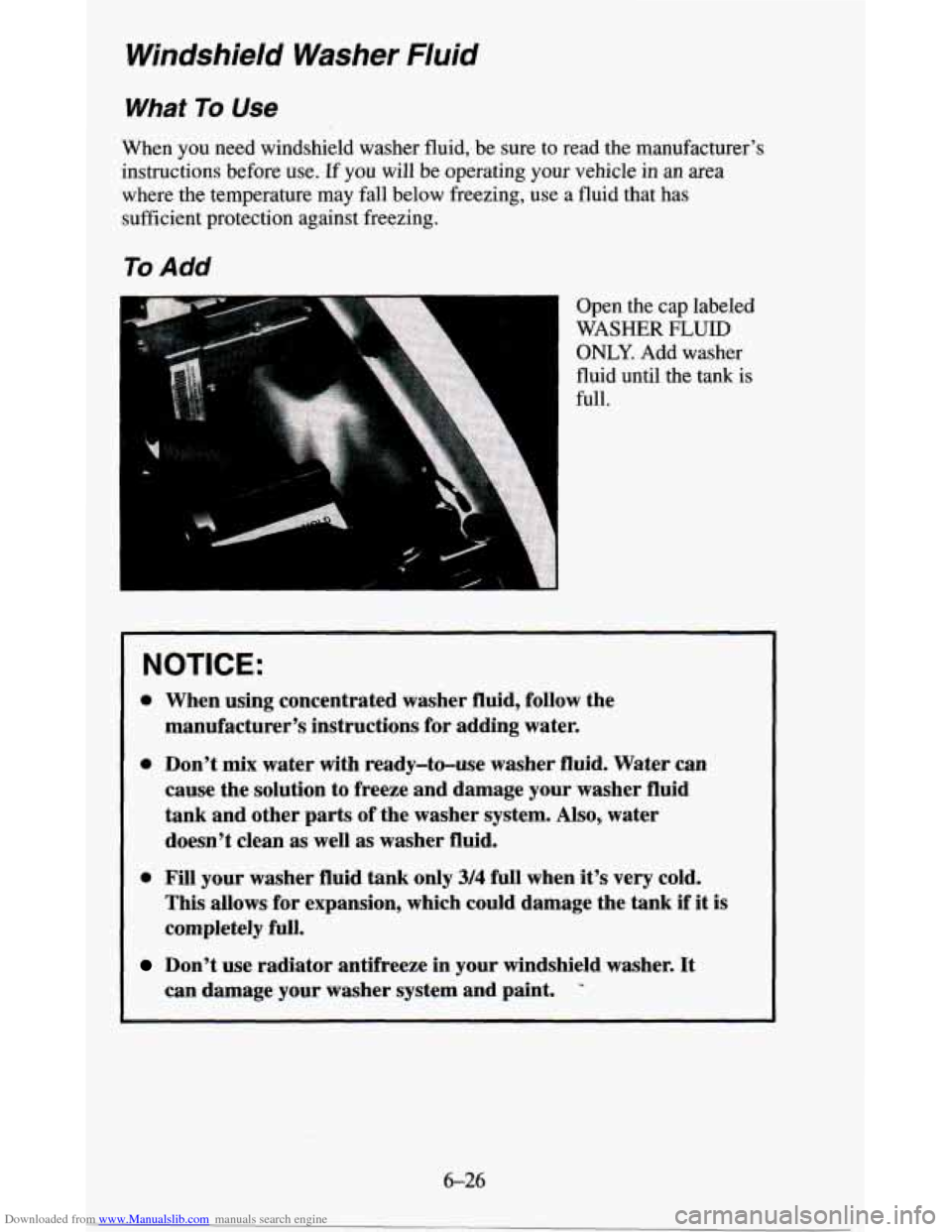
Open the cap labeled
WASHER FLUID
OmY. Add washer
fluid until the tank is
full.
~ NOTICE:
~ 0 When using concentrated washer fluid, follow the
manufacturer’s instructions for adding water.
’ 0 Don’t mix water with ready-to-use washer fluid. Water can
cause the solution to freeze and damage your washer fluid
tank and other parts of the washer system. Also, water
doesn’t clean
as well as washer fluid.
0 Fill your washer fluid tank only 3/4 full when it’s very cold.
This allows for expansion, which could damage the tank if it is
completely full.
Don’t use radiator antifreeze in your windshield washer. It
can damage your washer system and paint. -
6-26
Page 272 of 380
Downloaded from www.Manualslib.com manuals search engine Halogen Bulbs
Composite Headlamps
I. Open the hood.
2. Remove the black
protective caps
from the removal
pins at the top
of-
the radiator support.
Use a
hex socket
to
unscrew pins.
3. Pull the headlamp
lens assembly
out. (Some
vehicles may
have side by side
bulbs.)
4. Unplug the electrical
connector.
6-32
Page 310 of 380
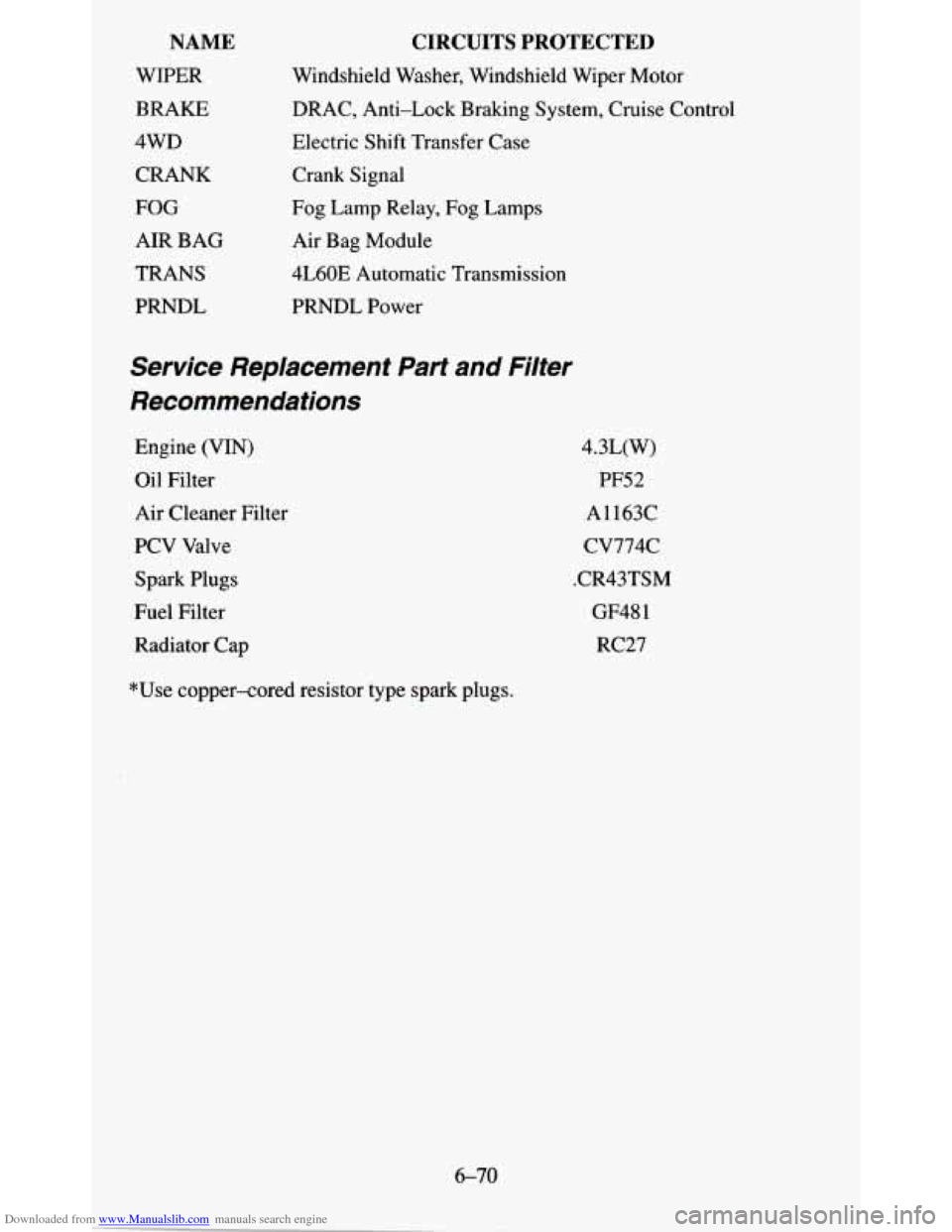
Downloaded from www.Manualslib.com manuals search engine NAME
WIPER
BRAKE
4WD
CRANK
FOG
AIR BAG
TRANS PRNDL
CIRCUITS PROTECTED
Windshield Washer, Windshield Wiper Motor
DRAC, Anti-Lock Braking
System, Cruise Control
Electric Shift Transfer Case
Crank Signal
Fog Lamp Relay, Fog Lamps
Air Bag Module
4L60E Automatic Transmission
PRNDL Power
Service Replacement Part and Filter
Recommendations
Engine (VIN)
Oil Filter
Air Cleaner Filter
PCV Valve Spark Plugs
Fuel Filter
Radiator Cap 4.3L(W)
PF52
A1163C
cv774c
.CR43TSM GF48 1
RC27
*Use copper-cored resistor type spark plugs.
6-70