Page 106 of 380

Downloaded from www.Manualslib.com manuals search engine Accessory Power Outlets (Option)
If you have accessory
power outlets, you can
plug in auxiliary
electrical equipment.
Just pull down from
the top of the door and
follow the proper installation
instructions that are
included with any
electrical equipment
you install.
These circuits are protected by a fuse and
have maximum current levels.
NOTICE:
When using the accessory power outlets, maximum electrical
load must not exceed 25 amps. Always turn off any electrical
equipment when not
in use. Leaving electrical equipment on for
extended periods will drain your battery.
Cigarette Lighter/Ashtrays
..
To use the lighter,
press it in all the way,
and let
go. When it's
ready,
it will pop back
by itself,
Don't hold a cigarette lighter in with
your hand while it is heating. If you
do, it won't be able to back away from the heating element when it's ready.
That can make it overload, damaging the lighter and the heating element.
2-54
Page 110 of 380
Downloaded from www.Manualslib.com manuals search engine Center Overhead Console
- I
P
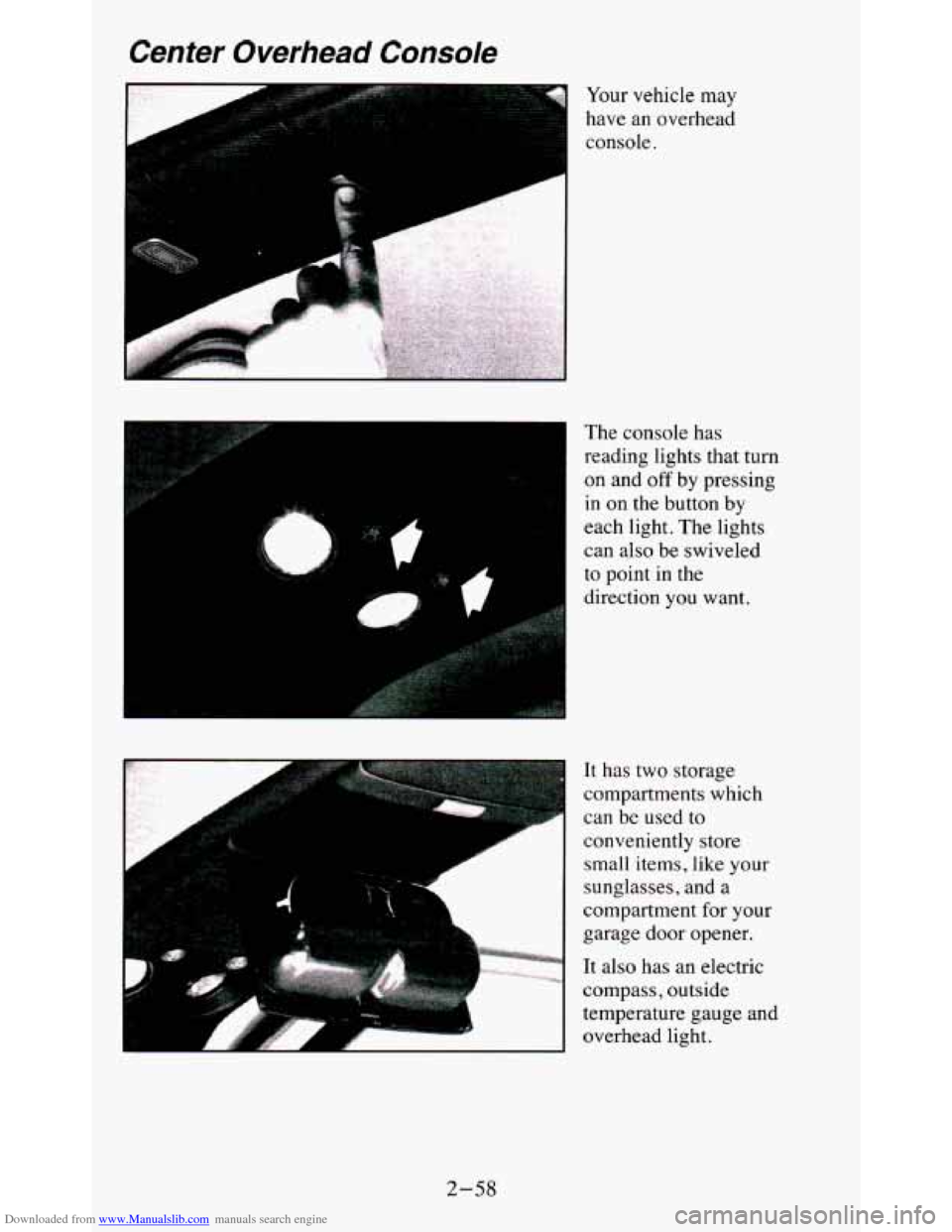
Your vehicle may
have an overhead
console
+
The console has
reading lights that turn
on and off by pressing
in on the button by
each light. The lights
can also be swiveled
to point in the
direction
you want.
It has two storage
compartments which
can
be used to
conveniently store small
items, like your
sunglasses, and a
compartment for your
garage door opener.
It also has an electric
compass, outside
temperature gauge and
overhead light.
2-58
Page 114 of 380
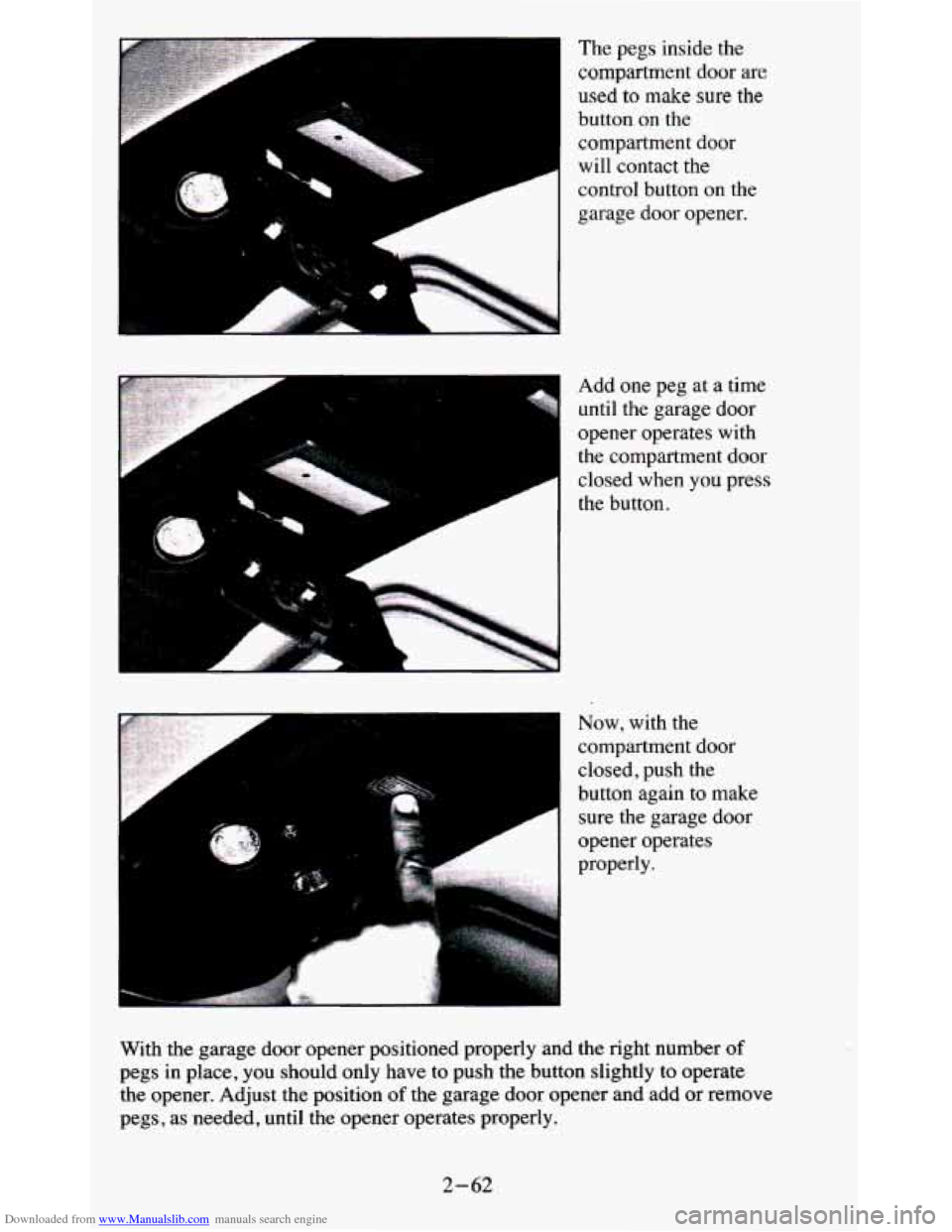
Downloaded from www.Manualslib.com manuals search engine The pegs inside the
compartment door are
used
to make sure the
button on the
1
compartment door
will contact the
control button on the
garage door opener.
Add one peg at a time
until the garage door
opener operates with
the compartment door
closed when you press
the button.
F
Now, with the
compartment door
closed, push the
button again to make
sure the garage door
opener operates
properly.
With the garage door opener positioned properly and the right number
of
pegs in place, you should only have to push the button slightly to operate
the opener. Adjust the position
of the garage door opener and add or remove
pegs, as needed, until the opener operates properly.
2-62
Page 115 of 380
Downloaded from www.Manualslib.com manuals search engine Convenience Net
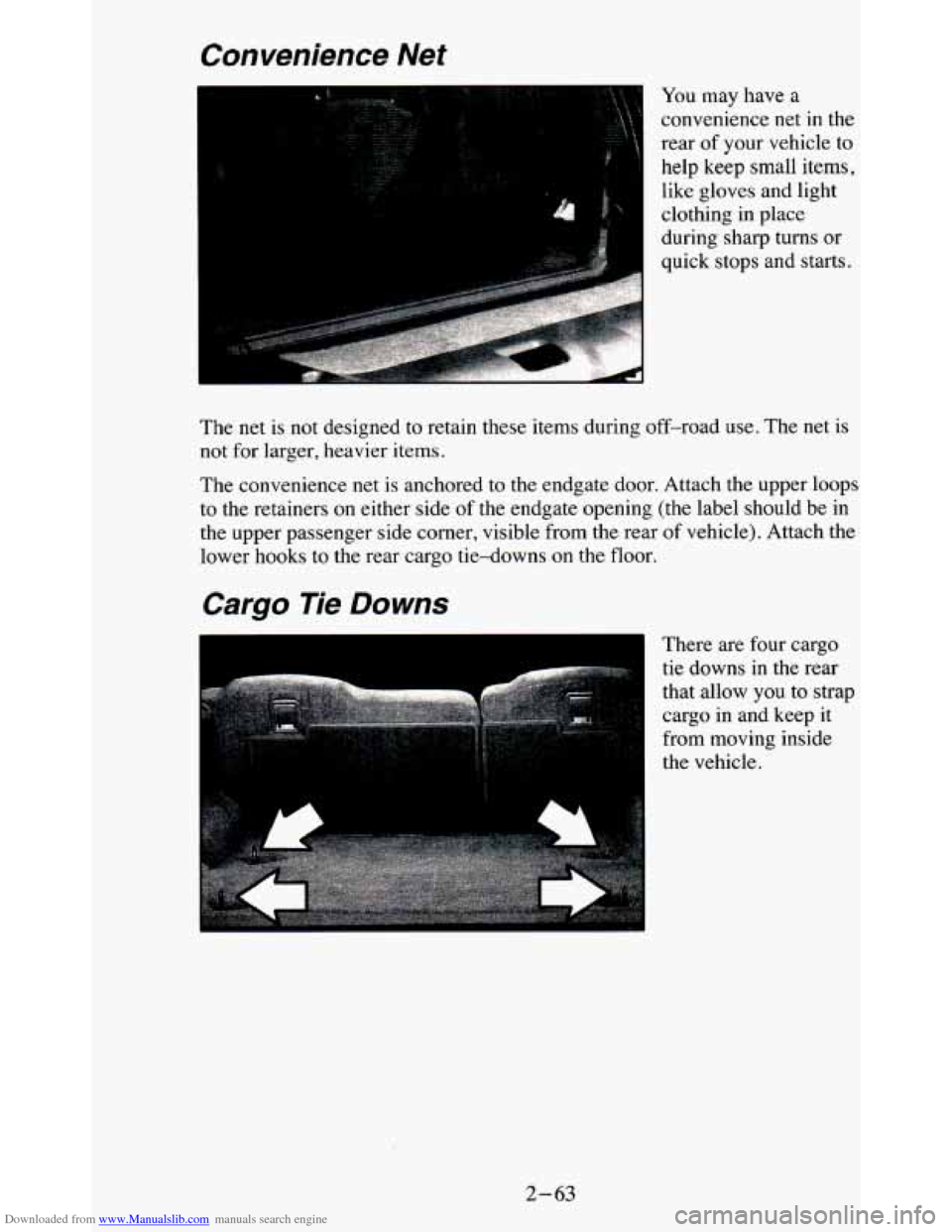
You may have a
convenience net
in the
rear
of your vehicle to
help keep small items,
like gloves and light
clothing
in place
during sharp turns or
quick stops
and starts.
The net
is not designed to retain these items during off-road use. The net is
not for larger, heavier items.
The convenience net is anchored to the endgate door. Attach the upper loops
to the retainers on either side
of the endgate opening (the label should be in
the upper passenger side corner, visible from the rear of vehicle). Attach the
lower hooks to the rear cargo tie-downs on the floor.
Cargo Tie Downs
There are four cargo
tie downs in the rear
that allow you to strap
cargo in and keep it
from moving inside
the vehicle.
2-63
Page 117 of 380
Downloaded from www.Manualslib.com manuals search engine Instrument Panel
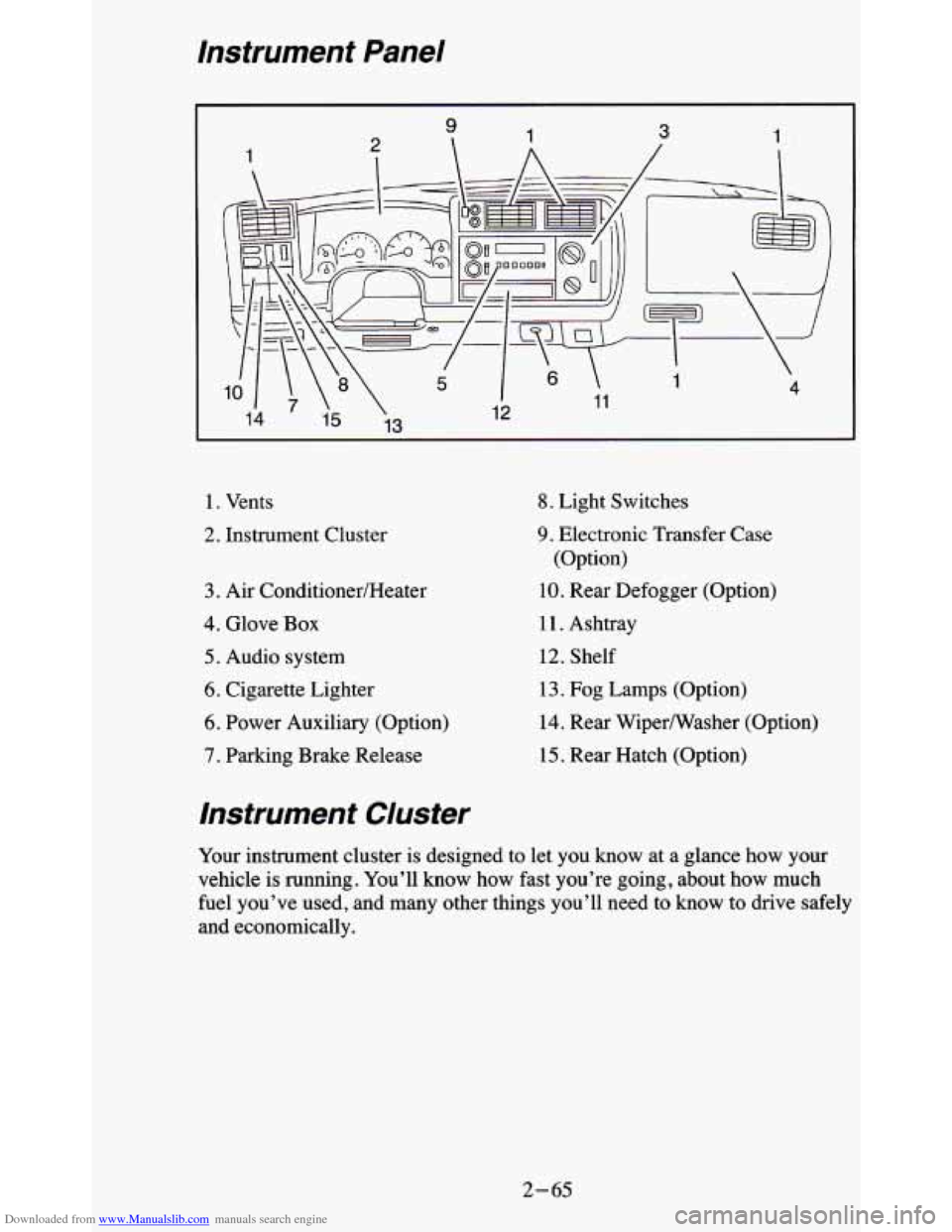
1. Vents
2. Instrument Cluster
3. Air ConditionedHeater
4. Glove Box
5. Audio system
6. Cigarette Lighter
6. Power Auxiliary (Option)
7. Parking Brake Release
8. Light Switches
9. Electronic Transfer Case
(Option)
10. Rear Defogger (Option)
11. Ashtray
12. Shelf
13. Fog Lamps (Option)
14. Rear Wipermasher (Option)
15. Rear Hatch (Option)
Instrument Cluster
Your instrument cluster is designed to let you know at a glance how your
vehicle
is running. You’ll know how fast you’re going, about how much
fuel you’ve used, and many other things you’ll need to know to drive safely
and economically.
2- 65
Page 120 of 380
Downloaded from www.Manualslib.com manuals search engine Normal operating range shows your engine speed during normal driving
conditions.
For example, when the needle points to 2, it means the engine is
running at 2,000 revolutions per minute (rpm). The tachometer needle will
vary all the time that the engine is running.
The red warning range tells you that your engine speed is reaching its upper
limits. Don’t drive very long with the tachometer in the red warning range.
If you have a manual transmission, shift to a higher gear as
soon as possible.
If you have an automatic transmission, lift your foot
off of the accelerator
pedal. If you drive for very long with the tachometer in the red danger
range, engine damage will result.
NOTICE:
Do not operate the engine with the tachometer in the red range,
or engine damage will occur.
The red danger range tells you that your engine speed is at its upper limits.
You should immediately shift to a higher gear, or lift your foot
off of the
accelerator pedal. If you drive for very long with the tachometer in the red
danger range, engine damage will result.
Warning Lights and Indicators
This part describes the warning lights and gages that may be on your
vehicle. The pictures will help you locate them.
Warning lights and gages can signal that something is wrong before it
becomes serious enough to cause an expensive repair or replacement.
Paying attention
to your warning lights and gages could also save you or
others from injury.
Warning lights come on when there may be or is a problem with one of your
vehicle’s functions.
As you will see in the details on the next few pages,
some warning lights come on briefly when you start the engine just to let
you know they’re working. If you are familiar with this section, you should
not be alarmed when this happens.
Gages caa indicate when there may be or is a problem with one of your
vehicle’s functions. Often gages and warning lights work together to let you
know when there’s a problem with your vehicle.
When one of the warning lights comes on and stays on when you are
driving, or when one of the gages shows there may be a problem, check the
section that tells you what
to do about it. Please follow this manual’s advice.
Waiting to
do repairs can be costly - and even dangerous. So please get to
know your warning lights and gages. They’re a big help.
2-68
Page 121 of 380
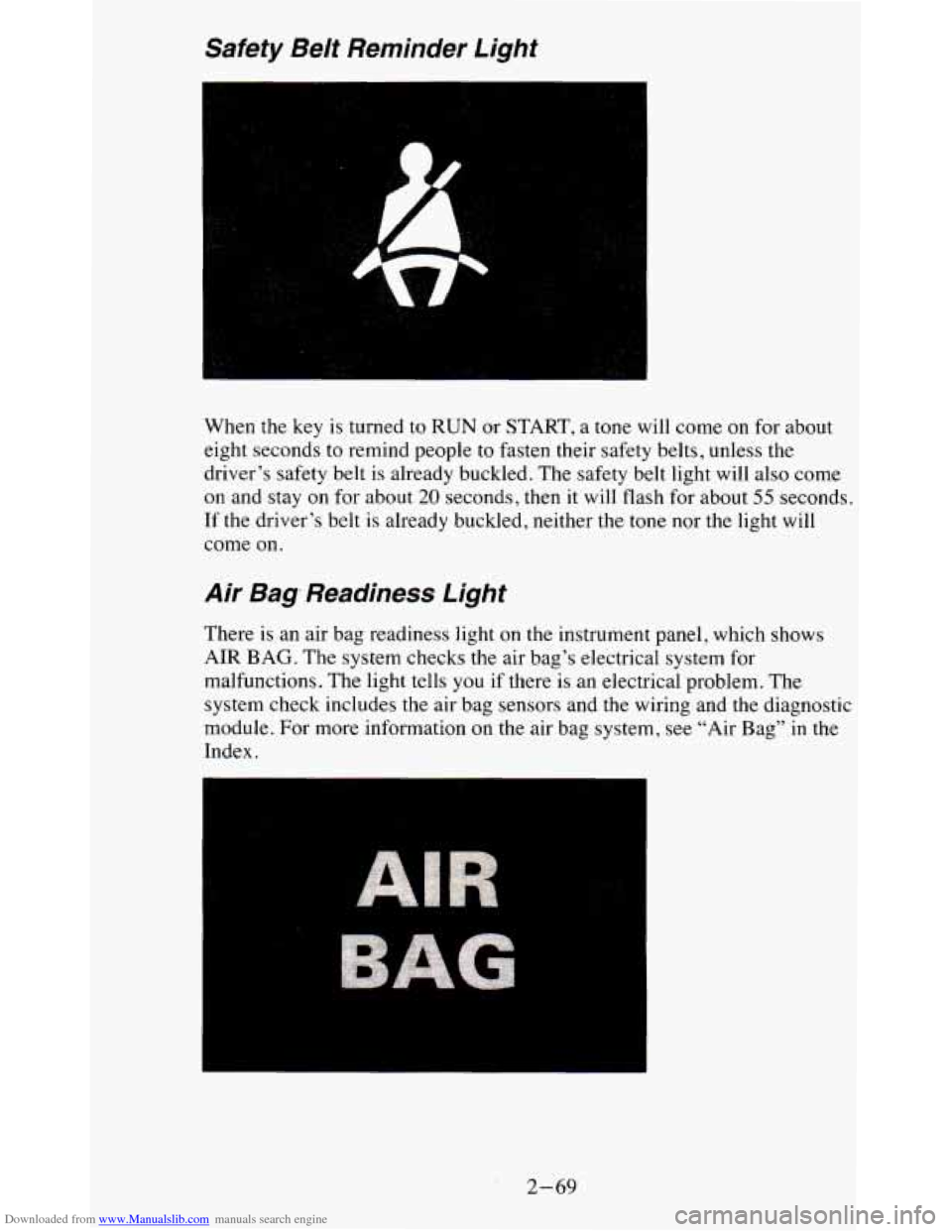
Downloaded from www.Manualslib.com manuals search engine Safety Be/t Reminder Light
When the key is turned to RUN or START, a tone will come on for about
eight seconds to remind people to fasten their safety belts, u\
nless the
driver’s safety belt is already buckled. The safety belt light
will also come
on and stay on for about
20 seconds, then it will flash for about 55 seconds.
If the driver’s belt
is already buckled, neither the tone nor the light will
come on.
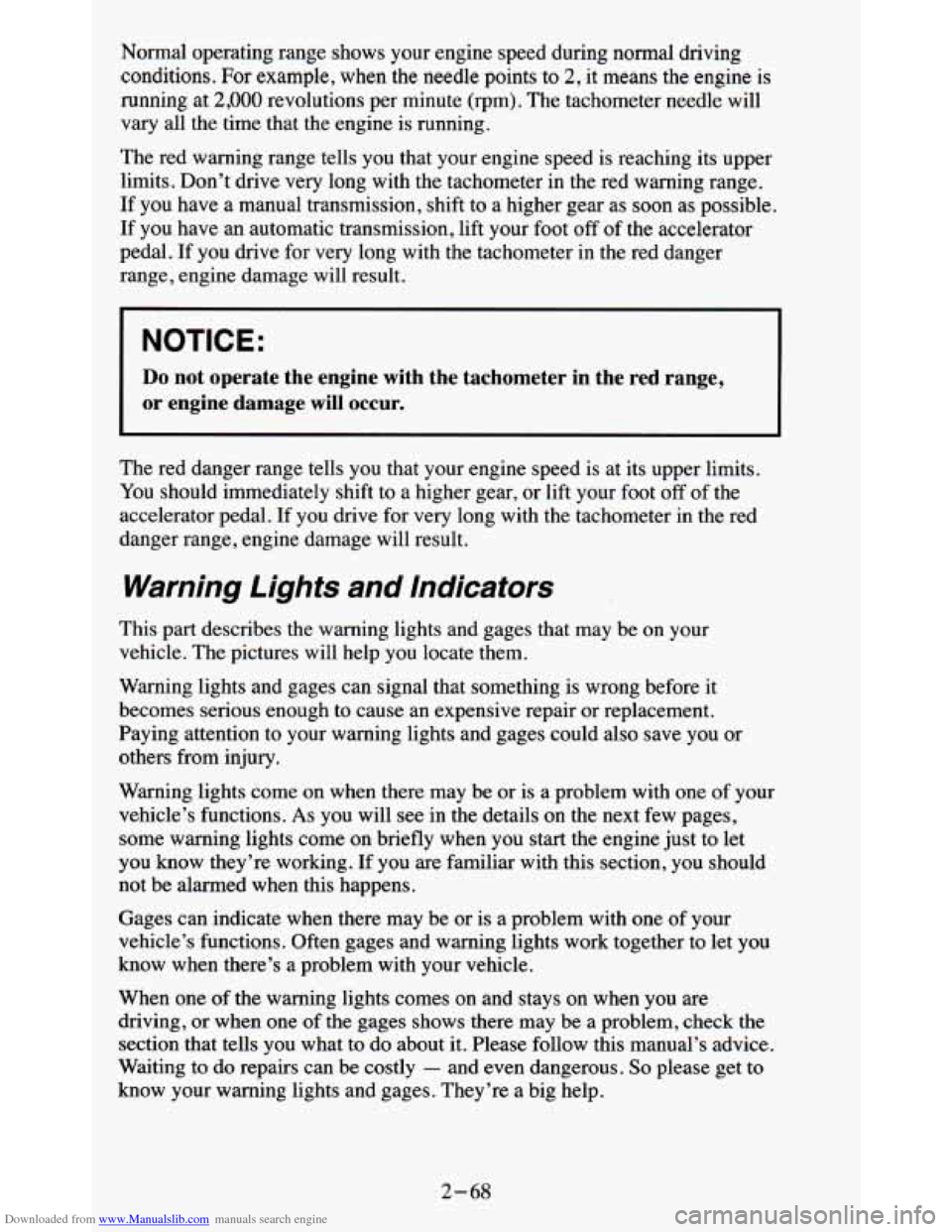
Air Bag, Readiness Light
There is an air bag readiness light on the instrument panel, which shows
AIR BAG. The system checks the air bag’s electrical system for
malfunctions. The light tells you
if there is an electrical problem. The
system check includes the air bag sensors and
the wiring and the diagnostic
module. For more information on the air bag system, see “Air Bag”
in the
Index.
2-69
Page 122 of 380
Downloaded from www.Manualslib.com manuals search engine You will see this light flash for a few seconds when you turn your ignition
to
RUN or START. Then the light should go out. This means the system is
ready.
If the air bag readiness light doesn’t come on when you start your vehicle,
or stays on,
or comes on when you are driving, your air bag system may not
work properly. Have your vehicle serviced right away.
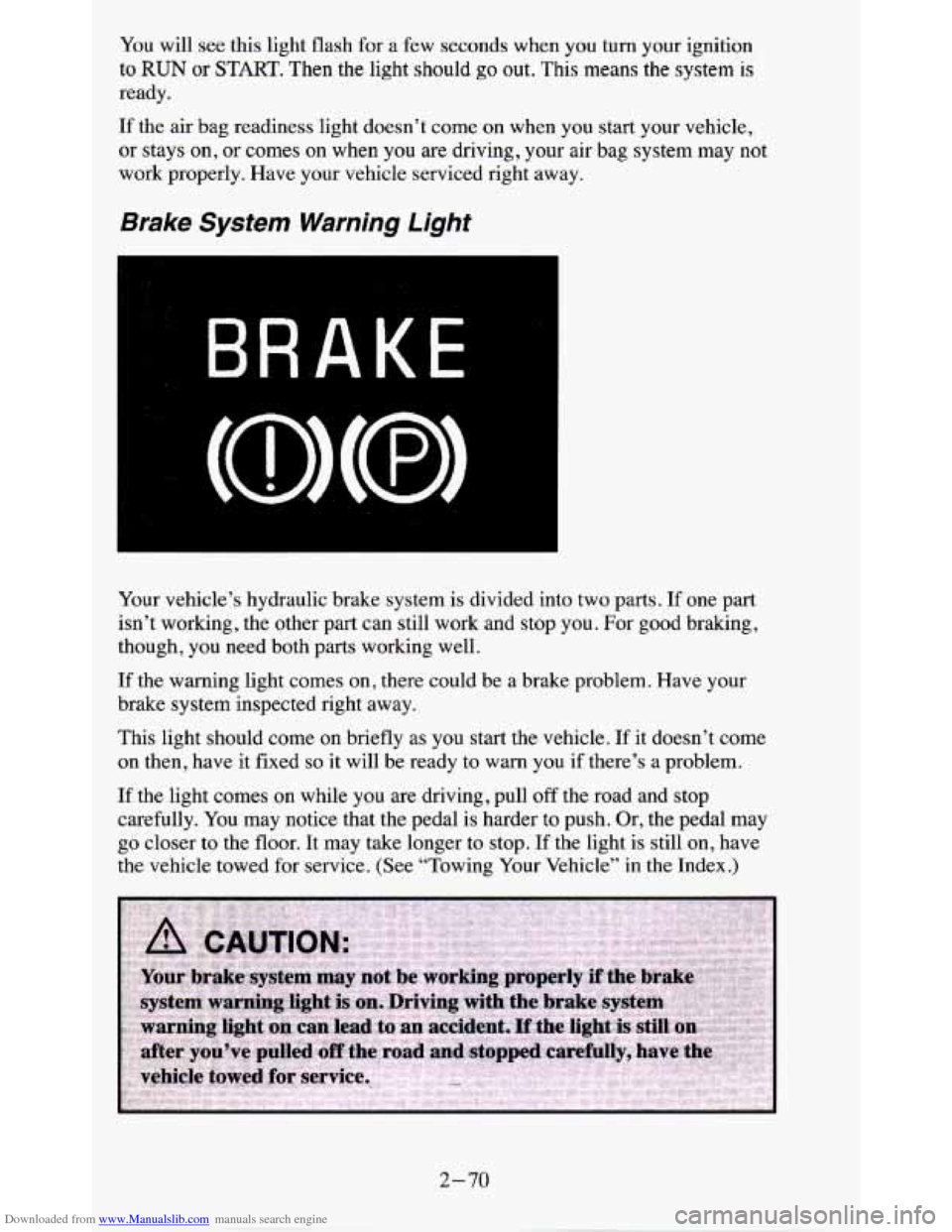
Brake System Warning Light
Your vehicle’s hydraulic brake system is divided into two parts. If one part
isn’t working, the other part can still work and stop
you. For good braking,
though, you need both parts working well.
If the warning light comes on, there could be a brake problem. Have your
brake system inspected right away.
This light should come on briefly
as you start the vehicle. If it doesn’t come
on then, have it fixed
so it will be ready to warn you if there’s a problem.
If the light comes on while you are driving, pull off the road and stop
carefully. You may notice that the pedal
is harder to push. Or, the pedal may
go closer to the floor. It may take longer to stop.
If the light is still on, have
the vehicle towed for service. (See “Towing Your Vehicle” in
the Index.)
2-70