Page 291 of 380
Downloaded from www.Manualslib.com manuals search engine Fabric Protection
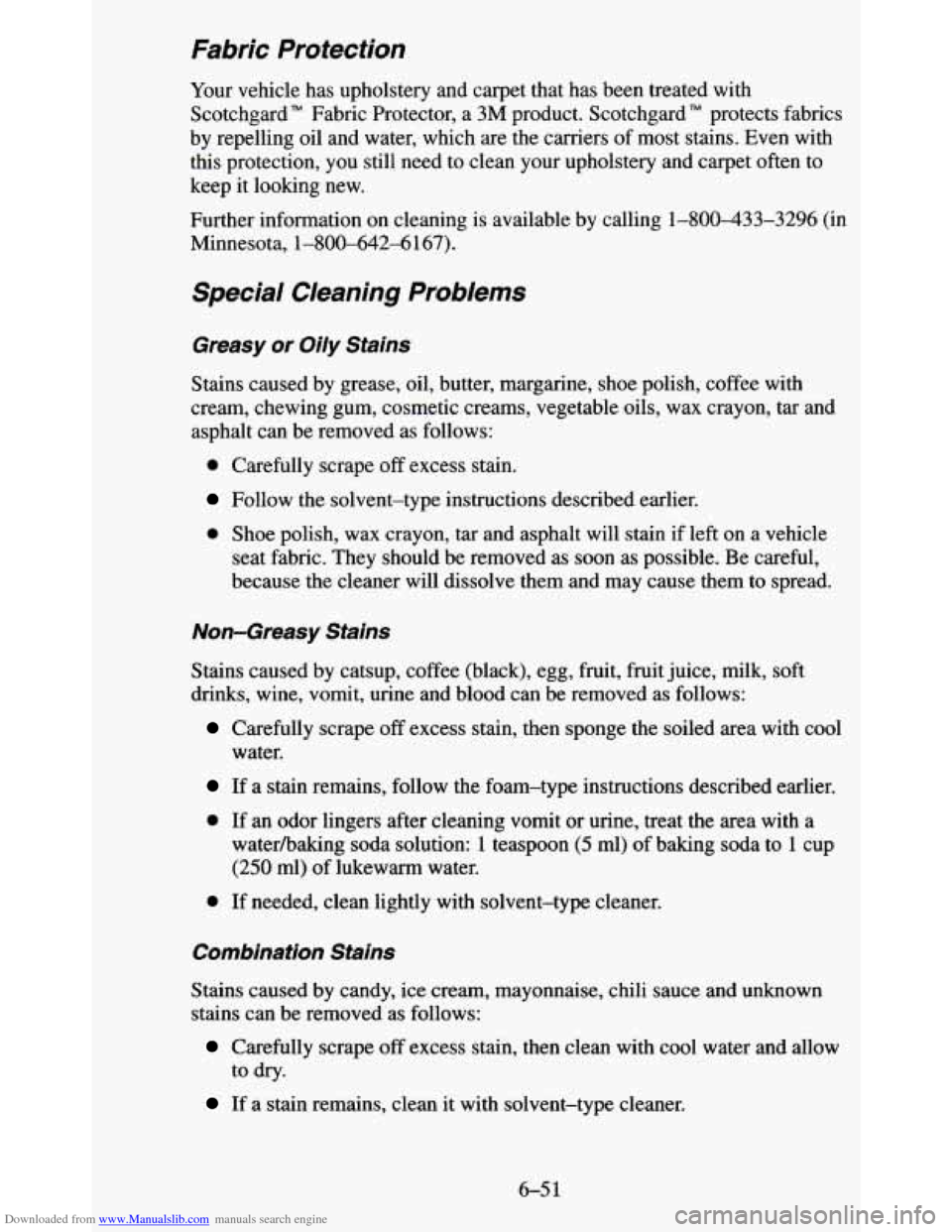
Your vehicle has upholstery and carpet that has been treated with
Scotchgard" Fabric Protector, a
3M product. Scotchgard R'( protects fabrics
by repelling oil and water, which are the carriers of most stains. Even with
this protection, you still need to clean your upholstery and carpet often to
keep it looking new.
Further information on cleaning is available by calling 1-800-433-3286
(in
Minnesota, 1-800-642-6 167).
SpeciaI CIeaning Problems
Greasy or Oily Stains
Stains caused by grease, oil, butter, margarine, shoe polish, coffee with
cream, chewing gum, cosmetic creams, vegetable oils, wax crayon, tar and
asphalt can be removed as follows:
0 Carefully scrape off excess stain.
Follow the solvent-type instructions described earlier.
0 Shoe polish, wax crayon, tar and asphalt will stain if left on a vehicle
seat fabric. They should be removed
as soon as possible. Be careful,
because the cleaner will dissolve them and may cause them to spread.
Non-Greasy Stains
Stains caused by catsup, coffee (black), egg, fruit, fruit juice, milk, soft
drinks, wine, vomit, urine and blood can be removed as follows\
:
Carefully scrape off excess stain, then sponge the soiled area with cool
water.
If a stain remains, follow the foam-type instructions described earlie\
r.
0 If an odor lingers after cleaning vomit or urine, treat the area with a
waterhaking soda solution: 1 teaspoon
(5 ml) of baking soda to 1 cup
(250
ml) of lukewarm water.
0 If needed, clean lightly with solvent-type cleaner.
Combination Stains
Stains caused by candy, ice cream, mayonnaise, chili sauce and unknown
stains can be removed as follows:
Carefully scrape off excess stain, then clean with cool water and allow
If a stain remains, clean it with solvent-type cleaner.
to
dry.
6-51
Page 292 of 380
Downloaded from www.Manualslib.com manuals search engine Cleaning Vinyl
Use warm water and a clean cloth.
Rub with a clean, damp cloth to remove dirt. You may have to do it
Things like tar, asphalt and shoe polish will stain if you don’t get them
more than once.
off quickly. Use a
clean cloth and a solvent-type vinyl cleaner.
C/eaning Leather
Use a soft cloth with lukewarm water and a mild soap or saddle soap.
For stubborn stains, use a mild solution of 10% isopropyl alcohol
(rubbing alcohol) and
90% water.
Never use oils, varnishes, solvent-based or abrasive cleaners, furniture
polish or
shoe polish on leather.
0 Soiled leather should be cleaned immediately. If dirt is allowed to work
into finish, it can harm the leather.
Creaning the Top of the Instrument Panel
Use only mild soap and water to clean the top surfaces of the instrument
panel. Sprays containing silicones or waxes may cause annoying reflections
in the windshield and even make
it difficult to see through the windshield
under certain conditions.
Care of Safety Belts
Keep belts clean and dry.
6-52
Page 294 of 380
Downloaded from www.Manualslib.com manuals search engine Washing Your Vehicle
The best way to preserve your vehicle’s finish is to keep it clean by washing
it often with lukewarm or cold water.
Don’t wash your vehicle in the direct rays of the sun. Don’t use strong soaps
or chemical detergents. Use liquid hand, dish or car washing (mild
detergent) soaps. Don’t use cleaning agents that are petroleum based, or that
contain acid or abrasives. All cleaning agents should be flushe\
d promptly
and not allowed to dry on the surface, or they could stain. Dry the finish
with a soft, clean chamois
or a 100% cotton towel to avoid surface scratches
and water spotting.
High pressure vehicle washes may cause water to enter your vehicle.
Finish Care
Occasional waxing or mild polishing of your vehicle by hand may be
necessary to remove residue from the paint finish. You can get GM
approved cleaning products from your dealer. (See “Appearance\
Care and
Materials” in the Index.)
Your vehicle has a “basecoatklearcoat” paint finish. The clearcoat gives
more depth and gloss to the colored basecoat. Always use waxes and
polishes that are non-abrasive and made for a basecoatklearcoat paint
finish.
NOTICE:
Machine compounding or aggressive polishing on a .
basecoatlclearcoat paint finish may dull the finish or leave sw\
irl
marks.
Foreign materials such as calcium chloride and other salts, ice melting
agents, road oil and tar, tree sap, bird droppings, chemicals from industrial
chimneys, etc. can damage your vehicle’s finish if they remain on painted
surfaces. Wash the vehicle as soon as possible. If necessary, use
non-abrasive cleaners that are marked safe for painted surfaces to remove
foreign matter.
Exterior painted surfaces are subject to aging, weather and chemical fallout
that can take their toll over a period
of years. You can help to keep the paint
finish looking new by keeping your vehicle garaged
or covered whenever
possible.
6-54
Page 295 of 380
Downloaded from www.Manualslib.com manuals search engine Protecting Exterior Bright Metal Parts
Bright metal parts should be cleaned regularly to keep their luster. Washing
with water is all that is usually needed. However, you may use
GM Chrome
Polish on chrome or stainless steel trim, if necessary.
Use special care with aluminum trim.
To avoid damaging protective trim,
never use auto or chrome polish, steam or caustic soap
to clean aluminum.
A coating of wax, rubbed to high polish, is recommended for all bright
metal parts.
Aluminum Wheels (If So Equipped)
Your aluminum wheels have a protective coating similar to the painted
surface
of your vehicle. Don’t use strong soaps, chemicals, chrome polish,
abrasive cleaners or abrasive cleaning brushes on them because you could
damage this coating. After rinsing thoroughly, a wax may be applied.
1 NOTICE:
If you have aluminum wheels, don’t use an automatic vehicle
wash that has hard silicon carbide cleaning brushes. These
brushes can take the protective coating
off your aluminum
wheels.
Tires
To clean your tires, use a stiff brush with a tire cleaner.
When applying a tire dressing always take care
to wipe off any overspray or
splash from painted surfaces. Petroleum-based products may damage the
paint finish.
Sheet Metal Damage
If your vehicle is damaged and requires sheet metal repair or replacement,
make sure the body repair shop applies anti-corrosion material to the parts
repaired or replaced to restore corrosion protection.
Foreign Material
Calcium chloride and other salts, ice melting agents, road oil and tar, tree
sap, bird droppings, chemicals from industrial chimneys, and other foreign
matter can damage your vehicle’s finish if they remain on painted surfaces.
Use cleaners that are marked safe for painted surfaces to remove foreign
matter.
6-55
Page 297 of 380
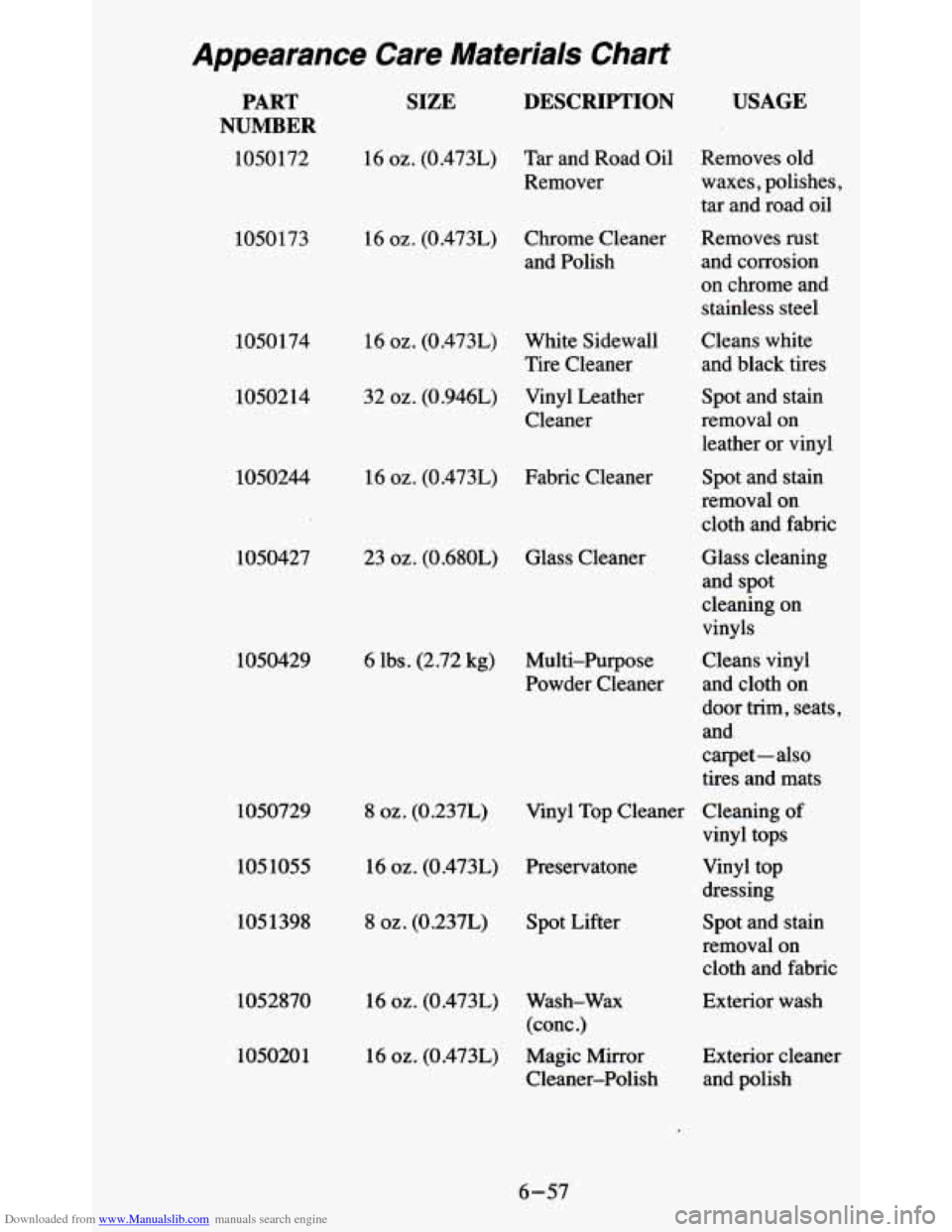
Downloaded from www.Manualslib.com manuals search engine Appearance Care Materials Chart
DESCRIPTION USAGE PART
NUMBER
1050172
SIZE
16 oz. (0.473L) Tar and Road Oil Removes old
Remover waxes, polishes,
tar and road oil
16 oz. (0.473L) Chrome Cleaner Removes rust
and Polish and corrosion on chrome and
stainless steel 1050173
1050174 16
oz. (0.473L) White Sidewall Cleans white
Tire Cleaner and black tires
1050214 32 oz. (0.946L) Vinyl Leather
Cleaner Spot
and stain
removal on
leather or vinyl
16 oz. (0.473L) Fabric Cleaner Spot and stain
removal
on
cloth and fabric
1050244
23 oz. (0.680L)
Glass Cleaner 1050427 Glass cleaning
and spot
cleaning on vinyls
1050429 6 lbs. (2.72 kg) Multi-Pufpose Powder Cleaner Cleans vinyl
and
cloth on
door trim, seats,
and
carpet
- also
tires and mats
1050729 8 oz. (0.237L) Vinyl Top Cleaner Cleaning of
vinyl tops
105 1055
1051398 16
oz. (0.473L) Preservatone
Vinyl top
dressing
8 oz. (0.237L) Spot Lifter Spot and stain
removal on
cloth and fabric
1052870
16 oz. (0.473L) Wash-Wax
16 oz. (0.473L) Magic Mirror (conc
.)
Cleaner-Polish Exterior wash
1050201 Exterior
cleaner
and
polish
6-57
Page 308 of 380
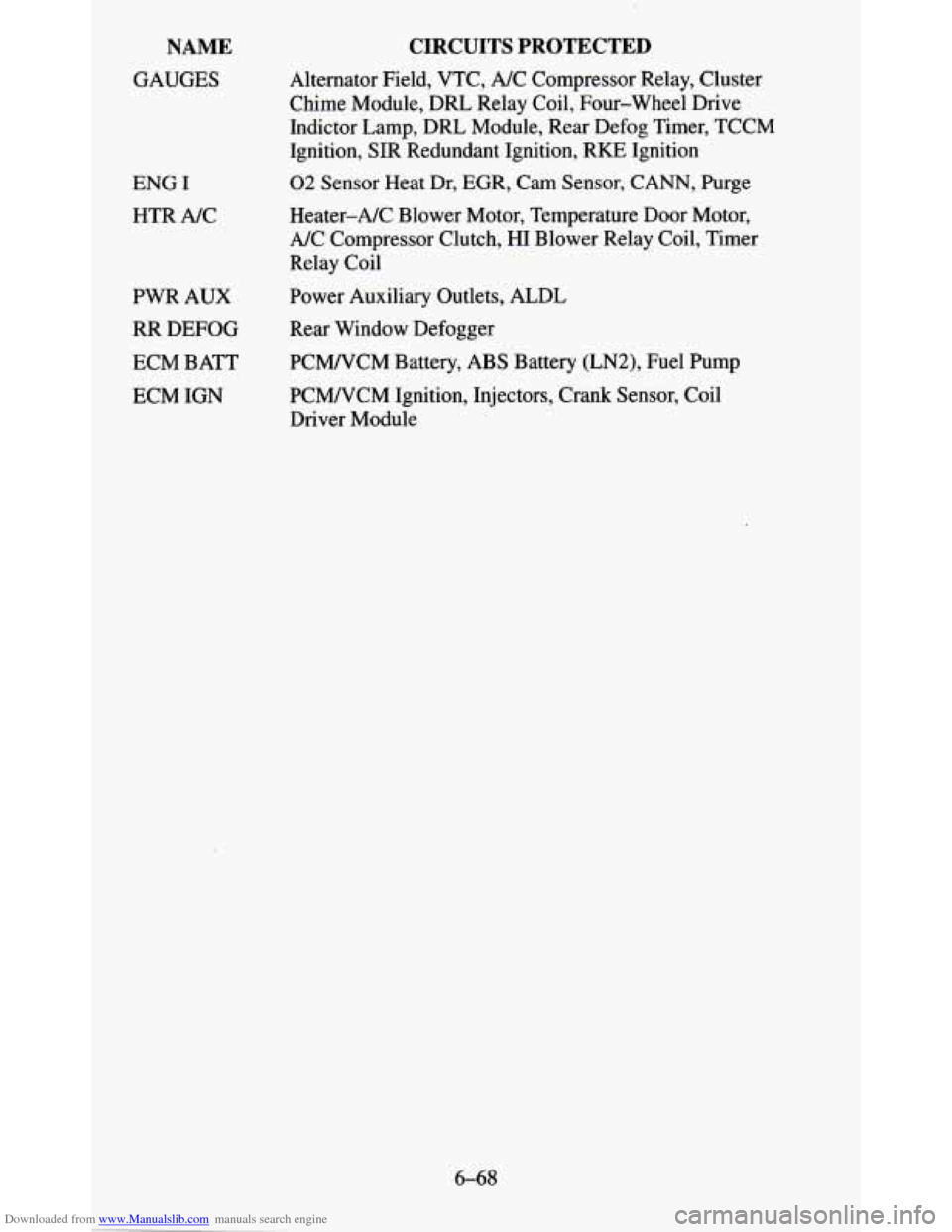
Downloaded from www.Manualslib.com manuals search engine NAME
GAUGES
ENG I HTR NC
PWR AUX
RR DEFOG
ECM BATT
ECM IGN
CIRCUITS PROTECTED
Alternator Field, VTC, A/C Compressor Relay, Cluster
Chime Module, DRL Relay Coil, Four-wheel Drive
Indictor Lamp, DRL Module, Rear Defog Timer, TCCM
Ignition,
SIR Redundant Ignition, RKE Ignition
02 Sensor Heat Dr, EGR, Cam Sensor, CANN, Purge
Heater-A/C Blower Motor, Temperature Door Motor,
A/C Compressor Clutch, HI Blower Relay Coil, Timer
Relay Coil
Power Auxiliary Outlets, ALDL
Rear Window Defogger
PCMNCM Battery, ABS Battery (LN2), Fuel Pump
PCMNCM Ignition, Injectors, Crank Sensor, Coil
Driver Module
6-68
Page 310 of 380
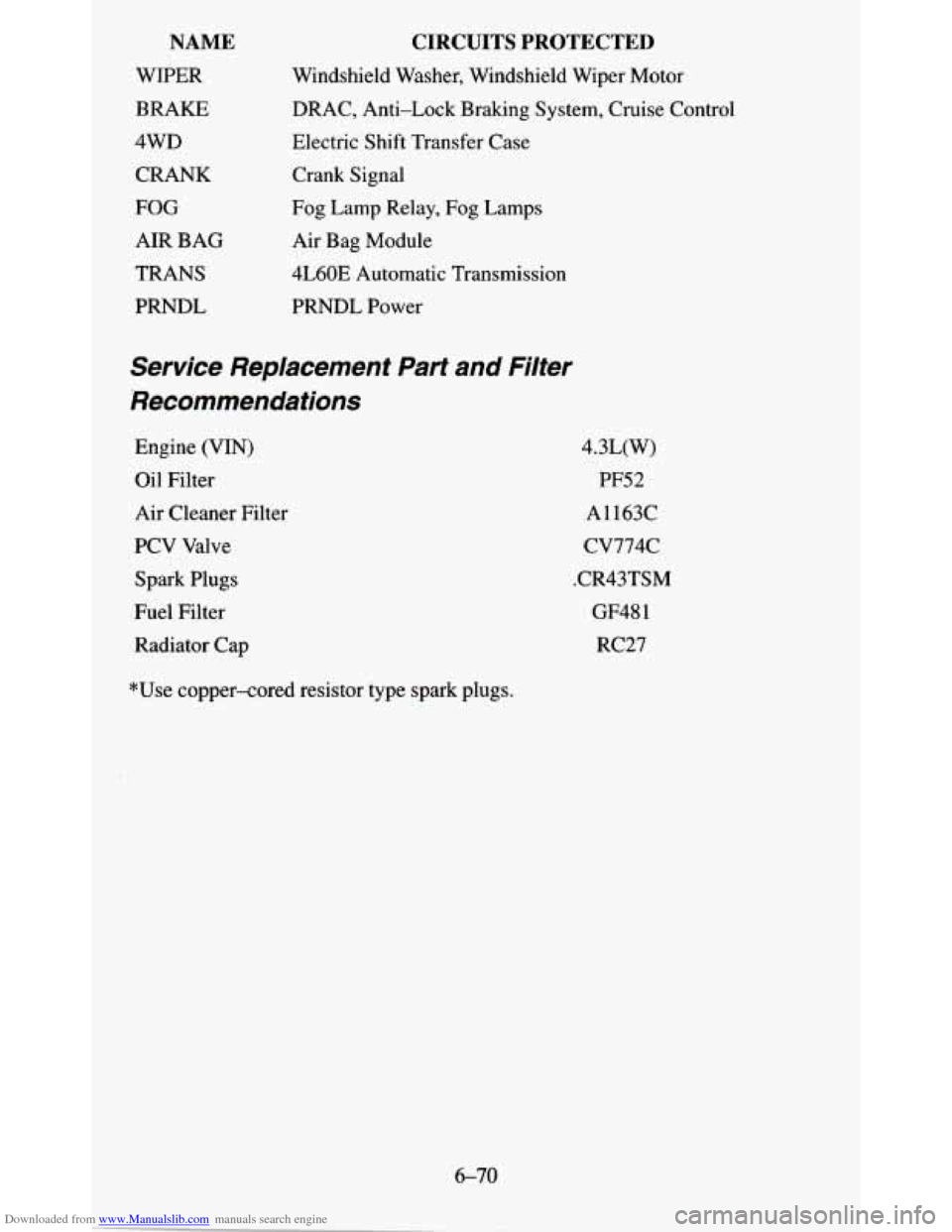
Downloaded from www.Manualslib.com manuals search engine NAME
WIPER
BRAKE
4WD
CRANK
FOG
AIR BAG
TRANS PRNDL
CIRCUITS PROTECTED
Windshield Washer, Windshield Wiper Motor
DRAC, Anti-Lock Braking
System, Cruise Control
Electric Shift Transfer Case
Crank Signal
Fog Lamp Relay, Fog Lamps
Air Bag Module
4L60E Automatic Transmission
PRNDL Power
Service Replacement Part and Filter
Recommendations
Engine (VIN)
Oil Filter
Air Cleaner Filter
PCV Valve Spark Plugs
Fuel Filter
Radiator Cap 4.3L(W)
PF52
A1163C
cv774c
.CR43TSM GF48 1
RC27
*Use copper-cored resistor type spark plugs.
6-70
Page 311 of 380
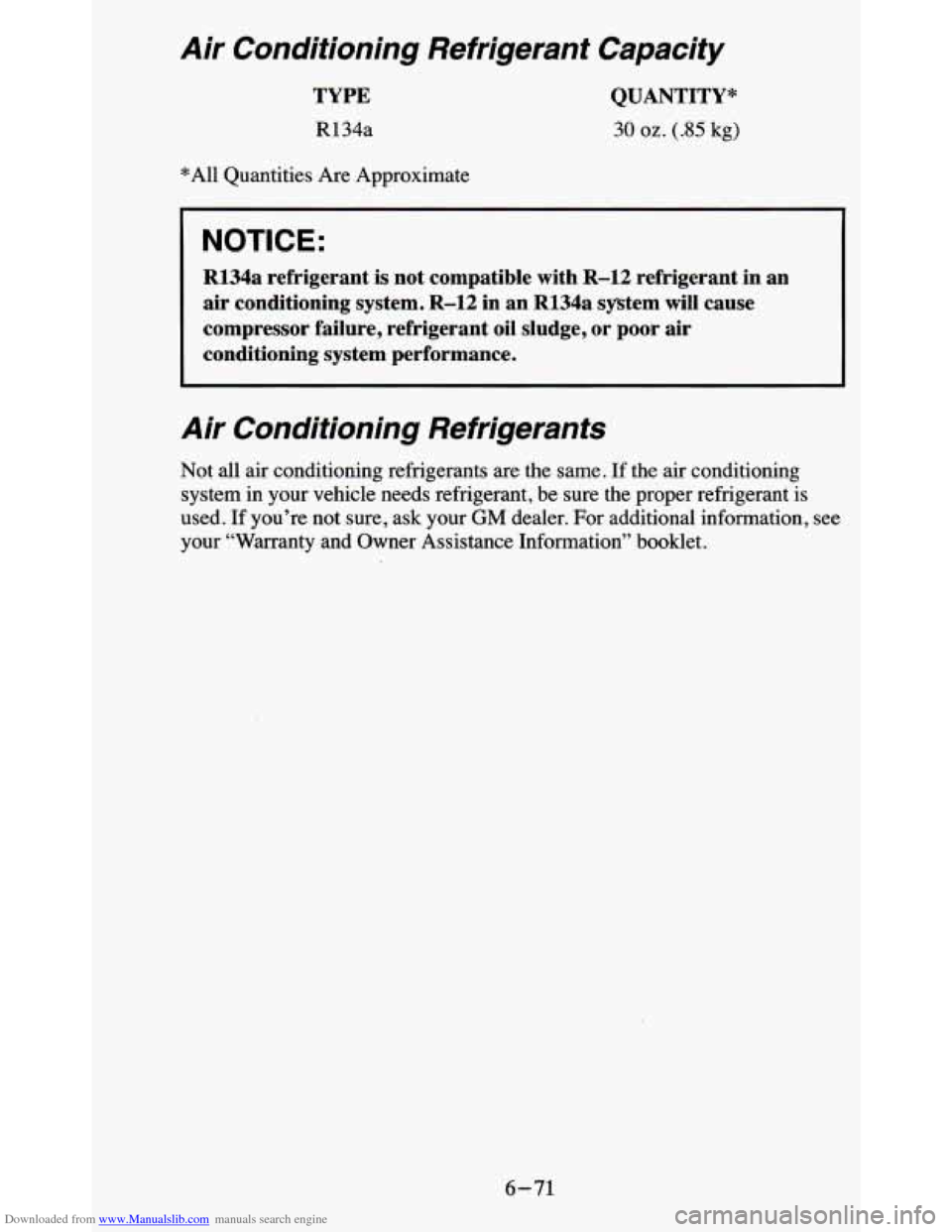
Downloaded from www.Manualslib.com manuals search engine Air Conditioning Refrigerant Capacity
TYPE
R134a
*All Quantities Are Approximate
QUANTITY*
30 oz. (.85 kg)
NOTICE:
R134a refrigerant is not compatible with R-12 refrigerant in an
air conditioning system. R-12 in an R134a system will cause
compressor failure, refrigerant oil sludge, or poor air
conditioning system performance.
Air Conditioning Refrigerants
Not all air conditioning refrigerants are the same. If the air conditioning
system in your vehicle needs refrigerant, be sure the proper refrigerant is
used. If you’re not sure, ask your
GM dealer. For additional information, see
your “Warranty and Owner Assistance Information” booklet.
6-71