1995 CHEVROLET BLAZER radio
[x] Cancel search: radioPage 151 of 380
Downloaded from www.Manualslib.com manuals search engine 4. Press the BAND knob and the time appears - indicating that the
disabling sequence was successful.
If the display indicates “SEC”, the
numbers did not match and the unit is still secured.
Disabling The Theft System
1. Press presets 1 and 4 for 5 seconds with ignition on and radio off. The
display will
show “SEC”, indicating the unit is in the secure mode.
2. Press the SET button. The display will show “000”.
3. Enter the first three digits of the code following steps 6 and 7 of the
preceding paragraphs (To Lock the System). The display will show the
numbers as entered.
4. Press the BAND knob. The radio will display “000”.
5. Enter the second three digits of the code. The display will show the
numbers as entered.
6. Press the BAND knob. If the display shows “- - - ”, the disabling
sequence was successful. The numbers matched the user-selected code
or the factory back-up code, and the unit is in the UNSECURED
mode. If the display shows “SEC”, the disabling sequence was
unsuccessful and the numbers did not match either of the codes and the
unit will remain in the SECURED mode.
Understanding Radio Reception
FM stereo will give you the best sound. But FM signals will reach only
about
10 to 40 miles (16 to 65 km). And, tall buildings or hills can interfere
with
FM signals, causing the sound to come and go.
The range for most AM stations is greater than for
FM, especially at night.
The longer range, however, can cause stations to interfere with each other.
AM can pick up noise from things like storms and power lines.
Try reducing
the treble
to reduce this noise if you ever get it.
AM Stereo means the Delco@ system can receive C-QUAM@stereo
broadcasts. Many AM stations around the count use C-QUAM@ to
produce stereo, though some do not. (C-QUAM
2 is a registered trademark
of Motorola, Inc.)
If your DelcoB system can get C-QUAM@, your
“STEREO” light will come on when you’re receiving it.
Be aware that hearing damage from loud noise is almost undetectable until
it is too late. Your hearing can adapt to higher volumes of sound. Sound that
seems normal can be loud and harmful to your hearing. Take precautions by
adjusting the volume control on your radio to a safe sound level before your
hearing adapts to it.
3-17
Page 152 of 380
Downloaded from www.Manualslib.com manuals search engine To help avoid hearing loss or damage:
1. Adjust the volume control to the lowest setting.
2. Increase volume slowly until you hear comfortably and clearly.
NOTICE:
Before you add any sound equipment to your vehicle - like a
tape player, CB radio, mobile telephone or two-way radio - be
sure you can add what you want.
If you can, it’s very important
to do
it properly. Added sound equipment may interfere with the
operation of your vehicle’s engine, Delco’ radio or other
systems, and even damage them. And, your vehicle’s systems
may interfere with the operation of sound equipment that has
been added improperly.
So, before adding sound equipment, check with your dealer and
be sure to check Federal rules covering mobile radio and
telephone units.
Care of Your Cassette PIayer and Tape
A tape player that is not cleaned regularly is subject to reduce\
d sound
quality, ruining the cassette, or damaging the mechanism. Tape cassettes that
are not properly stored in their plastic cases away from contaminan\
ts, direct
sunlight, and extreme heat, may not operate properly and could cause
premature failure
of the tape player.
Your tape player should be cleaned with every
50 hours of use to provide
optimum performance. Your radio may display “Cln” (Clean) to indicate
that you have used your tape player for
50 hours without re-setting the tape
clean timer.
If you notice a reduction in sound quality, regardless of when
the tape player was last cleaned,
try playing a different cassette to see if the
tape or tape player is at fault. If the second cassette results in no
improvement in sound quality,
try cleaning the tape player.
Proper tape player cleaning should be done with a scrubbing action,
non-abrasive cleaning cassette. This is a wet-type cleaning system that uses
a cleaning cassette with pads which scrub the tape head as the \
hubs of the
cleaner cassette turn.
To properly clean your tape player, follow instructions
with the cleaning cassette. If you use this type of cleaner, the radio may
display an error and eject the cartridge. This is normal and \
is the result
of an
added feature
in the tape player that detects broken tapes. If an error occurs,
you will need to insert the cleaning cassette at least
3 times to thoroughly
clean the tape player.
3-18
Page 153 of 380
Downloaded from www.Manualslib.com manuals search engine You may prefer to use a non-scrubbing action, wet-type cleaner. This type
of cleaner uses a fabric belt to clean the tape head. This type of cleaner
cassette will not cause an error, but it may not clean the tape player as
thoroughly as the scrubbing type cleaner.
A scrubbing action cleaner cassette is available through your retailer (SPO
12344600).
Cassettes are subject to wear and the sound quality may degrade over time.
Always verify that the cassette tape
is in good condition and the tape player
is clean before obtaining service on your tape player.
t
NOTICE:
Cassette tape adapter kits for portable CD players will not work
in your cassette player. These adapters will cause the radio t\
o
display an error and the adapter cassette will be ejected.
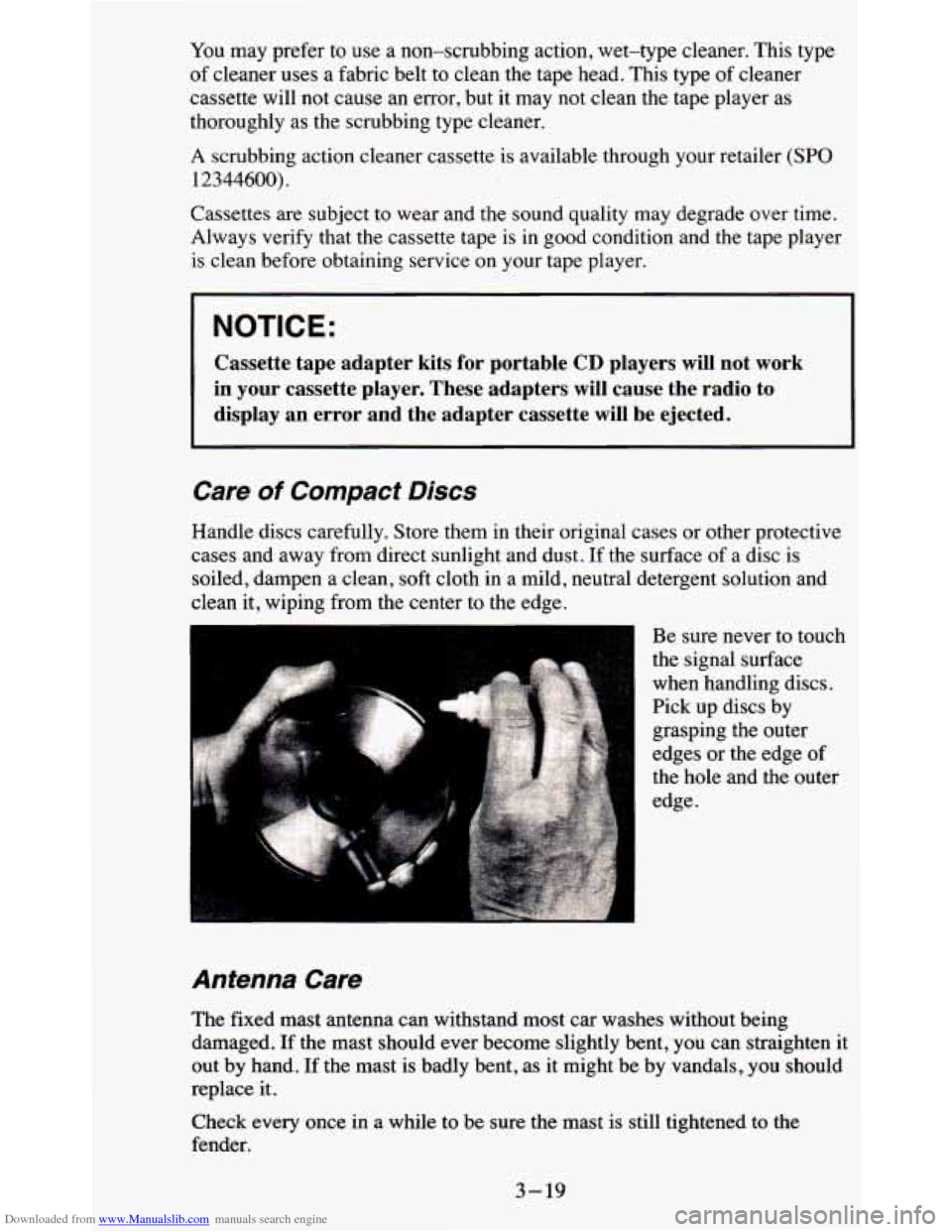
Care of Compact Discs
Handle discs carefully. Store them in their original cases or other protective
cases and away from direct sunlight and dust. If the surface of a disc
is
soiled, dampen a clean, soft cloth in a mild, neutral detergent solution and
clean it, wiping from the center to the edge.
Be sure never to touch
the signal surface
when handling discs.
Pick up discs by
grasping the outer
edges or the edge
of
the hole and the outer
edge.
Antenna Care
The fixed mast antenna can withstand most car washes without being
damaged.
If the mast should ever become slightly bent, you can straighten it
out by hand. If the mast is badly bent, as it might be by vandals, you should
replace it.
Check every once in a while to be sure the mast
is still tightened to the
fender.
3-19
Page 206 of 380
Downloaded from www.Manualslib.com manuals search engine You could be injured if the vehicles roll. Set the parking brake firmly
on each vehicle. Put an automatic transmission in PARK (P) or a
manual transmission in NEUTRAL
(N). If you have a
four-wheel-drive vehicle with a manual transfer case shift lever, be
sure the transfer case
is not in NEUTRAL (N).
3. Turn off the ignition on both vehicles. Turn off all lights that aren’t
needed, and radios. This will avoid sparks and help save both batteries
And it could save your radio!
NOTICE:
If you leave your radio on, it could be badly damaged. The
repair wouldn’t be covered by your warranty.
~~
4. Open both hoods and locate the batteries. Find the positive (+) and
negative
(-) terminals on each battery.
5. Check that the jumper cables don’t have loose or missing insulation. If
they do, you could get a shock. The vehicles could be damaged too.
Before you connect the cables, here are some basic things you should
know. Positive (+) will go to positive (+) and negative (-) will go to
negative
(-) or a metal engine part. Don’t connect (+) to (-) or you’ll
get a
short that would damage the battery and maybe other parts too.
5-4
Page 302 of 380
Downloaded from www.Manualslib.com manuals search engine Be sure to use the
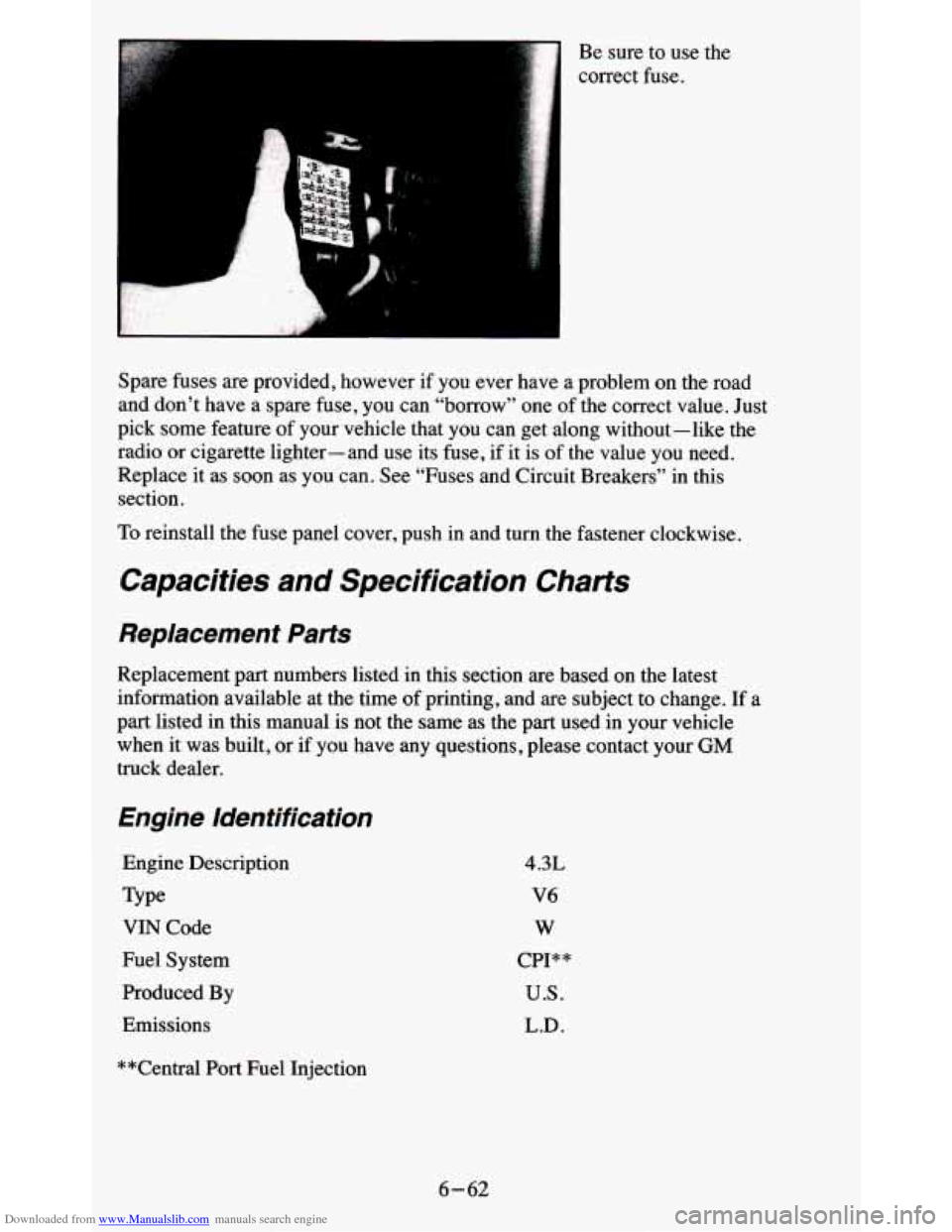
correct fuse.
Spare fuses are provided, however if you ever have a problem on the road
and don’t have a spare fuse, you can “borrow” one of the correct value. Just
pick some feature
of your vehicle that you can get along without-like the
radio
or cigarette lighter-and use its fuse, if it is of the value you need.
Replace it as soon
as you can. See “Fuses and Circuit Breakers” in this
section.
To reinstall the fuse panel cover, push in and turn the fastener clockwise.
Capacities and Specification Charts
Replacement Parts
Replacement part numbers listed in this section are based on the latest
information available at the time
of printing, and are subject to change. If a
part listed in this manual is not the same as the part used in your vehicle
when it was built, or if you have any questions, please contact your
GM
truck dealer.
Engine Identification
Engine Description
Type
VIN Code
Fuel System
Produced By
Emissions
4.3L
V6
W
CPI* *
us.
L.D.
**Central Port Fuel Injection
6-62
Page 309 of 380
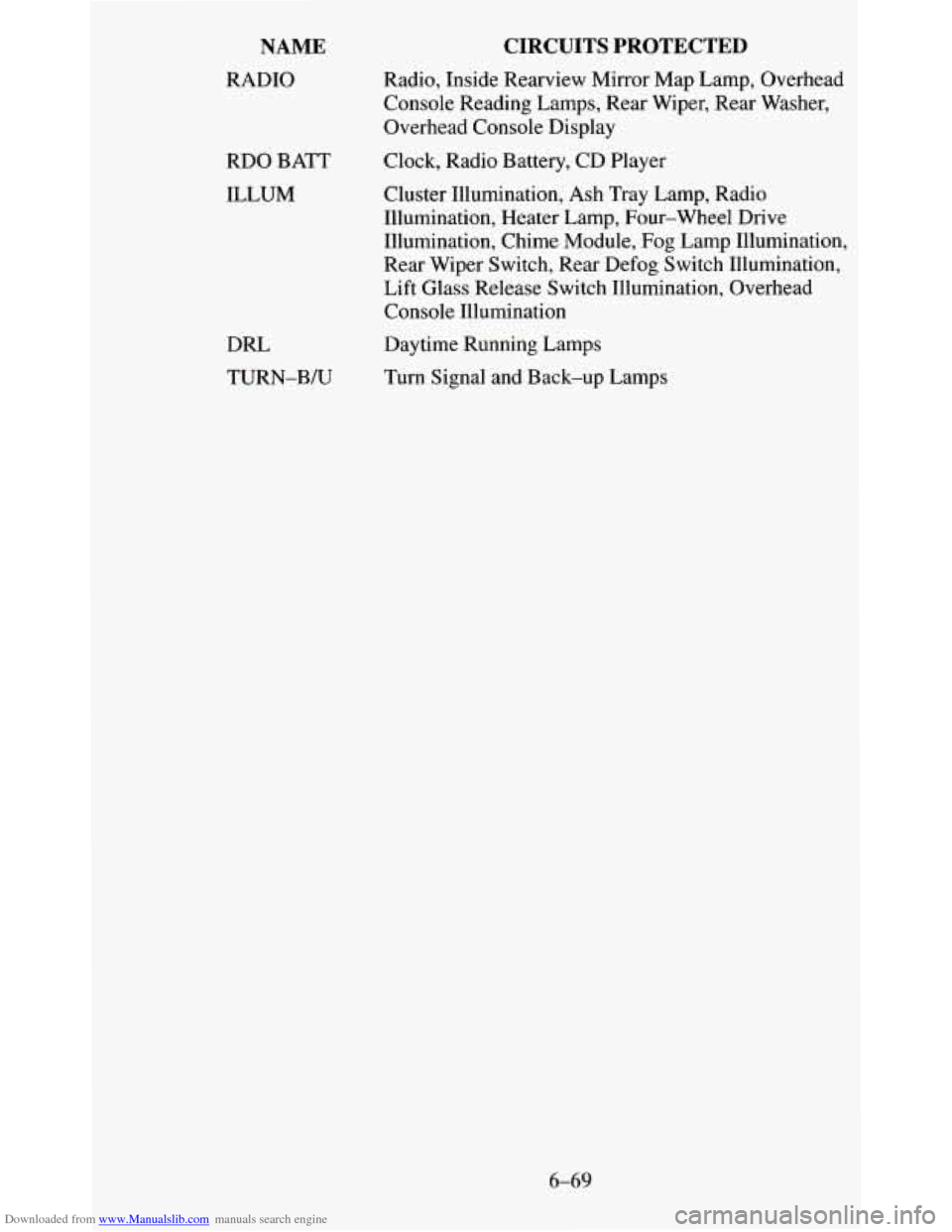
Downloaded from www.Manualslib.com manuals search engine NAME
RADIO RDO BATT
ILLUM
DRL
TURN-B/U
CIRCUITS PROTECTED
Radio, Inside Rearview Mirror Map Lamp, Overhead
Console Reading Lamps, Rear Wiper, Rear Washer,
Overhead Console Display Clock, Radio Battery, CD Player
Cluster Illumination,
Ash Tray Lamp, Radio
Illumination, Heater Lamp, Four-wheel Drive
Illumination, Chime Module, Fog Lamp Illumination, Rear Wiper Switch, Rear Defog Switch Illumination,
Lift Glass Release Switch Illumination, Overhead Console Illumination
Daytime Running Lamps
Turn Signal and Back-up Lamps
6-69
Page 369 of 380
Downloaded from www.Manualslib.com manuals search engine Index
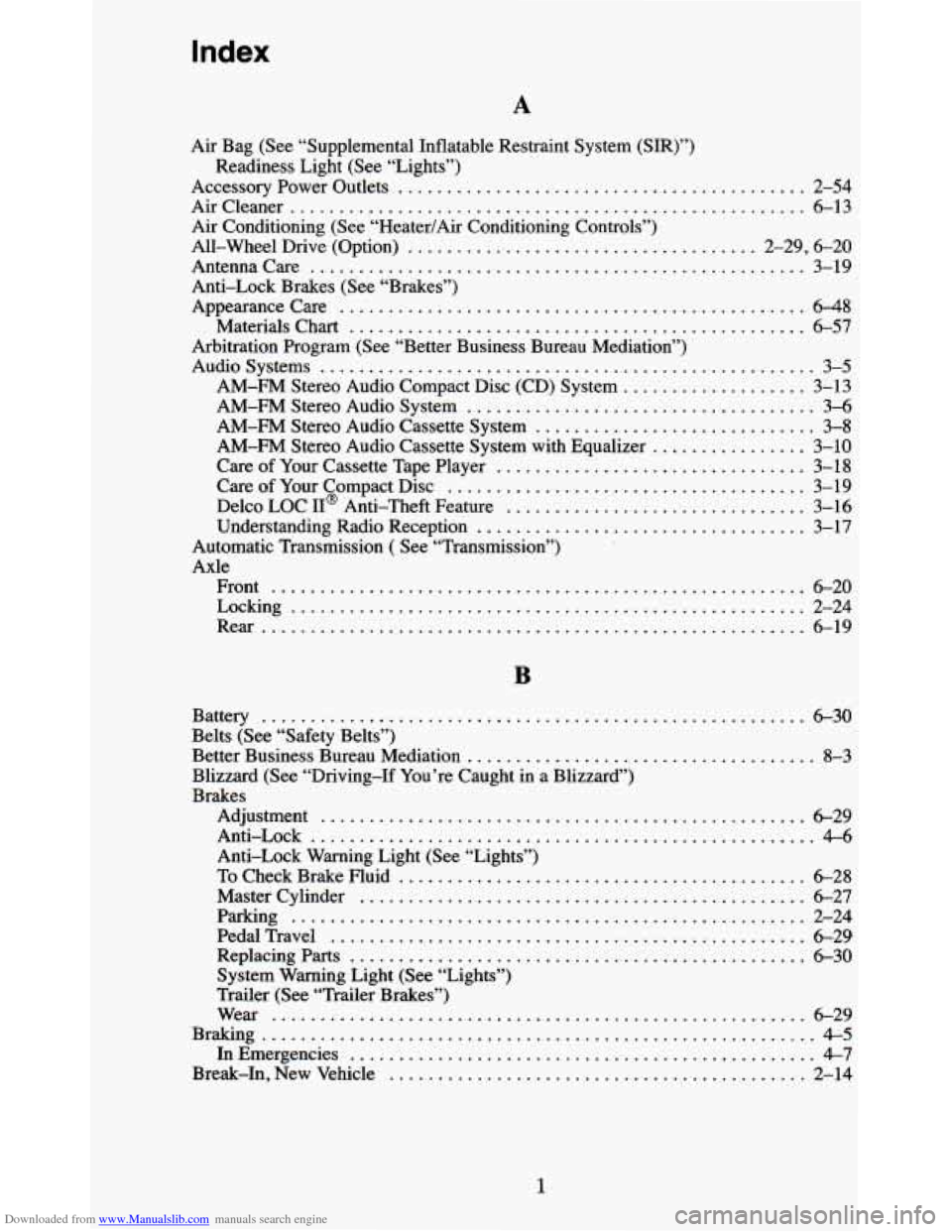
A
Air Bag (See “Supplemental Inflatable Restraint System (SIR)”)
Readiness Light (See “Lights”)
Accessory Power Outlets
.......................................... 2-54
Aircleaner ..................................................... 6-13
Air Conditioning (See “Heater/Air Conditioning Controls”)
All-Wheel Drive (Option)
.................................... 2-29. 6-20
Antennacare ................................................... 3-19
Anti-Lock Brakes (See “Brakes”)
Appearancecare
................................................ 6-48
Materials Chart ............................................... 6-57
Arbitration Program (See “Better Business Bureau Mediation”)
Audiosystems
................................................... 3-5
AM-FM Stereo Audio Compact Disc (CD) System ................... 3-13
AM-FM Stereo Audio System .................................... 3-6
AM-FM Stereo Audio Cassette System ............................. 3-8
Care of Your Cassette Tape Player ................................ 3-18
Care of Your Compact Disc ..................................... 3-19
Delco LOC II@ Anti-Theft Feature ............................... 3-16
AM-FM Stereo Audio Cassette System with Equalizer ................ 3-10
Understanding Radio Reception .................................. 3-17
Automatic Transmission ( See “Transmission”)
Axle
Front
....................................................... 6-20
Locking ..................................................... 2-24
Rear ........................................................ 6-19
Battery ........................................................ 6-30
Belts (See “Safety Belts”)
Better Business Bureau Mediation
.................................... 8-3
Blizzard (See “Driving-If You’re Caught in a Blizzard”)
Brakes Adjustment
.................................................. 6-29
Anti-Lock .................................................... 4-6
Anti-Lock Warning Light (See “Lights”)
To Check Brake Fluid .......................................... 6-28
Master Cylinder .............................................. 6-27
Parking ..................................................... 2-24
PedalTravel ................................................. 6-29
Replacing Parts ............................................... 6-30
System Warning Light (See “Lights”)
Trailer (See “Trailer Brakes”)
Wear
....................................................... 6-29
Braking ......................................................... 4-5
InEmergencies ................................................ 4-7
Break-In. New Vehicle ............................................ 2-14
1
Page 375 of 380
Downloaded from www.Manualslib.com manuals search engine Radiator Pressure Cap ............................................ 6-24
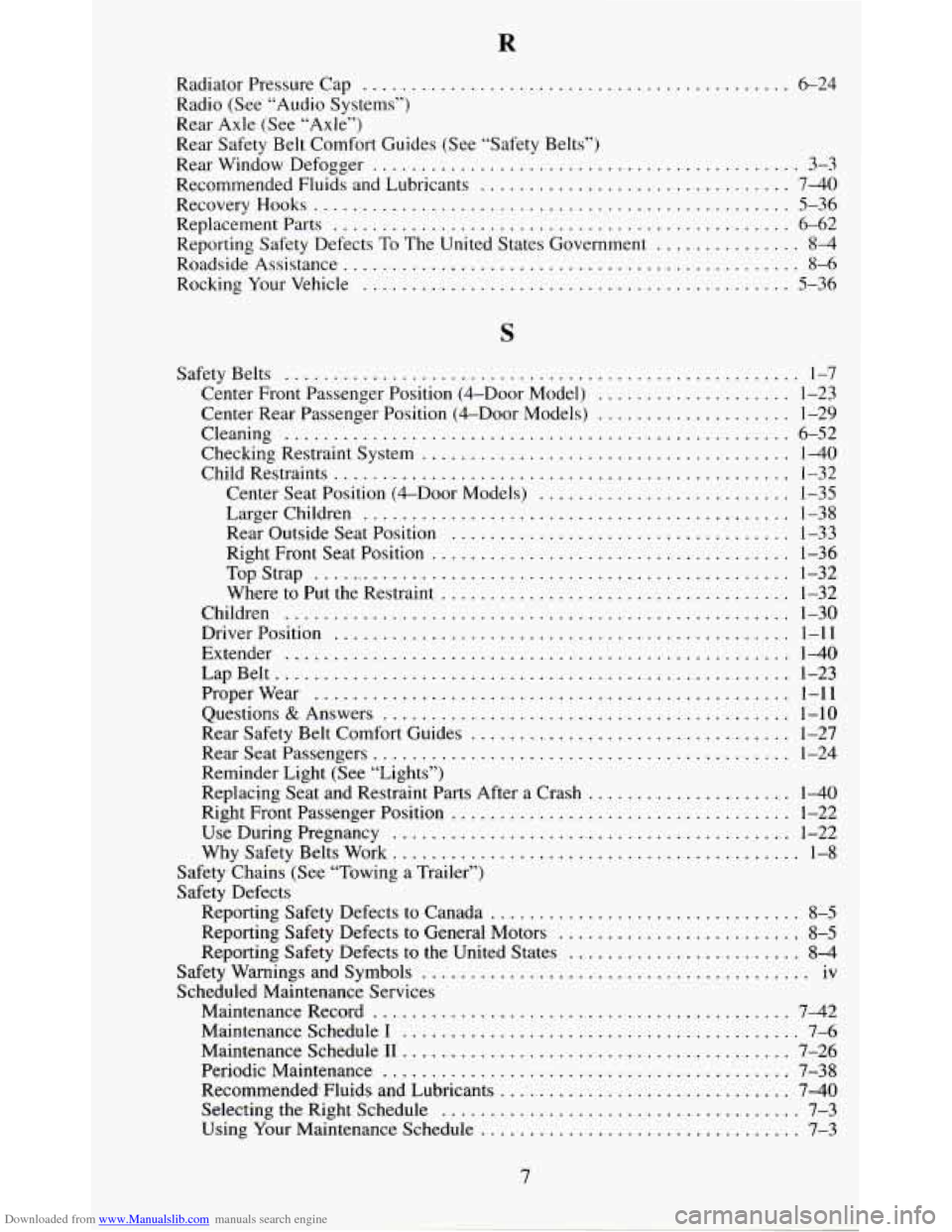
Radio (See “Audio Systems”)
Rear Axle (See “Axle”)
Rear Safety Belt Comfort Guides (See “Safety Belts”)
Rear Window Defogger
............................................ 3-3
Recommended Fluids and Lubricants ................................ 740
Recovery Hooks
................................................. 5-36
Replacement Parts
............................................... 6-62
Reporting Safety Defects
To The United States Government ............... 8-4
Roadside Assistance ............................................... 8-6
RockingYourVehicle
............................................ 5-36
S
SafetyBelts ..................................................... 1-7
Center Front Passenger Position (&Door Model) .................... 1-23
Center Rear Passenger Position (4-Door Models)
.................... 1-29
Cleaning
.................................................... 6-52
Checking Restraint System
...................................... 140
Child Restraints
............................................... 1-32
Center Seat Position (&Door Models)
.......................... 1-35
Larger Children
............................................ 1-38
Right Front Seat Position
..................................... 1-36
Rear Outside Seat Position
................................... 1-33
TopStrap .................................................. 1-32
Where to Put the Restraint
.................................... 1-32
Children
.................................................... 1-30
DriverPosition ............................................... 1-11
Extender
..................................................... 1-40
Properwear ................................................. 1-11
Rear Safety Belt Comfort Guides
................................. 1-27
Reminder Light (See “Lights”)
Replacing Seat and Restraint Parts After a Crash
..................... 1-40
Right Front Passenger Position ................................... 1-22
LapBelt
..................................................... 1-23
Questions
& Answers .......................................... 1-10
RearSeatPassengers ........................................... 1-24
Use During Pregnancy
......................................... 1-22
Why Safety Belts Work
.......................................... 1-8
Safety Chains (See “Towing a Trailer”)
Safety Defects
Reporting Safety Defects to Canada
................................ 8-5
Reporting Safety Defects to General Motors ......................... 8-5
Reporting Safety Defects to the United States ........................ 8-4
Safety Warnings and Symbols
........................................ iv
Scheduled Maintenance Services Maintenance Record
........................................... 7-42
Maintenance Schedule
I ......................................... 7-6
MaintenanceSchedulen
........................................ 7-26
Periodic Maintenance
.......................................... 7-38
Recommended: Fluids and Lubricants
.............................. 7-40
Selecting the Right Schedule
..................................... 7-3
Using Your Maintenance Schedule
................................. 7-3
7