Page 229 of 342
Downloaded from www.Manualslib.com manuals search engine A//- Wheel Drive
If you have an all-wheel-drive vehicle, be sure to perform the lubricant
checks described in this section. However, they have two additional systems
that need lubrication.
Transfer Case
When to Check Lubricant
Refer to the Maintenance Schedule to determine how often to check the
lubricant. See “Periodic Maintenance Inspections’’ in the Index.
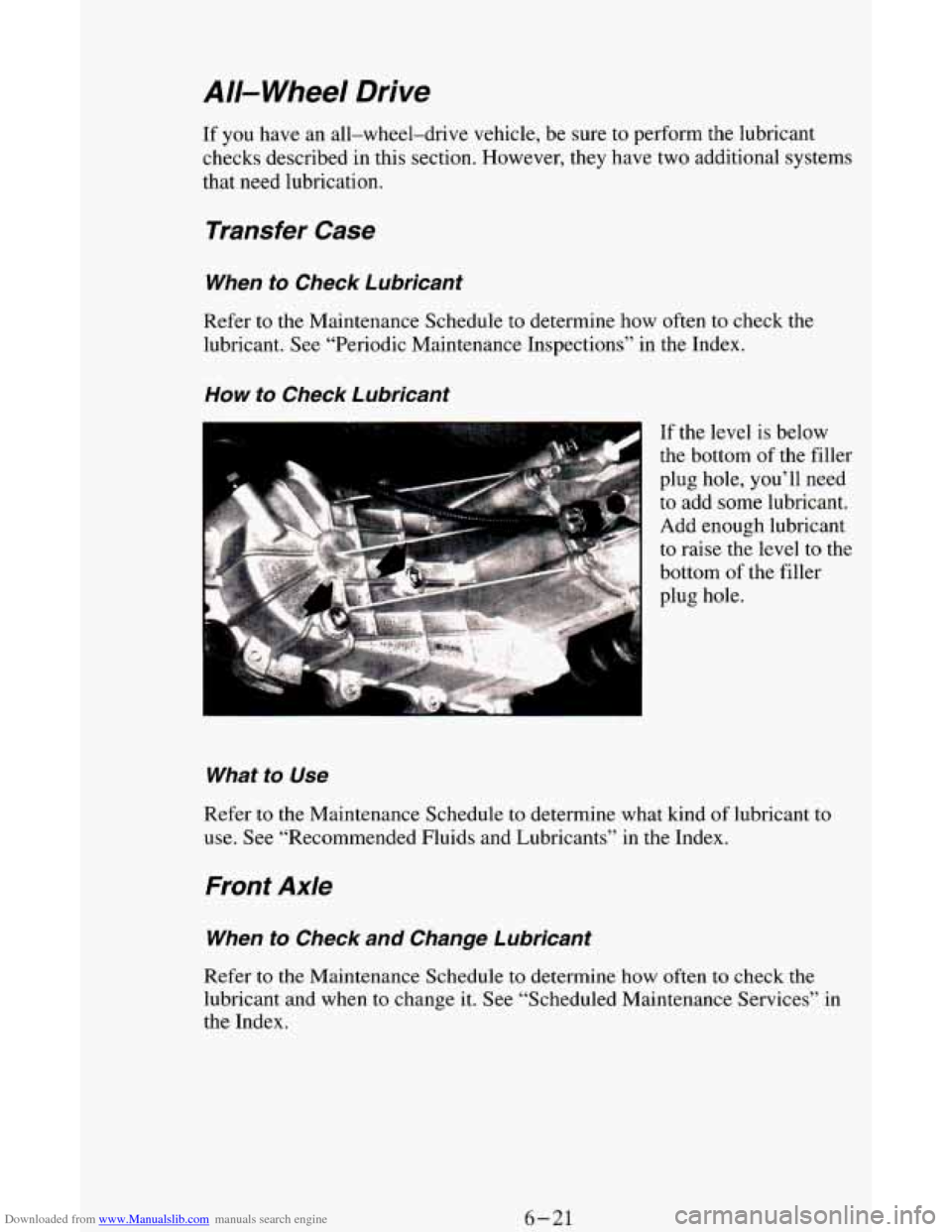
How to Check Lubricant
If the level is below
the bottom
of the filler
plug hole, you’ll need
to add some lubricant.
Add enough lubricant
to raise the level
to the
bottom
of the filler
plug hole.
What to Use
Refer to the Maintenance Schedule to determine what kind of lubricant to
use. See “Recommended Fluids and Lubricants” in the Index.
Front Axle
When to Check and Change Lubricant
Refer to the Maintenance Schedule to determine how often to check the
lubricant and when to change it.
See “Scheduled Maintenance Services’’ in
the Index.
6-21
Page 230 of 342
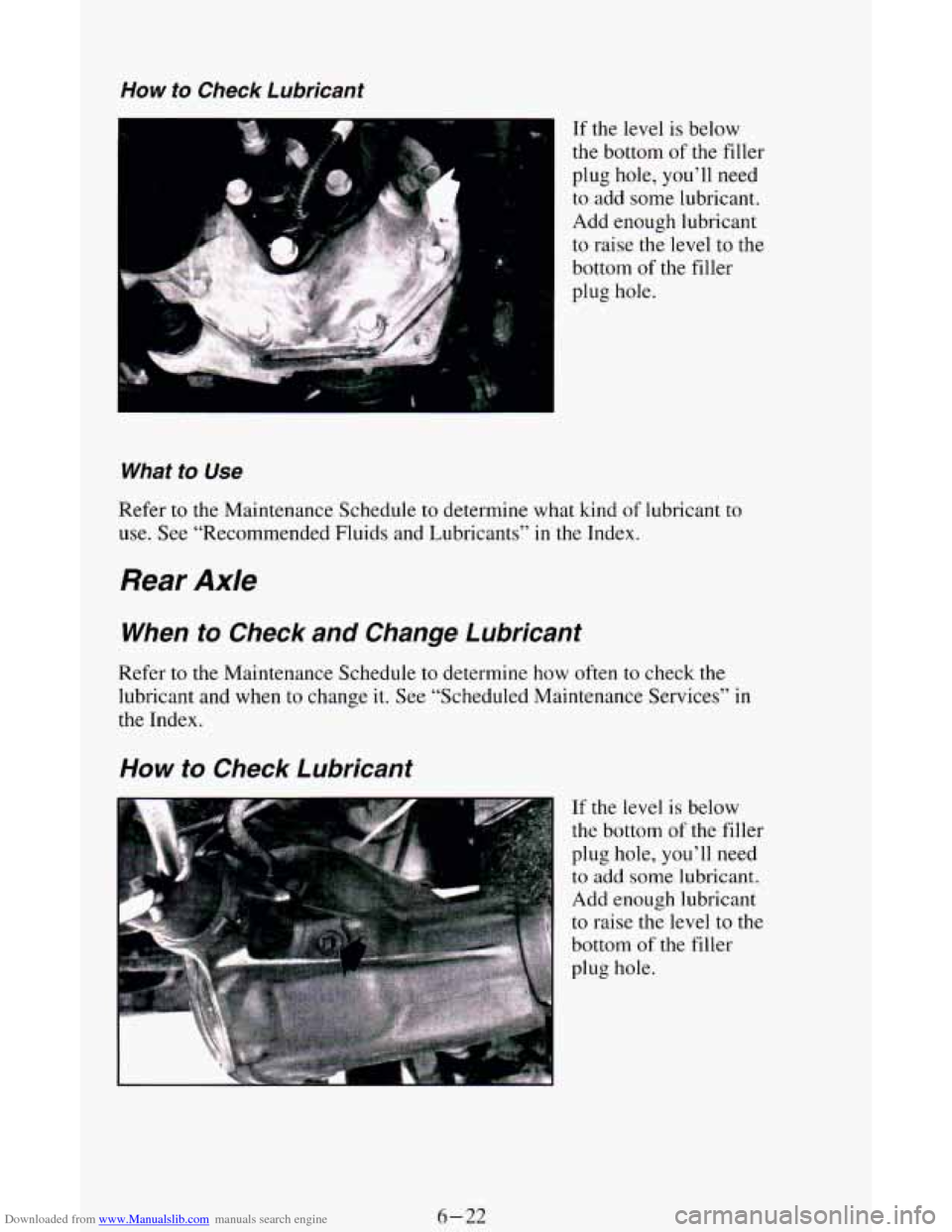
Downloaded from www.Manualslib.com manuals search engine How to Check Lubricant
If the level is below
the bottom
of the filler
plug hole, you’ll need
to add some lubricant.
Add enough lubricant
to raise the
level to the
bottom of the filler
plug hole.
What to Use
Refer to the Maintenance Schedule to determine what kind of lubricant to
use. See “Recommended Fluids and Lubricants’’
in the Index.
Rear Axle
When to Check and Change Lubricant
Refer to the Maintenance Schedule to determine how often to check the
lubricant and when to change
it. See “Scheduled Maintenance Services” in
the Index.
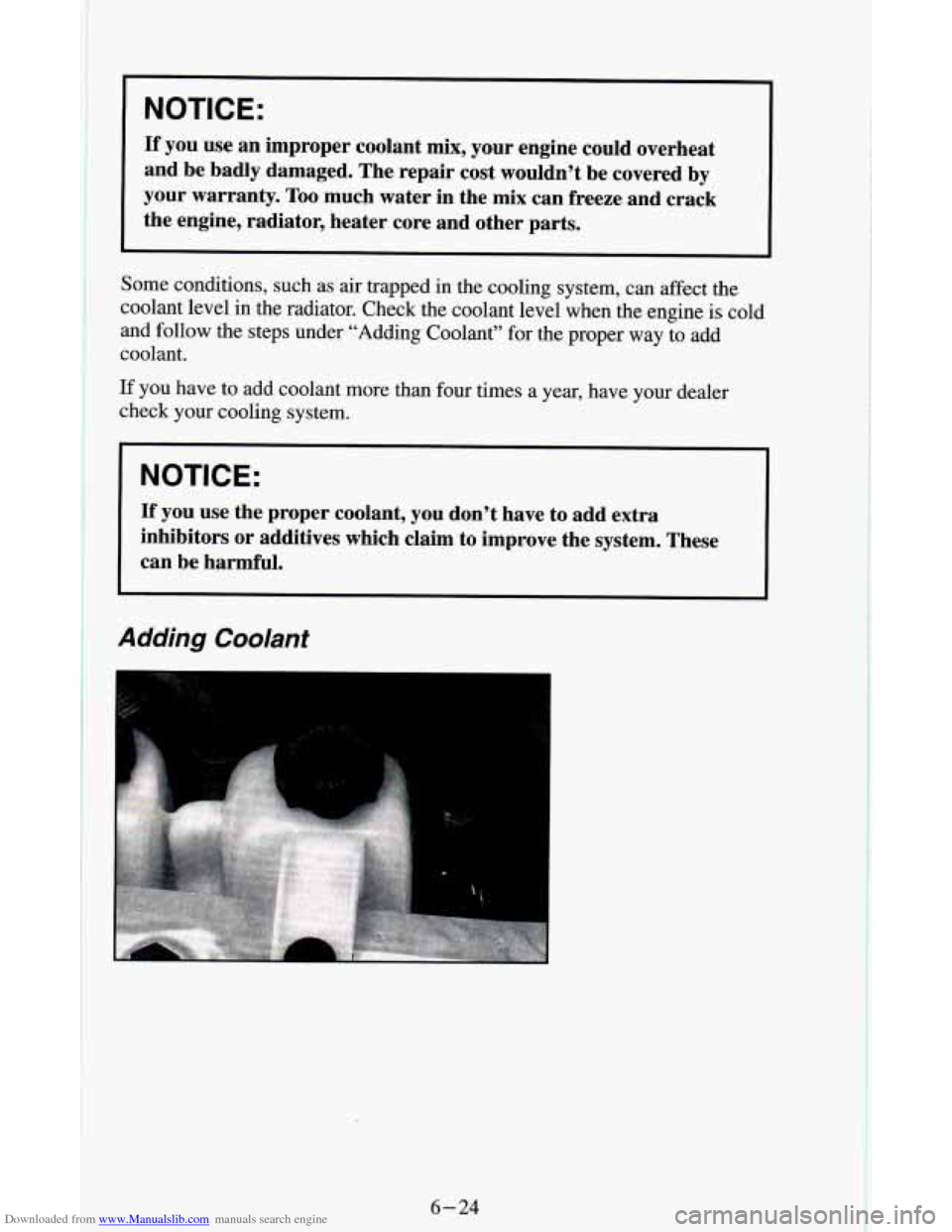
How to Check Lubricant
- If the level is below
the bottom
of the filler
plug hole, you’ll need
to add some lubricant.
Add enough lubricant
to raise the level to the
bottom of the filler
plug hole.
6-22
Page 232 of 342
Downloaded from www.Manualslib.com manuals search engine NOTICE:
If you use an improper coolant mix, your engine could overheat
and be badly damaged. The repair cost wouldn’t be covered by
your warranty.
Too much water in the mix can freeze and crack
the engine, radiator, heater core and other parts.
Some conditions, such as air trapped in the cooling system, can affect the
coolant level in the radiator. Check the coolant level when the engine is cold
and follow the steps under “Adding Coolant” for the proper way to add
coolant.
If you have to add coolant more than four times a year, have your dealer
check your cooling system.
NOTICE:
If YOU use the proper coolant, you don’t have to add extra
inhibitors or additives which claim to improve the system. These
can be harmful.
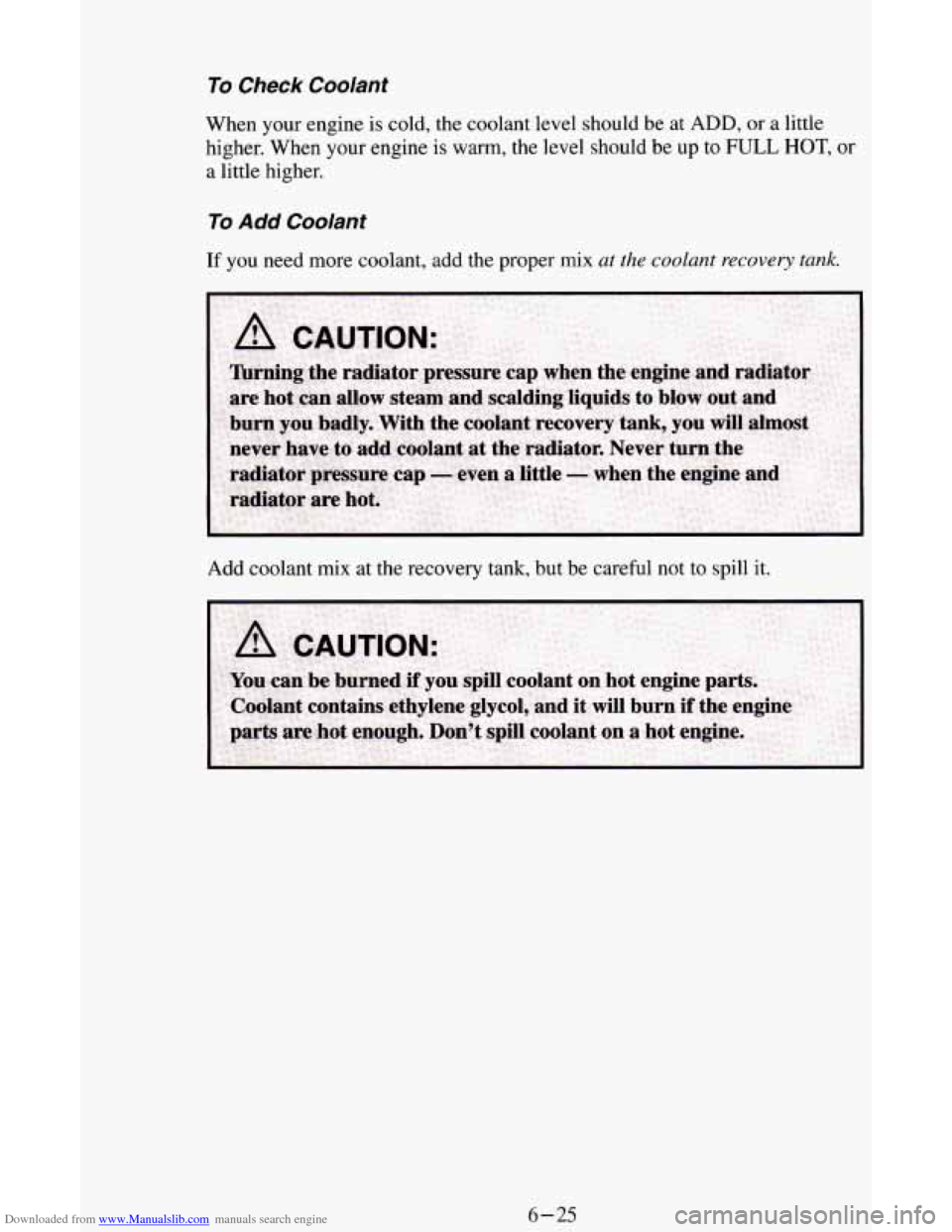
Adding Coolant
6-24
Page 233 of 342
Downloaded from www.Manualslib.com manuals search engine To Check Coolant
When your engine is cold, the coolant level should be at ADD, or a little
higher. When your engine is warm,
the level should be up to FULL HOT, or
a little higher.
To Add Coolant
If you need more coolant, add the proper mix at the coolant recovery tank.
~~ ~
Add coolant mix at the recovery tank, but be careful not to spill it.
6-25
Page 235 of 342
Downloaded from www.Manualslib.com manuals search engine Power Steering Fluid
How To Check Power Steering Fluid
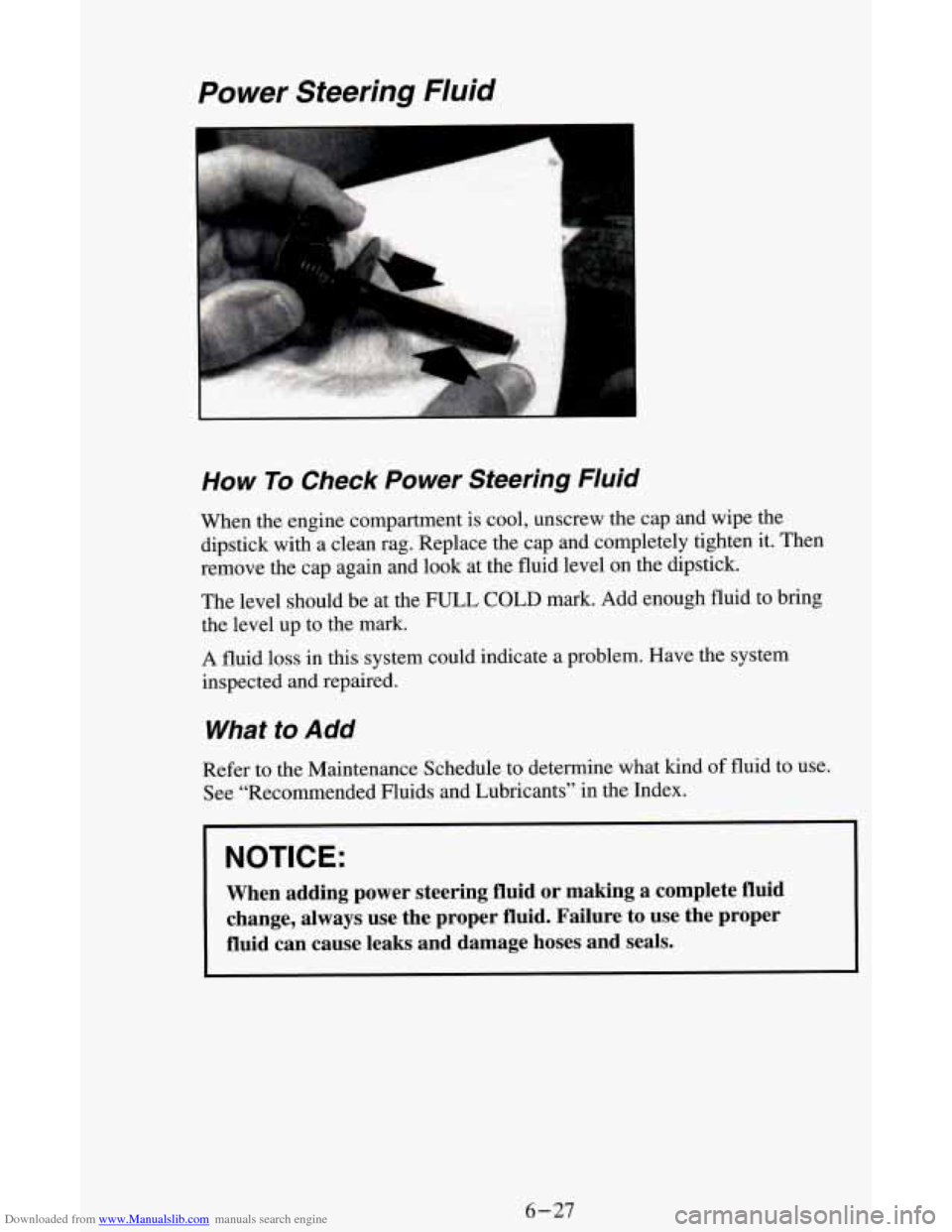
When the engine compartment is cool, unscrew the cap and wipe the
dipstick with a clean rag. Replace the cap and completely tighten it. Then
remove the cap again and look at the fluid level on the dipstick.
The level should be at the FULL
COLD mark. Add enough fluid to bring
the level up to the mark.
A fluid loss in this system could indicate a problem. Have the system
inspected and repaired.
What to Add
Refer to the Maintenance Schedule to determine what kind of fluid to use.
See “Recommended Fluids and Lubricants” in the Index.
NOTICE:
When adding power steering fluid or making a complete fluid
change, always use the proper fluid. Failure to use the proper\
fluid can cause leaks and damage hoses and seals.
6-27
Page 237 of 342
Downloaded from www.Manualslib.com manuals search engine Brakes
Brake Master Cylinder
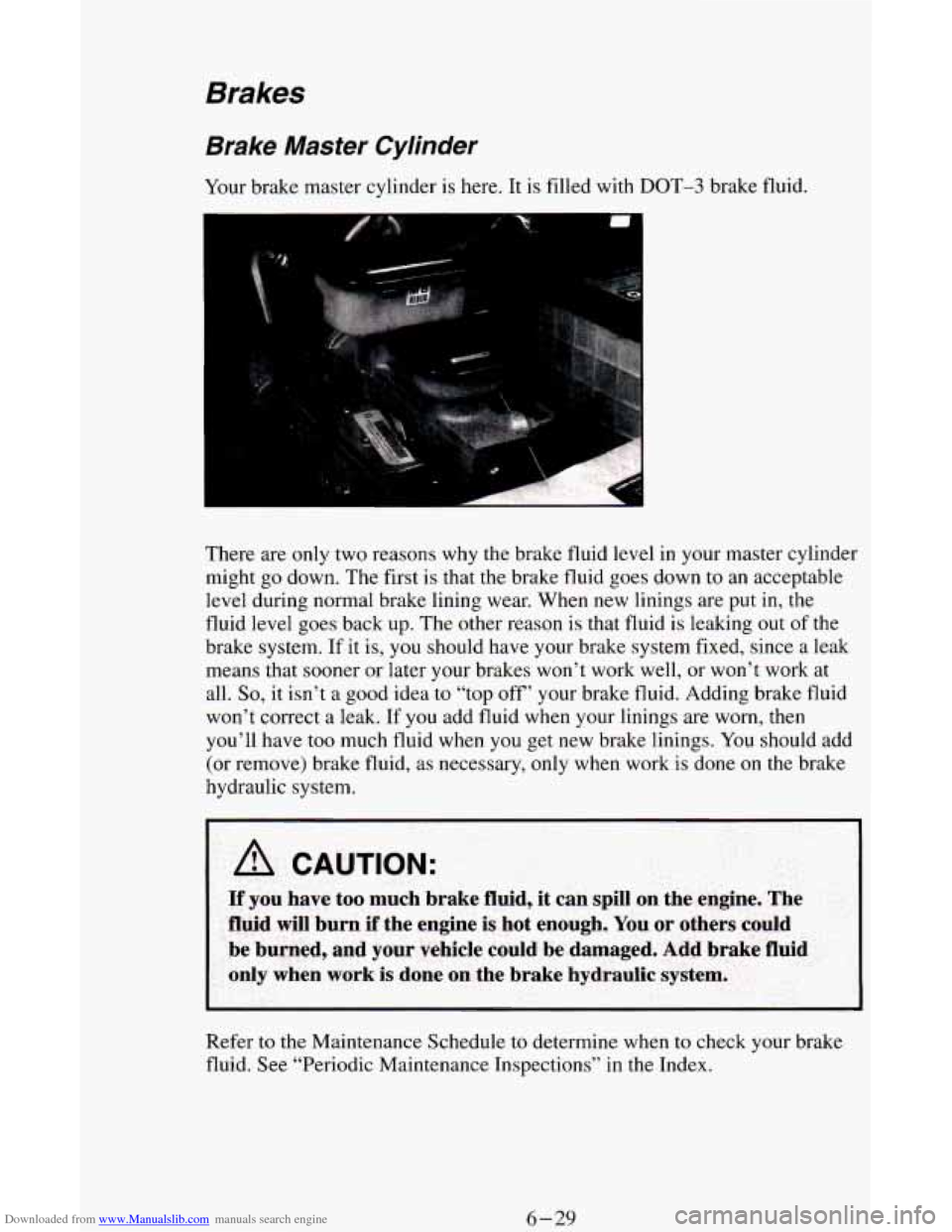
Your brake master cylinder is here. It is filled with DOT-3 brake fluid.
There are only two reasons why the brake fluid level in your master cylinder
might
go down. The first is that the brake fluid goes down to an acceptable
level during normal brake lining wear. When new linings are put in, the
fluid level goes back up. The other reason is that fluid
is leaking out of the
brake system.
If it is, you should have your brake system fixed, since a leak
means that sooner or later your brakes won’t work well, or won’t work at
all.
So, it isn’t a good idea to “top off’ your brake fluid. Adding brake fluid
won’t correct a leak.
If you add fluid when your linings are worn, then
you’ll have too much fluid when you get new brake linings. You should add
(or remove) brake fluid, as necessary, only when work is done on the brake
hydraulic system.
A CAUTION:
If you have too much brake fluid, it can spill on the engine. The
fluid will burn
if the engine is hot enough. You or others could
be burned, and your vehicle could be damaged. Add brake fluid \
only
when work is done on the brake hydraulic system.
Refer to the Maintenance Schedule to determine when to check your brake
fluid. See “Periodic Maintenance Inspections” in the Index.
6-29
Page 238 of 342
Downloaded from www.Manualslib.com manuals search engine To Check Brake Fluid
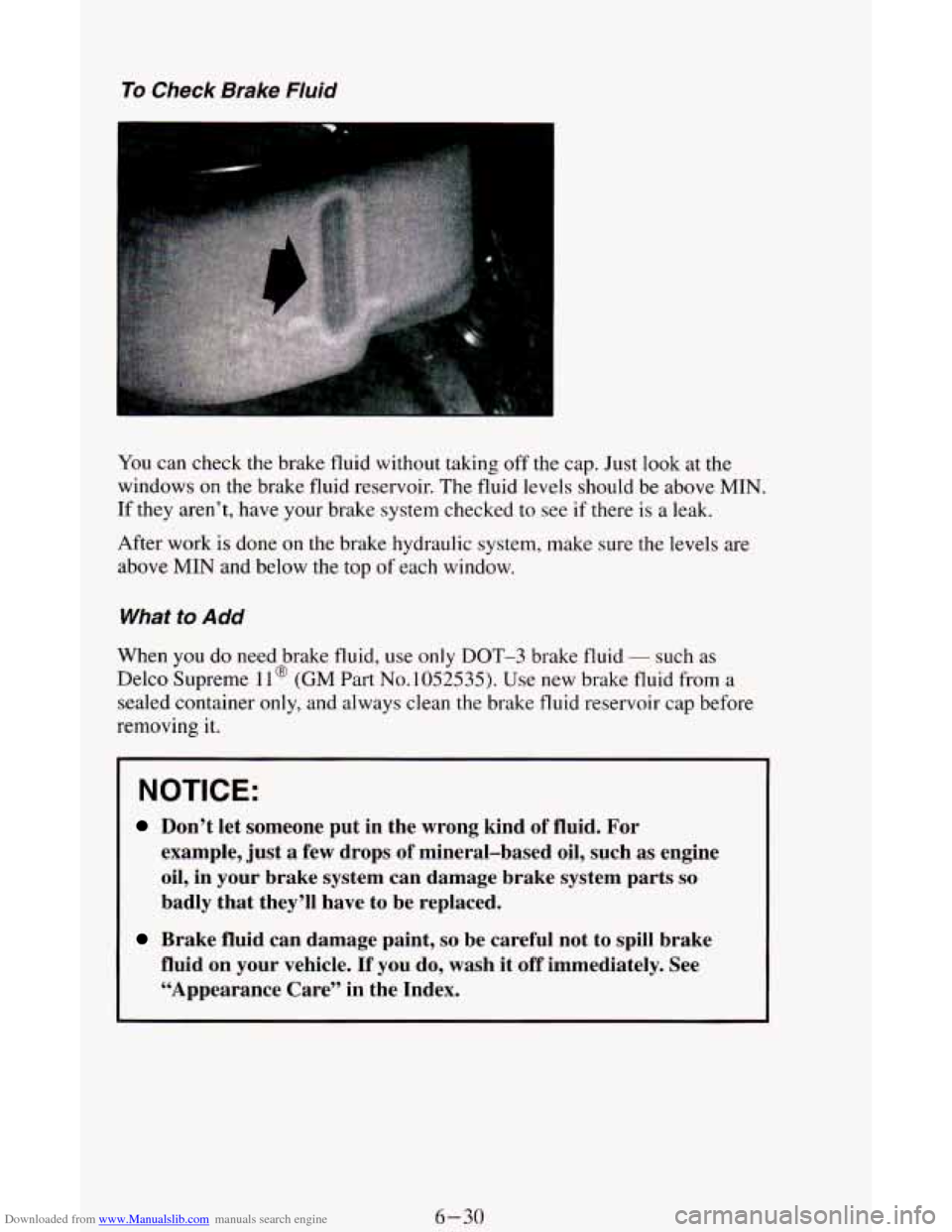
You can check the brake fluid without taking off the cap. Just look at the
windows
on the brake fluid reservoir. The fluid levels should be above MIN.
If they aren’t, have your brake system checked to see if there is a leak.
After work is done on the brake hydraulic system, make sure the levels are
above
MIN and below the top of each window.
What to Add
When you do need brake fluid, use only DOT-3 brake fluid - such as
Delco Supreme 11 @ (GM Part No. 1052535). Use new brake fluid from a
sealed container only, and always clean the brake fluid reservoir cap before
removing it.
NOTICE:
Don’t let someone put in the wrong kind of fluid. For
example, just
a few drops of mineral-based oil, such as engine
oil, in your brake system can damage brake system parts
so
badly that they’ll have to be replaced.
Brake fluid can damage paint, so be careful not to spill brake
fluid on your vehicle.
If you do, wash it off immediately. See
“Appearance Care” in the Index.
6-30
Page 240 of 342
Downloaded from www.Manualslib.com manuals search engine Replacing Brake System Parts
The braking system on a modern vehicle is complex. Its many parts have to
be of top quality and work well together if the vehicle is to have really good
braking. Vehicles we design and test have topquality
GM brake parts in
them, as your vehicle does when it is new. When you replace parts of your
braking system
- for example, when your brake linings wear down and
you have to have
new ones put in - be sure you get new genuine GM
replacement parts. If you don’t, your brakes may no longer work properly.
For example, if someone puts in brake linings that are wrong for your
vehicle, the balance between your front and rear brakes can change
- for
the worse. The braking performance you’ve come to expect can change in
many other ways if someone puts in the wrong replacement brake parts.
Hydro-Boost Brake System
The power steering pump also powers the Hydro-Boost. Refer to “Power
Steering Fluid” in this section when checking the fluid level or adding fluid.
Battery
Every new vehicle has a Delco Freedom’ battery. You never have to add
water to one of these. When it’s time for a new battery, we recommend
a
Delco Freedom’ battery. Get one that has the replacement number shown
on the original battery’s label.
Vehicle Storage
If you’re not going to drive your vehicle for 25 days or more, take off the
black, negative (-) cable from the battery. This will help keep your battery
from running down.
Contact your dealer
to learn how to prepare your vehicle for longer storage
periods.
6-32