Page 156 of 342
Downloaded from www.Manualslib.com manuals search engine Then here are some tips:
Make sure your vehicle is well ventilated, with a comfortably cool
Keep your eyes moving. Scan the road ahead and to the sides. Check
If you get sleepy, pull off the road into a rest, service, or parking area
interior.
your mirrors
and your instruments frequently.
and take a nap, get some exercise, or both. For safety, treat drowsiness
on the highway as an emergency.
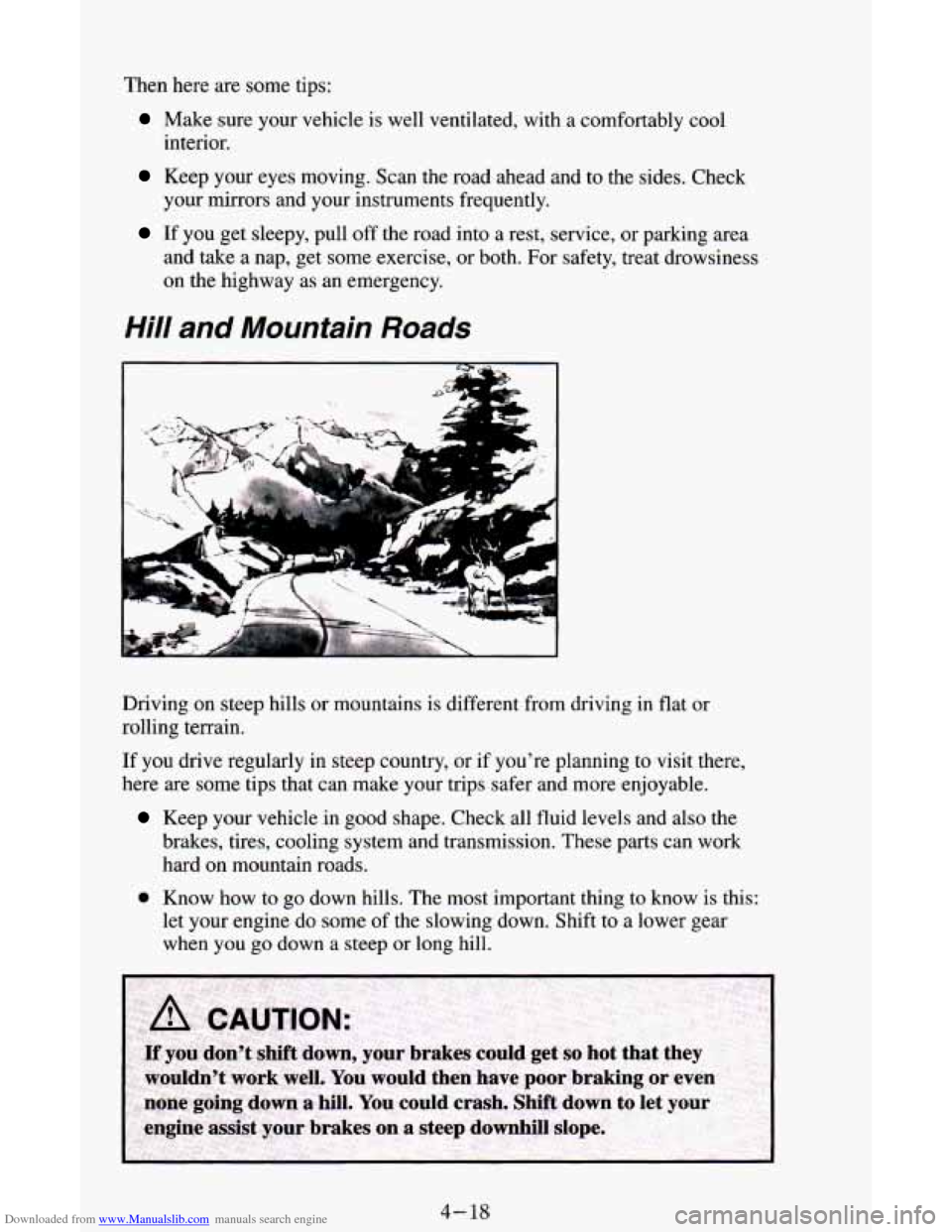
Hill and Mountain Roads
Driving on steep hills or mountains is different from driving in flat or
rolling terrain.
If you drive regularly in steep country, or if you’re planning to visit there,
here are some tips that can make your trips safer and more enjoyable.
Keep your vehicle in good shape. Check all fluid levels and also the
brakes, tires, cooling system and transmission. These parts can work
hard on mountain roads.
0 Know how to go down hills. The most important thing to know is this:
let your engine
do some of the slowing down. Shift to a lower gear
when you go down
a steep or long hill.
4- 18
Page 167 of 342
Downloaded from www.Manualslib.com manuals search engine Safety Chains
You should always attach chains between your vehicle and your trailer.
Cross the safety chains under the tongue of the trailer
so that the tongue will
not drop to the road if it becomes separated from the hitch. Instructions
about safety chains may be provided by the hitch manufacturer or by the
trailer manufacturer. Follow the manufacturer’s recommendation for
attaching safety chains and do not attach them to the bumper. Always leave
just enough slack
so you can turn with your rig. And, never allow safety
chains
to drag on the ground.
Trailer Brakes
If your trailer weighs more than 1,000 pounds (450 kg) loaded, then it needs
its own brakes
- and they must be adequate. Be sure to read and follow the
instructions for the trailer brakes
so you’ll be able to install, adjust and
maintain them properly.
Your trailer brake system can tap into your vehicles’s hydraulic brake
system, except:
Don’t tap into your vehicle’s brake system if the trailer’s brake system
will use more than
0.02 cubic inch (0.3~~) of fluid from your vehicle’s
master cylinder. If it does, both braking systems won’t work well. You
could even lose your brakes.
Will the trailer parts take 3,000 psi (20 650 kPa) of pressure? If not, the
trailer brake system must
not be used with your vehicle.
If everything checks out this far, then make the brake fluid tap at the
port on the master cylinder that sends fluid to the rear brakes. But don’t
use copper tubing for this.
If you do, it will bend and finally break off.
Use steel brake tubing.
4-29
Page 168 of 342
Downloaded from www.Manualslib.com manuals search engine Driving with a Trailer
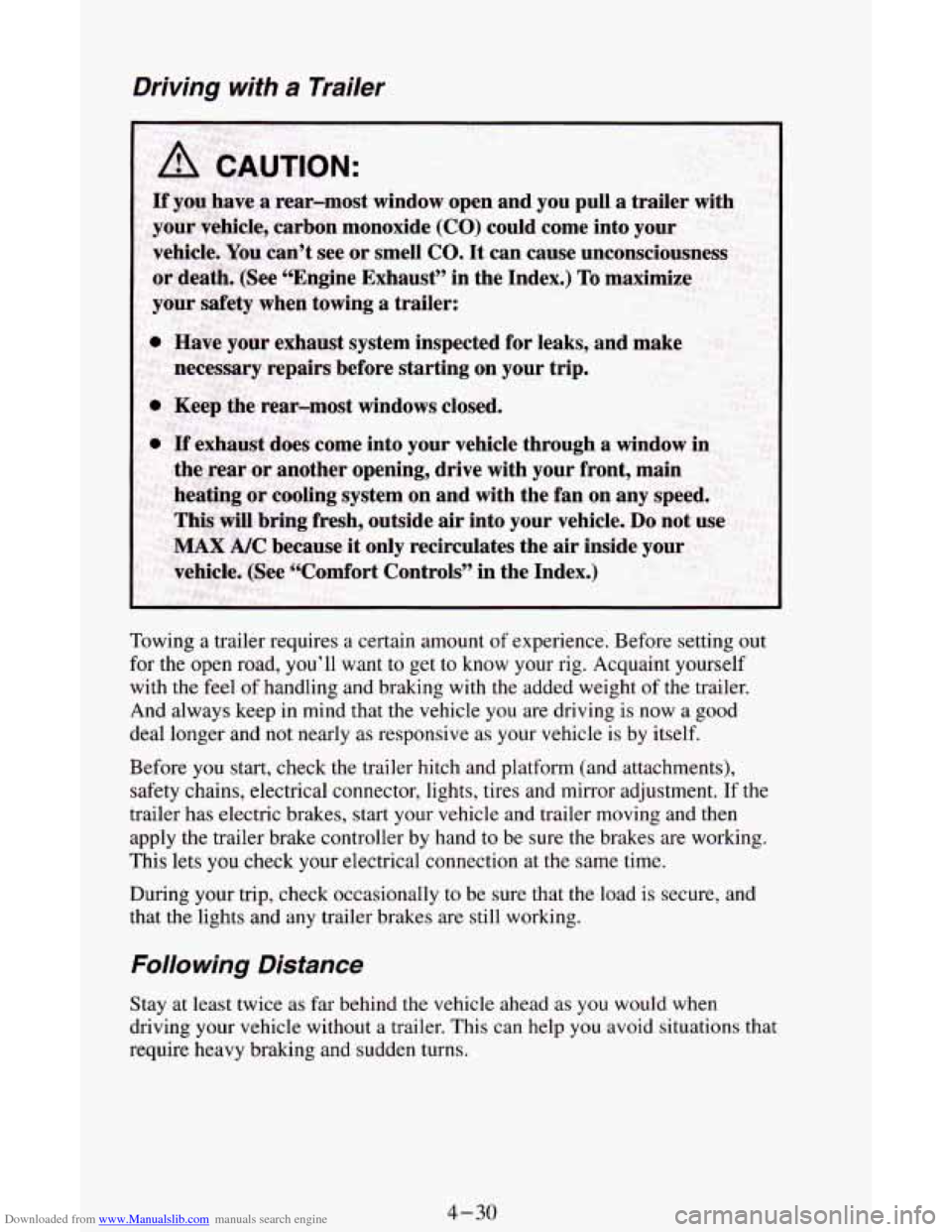
Towing a trailer requires a certain amount of experience. Before setting out
for the open road, you’ll want
to get to know your rig. Acquaint yourself
with the feel
of handling and braking with the added weight of the trailer.
And always keep in mind that the vehicle you are driving is now a good
deal longer and not nearly as responsive as your vehicle is by itself.
Before you start, check the trailer hitch and platform (and attachments),
safety chains, electrical connector, lights, tires and mirror adjustment.
If the
trailer has electric brakes, start
your vehicle and trailer moving and then
apply the trailer brake controller by hand to be sure the brakes are working.
This lets
you check your electrical connection at the same time.
During your trip, check occasionally
to be sure that the load is secure, and
that the lights and any trailer brakes are still working.
Following Distance
Stay at least twice as far behind the vehicle ahead as you would when
driving your vehicle without a trailer. This can help you avoid situations that
require heavy braking and sudden turns.
4-30
Page 169 of 342
Downloaded from www.Manualslib.com manuals search engine Passing
You’ll need more passing distance up ahead when you’re towing a trailer.
And, because you’re a good deal longer, you’ll need to go much farther
beyond the passed vehicle before
you can return to your lane.
Backing Up
Hold the bottom of the steering wheel with one hand. Then, to move the
trailer to the left,
just move that hand to the left. To move the trailer to the
right, move your hand to the right. Always back up slowly and, if possible,
have someone guide you.
Making Turns
NOTICE:
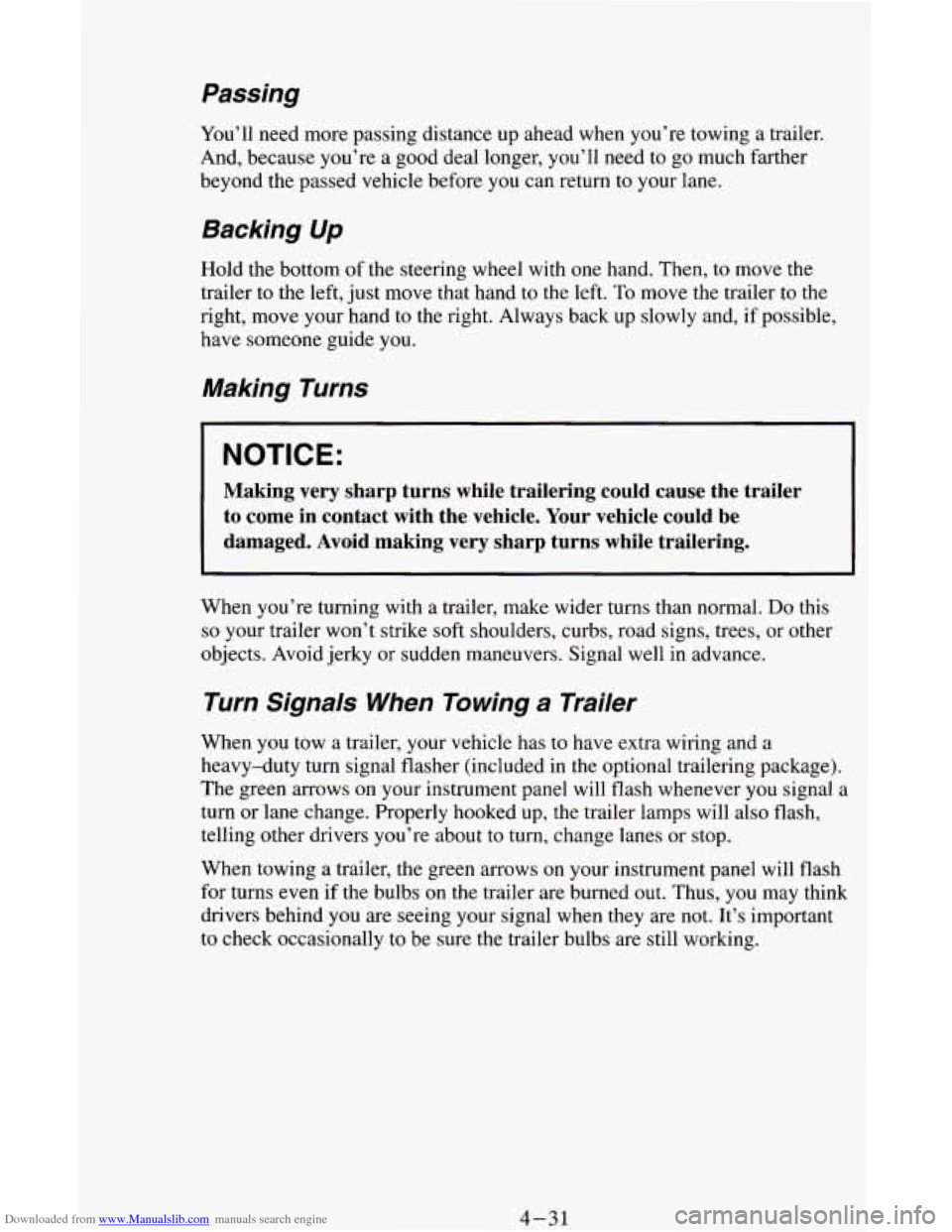
Making very sharp turns while trailering could cause the traile\
r
to come in contact with the vehicle. Your vehicle could be
damaged. Avoid making very sharp turns while trailering.
When you’re turning with a trailer, make wider turns than normal. Do this
so your trailer won’t strike soft shoulders, curbs, road signs, trees, or other
objects. Avoid jerky or sudden maneuvers. Signal well in advance.
Turn Signals When Towing a Trailer
When you tow a trailer, your vehicle has to have extra wiring and a
heavy-duty turn signal flasher (included in the optional trailering package).
The green arrows
on your instrument panel will flash whenever you signal a
turn or lane change. Properly hooked up, the trailer lamps will also flash,
telling other drivers you’re about
to turn, change lanes or stop.
When towing a trailer, the green arrows
on your instrument panel will flash
for turns even if the bulbs
on the trailer are burned out. Thus, you may think
drivers behind you are seeing your signal when they are not. It’s important
to check occasionally to be sure the trailer bulbs are still working.
4-31
Page 171 of 342
Downloaded from www.Manualslib.com manuals search engine Maintenance When Trailer Towing
Your vehicle will need service more often when you’re pulling a trailer. See
the Maintenance Schedule for more
on this. Things that are especially
important in trailer operation are automatic transmission fluid (don’t
overfill), engine oil, axle lubricant, belt, cooling system, and brake
adjustment. Each of these is covered in this manual, and the Index will help
you find them quickly. If you’re trailering, it’s a good idea to review these
sections before you start your trip.
Check periodically to see that all hitch nuts and bolts are tight.
Trailer Lighting Systems Wiring
See “Trailer Wiring Harness” in the Index.
4-33
Page 175 of 342
Downloaded from www.Manualslib.com manuals search engine Jump Starting
If your battery has run down, you may want to use another vehicle and some
jumper cables to start your vehicle. But please follow the steps below to do
it safely.
I NOTICE:
Ignoring these steps could result in costly damage to your
vehicle that wouldn’t be covered by your warranty.
Trying to start your vehicle by pushing or pulling it won’t work,
and it could damage your vehicle.
To Jump Start Your Vehicle:
1. Check the other vehicle. It must have a 12-volt battery with a negative
ground system.
r
~ ~~
NOTICE:
If the other system isn’t a 12-volt system with a negative
ground, both vehicles can be
damaged.
5-3
Page 176 of 342
Downloaded from www.Manualslib.com manuals search engine 2. Get the vehicles close enough so the jumper cables can reach, but be
sure the vehicles aren’t touching each other.
If they are, it could cause a
ground connection you don’t want. You wouldn’t be able to start your
vehicle, and the bad grounding could damage the electrical systems.
You could be injured if the vehicles roll. Set the parking brake firmly
on each vehicle. Put an automatic transmission in PARK
(P) or a
manual transmission in NEUTRAL (N).
If you have a
four-wheel-drive vehicle with
a manual transfer case shift lever, be
sure the transfer case is
not in NEUTRAL (N).
3. Turn off the ignition on both vehicles. Turn off all lights that aren’t
needed, and radios. This will avoid sparks and help save both batteries.
And it could save your radio!
- ~-
NOTICE:
If you leave your radio on, it could be badly damaged. The
repairs wouldn’t be covered by your warranty.
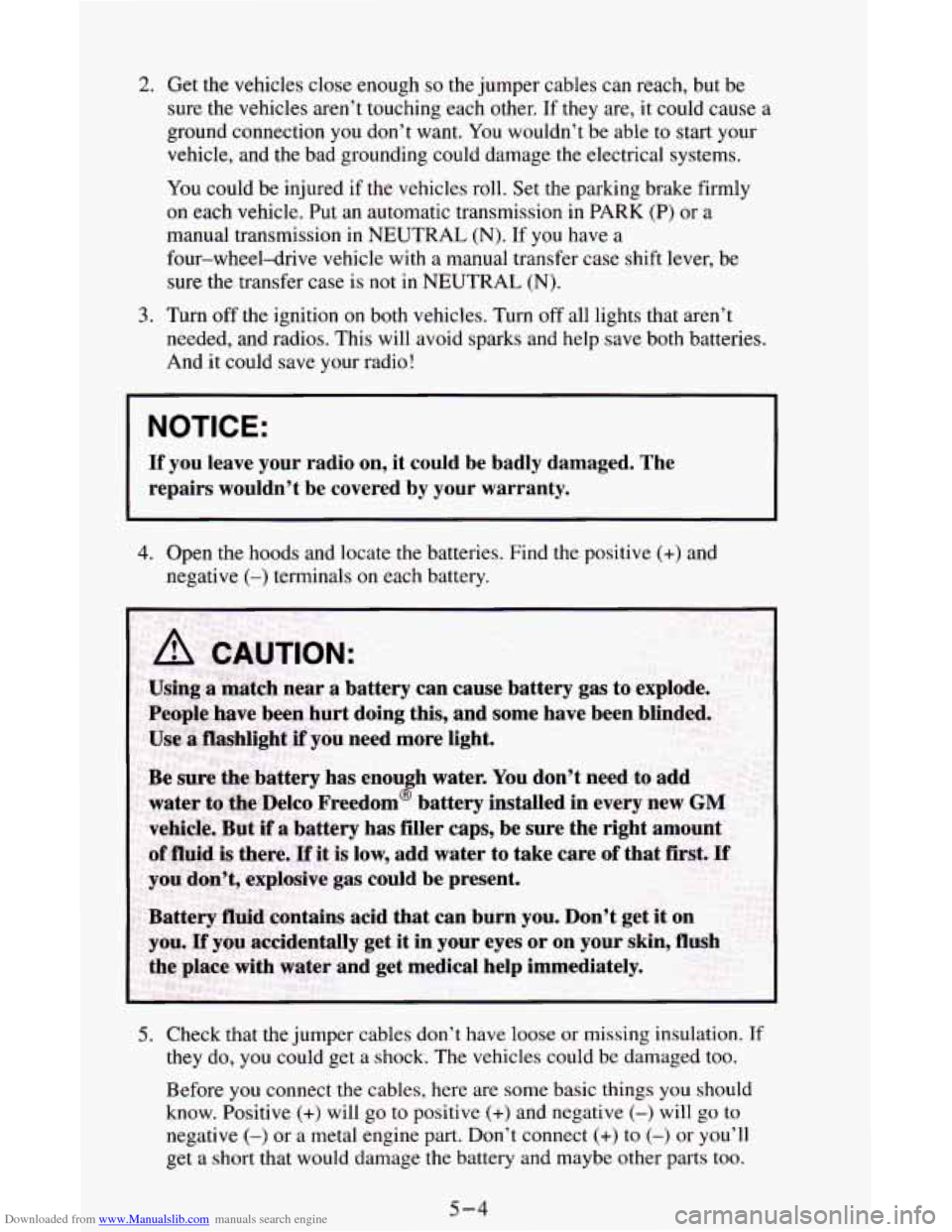
4. Open the hoods and locate the batteries. Find the positive (+) and
negative
(-) terminals on each battery.
5. Check that the jumper cables don’t have loose or missing insulation. If
they do, you could get a shock. The vehicles could be damaged too.
Before
you connect the cables, here are some basic things you should
know. Positive
(+> will go to positive (+) and negative (-) will go to
negative
(-1 or a metal engine part. Don’t connect (+) to (-) or you’ll
get a short that would damage the battery and maybe other parts too.
5-4
Page 206 of 342
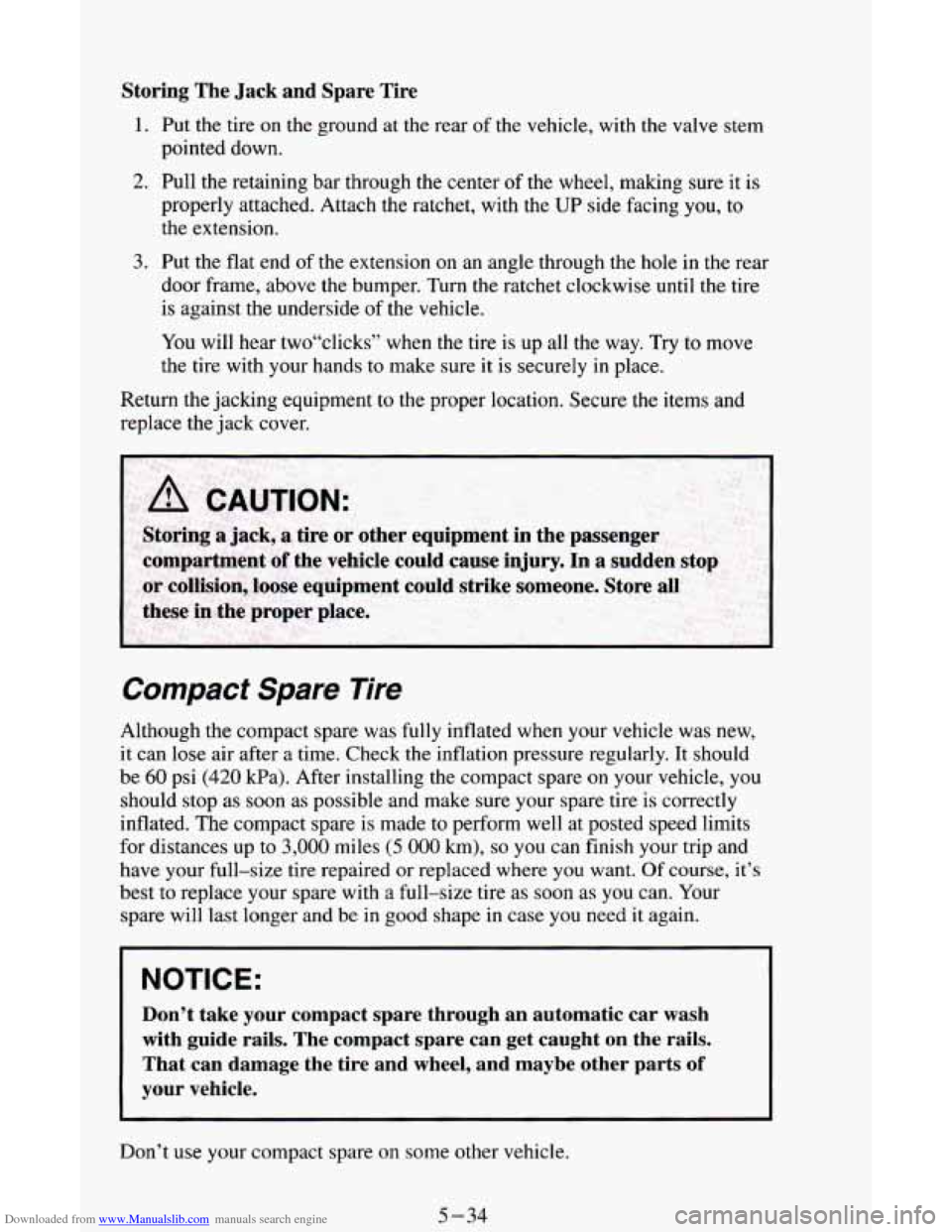
Downloaded from www.Manualslib.com manuals search engine Storing The Jack and Spare Tire
1. Put the tire on the ground at the rear of the vehicle, with the valve stem
pointed down.
2. Pull the retaining bar through the center of the wheel, making sure it is
properly attached. Attach the ratchet, with the UP side facing you, to
the extension.
3. Put the flat end of the extension on an angle through the hole in the rear
door frame, above the bumper. Turn the ratchet clockwise until the tire
is against the underside
of the vehicle.
You will hear two“c1icks” when the tire is up all the way. Try to move
the tire with your hands to make sure it is securely in place.
Return the jacking equipment to the proper location. Secure the items and
replace the jack cover.
Compact Spare Tire
Although the compact spare was fully inflated when your vehicle was new,
it can lose air after
a time. Check the inflation pressure regularly. It should
be
60 psi (420 kPa). After installing the compact spare on your vehicle, you
should stop as soon as possible and make sure your spare tire is correctly
inflated. The compact spare is made to perform well at posted speed limits
for distances up to
3,000 miles (5 000 km), so you can finish your trip and
have your full-size tire repaired or replaced where you want. Of course, it’s
best to replace your spare with a full-size tire as soon as you can. Your
spare will last longer and be in good shape in case you need
it again.
I NOTICE:
Don’t take your compact spare through an automatic car wash \
with guide rails. The compact spare can get caught
on the rails.
That can damage the tire and wheel, and maybe other parts
of
your vehicle.
Don’t use your compact spare on some other vehicle.
5-34