1995 CADILLAC SEVILLE display
[x] Cancel search: displayPage 184 of 410
Downloaded from www.Manualslib.com manuals search engine ---
I-
The Upper Knob
The upper knob does the following:
It turns the radio on and off.
It controls the volume.
0 It lets you see what station you have. (When the radio is
RCWPROG knob to display the station.) on,
press the
It tells you the time. (When the ignition is off, press the RCWPROG
0 It allows you to hear the other side of tape play. (When a cassette is
knob
to display the time.)
inserted into the player, press the knob to change sides.)
The Lower Knob
Turn the lower knob to choose radio stations. Press the knob to switch
between
AM and FM.
Behind the lower knob is the fade control. It moves the sound between
the front and rear speakers.
Finding a Station
SCAN When you press this button, the SCAN indicator in the display will
light and the radio will find the next station and stay there for about five
seconds. Then it
will go to the next station and pause, and keep doing that
until
you press either the SCAN button again or the upper knob.
SEEK This button selects stations, but it doesn’t keep moving as SCAN
does. When you press SEEK the radio will automatically go to the next
station and stay there.
Pushbuttons: You can set the pushbuttons to get up to 10 favorite stations
(five
on FM and five more on AM.)
1. Choose either AM or FM.
2. Tune in the station.
3. Press the SET button.
4. Press one of the five pushbuttons within five seconds.
5. Repeat these steps for each of the five pushbuttons.
3- 15
Page 185 of 410
Downloaded from www.Manualslib.com manuals search engine Setting the Tone
BASS: The slide control increases or decreases the bass response tone.
Moving the control to the right increases bass while moving it to the
left
decreases it.
TREBLE: The slide control increases or decreases the treble response
tone. Moving the control to the right increases the treble while moving it
to the
left decreases it.
Your Cassette Tape Player
Your cassette tape player works best with tapes that are 30 to 45 minutes
long on each side. Tapes longer than that are
so thin that they may not
work well in this player.
If you look at the tape, or on its label or box,
it should say whether its bias,
or “equalization,” is
70 microseconds (70 p) or 120 microseconds (120 p).
Chrome and metal tapes are 70 p sec and standard iron tapes are 120 p sec.
Your tape player
will adjust automatically for either type of cassette tape.
To Play a Cassette Tape
1. Turn the radio on.
2. Insert the cassette through the tape door. (The TAPE indicator in the
display will light.)
If you hear nothing or hear just a garbled sound, the cassette may not be
in squarely. Press the EJCT button to remove the tape and start over. The
tape equalization is automatically sensed and set. Inserting the cassette
also activates
DOLBY@ noise reduction.
DNR@ is the Dynamic Noise Reduction. It helps remove background hiss
noise from the radio.
*DNR@ is a registered trademark of National Semiconductor
Corporation.
3. Once the tape is playing, use the upper and lower knobs to adjust the
volume and balance, just as you do for the radio. Press the upper knob
to change tape direction. The arrow in the display shows which
direction the tape is being played.
3-16
Page 186 of 410
Downloaded from www.Manualslib.com manuals search engine FWD: Press this button to go forward rapidly to another part of the tape.
The radio will play during fast forward.
To stop the tape press the same
button and the tape will start to play.
REV: Press this button to reverse the tape. To stop the tape press the same
button lightly or any
of the other buttons. The radio will play during this
reverse function.
PREV: Press this button to go back to the beginning of the last selection.
If the player has played less than
10 seconds into the current selection,
pressing the PREV button will cause the player to find the beginning of
the previous selection and resume play from that point. If the player is
more than
10 seconds into the current selection, pressing the PREV
button will cause the player to find the beginning of the current selection
and resume play from that point.
If PREV is pressed while the first
selection on the tape is being played, the player will return to the
beginning
of that side of the tape.
NEXT: Press this button to advance to the next selection. If the selection
is at the end of the tape, the tape will reverse directions and begin playing
at a normal speed.
ST/PL Press this button to switch back to the radio without ejecting the
tape. Press it
a second time to start playing the tape again.
EJCT Press this button to remove the tape.
To Play a Compact Disc
Before you begin, please note: don’t use the mini-discs that are called
“singles” (even with an adapter). They won’t eject. Use full-size compact
discs only.
1. Turn the radio on.
2. Insert a CD (label side up) partway into the slot. The player will pull it
in.
Wait a few seconds and the CD will play. Then only the time of day
and
CD will display.
If the
CD comes back out, check to see if
0 The disc is upside down.
0 The disc is dirty, scratched or wet.
0 There’s too much moisture in the air. If there is, wait about one hour
and
try it again.
Page 187 of 410
Downloaded from www.Manualslib.com manuals search engine ERR: This error message is displayed if you have a condition of either
extreme temperature, moisture
or an incorrect CD. The CD will
automatically be ejected. When conditions are back to normal the CD
should play again.
RCL/PROG: Press this recall/program button once to see what track is
being played. Within
five seconds press it a second time to see how long
the track has been playing. Press it a third time to see the time of day.
REV: Press and hold the reverse button to return rapidly within a track.
Release it to play the passage. The elapsed time
will be displayed to show
the reverse progress
of the CD.
FWD: Press and hold this forward button to advance rapidly within a
track. Release it to resume playing. Elapsed time will be displayed to show
the forward progress of the CD.
PREV: Press this button to go back to the beginning of the track. Pressing
this button when in the pause period between tracks
will take it back to
the start
of the track preceding the pause.
NEXT: Press this button to advance to the next track.
ST/PL: Press this button and the tape or CD will stop without ejecting and
the radio will start to play. Press it again and the tape or CD will start to
play again.
EJCT Press this button to remove the tape or CD. If you have both a CD
and a tape in the player, then the other playback media
will start to play.
Press it again and the other media
will eject.
COMP: Pressing this button makes soft and loud passages more equal in
volume. For example, classical or jazz music has very quiet and very loud
passages in the same tune. The COMP display
will light as long as COMP
is
on.
LI
Page 202 of 410
Downloaded from www.Manualslib.com manuals search engine --
Traction Control System
Your vehicle has a traction control system that limits wheel spin. This is
especially useful in slippery road conditions. The system operates only if it
senses that one
or both of the front wheels are spinning or beginning to
lose traction. When this happens, the system works the front brakes and
reduces engine power (by shutting
off fuel injectors) to limit wheel spin.
The TRACTION ACTIVE message will display on the Drivef
Information Center when the traction control system is limiting wheel
spin. See “Driver Information Center Messages” in the Index. You may
feel the system working,
or you may notice some noise, but this is normal.
If your vehicle
is in cruise control when the traction control system begins
to limit wheel spin, the cruise control
will automatically disengage. When
road conditions allow you to safely use it again, you may re-engage the
cruise control. (See “Cruise Control” in the Index.)
The TRACTION DISABLED message will display on the Driver
Information Center to let you know if there’s a problem with your traction
control system. See “Driver Information Center Messages” in the Index.
When this message is displayed, the system will not limit wheel spin.
Adjust your driving accordingly.
Braking in Emergencies
Use your anti-lock braking system when you need to. With anti-lock, you
can steer and brake at the same time. In many emergencies, steering can
help you more than even the very best braking.
4-1 1
Page 239 of 410
Downloaded from www.Manualslib.com manuals search engine Adahtenance When Trailer Towing
Your vehicle will need service more often when you're pulling a trailer.
See the Maintenance Schedule for more
on this. Things that are especially
important in trailer operation are automatic transaxle fluid (don't
overfill), engine oil, belt, cooling system, and brake adjustment. Each
of
these is covered in this manual, and the Index will help you find them
quickly. If you're trailering, it's a good idea to review these sections before
you start your trip.
--
Check periodically to see that all hitch nuts and bolts are tight.
Engine Coding When Trailering
Your cooling system may temporarily overheat during severe operating
conditions such as:
Climbing grades steeper than 4% at ambient temperatures above
90°F (32" C) with a loaded vehicle and trailer.
Stopping after high-speed driving.
Idling for long periods in stop-and-go traffic.
If the ENGINE HOT-A/C COMPRESSOR OFF message appears on the
Driver Information Center, do
not be alarmed. This is a normal function
designed to reduce the load on the engine and cooling system. You can
continue to drive your vehicle.
If the ENGINE COOLANT HOT-IDLE ENGINE message appears on
the Driver Information Center, pull
off to the side of the road as soon as
it is safe to do
so. When the vehicle is at a complete stop, shift the
transaxle selector to PARK
(P) and allow the engine to idle. Do not turn
off the engine or increase engine speed above a normal idle. After several
minutes, resume driving at a reduced speed. Return
to normal driving
after
10 minutes if the ENGINE COOLANT HOT-IDLE ENGINE
message is not displayed.
4-48
Page 251 of 410
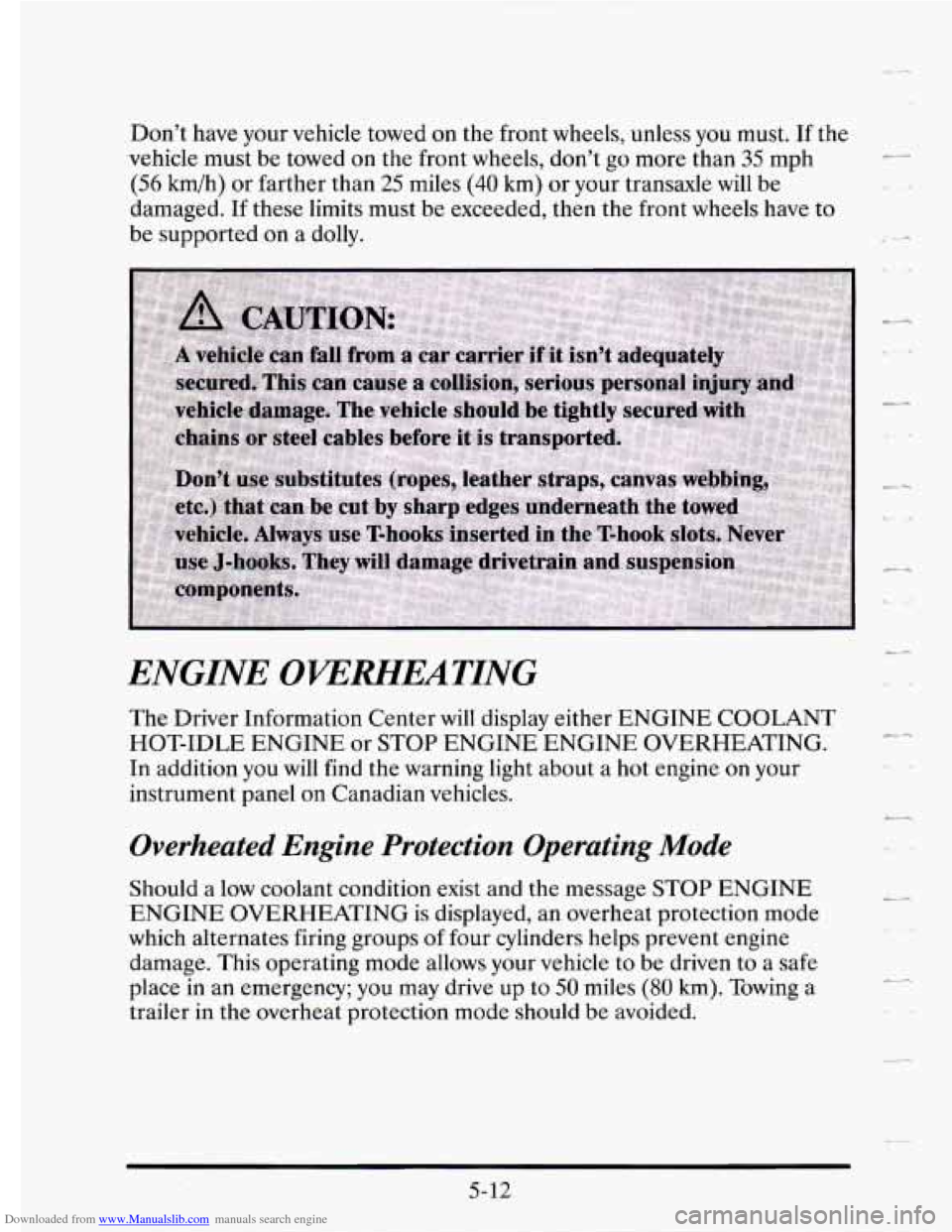
Downloaded from www.Manualslib.com manuals search engine Don’t have your vehicle towed on the front wheels, unless you must. If the
vehicle must be towed
on the front wheels, don’t go more than 35 mph
(56 kmih) or farther than 25 miles (40 km) or your transaxle will be
damaged. If these limits must be exceeded, then the front wheels have to
be supported on a dolly.
ENGINE OVERHEATING
The Driver Information Center will display either ENGINE COOLANT
HOT-IDLE ENGINE
or STOP ENGINE ENGINE OVERHEATING.
In addition you will find the warning light about a hot engine
on your
instrument panel
on Canadian vehicles.
6-4
Overheated Engine Protection Operating Mode
Should a low coolant condition exist and the message STOP ENGINE
ENGINE OVERHEATING is displayed, an overheat protection mode
which alternates firing groups
of four cylinders helps prevent engine
damage. This operating mode allows your vehicle
to be driven to a safe
place in an emergency; you may drive
up to 50 miles (80 km). Towing a
trailer
in the overheat protection mode should be avoided.
5-12
Page 281 of 410
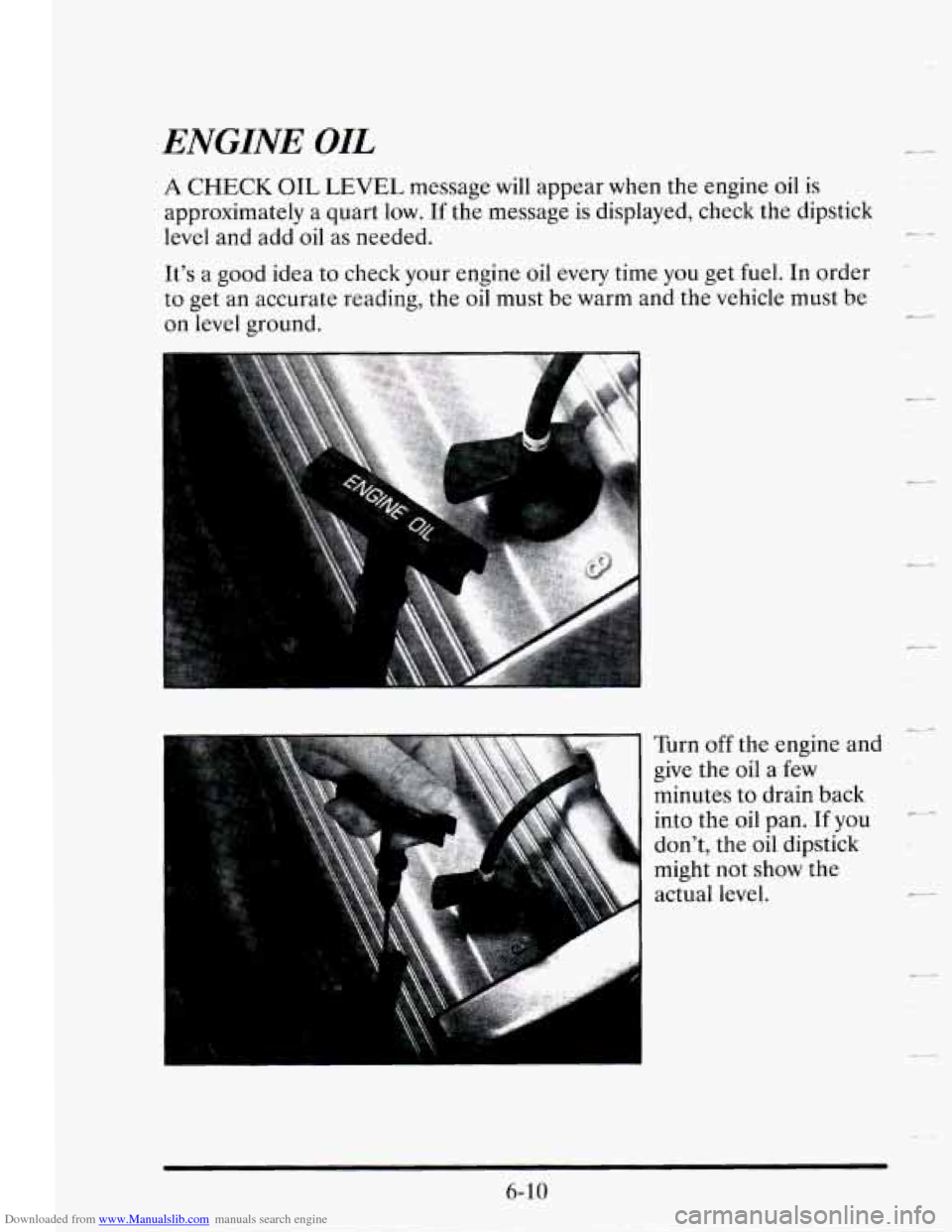
Downloaded from www.Manualslib.com manuals search engine ENGINE OIL
A CHECK OIL LEVEL message will appear when the engine oil is
approximately
a quart low. If the message is displayed, check the dipstick
level and add
oil as needed.
It’s
a good idea to check your engine oil every time you get fuel. In order
to get an accurate reading, the oil must be warm and the vehicle must be
on level ground.
Turn
off the engine and
give the oil a
few
minutes to drain back
into the oil
pan. If you
don’t, the oil dipstick
might not show the
actual level.
6-10
c1
Cr
c-
--